Advertisements
Advertisements
प्रश्न
Verbal to Non-verbal
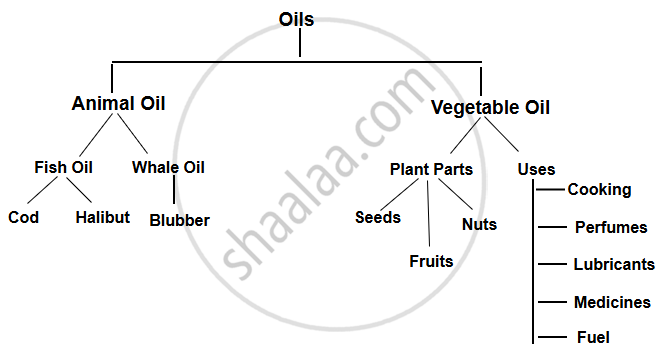
Read the following paragraph and convert it into a tree diagram:
|
Two common types of oils are animal oil and vegetable oil. Vegetable oils are extracted from different plant parts such as seeds, nuts and the flesh of fruits. They are widely used in cooking. From very ancient times they have been used in households for various reasons. The oils of certain flowers are extracted to make perfumes. Vegetable oils such as castor oil are used as medicine and as lubricants. In recent times, there have been debates on using waste vegetable oils as fuel. |
Advertisements
उत्तर
APPEARS IN
संबंधित प्रश्न
Read the following extract and extend it by adding an imaginary paragraph of your own in about 120 words :
Rosalind and Orlando were married at once in the forest
and on the same day Oliver who was 110 longer selfish and married Celia. Just as they were going to be married, a mess,enger came to ask Duke senior to go back to his dukedom. Celia s fathcr; Duke Frederick, had mended his wicked ways and asked his brother to return.
Frederick had set out with a11 anny to fight the old Duke, but on his way he had met a wise and holy man, who had persuaded him that it was wrong and wicked to drive his elder brother from the court. So Frederick had given up the dukedom and the good.
Duke could go home again. There was great rejoicing in the forest of Arden, under the greenwood tree. Frederick was forgiven and Duke senior and his followers returned from the forest to live happily in their Own homes.
Look at the following web chart and write a short paragraph based on it in about 120 words. Suggest a suitable title:

A survey was conducted among the teachers of New Hope High School to find out whether Class X students should be allowed to use mobile phones in the campus. The results of the survey are shown in the pie-chart below.
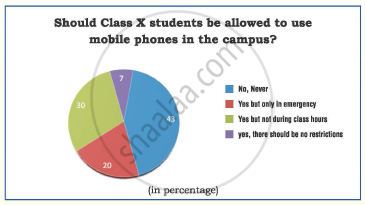
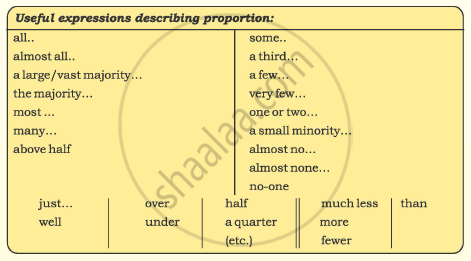
Look at the pie chart and the useful expressions above. Fill in the gaps in the following summary of results.
As can be seen from the above pie-chart, nearly a__________ of the teachers felt that Class X students must not be allowed to use mobile phones in the school campus. However, nearly one____________ believed
the phones should be permitted but not during class hours. About __________were of the opinion that the students may be allowed to use these phones only in times of emergency while a very__________ did not favour any restrictions on their use in the campus.
Read the following tree-diagram and prepare a short paragraph regarding 'Soil Erosion'.

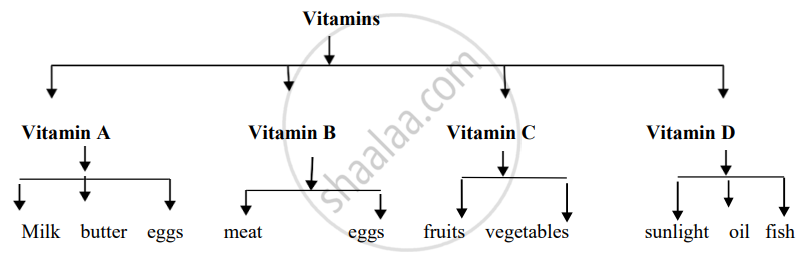
Read the information given in the following tree diagram regarding “Types of vitamins” Write a paragraph with the given points and give a suitable title to it.
Write two short paragraphs on ‘Village life’ by using the points given in the following web diagram:

Non-verbal to Verbal
Study the table given below and prepare a paragraph on it.
| Alligators | Crocodiles | |
| 1. | U shaped round snout | V shaped round snout |
| 2. | Live in fresh water | Live in fresh water and saline water |
| 3. | Have wide jaws; upper jaw is wider than the lower jaw | Have narrow jaws; both the jaws are of the same size |
| 4. | Only upper teeth are visible when the mouth is closed | Both the teeth are visible when the mouth is closed. |
| 5. | No functioning salt glands | Very functional salt glands |
| 6. | Sensory pits on scales near the jaw | Sensory pits in every scale of the body |
Read the following information and complete the table given below. Give a suitable title:
|
Turtles and tortoises are closely related. They are both reptiles from the same family (Testudines or Chelonian). The main difference between the two is that turtle is the name given to water-dwellers and tortoise is the name given to land-dwellers. They are easily identified by the presence of a shell, from which their head and limbs protrude. Turtles are found in Africa and America. Its shell is lighter and more streamlined than that of a tortoise. To enable swimming, it has webbed feet with long claws. Turtles are omnivores, eating both vegetation and meat. Their lifespan is shorter than that of the tortoise with an average of 20-40 years and a maximum of 86 years. Tortoises are found mainly in Asia and Africa, but also in America. It has a rounder, bumpier, heavier shell than a turtle. Its bent legs are short and sturdy. Tortoises are usually herbivores, but some eat meat, their lifespan is longer than that of the turtle with an average of 80-150 years and a maximum of 188 years. |
| FEATURES | TURTLES | TORTOISE |
| (i) Habitat | ||
| (ii) Places found in | ||
| (iii) Shell | ||
| (iv) Lifespan |
Verbal to Non-Verbal
Read the information in the given paragraphs and complete the table:
| Man and forest live in a close relationship. The forest fulfils most of man's needs. He collects resin, cane, timber, food and fruits from forests. The fallen branch gives him firewood. Trees purify the polluted air. But men have been unkind towards the forest for a few years. People must be made aware of the value of forests. Planting campaigns should be launched. The government of the world should enforce severe laws against wrongdoers. Vast areas of forest lands should be declared nature reserves. Scientists and engineers should be encouraged to find substitutes for wood like bamboo, hemp, etc. |
| ITEM | INFORMATION |
| Products of forest | |
| Firewood comes from | |
| Forests should be declared | |
| Substitutes for wood |
Verbal to Non-verbal:
Read the following information and complete the given table below. Suggest a suitable title to it:
|
Chandrayaan-1 was India's first mission to the moon. It launched on Oct. 22, 2008 from the Satish Dhawan Space Centre in Sriharikota, India. Its scientific goals are to study the chemical, mineralogical and photogeological mapping of the moon. In addition to find out water on the moon. Then to perform high resolution remote sensing of the moon’s surface. The Chandrayaan-2 mission was successfully launched on 22nd July, 2019 from Satish Dhawan Space Centre, Sriharikota. The primary objectives were to demonstrate the ability to soft land and operate a robotic rover on the lunar surface. The mission was arranged to study the lunar topography, mineralogy, elemental abundance and the lunar ecosphere, conduct a detailed search for water and ice in polar region. Chandrayaan 2’s objectives are to find Chandrayaan-1 as reported by the ISRO. The mission targeted the “South Polar region” of the moon which was completely unexplored. The mission focused on the extensive mapping of the lunar surface for studying variations in its composition and tracing the moon's origin and evolution. Chandrayaan-3 launched to the moon on July 14, 2023 from the Satish Dhawan Space Centre in Sriharikota, India, the medium-life launch vehicle Mark-III (LVM3) rocket. The three main objectives of Chandrayaan-3 are to land safely on the surface, to demonstrate rover operations and to perform scientific experiments on site, according to the official website. |
Title: __________________
| Name of Chandrayaan | Date of launching | Objectives of Mission |
| Chandrayaan-1 | ||
| Chandrayaan-2 | ||
| Chandrayaan-3 |
