Advertisements
Advertisements
प्रश्न
A survey was conducted among the teachers of New Hope High School to find out whether Class X students should be allowed to use mobile phones in the campus. The results of the survey are shown in the pie-chart below.
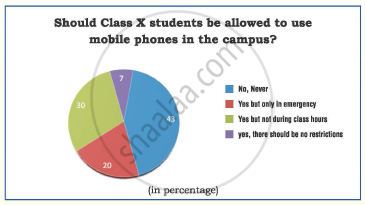
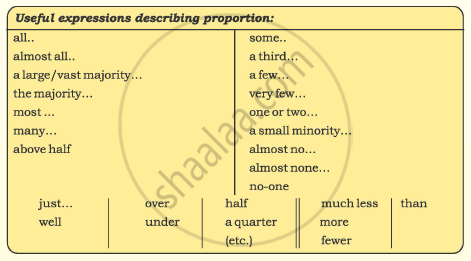
Look at the pie chart and the useful expressions above. Fill in the gaps in the following summary of results.
As can be seen from the above pie-chart, nearly a__________ of the teachers felt that Class X students must not be allowed to use mobile phones in the school campus. However, nearly one____________ believed
the phones should be permitted but not during class hours. About __________were of the opinion that the students may be allowed to use these phones only in times of emergency while a very__________ did not favour any restrictions on their use in the campus.
Advertisements
उत्तर
As can be seen from the above pie-chart, nearly a half of the teachers felt that Class X students must not be allowed to use mobile phones in the school campus. However, nearly one quarter believed
the phones should be permitted but not during class hours. About one third were of the opinion that the students may be allowed to use these phones only in times of emergency while a very small number did not favour any restrictions on their use in the campus.
APPEARS IN
संबंधित प्रश्न
A1.Books have the power to inspire and do many more things. Observe the web diagram and convert the information into a paragraph. Add a few more points to the given information:

A2. Read the given information and fill the table provided:
Acclaimed in Indian classics as the Kalpavriksha, the all giving tree the coconut palm grows in several states in India. The coconut palm is member of the plant family Arecaceae popularly known as palm family. It flourishes on sandy soils requiring high humidity abundant sunlight and high rainfall for optimal growth. All parts of the palm are used in some way or another in the daily life of the people. Coconut water provides a refreshing and nutritious drink. The firm kernel that line the inside is high in calories and the white milk extracted from it is used in many different ways. Oil extracted from dried mature coconuts is used as cooking oil. The leaves are braided to make thatched roof and mats. The mid ribs of the leaves are dried and tied together to make brooms. The coconut shell and husk are good sources of efficient fuel. During religious ceremonies married women are often presented with a coconut along with a few grains of rice as a symbol of fertility and prosperity.
| Name : | |
| Scientific name : | |
| Place where grown : | |
| Climate required : | |
| Uses : | |
| (a) Liquid | |
| (b) Kernel | |
| (c) Leaves | |
| (d) Shell | |
| Symbolises : |
Read the following extract and complete the table given below :
Computer Assisted Language Leaming (CALL) materials come in two main formats: CD/DVD RO Ms and Web-based. Some are tailored to the content to be used in the classrooms whereas others can be used independently. CALL materials allow you to work at your own pace.
Multimedia materials offer you the opportunity to take part in other computer-assisted activities, such as text-based gap-filling, multiple-choice and text reconstruction activities. Language teachers often develop such text-based CALL activities to accompany a particular course. CALL materials can be regularly updated.
Because CALL learning activity types are usually designed from a template, they can sometimes be repetitive.
A major advantage of CALL materials is that they offer instant feedback on your spoken or written performance. However, such feedback can be limited. If you are more interested in creating your own responses or elaborating on your ideas, you may find this type of Facebook frustrating. Web-based CALL materials can offer more variety through the use of hyperlinks, but feedback is still limited.
Just as representations of the cultures of the target language offered by courses using books; audio and videotapes can perpetuate stereotypes.
| Computer Assisted Language Learning Material | ||
| Formats | Advantages | Disadvantages |
| ------------and Web-based | (a) content tailored for classroom use |
(i) ------- |
| (b) ----------- | (ii) limited feedback | |
| (c) ----------- | (iii) --------- | |
| (d) offer opportunity to take part in other computer-assisted activities | (iv)-------- | |
| (e) ----------- | ||
| (f) ----------- | ||
| (g) offer variety | ||
Read the following extract and complete the tree – diagram given below:

Information Transfer Non-Verbal to Verbal :
Observe the following web-chart carefully and write two short paragraphs of ‘Advantages of watching Television’ with the help of the points given.
Information Transfer: Non-verbal to Verbal
Look at the following web chart and write a short paragraph based on it in about 120 words. Suggest a suitable title:

Read the following tree-diagram and prepare a short paragraph regarding 'Soil Erosion'.

Transfer the information into a paragraph:
Read the following web diagram to transform into a paragraph:

Read the following paragraph and transfer the information in the form of a tree diagram:
|
The United Nations was established at the end of the second world war to maintain international peace and security. The UN has several specialized agencies such as the World Health Organisation (WHO), the Food and Agricultural Organisation (FAO), the International Labour Organization (ILO), the United Nations Educational, Scientific and Cultural Organisation (UNESCO). |
(i) Read the following tree diagram and find out more information about opportunities in ‘on and off the shore’ the Indian Navy.

(ii) Required qualifications and various fields/opportunities for women to join in the Navy.

(iii) Colleges that provide education in oceanography -
- National Institute of Oceanography, Goa
- National Institute of Oceanography, Mumbai
- MBA (Logistic Shipping Management), IIKM Business School, Calicut, Kerala
- Indira Gandhi College of Distance Education IGCDE Tamil Nadu.
Non-verbal to Verbal
Study the table given below and prepare a paragraph on it.
| Alligators | Crocodiles | |
| 1. | U shaped round snout | V shaped round snout |
| 2. | Live in fresh water | Live in fresh water and saline water |
| 3. | Have wide jaws; upper jaw is wider than the lower jaw | Have narrow jaws; both the jaws are of the same size |
| 4. | Only upper teeth are visible when the mouth is closed | Both the teeth are visible when the mouth is closed. |
| 5. | No functioning salt glands | Very functional salt glands |
| 6. | Sensory pits on scales near the jaw | Sensory pits in every scale of the body |
Study the concept chart from the self-help magazine section of a monthly publication.

Write a paragraph in not more than 120 words, analysing the listed responses to the situation when one faces setbacks.
Read the following information and complete the table given below. Give a suitable title:
|
Turtles and tortoises are closely related. They are both reptiles from the same family (Testudines or Chelonian). The main difference between the two is that turtle is the name given to water-dwellers and tortoise is the name given to land-dwellers. They are easily identified by the presence of a shell, from which their head and limbs protrude. Turtles are found in Africa and America. Its shell is lighter and more streamlined than that of a tortoise. To enable swimming, it has webbed feet with long claws. Turtles are omnivores, eating both vegetation and meat. Their lifespan is shorter than that of the tortoise with an average of 20-40 years and a maximum of 86 years. Tortoises are found mainly in Asia and Africa, but also in America. It has a rounder, bumpier, heavier shell than a turtle. Its bent legs are short and sturdy. Tortoises are usually herbivores, but some eat meat, their lifespan is longer than that of the turtle with an average of 80-150 years and a maximum of 188 years. |
| FEATURES | TURTLES | TORTOISE |
| (i) Habitat | ||
| (ii) Places found in | ||
| (iii) Shell | ||
| (iv) Lifespan |
Verbal to Non-Verbal
Read the following information and complete the table given below:
| Basically industries are broadly classified on the basis of raw material, the scale of production and the volume of investment made. Further they are classified as per the source of raw material, example, agro-based industries such as sugar, cotton, etc. Forest based such as paper, lac, and mineral based such as iron, steel and chemicals, etc. The scale of the production determines whether they are small scales, such as food processing, leather goods, etc., or large scale, automobile, shipbuilding, etc. Similarly, there are industries which are set up by the government, called Public Sector. Those industries which are set up by the Private entrepreneur are called Private Sector and those which are run collectively by a group of people are called Co-operative Sector. |
| Table | Information |
| (1) Examples of forest-based industries. | |
| (2) Examples of small scale industries. | |
| (3) Examples of large scale industries. | |
| (4) Industries setup by private entrepreneur. | |
| (5) Industries run by a group of people. |
Transfer the given information in the form of a paragraph.
THE WATER CYCLE PROCESS

Non-Verbal to Verbal
Transfer the given information in the form of a paragraph.

A survey was conducted in the National Capital in over twenty schools about 40 different activities that interest the children in the age group of 13 years to 15 years. Write a paragraph in not more than 120 words, analyzing the following information.

Given below is a web diagram containing information about the different means of electronic devices of entertainment-some audio, some visual and some audio-visual.
Write a short paragraph based on information from the web. Give a suitable title to it.

Non-verbal to Verbal:
Transfer the given information into a paragraph. Suggest a suitable title:
| Caused by Man | Caused by Nature | Solutions | |
| i. | Too many people | Droughts | Stricter laws to control population. |
| ii. | More agricultural land required to meet the needs of the ever growing populations | Floods | Stricter laws and proper execution of laws |
| iii. | Cutting of forests for wood etc. | Forest fires | Use alternative products. |
| iv. | Poaching by hunters. | - | Reduce demand for illegal wildlife parts and products by not purchasing products made from these items. |
