Advertisements
Advertisements
प्रश्न
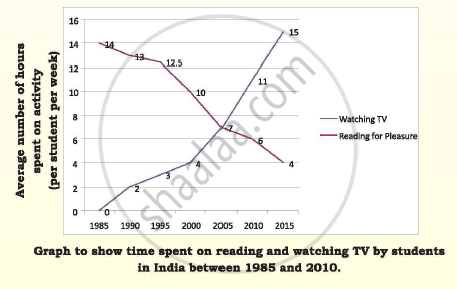
The graph below describes the average number of hours spent by students aged 11-15 years on two activities (per student per week) in India between 1985 and 2010 and gives projections for 2015. Study the information carefully and then write a paragraph interpreting the data. Include the following:
• A comparison of the trends in the two activities
• A comparison of the situation in 1985
• A comparison of the situation between 1985 and 2010
• Predictions for the future
Advertisements
उत्तर
It can be seen from the graph that on the whole, time spent by the students on viewing TV between 1985 and 2010 has been increasing ; and on reading for pleasure, it has been decreasing. For instance in the year 1985, students spent hardly any time per week on watching TV as against fourteen hours spent by them on reading for pleasure. In the year 2010, they spent only three-fourth as much time reading as they did in 1985. If the present trends continue, the students by the year 2015 would be spending their time on viewing TV, a little more. It would be almost four times higher than on reading for pleasure.
APPEARS IN
संबंधित प्रश्न
Study carefully the following pie-chart about the Income Sources of a City Budget and write a short continuing paragraph based on it in about 120 words :

|
Courses
|
Intake capacity
|
Vacant seats
|
|
Engineering:
|
||
|
Degree
|
1, 55, 102
|
42, 497
|
|
Diploma
|
1, 65, 413
|
55, 107
|
|
Post - graduation
|
13, 651
|
1, 810
|
|
Pharmacy:
|
||
|
Degree
|
9, 712
|
924
|
|
Diploma
|
12, 959
|
1, 771
|
|
Post - graduation
|
5, 296
|
3, 506
|
Read the following extract and complete the tree – diagram given below:

Question:
Read the following graph regarding ‘High Awareness but Little Action’ about organ donation. Write a paragraph based on it in about 120 words:

Information Transfer Non-Verbal to Verbal :
Observe the following web-chart carefully and write two short paragraphs of ‘Advantages of watching Television’ with the help of the points given.
Information Transfer: Verbal to Non-verbal
Read the following paragraph and prepare a tree-digram using the information given in the paragraph.
Quite often it is your family and friends who are the only source of solace in times of tension and confusion. Whether it is the time of exams, results and admission, school issues or a misunderstanding with a dear friend, you will notice
that your family members might want you to share your worries with them. One great advantage about sharing problems with your family members is that they actually care about your happiness. Your problem will not go beyond the people whom you are confiding in and will ensure that you are relieved of the stress and worries besides being the source of practical solutions for your problems.The relief it brings is immense not just for you but also for them as they would be the happiest to see you relaxed and calm. This is what makes family bonding
special. Situations such as these can bring you closer to your siblings and make you realise that such oneness is unique and special.
The chart below shows information on the economics of the Annual
Sports Meet. Study the chart carefully.
| The Economics of the Annual Sports Meet |


The total cost estimated of the Meet will be~ 11, 00, 000/-
No of athletes : 1250 (750 Girls+ 500 Boys; Category wise: sub-junior: 350, junior: 500 and senior: 400)
Staff on Duty : Teachers: 95 (35 men + 60 women), Support Staff 40 (21 men + 19 women), Staff on Parking and Security duty : 25 (20 men+ 5 women)
No of events : 100 ( 70 Track & Field events and 30 Jumps and Throws)
Medals : 100 Gold, 100Silver& 100Bronze
Best Athlete Trophies : Boys: 3, Girls: 3
Best House Trophies : 4( 1 for each category and 1 over all)
Suppose you are the Prin cipal of the school. Taking information from the chart, prepare an oral presentation for the Management Committee of the school. Use as many expressions of comparison as you can. You have been given some examples.
Observe the following table and transfer the information into a paragraph:
Statewise Distribution of Urban and Rural Population in India:
| States | Population in Millions | |
| Rural | Urban | |
| Maharashtra | 560 | 410 |
| Gujarat | 320 | 190 |
| Madhya Pradesh | 440 | 160 |
| Chhattisgarh | 170 | 40 |
| Andhra Pradesh | 550 | 210 |
| Karnataka | 350 | 180 |
Extend the given extract by adding an imaginary paragraph of your own (about 120 words)
A couple of days later, I was walking around the camp, around the barracks, near the barbed-wire fence where the guards could not easily see. I was alone.
On the other side of the fence, I spotted someone: a little girl with light, almost luminous curls. She was half-hidden behind a birch tree.
I glanced around to make sure no one saw me. I called to her softly in German. 'Do you have something to eat?'
She didn't understand.
I inched closer to the fence and repeated the question in polish. She stepped forward. I was thin and gaunt, with rags wrapped around my feet, but the girl looked unafraid. In her eyes, I saw life.
She pulled an apple from her woollen jacket and threw it over the fence.
I grabbed the fruit and, as I started to run away, I heard her say faintly, 'I'II see you tomorrow."
Read the following passage and complete the table
Dialect is a form of a language spoken in one area which may be different from other forms of the same language. Each language has dialects which change every few kilometers. India is a multi-lingual country. Each state follows its own language as official language. For example, Marathi is the official language of Maharashtra, while Ahirani, Wharadi, Konkani and Malwani are its dialects. Several languages in India are spoken but do not have any script. In Karnataka, Kannada is the official language. Tulu is spoken in Karnataka but has no script. In England, English is the official language while Scottish, spoken in Scotland and Welsh spoken in Wales are dialects of English.
| State | Official language | Dialects | Spoken/ Without script |
| Maharashtra | Marathi | ||
| Karnataka | |||
| England |
Read the following paragraph and transfer the information in the form of a tree diagram:
The United Nations was established at the end of the second world war to maintain international peace and security.
In the central system of the UN, there are 15 members of the Security Council. The Economic and Social Council has 54 members. The Secretariat of the United Nations is headed by Secretary-General.
The UN has several specialized agencies such as the World Health Organisation (WHO), the Food and Agricultural Organisation (FAO), the International Labour Organization (ILO), the United Nations Educational, Scientific and Cultural Organisation (UNESCO).
Information Transfer:
1) Non-verbal to verbal:
Read the information given in the following tree diagram regarding “Types of vitamins” Write a paragraph with the given points and give suitable title to it.

OR
2) Verbal to Non-Verbal:
Your friend lives in red zone area of COVID 19 epidemic. In order to take safety measures at entrances of building, here are some tips to reduce risk of infection. Put the instructions in do's and don't.
- You should wash your hands often.
- Use soap and water or sanitizer.
- You should cover your mouth and nose if you cough or sneeze
- You should not get close to anyone who is suffering from cold, fever or cough.
- If you go out you should not touch the animals.
- You should keep atleast 1 meter physical distance between yourself and other person.
- You should not shake your hands with others.
- You should try to avoid crowd/mass gathering.
| Do’s | Don’t | |
Non-verbal to Verbal
Study the table given below and prepare a paragraph on it.
| Alligators | Crocodiles | |
| 1. | U shaped round snout | V shaped round snout |
| 2. | Live in fresh water | Live in fresh water and saline water |
| 3. | Have wide jaws; upper jaw is wider than the lower jaw | Have narrow jaws; both the jaws are of the same size |
| 4. | Only upper teeth are visible when the mouth is closed | Both the teeth are visible when the mouth is closed. |
| 5. | No functioning salt glands | Very functional salt glands |
| 6. | Sensory pits on scales near the jaw | Sensory pits in every scale of the body |
Transfer the information into a paragraph:
Observe the chart and write a paragraph on it. Suggest a suitable title:

Verbal to Non-verbal
Read the information from the given paragraph and write it into a tree diagram.
| There are different kinds of musical instruments. They are divided into three main classes according to the way that they are played. Some instruments are played by blowing air into them. These are called wind instruments. Some of these are said to be of the wood wind family. Examples of woodwind instruments are the flute, the clarinet and the horn. There are also various other wind instruments such as the mouth organ and the bagpipes. Some instruments are played by banging or striking them. Instruments like this are called percussion instruments. The last big group of musical instruments have strings. There are two kinds of stringed instruments. Examples are the harp and the guitar, the violin and the cello. |
Verbal to Non-verbal:
Read the following statements and prepare a chart of ‘Dos’ and ‘Don'ts’. Suggest a suitable title for it.
Nature is abode for all of us. It provides us with all our basic needs. However, we must take care of the following things so that our mother nature is not harmed.
- We must plant more trees.
- We should not cut trees.
- We must keep our area neat and clean.
- We should never discharge garbage without proper management.
- We should not pollute air and water.
- We should not use plastic bags.
- We should not hunt birds or animals.
- We should use more of public transport.
- We should spread awareness about the importance of maintaining balance in nature.
Gurmeet Kaur is an aspiring candidate for a public- funded engineering college in the suburbs. She belongs to a nearby village, has minimal technological skills and exposure, has the required cut-off percentage and is looking for a complete or partial scholarship.
Write a paragraph in about 100-120 words analysing her SWOT notes to support your stand on whether she should /not join the college.
|
STRENGTH
|
WEAKNESS
|
|
OPPORTUNITIES
|
THREAT
|
Non-Verbal to Verbal
Write a paragraph of 100 words based on the information given in the following table and give a suitable title for it:
| Types of Forests | Plants | Animals | |
| (1) |
Equatorial Evergreen |
Mahogany, Rosewood, Ironwood, Oil palm |
Different types of monkeys, snakes, lizards, bats, tse-tse flies |
| (2) | Marshes |
Mangraove, Creepers, Numerous tall trees like Mahogany |
Different types of insects, snakes, crocodiles, tse-tse and other flies |
(A1) Verbal to Non-Verbal:
Read the following information and complete the flowchart for the same, and give a suitable title.
|
Sugar beet grows through the summer and is harvested in autumn and winter. When it arrives on site, the sugar beet is washed. The sugar beet is sliced into thin strips called cossettes.‘These thin strips are mixed with hot water to extract the sugar and a lime solution is added to the raw juice to remove any impurities. |
Non-verbal to verbal:
Read the information given in the following tree-diagram and write two short paragraphs based on it. Give a suitable title to your write up:

