Advertisements
Advertisements
Question
The angle of reflection is equal to the angle of incidence:
(a) always
(b) sometimes
(c) under special conditions
(d) never
Advertisements
Solution
(a) Always, in accordance with the first law of reflection, which states that the angle of reflection is equal to the angle of incidence.
APPEARS IN
RELATED QUESTIONS
Where is the image when you look at something in a mirror?
With the help of a labelled ray-diagram, describe how a plane mirror forms an image of a point source of light placed in front of it. State the characteristics of the image formed in a plane mirror.
A man sits in an optician's chair looking into plane mirror which is 2 m away from him and views the image of a chart which faces the mirror and is 50 cm behind his head. How far away from his eyes does the chart appear to be?
If a ray of light goes form a denser medium to a rarer medium, will it bend towards the normal or away from the normal?
When a ray of light passes from air into glass, is the angle of refraction greater than or less than the angle of incidence?
Which phenomenon of light makes the water to appear shallower than it really is?
Name the phenomenon due to which a pencil partly immersed in water and held obliquely appears to be bent at the water surface.
The depth of a pond when seen from above appears to be less.
Image is formed by a mirror due to refraction of light.
When a ray of light travels from air to glass, it bends .......... the normal.
Light enters from air to glass having refractive index 1.50. What is the speed of light in the glass? The speed of light in vacuum is 3 × 10⁸ m s−1.
What is atmospheric reflection? Explain with the help of a labelled diagram that the position of a star as seen by us is not its true position.
The size of image of an object by a convex lens of focal length 20 cm is observed to be reduced to `1/3` rd of its size . Find the distance of the object from the optical centre of the lens .
The phenomenon of change in the direction of light when it passes from one transparent medium to another is called ___________.
Identify the wrong figure from the following.
Write scientific reason.
The sun appears on the western horizon for some time after sunset.
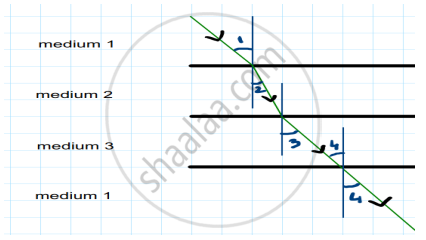
In the above diagram light is travelling through different media. It is noted by a scientist that ∠1= ∠3 = ∠4 but ∠2 < ∠1. Which of the following statement would be correct?
A star appears twinkling into the sky because of the reflection of light by the atmosphere.
A ray of light starting from diamond is incident on the interface separating diamond and water. Draw a labelled ray diagram to show. the refraction of light in this case.
When a ray of light travels normal to the given surface, then the angle of refraction is ______.
