Advertisements
Advertisements
Question
Suggest optimum solution to the following assignment. Problem, also find the total minimum service time.
Service Time ( in hrs.)
| Counters | Salesmen | |||
| A | B | C | D | |
| W | 41 | 72 | 39 | 52 |
| X | 22 | 29 | 49 | 65 |
| Y | 27 | 39 | 60 | 51 |
| Z | 45 | 50 | 48 | 52 |
Advertisements
Solution
This problem is already 4 x 4.
Select the smallest element in each row and subtract it from every element in each row :
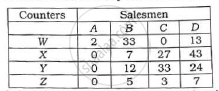
Select the smallest element in each column of the above matrix and subtract it form every element in that column.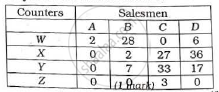
Draw the minimum lines covering all zeros.
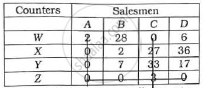
Minimum lines covering all zeros is not equal to the order of the matrix.
Minimum uncovered value 2 is subtracted from uncovered values and added to values at intersection of the lines.
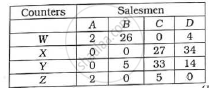
Draw minimum lines covering all the zeros.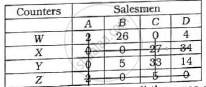
Minimum lines covering all the zeros equal to the order of the matrix.
∴ Allocation of counters can be done.
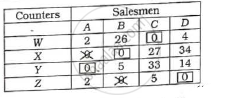
The allocation of the counters to the salesmen is
W → C, X → B, Y → A, Z → D
The minimum time = 39 + 29 + 27 +52 = 147 Hrs.
APPEARS IN
RELATED QUESTIONS
A job production unit has four jobs A, B, C, D which can be manufactured on each of the four machines P, Q, R and S. The processing cost of each job is given in the following table:
|
Jobs
|
Machines |
|||
|
P |
Q |
R |
S |
|
|
Processing Cost (Rs.)
|
||||
|
A |
31 |
25 |
33 |
29 |
|
B |
25 |
24 |
23 |
21 |
|
C |
19 |
21 |
23 |
24 |
|
D |
38 |
36 |
34 |
40 |
How should the jobs be assigned to the four machines so that the total processing cost is minimum?
In a factory there are six jobs to be performed each of which should go through two machines A and B in the order A - B. The processing timing (in hours) for the jobs arc given here. You are required to determine the sequence for performing the jobs that would minimize the total elapsed time T. What is the value of T? Also find the idle time for machines · A and B.
| Jobs | J1 | J2 | J3 | J4 | J5 | J6 |
| Machine A | 1 | 3 | 8 | 5 | 6 | 3 |
| MAchine B | 5 | 6 | 3 | 2 | 2 | 10 |
Five wagons are available at stations 1, 2, 3, 4, and 5. These are required at 5 stations I, II, III, IV, and V. The mileage between various stations are given in the table below. How should the wagons be transported so as to minimize the mileage covered?
| I | II | III | IV | V | |
| 1 | 10 | 5 | 9 | 18 | 11 |
| 2 | 13 | 9 | 6 | 12 | 14 |
| 3 | 3 | 2 | 4 | 4 | 5 |
| 4 | 18 | 9 | 12 | 17 | 15 |
| 5 | 11 | 6 | 14 | 19 | 10 |
Choose the correct alternative :
The assignment problem is said to be balanced if it is a ______.
Fill in the blank :
An _______ is a special type of linear programming problem.
In an assignment problem, if number of column is greater than number of rows, then a dummy column is added.
State whether the following is True or False :
In assignment problem, each facility is capable of performing each task.
Solve the following problem :
A dairy plant has five milk tankers, I, II, III, IV and V. These milk tankers are to be used on five delivery routes A, B, C, D and E. The distances (in kms) between the dairy plant and the delivery routes are given in the following distance matrix.
| I | II | III | IV | V | |
| A | 150 | 120 | 175 | 180 | 200 |
| B | 125 | 110 | 120 | 150 | 165 |
| C | 130 | 100 | 145 | 160 | 175 |
| D | 40 | 40 | 70 | 70 | 100 |
| E | 45 | 25 | 60 | 70 | 95 |
How should the milk tankers be assigned to the chilling center so as to minimize the distance travelled?
Choose the correct alternative:
The assignment problem is generally defined as a problem of ______
State whether the following statement is True or False:
The objective of an assignment problem is to assign number of jobs to equal number of persons at maximum cost
State whether the following statement is True or False:
In assignment problem, if number of columns is greater than number of rows, then a dummy row is added
State whether the following statement is True or False:
In assignment problem each worker or machine is assigned only one job
What is the Assignment problem?
Three jobs A, B and C one to be assigned to three machines U, V and W. The processing cost for each job machine combination is shown in the matrix given below. Determine the allocation that minimizes the overall processing cost.
| Machine | ||||
| U | V | W | ||
| Jobs | A | 17 | 25 | 31 |
| B | 10 | 25 | 16 | |
| C | 12 | 14 | 11 | |
(cost is in ₹ per unit)
Choose the correct alternative:
Number of basic allocation in any row or column in an assignment problem can be
Choose the correct alternative:
North – West Corner refers to ______
Choose the correct alternative:
The solution for an assignment problem is optimal if
A natural truck-rental service has a surplus of one truck in each of the cities 1, 2, 3, 4, 5 and 6 and a deficit of one truck in each of the cities 7, 8, 9, 10, 11 and 12. The distance(in kilometers) between the cities with a surplus and the cities with a deficit are displayed below:
| To | |||||||
| 7 | 8 | 9 | 10 | 11 | 12 | ||
| From | 1 | 31 | 62 | 29 | 42 | 15 | 41 |
| 2 | 12 | 19 | 39 | 55 | 71 | 40 | |
| 3 | 17 | 29 | 50 | 41 | 22 | 22 | |
| 4 | 35 | 40 | 38 | 42 | 27 | 33 | |
| 5 | 19 | 30 | 29 | 16 | 20 | 33 | |
| 6 | 72 | 30 | 30 | 50 | 41 | 20 | |
How should the truck be dispersed so as to minimize the total distance travelled?
