Advertisements
Advertisements
प्रश्न
Suggest optimum solution to the following assignment. Problem, also find the total minimum service time.
Service Time ( in hrs.)
| Counters | Salesmen | |||
| A | B | C | D | |
| W | 41 | 72 | 39 | 52 |
| X | 22 | 29 | 49 | 65 |
| Y | 27 | 39 | 60 | 51 |
| Z | 45 | 50 | 48 | 52 |
Advertisements
उत्तर
This problem is already 4 x 4.
Select the smallest element in each row and subtract it from every element in each row :
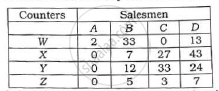
Select the smallest element in each column of the above matrix and subtract it form every element in that column.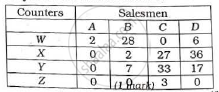
Draw the minimum lines covering all zeros.
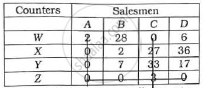
Minimum lines covering all zeros is not equal to the order of the matrix.
Minimum uncovered value 2 is subtracted from uncovered values and added to values at intersection of the lines.
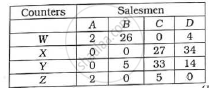
Draw minimum lines covering all the zeros.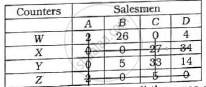
Minimum lines covering all the zeros equal to the order of the matrix.
∴ Allocation of counters can be done.
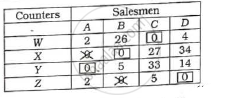
The allocation of the counters to the salesmen is
W → C, X → B, Y → A, Z → D
The minimum time = 39 + 29 + 27 +52 = 147 Hrs.
APPEARS IN
संबंधित प्रश्न
A job production unit has four jobs A, B, C, D which can be manufactured on each of the four machines P, Q, R and S. The processing cost of each job is given in the following table:
|
Jobs
|
Machines |
|||
|
P |
Q |
R |
S |
|
|
Processing Cost (Rs.)
|
||||
|
A |
31 |
25 |
33 |
29 |
|
B |
25 |
24 |
23 |
21 |
|
C |
19 |
21 |
23 |
24 |
|
D |
38 |
36 |
34 |
40 |
How should the jobs be assigned to the four machines so that the total processing cost is minimum?
Solve the following minimal assignment problem and hence find the minimum value :
| I | II | III | IV | |
| A | 2 | 10 | 9 | 7 |
| B | 13 | 2 | 12 | 2 |
| C | 3 | 4 | 6 | 1 |
| D | 4 | 15 | 4 | 9 |
Determine `l_92 and l_93, "given that" l_91 = 97, d_91 = 38 and q_92 = 27/59`
A job production unit has four jobs A, B, C, D which can be manufactured on each of the four machines P, Q, R and S. The processing cost of each job for each machine is given in the following table:
| Jobs | Machines (Processing Cost in ₹) |
|||
| P | Q | R | S | |
| A | 31 | 25 | 33 | 29 |
| B | 25 | 24 | 23 | 21 |
| C | 19 | 21 | 23 | 24 |
| D | 38 | 36 | 34 | 40 |
Find the optimal assignment to minimize the total processing cost.
Five different machines can do any of the five required jobs, with different profits resulting from each assignment as shown below:
| Job | Machines (Profit in ₹) | ||||
| A | B | C | D | E | |
| 1 | 30 | 37 | 40 | 28 | 40 |
| 2 | 40 | 24 | 27 | 21 | 36 |
| 3 | 40 | 32 | 33 | 30 | 35 |
| 4 | 25 | 38 | 40 | 36 | 36 |
| 5 | 29 | 62 | 41 | 34 | 39 |
Find the optimal assignment schedule.
The assignment problem is said to be balanced if ______.
Choose the correct alternative :
The assignment problem is said to be balanced if it is a ______.
Solve the following problem :
A plant manager has four subordinates, and four tasks to be performed. The subordinates differ in efficiency and the tasks differ in their intrinsic difficulty. This estimate of the time each man would take to perform each task is given in the effectiveness matrix below.
| I | II | III | IV | |
| A | 7 | 25 | 26 | 10 |
| B | 12 | 27 | 3 | 25 |
| C | 37 | 18 | 17 | 14 |
| D | 18 | 25 | 23 | 9 |
How should the tasks be allocated, one to a man, as to minimize the total man hours?
Choose the correct alternative:
When an assignment problem has more than one solution, then it is ______
State whether the following statement is True or False:
The objective of an assignment problem is to assign number of jobs to equal number of persons at maximum cost
What is the Assignment problem?
What is the difference between Assignment Problem and Transportation Problem?
Three jobs A, B and C one to be assigned to three machines U, V and W. The processing cost for each job machine combination is shown in the matrix given below. Determine the allocation that minimizes the overall processing cost.
| Machine | ||||
| U | V | W | ||
| Jobs | A | 17 | 25 | 31 |
| B | 10 | 25 | 16 | |
| C | 12 | 14 | 11 | |
(cost is in ₹ per unit)
A computer centre has got three expert programmers. The centre needs three application programmes to be developed. The head of the computer centre, after studying carefully the programmes to be developed, estimates the computer time in minitues required by the experts to the application programme as follows.
| Programmers | ||||
| P | Q | R | ||
| Programmers | 1 | 120 | 100 | 80 |
| 2 | 80 | 90 | 110 | |
| 3 | 110 | 140 | 120 | |
Assign the programmers to the programme in such a way that the total computer time is least.
Choose the correct alternative:
The purpose of a dummy row or column in an assignment problem is to
Choose the correct alternative:
In an assignment problem involving four workers and three jobs, total number of assignments possible are
A car hire company has one car at each of five depots a, b, c, d and e. A customer in each of the fine towers A, B, C, D and E requires a car. The distance (in miles) between the depots (origins) and the towers(destinations) where the customers are given in the following distance matrix.
| a | b | c | d | e | |
| A | 160 | 130 | 175 | 190 | 200 |
| B | 135 | 120 | 130 | 160 | 175 |
| C | 140 | 110 | 155 | 170 | 185 |
| D | 50 | 50 | 80 | 80 | 110 |
| E | 55 | 35 | 70 | 80 | 105 |
How should the cars be assigned to the customers so as to minimize the distance travelled?
A job production unit has four jobs P, Q, R, and S which can be manufactured on each of the four machines I, II, III, and IV. The processing cost of each job for each machine is given in the following table:
| Job | Machines (Processing cost in ₹) |
|||
| I | II | III | IV | |
| P | 31 | 25 | 33 | 29 |
| Q | 25 | 24 | 23 | 21 |
| R | 19 | 21 | 23 | 24 |
| S | 38 | 36 | 34 | 40 |
Find the optimal assignment to minimize the total processing cost.
A department store has four workers to pack goods. The times (in minutes) required for each worker to complete the packings per item sold is given below. How should the manager of the store assign the jobs to the workers, so as to minimize the total time of packing?
| Workers | Packing of | |||
| Books | Toys | Crockery | Cutlery | |
| A | 3 | 11 | 10 | 8 |
| B | 13 | 2 | 12 | 12 |
| C | 3 | 4 | 6 | 1 |
| D | 4 | 15 | 4 | 9 |
