Advertisements
Advertisements
Question
Read the line given below and answer the question that follow.
“Life is a soft loam; be gentle; go easy.” And this too might serve him.
- Why does the poet suggest to take life easy?
- Identify the figure of speech in the above line.
Advertisements
Solution
- There are certain occasions one needs to treat life-like wet clay very gently. Take life as it comes without hard resistance. The poet says, “Brutes have been gentled where lashes failed.”
- Metaphor
APPEARS IN
RELATED QUESTIONS
Have you ever visited a fort or a castle?
Why didn’t the narrator want to tell the tale to anybody?
Read the given line and answer the question that follow in a line or two.
Our gates were strong, our walls were thick,
So smooth and high, no man could win.
- How safe was the castle?
- What was the firm belief of the soldiers?
Read the given line and answer the question that follow in a line or two.
| Oh then our maze of tunneled stone Grew thin and treacherous as air. The castle was lost without a groan, The famous citadel overthrown, |
- Bring out the contrast in the first two lines.
- What is the rhyme scheme of the given stanza?
Identify the figure of speech used in the following line.
Grew thin and treacherous as air.
You visit your school after several years. As you cross the banyan tree at the entrance, cheerful memories fi ll your mind. Fill the bubbles with your memories.

The casuarina tree will be remembered forever. Why?
Read the line given below and answer the question that follow.
The giant wears the scarf, and flowers are hung
In crimson clusters all the bough among!
- Who is the giant here?
- Why is the scarf colourful?
Pick out the word in ‘alliteration’ in the following line.
“Jealous in honour, sudden and quick in quarrel.”
Introduction
The poem ‘Ulysses’ is a dramatic monologue that contains 70 lines of blank verse. Ulysses, the King of Ithaca, gathers his men together to prepare for the journey and exhorts them not to waste their time left on earth. Ulysses has grown old, having experienced many adventures at the battle of Troy and in the seas. After returning to Ithaca, he desires to embark upon his next voyage. His inquisitive spirit is always looking forward to more and more of such adventures.
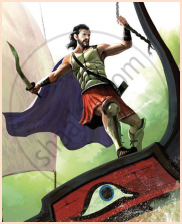
Pick out the lines which convey that his quest for travel is unending.
In what ways were Ulysses and his mariners alike?
Identify the figure of speech employed in the following line.
Thro’ scudding drifts the rainy Hyades Vext the dim sea...
Identify the figure of speech employed in the following line.
And drunk delight of battle with my peers;
Identify the figure of speech employed in the following line.
.....the deep Moans round with many voices.
Read the set of line from the poem and answer the question that follow.
… I mete and dole
Unequal laws unto a savage race,
That hoard, and sleep, and feed, and
know not me.
- What does Ulysses do?
- Did he enjoy what he was doing? Give reasons.
Read the set of line from the poem and answer the question that follow.
Little remains: but every hour is saved
From that eternal silence, something more,
A bringer of new things; and vile it were
- How is every hour important to Ulysses?
- What does the term ‘Little remains’ convey?
Read the set of line from the poem and answer the question that follow.
……for my purpose holds
To sail beyond the sunset, and the baths
Of all the western stars, until I die.
- What was Ulysses’ purpose in life?
- How long would his venture last?
Explain with reference to the context the following line.
To strive, to seek, to find, and not to yield.
Where are the final decisions taken?
Here are a few poetic device used in the poem.
Transferred Epithet- It is a figure of speech in which an epithet grammatically qualifies a noun other than the person or a thing, it is actually meant to describe.
Here are a few poetic device used in the poem.
Repetition- It is a figure of speech.
Read the line given below and answer the question that follow.
“Life is hard; be steel; be a rock.”
- How should one face life?
- Identify the figure of speech in the above line.
Pick out the alliterated words from the poem and write.
And this might stand him for the storms
Explain the following line with reference to the context.
and guide him among sudden betrayals
and tighten him for slack moments.
Explain the following line with reference to the context.
He will be lonely enough
to have time for the work
Fill in the blanks choosing the words from the box given and complete the summary of the poem.
The poet Robert Browning narrates an incident at the French Camp in the war of 1809 between France and Austria, in a (a)______version. He describes the brave action of a (b)______soldier, whose heroic devotion to duty and his (c) ______ in it is inspiring and worthy of (d) ______. During the attack of the French army on Ratisbon, Napoleon was anxious about the (e) ______. Austrians were defending Ratisbon with great (f) ______and courage. Napoleon was watching the war standing on a (g) ______near the battlefield.
All of a sudden a rider appeared from the closed smoke and dust. Riding at great speed, jumping and leaping, he approached the mound where Napoleon stood. As he came closer, the narrator noticed that the rider, a young boy, was severely wounded. But the rider showed no sign of pain and smiling in joy, jumped off the horse and gave the happy news of (h) ______to the emperor.
He exclaimed with pride that the French had (i) ______Ratisbon and he himself had hoisted the flag of France. When Napoleon heard the news, his plans (j) ______up like fire. His eyes (k) ______when he saw that the soldier was severely wounded. Like a caring mother eagle, the emperor asked if he was wounded. The (l) ______soldier replied proudly that he was killed and died heroically.
| determination | result | dramatic |
| pride | admiration | softened |
| wounded | mound | victory |
| conquered | soared | valiant |
How did the young soldier face his end?
What is the role of the young soldier in the victory of the French at Ratisbon?
