Advertisements
Advertisements
Question
Advertisements
Solution
1. Ans. The extract points out how dairy farming can become the best source of income and generate employment opportunities to people.
2. Ans. The manure from animals provides a good source of organic matter for improving soil fertility and crop yields. The gobar gas obtained by processing dung is used as fuel for domestic purposes and lastly, the fuel helps to run engines and to draw water from wells. The surplus fodder and agricultural by-products are used to feed animals. In this way dairy farming beneficial for farmers besides getting milk.
3. Ans. The National Sample Survey of 1993 - 94 provides the information that, livestock sector produces regular employment to about 9.8 million persons in principal status and 8.6 million in subsidiary status. It constitutes about 5 % of the total workforce.
-
The manure from animals provides a good source of organic matter for improving soil fertility and crop yields.
-
The gobar gas obtained by processing dung is used as fuel for domestic purposes and lastly, the fuel helps to run engines and to draw water from wells.
-
The surplus fodder and agricultural by-products are used to feed animals. In this way dairy farming beneficial for farmers besides getting milk.
APPEARS IN
RELATED QUESTIONS
 During the devastating July 2005 floods that hit Mumbai, Rajen Dutia received an urgent call from a relative, Lopa Vyas late in the evening. “A friend’s mother is stranded near your home, Rajen. Can you please take her home? Her name is Rashmi,” Vyas told him.
Mumbai had come to a halt and people were trapped everywhere. Despite power failure and raging rain, Dutia stepped out and made his way to the spot, where he found Rashmi as well as a dozen other people. They were stranded in the dark, shivering in the rain. They all lived far away and had no place to go for the night.
Rajen took all of them to his one-bedroom flat, where he served them dinner and invited them to spend the night.
"By doing so," says Rajen, "I was simply fulfilling my karma, paying the universe back for the good it had done for me."
"God is kind. My daughter had just started her new job that day, and had gone for her training. She was stranded too. While she was trying to get to our relatives, she almost drowned, but a young stranger saved her. He and his friends even dropped her to my relative's place and phoned me to say she was safe. One good turn deserves another."
A2. Order
Look at the following sentences from the passage and put them in the correct sequence: (2)
(a) He took them to his one-bedroom flat.
(b) Rajen found Rashmi as well as a dozen other people shivering in the rain.
(c) Mumbai had come to a halt and people were trapped everywhere.
(d) Rajen Dutia received an urgent call.
A3
During the devastating July 2005 floods that hit Mumbai, Rajen Dutia received an urgent call from a relative, Lopa Vyas late in the evening. “A friend’s mother is stranded near your home, Rajen. Can you please take her home? Her name is Rashmi,” Vyas told him.
Mumbai had come to a halt and people were trapped everywhere. Despite power failure and raging rain, Dutia stepped out and made his way to the spot, where he found Rashmi as well as a dozen other people. They were stranded in the dark, shivering in the rain. They all lived far away and had no place to go for the night.
Rajen took all of them to his one-bedroom flat, where he served them dinner and invited them to spend the night.
"By doing so," says Rajen, "I was simply fulfilling my karma, paying the universe back for the good it had done for me."
"God is kind. My daughter had just started her new job that day, and had gone for her training. She was stranded too. While she was trying to get to our relatives, she almost drowned, but a young stranger saved her. He and his friends even dropped her to my relative's place and phoned me to say she was safe. One good turn deserves another."
A2. Order
Look at the following sentences from the passage and put them in the correct sequence: (2)
(a) He took them to his one-bedroom flat.
(b) Rajen found Rashmi as well as a dozen other people shivering in the rain.
(c) Mumbai had come to a halt and people were trapped everywhere.
(d) Rajen Dutia received an urgent call.
A3(i). Fill in the blanks :
Select the words given in the passage (1)
(i) Thousands Of pilgrims were …………….. due to the cloud burst in Uttarakhand.
(ii) The tiger was ……………… by the hunter.
(ii). Antonyms:
Select the correct antonyms for the given words from the alternatives :
(1) Please :
(a) unplease (b) displease (c) misplease
(2) Safe: '
(a) insafe (b) safeless (c) unsafe
A4(i) Tags :
Select the correct tag for the alternatives given below :
One good turn deserves another.
(a) Doesn’t it? (b) don’t it (c) does it?
(ii). Guess:
Choose the correct answer : (1)
Rajen can you please take her home? ‘Can’ indicates :
(a) Obligation (b) ability (c) permission
A5. Personal Response :
‘ one good turn
Deserves another.’
Explain with an
example of your own.
Look at the balloons. Which are the qualities inculcated in the author by her teacher? Write them. (2)

Sister Monica, however, wasn't quite as lenient as that, and spent most of the time telling me about the importance of regularity and hard work. She made me realise that success is, like genius, 99 per cent perspiration and 1 per cent inspiration. It's a lesson that has stood me in good stead.
The teachers I'm most grateful to, though, are not those who have taught me the most, but those who have simply been friends to me, believed me and believed in me. Prominent among them is Sudha Ramasubramanium-Rambo, as we used to call her. I didn't know her too well. She taught me in college, and apart from being incredible in class unless one missed class, she also believed that I actualIy had a Problem when I developed an injury (which several doctors found difficult to diagnose). Despite my missing an exam-the HSC, of all exams- she was the only person who told me to concentrate on my health and assured me that I could take the exam off the top of my head any time I wanted to.
I'm not even certain she remembers it, but at the time, it felt like one of the only rays of hope in an extremely dark tunnel. Perhaps few teachers realize how far their influence extends or how much of a difference their actions and words can make. A number of my teachers have unfortunately taught me kindness and tolerance and patience by being precisely the opposite, and quite obviously, they aren't the people I like to think about. But many of my teachers have been extraordinary people, who have not only taught me in class but also helped mould me and my character in every other way. I only hope that I live up to what their endeavors were undoubtedly mean to create.
B2.Answer
(1) What kind of teachers are disliked by the author? (1)
(2) What was Sudha Ramasubramanium's advice to the author when she was going to miss her HSC exam. ? (1)
B3. Match :
Match the words with their appropriate meanings : (2)
| ‘A’ | ‘B’ |
| (i) Prominent | (a) Treatment |
| (ii) Incredible | (b) Natural |
| (iii) Diagnose | (c) Unbelievable |
| (iv) Endeavours | (d) Noticeable |
| (e) Efforts | |
| (f) Identify a disease |
B.4(i) ‘Wh question’
She made me realize that success is, like genius. (1)
(Frame a ‘Wh’ question to get the underlined part as an answer)
(ii) She taught me in college. (1)
(Begin the sentence with ‘I’ and rewrite).
B5. Personal Response
Do you agree that a teacher should also be your good friend? Justify your answer. (2)
B1. Choose
Choose the correct alternatives and complete the sentences (2)
(1) The narrator is :
(a) an astronaut
(b) an engineer studying in BITS Pilani
(c) in the team of astronauts.
(2) Armstrong said, 'That's one small step for a man, one giant leap for mankind which means:
(a) one step on the moon means, many steps on the earth.
(b) he felt like a giant on the moon.
(c) one moon mission had opened up many avenues in science and technology for mankind.
It was late evening of July 20. 1969, when we turned up the hostel radio. I was an engineering student at BITS, Pilani. I still remember the feverish excitement that gripped us from July 16 when Apollo 11. the US space rocket, took off from Cape Kennedy, Florida. Neil Armstrong and his team of astronauts, Edwin "Buzz" Aldrin and Michael Collins, were to land on moon, for the first time in human history. We listened 'with rapt attention when Armstrong declared: "That's one small step for a man, one giant leap for mankind."
His death on Saturday, August 25, is a moment to salute the romance of space science that Apollo 11 unleashed. It has changed forever the way we look at our planet Earth and its satellite, the moon.
Standing on powdery moondust, Armstrong put up his thumb, shut one eye and found his thumb blotting out the Earth. "It suddenly struck me that that tiny pea, pretty and blue, was the Earth” he said later. "I felt very, very small." But behind that humbling realisation stood a giant truth:
The effort to explore the universe united mankind in technology and knowledge. Each moon mission, about 110 till date, provided more confidence to take on bolder projects.
B2. Complete (2)
(1) Armstrong describes the earth as ……………
(2) The effort to explore the universe has ………………
(3) Apollo 11 unleashed and changed forever ………………
(4) The author came to know about Apollo 11 mission when he …………..
B3. Solve
Solve the crossword with the clues given below. Refer to the passage for your answers: (2)

Down : (1) The area beyond the earth's atmosphere .
(2) The name of the spacecraft that Armstrong travelled.
Across : (3) A person trained to travel in space.
(4) Y A natural satellite of the earth.
B4. Begin the sentence
(i) With-For the first time .......and rewrite [1]
Neil Armstrong, Edwin Aldrin and Michael Collins were, to land on the moon for the first time.
(ii) Insert 'that' appropriately and rewrite. [1]
Armstrong found his thumb blotting out the Earth.
B5. Personal Response
Would you like to be an astronaut? Give reasons.
It is rare to find someone with good technical and communication skills. You can get far ahead of your colleagues if you combine the two early in your career. People will judge, evaluate, promote or block you based on your communication skills. Since habits form by repeating both good and bad forms of communication, learn to observe great communicators and adopt their styles and traits — in written and verbal forms. The art of listening and learning from each and every interaction is another secret recipe. Develop the subconscious habit of listening to yourself as you speak and know when to pause.
Learning what not to say is probably more important than learning what to say. As your career develops, you will realize that the wise speak less. Speak when you have value to add, else refrain. Poorly constructed emails with grammatical errors are acceptable between friends, but they should be seriously avoided while communicating formally with your seniors. Avoid any communication in an emotional state when might say things you will regret later. One unnecessary word uttered at the wrong time or place can ruin a relationship, career or even your life. Such is the power of words. If such a thing happens, you should immediately apologise, else it may haunt you for life.
Another problem to overcome is speaking too fast. Since our minds are working faster than our speech, we are inclined to speak fast. This does not necessarily mean that the person hearing it will get it any faster. On the contrary, it is always the reverse. So slow down and think before you speak. “When I get ready to speak to people,” Abraham Lincoln said, “I spend two-thirds of the time thinking what they want to hear and one-thirds of the time thinking what they want to hear and one-third thinking what I want to say.” Adding humour and wit is also essential. But realize that not all jokes are funny and observe certain boundaries. Never say anything that could offend. Remember you are not a comedian who must offend as many people as you can to be witty.
2.1 Answer the following questions briefly:
(a) Why is it necessary to have good communication skills?
(b) How can communication skills be developed?
(c) What, according to the writer, should be avoided while communicating?
(d) Why should you be careful when you tend to be humorous?
2.2 Choose the most appropriate meanings of the given words from the options provided:
(a) evaluate (para 1)
(i) estimate
(ii) assume
(iii) punish
(iv) evolve
(b) trait (para 1)
(i) treaty
(ii) trail
(iii) quality
(iv) liberty
(c) utter (para 2)
(i) flatter
(ii) speak
(iii) rot
(iv) unique
(d) haunt (para 2)
(i) hunt
(ii) chant
(iii) trouble
(iv) avoid
Q1 Read the following passage and answer the questions that follow:
1. Too many parents these days can't say no, As a result, they find themselves raising 'children' who respond greedily to the advertisements aimed right at them. Even getting what they want doesn't satisfy some kids; they only want more. Now, a growing number of psychologists, educators, and parents think it's time to stop the madness and start teaching kids about what's really important: values like hard work, contentment, honesty, and compassion. The struggle to set limits has never been tougher ‒ and the stakes have never been higher. One recent study of adults who were overindulged as children paints a discouraging picture of their future: when given too much too soon, they grow up to be adults who have difficulty coping with life's disappointments. They also have a distorted sense of entitlement that gets in the way of success in the workplace and in relationships.
2. Psychologists say that parents who overindulge their kids set them up to be more vulnerable to future anxiety and depression. Today's parents themselves raised on values of thrift and self-sacrifice, grew up in a culture where no was a household word. Today's kids want much more, partly because there is so much more to want. The oldest members of this generation were born in the late 1980s, just as PCs and video games were making their assault on the family room. They think of MP3 players and flat-screen TV as essential utilities, and they have developed strategies to get them. One survey of teenagers found that when they crave something new, most expect to ask nine times before their parents give in. By every measure, parents are shelling out record amounts. In the heat of this buying blitz, even parents who desperately need to say no find themselves reaching for their credit cards.
3. Today's parents aren't equipped to deal with the problem. Many of them, raised in the 1960s and '70s, swore they'd act differently from their parents and have closer relationships with their own children. Many even wear the same designer clothes as their kids and listen to the same music. And they work more hours; at the end of a long week, it's tempting to buy peace with 'yes' and not mar precious family time with conflict. Anxiety about the future is another factor. How do well-intentioned parents say no to all the sports gear and arts and language lessons they believe will help their kids thrive in an increasingly competitive world? Experts agree: too much love won't spoil a child. Too few limits will.
4. What parents need to find, is a balance between the advantages of an affluent society and the critical life lessons that come from waiting, saving, and working hard to achieve goals. That search for balance has to start early. Children need limits on their behaviour because they feel better and more secure when they live within a secure structure. Older children learn self-control by watching how others, especially parents act. Learning how to overcome challenges is essential to becoming a successful adult. Few parents ask kids to do chores. They think their kids are already overburdened by social and academic pressures. Every individual can be of service to others, and life has meaning beyond one's own immediate happiness. That means parents eager to teach values have to take a long, hard look at their own.
(a) Answer the following:
- What values do parents and teachers want children to learn?
- What are the results of giving the children too much too soon?
- Why do today's children want more?
- What is the balance which the parents need to have in today's world?
- What is the necessity to set limits for children?
(b) Pick out words from the passage that mean the same as the following:
- a feeling of satisfaction (para 1)
- valuable (para 3)
- important (para 4)
Read the following passage:
In India, eating organic food is more of a style statement than due to health worries because the stuff is expensive. But people who can, do indulge in not only organic vegetables but even organic eggs laid by 'happy hens', who are allowed to roam around freely whereas 'unhappy hens' are kept in coops. Then there are companies that have installed music channels in their cowsheds and the milk from those sheds are sold at a marked up price since it has more nutritional value because the animals are happy thanks to lilting 24×7 music. We don't know yet any farmer using music to improve his crop quality, but then you never know : plants are known to respond to music.
Why such pickiness about food ? These days, the huge number of TV shows and articles that we see and read on food provide bread and butter for the specialist. But instead of decoding food, its sources and what has gone into growing it, isn't it much better to enjoy what's on the plate ?
Complete the statements given below by choosing the correct options from those that follow:
(a) According to a Stanford University study, organic food in relation to conventional food is________.
(i) less nutritious
(ii) more nutritious
(iii) very conventional
(iv) as nutritious
(b) The study will not be welcomed by _________.
(i) farmers of conventional food
(ii) makers of pesticides
(iii) all sectors
(iv) exporters of organic food
(c) We can save some hard cash by _________.
(i) buying organic food
(ii) not buying organic food
(iii) going to the shop
(iv) not buying food with pesticides
(d) Music channels are installed in the cowshed because the _________.
(i) cows then give more milk
(ii) milk is sold at a higher price
(iii) milk becomes more pure
(iv) workers becomes happy
(e) In the second paragraph, the author's attitude to the people who eat food sourced from 'happy' animals is that he _________.
(i) is happy with them
(ii) is unhappy with them
(iii) is laughing at them
(iv) wants crops to be grown similarly
(f) One benefit of organic food is that __________.
(i) it is fashionable to eat
(ii) only rich people can afford it
(iii) it is less contaminated with pesticides
(iv) even poor people can afford it
(g) The word 'contaminated' means ________.
(i) adulterated
(ii) for adults
(iii) containing
(iv) not healthy
Read the following passage carefully:
Gandhiji As a Fund Raiser
Gandhiji was an incurable and irrestible fund raiser. He found special relish in getting jewellery from women. Ranibala of Burdwan was ten years old. One day she was playing with Gandhiji. He explained to her that her bangles were too heavy for her delicate little wrists. She removed the bangles and gave them away to Gandhiji.
He used to talk jokingly to small girls and created distaste for ornaments and created a desire in them to part with the jewellery for the sake of the poor. He motivated them to donate their jewellery for social usage.
Kasturbai didn’t appreciate this habit of Gandhiji. Once she stated calmly, ‘You don’t wear jewels, it is easy for you to get around the boys. But what about our daughters-in-law ? They would surely want them.
“Well!” Gandhiji put in mildly, "our children are young and when they grow up they will not surely choose wives who are found of wearing jewellery.” Kasturbai was very upset with the answer.
Gandhiji was determined to keep the jewels to raise community fund. He was of the opinion that a public worker should accept no costly gifts. He believed that he should not own anything costly, whether given or earned. Kasturbai was a female with a desire to adorn. But Gandhiji moved towards renunciation and donated every penny earned in South Africa to the trustees for the service of South African Indians.
2.1 Answer the questions given below:
(ii) untreatable
(iii) disagreeable
(iv) unbeatable
(ii) emboldened
(iii) incited
(iv) softened
(ii) furious
(iii) confused
(iv) distressed
(ii) disagreement
(iii) opposition
(iv) termination
Read the passage given below:
1. I rested for a moment at the door of Anand Bhawan, on Market Road, where coffee-drinkers and tiffin-eaters sat still at their tables, uttering low moans on seeing me. I wanted to assure them, "Don't mind me, you hugging the cash box − you are a coward, afraid even to breathe. Go on, count the cash, if that is your pleasure. I just want to watch, that's all. If my tail trails down to the street, if I am blocking your threshold, it is because, I'm told, I'm eleven feet tip to tail. I can't help it. I'm not out to kill − I'm too full. I found a green pasture full of food on my way. I won't attack until I feel hungry again. Tigers attack only when they feel hungry, unlike human beings who slaughter one another without purpose or hunger."
2. To the great delight of children, schools were being hurriedly closed. Children of all ages and sizes were running helter-skelter, screaming joyously. "No school, no school. Tiger, tiger!" They were shouting and laughing and even enjoying being scared. They seemed to welcome me. I felt like joining them. So I bounded away from the restaurant door. I walked along with them, at which they cried, 'The tiger is coming to eat us; let us get back to school!"
3. I followed them through their school gate while they ran up and shut themselves in the school hall securely. I climbed up the steps of the school, saw an open door at the far end of a veranda, and walked in. It happened to be the headmaster's room. I noticed a very dignified man jumping on the table and heaving himself up into an attic. I walked in and flung myself on the cool floor, having a special liking for cool stone floors.
4. As I drowsed, I was aware of cautious steps and hushed voices all around. I was in no mood to bother about anything. All I wanted was a little moment of sleep; the daylight was very bright.
On the basis of your reading of the above passage, answer the following questions:
(a) How did the diners at Anand Bhawan react on seeing the tiger?
(b) When do tigers attack? In this context, how are human beings different from tigers?
(c) Why were children happy and even enjoying being scared?
(d) What did the headmaster do on seeing the tiger? What did the tiger like to do in the headmaster's office?
(e) Identify the word which means the same as 'hugging'. (Para 1)
(i) counting
(ii) hiding
(iii) rubbing
(iv) holding tightly in the arms
(f) Identify the word which means the same as 'delight'. (Para 2)
(i) pleasure
(ii) fear
(iii) sorrow
(iv) nervousness
(g) Identify the word which means the same as 'dignified'. (Para 3)
(i) tall
(ii) honourable
(iii) terrified
(iv) tired
(ii) jumped forward
(iii) walked with heavy steps
(iv) ran lazily
Read the extract given below and answer the questions that follow :
When I got to New Mullion, my eager expectations of a sweet and simple country village were severely disappointed. Its streets were rivers of mud, with rows of wooden shops, either painted a sour brown, or bare of any paint at all.
(a) Who is 'I'?
(b) Why was 'I' disappointed?
(c) What does the word 'expectations' mean ?
Read the passage given below and answer the questions that follow:
1. We sit in the last row, bumped about but free of stares. The bus rolls out of the dull crossroads of the city, and we are soon in open countryside, with fields of sunflowers as far as the eye can see, their heads all facing us. Where there is no water, the land reverts to desert. While still on level ground we see in the distance the tall range of the Mount Bogda, abrupt like a shining prism laid horizontally on the desert surface. It is over 5,000 metres high, and the peaks are under permanent snow, in powerful contrast to the flat desert all around. Heaven Lake lies part of the way up this range, about 2,000 metres above sea-level, at the foot of one of the higher snow-peaks.
2. As the bus climbs, the sky, brilliant before, grows overcast. I have brought nothing warm to wear: it is all down at the hotel in Urumqi. Rain begins to fall. The man behind me is eating overpoweringly smelly goat's cheese. The bus window leaks inhospitably but reveals a beautiful view. We have passed quickly from desert through arable land to pasture, and the ground is now green with grass, the slopes dark with pine. A few cattle drink at a clear stream flowing past moss-covered stones; it is a Constable landscape . The stream changes into a white torrent, and as we climb higher I wish more and more that I had brought with me something warmer than the pair of shorts that have served me so well in the desert .The stream (which, we are told rises in Heaven Lake) disappears, and we continue our slow ascent. About noon, we arrive at Heaven Lake, and look for a place to stay at the foot, which is the resort area. We get a room in a small cottage, and I am happy to note that there are thick quilts on the beds.
3. Standing outside the cottage we survey our surroundings. Heaven Lake is long, sardine-shaped and fed by snowmelt from a stream at its head. The lake is an intense blue, surrounded on all sides by green mountain walls, dotted with distant sheep. At the head of the lake, beyond the delta of the inflowing stream, is a massive snow-capped peak which dominates the vista; it is part of a series of peaks that culminate, a little out of view, in Mount Bogda itself.
5. "Swimming?" Mr. Cao says. "You aren't thinking of swimming, are you?"
6. "I thought I might," I confess. "What's the water like?"
7. He doesn't answer me immediately, turning instead to examine some receipts with exaggerated interest. Mr. Cao, with great off-handedness, addresses the air. "People are often drowned here," he says. After a pause, he continues. "When was the last one?" This question is directed at the cook, who is preparing a tray of mantou (squat white steamed bread rolls), and who now appears, wiping his doughy hand across his forehead. "Was it the Beijing athlete?" asks Mr. Cao.
On the basis of your understanding of the above passage, complete the statements given below with the help of options that follow:
(a) One benefit of sitting in the last row of the bus was that:
(b) The narrator was travelling to:
(c) On reaching the destination the narrator felt relieved because:
(d) Mount Bogda is compared to:
Answer the following questions briefly:
(e) Which two things in the bus made the narrator feel uncomfortable?
(f) What made the scene look like a Constable landscape?
(g) What did he regret as the bus climbed higher?
(h) Why did the narrator like to buy food from outside?
(i) What is ironic about the pair of trousers lent by Mr. Cao?
(j) Why did Mr. Cao not like the narrator to swim in the lake?
(k) Find words from the passage which mean the same as the following:
Read the passage given below and answer the questions that follow:
The most alarming of man’s assaults upon the environment is the contamination of air, earth, rivers, and sea with lethal materials. This pollution is for the most part irrevocable; the chain of evil it initiates is for the most part irreversible. In this contamination of the environment, chemicals are the sinister partners of radiation in changing the very nature of the world; radiation released through nuclear explosions into the air, comes to the earth in rain, lodges into the soil, enters the grass or corn, or wheat grown there and reaches the bones of a human being, there to remain until his death. Similarly, chemicals sprayed on crops lie long in soil, entering living organisms, passing from one to another in a chain of poisoning and death. Or they pass by underground streams until they emerge and combine into new forms that kill vegetation, sicken cattle, and harm those who drink from once pure wells.
It took hundreds of millions of years to produce the life that now inhabits the earth and reached a stage of adjustment and balance with its surroundings. The environment contained elements that were hostile as well as supporting. Even within the light of the sun, there were short wave radiations with power to injure. Given time, life has adjusted and a balance reached. For time is the essential ingredient, but in the modern world is no time.
The rapidity of change and the speed with which new situations are created follow the heedless pace of man rather than the deliberate pace of nature. Radiation is no longer the bombardment of cosmic rays; it is now the unnatural creation of man’s tampering with the atom. The chemicals to which life is asked to make adjustments are no longer merely calcium and silica and copper and all the rest of the minerals washed out of the rocks and carried in the rivers to the sea; they are the synthetic creations of man’s inventive mind, brewed in his laboratories, and having no counterparts in nature.
(a) On the basis of your understanding of the above passage make notes on it using headings and sub-headings. Use recognizable abbreviations (wherever necessary-minimum four) and a format you consider suitable. Also supply a title to it.
(b) Write a summary of the passage in about 80 words.
Read the passage given below and answer the questions that follow:
The most alarming of man’s assaults upon the environment is the contamination of air, earth, rivers, and sea with lethal materials. This pollution is for the most part irrevocable; the chain of evil it initiates is for the most part irreversible. In this contamination of the environment, chemicals are the sinister partners of radiation in changing the very nature of the world; radiation released through nuclear explosions into the air, comes to the earth in rain, lodges into the soil, enters the grass or corn, or wheat grown there and reaches the bones of a human being, there to remain until his death. Similarly, chemicals sprayed on crops lie long in soil, entering living organisms, passing from one to another in a chain of poisoning and death. Or they pass by underground streams until they emerge and combine into new forms that kill vegetation, sicken cattle, and harm those who drink from once pure wells.
It took hundreds of millions of years to produce the life that now inhabits the earth and reached a stage of adjustment and balance with its surroundings. The environment contained elements that were hostile as well as supporting. Even within the light of the sun, there were short wave radiations with power to injure. Given time, life has adjusted and a balance reached. For time is the essential ingredient, but in the modern world is no time.
The rapidity of change and the speed with which new situations are created follow the heedless pace of man rather than the deliberate pace of nature. Radiation is no longer the bombardment of cosmic rays; it is now the unnatural creation of man’s tampering with the atom. The chemicals to which life is asked to make adjustments are no longer merely calcium and silica and copper and all the rest of the minerals washed out of the rocks and carried in the rivers to the sea; they are the synthetic creations of man’s inventive mind, brewed in his laboratories, and having no counterparts in nature.
(a) On the basis of your understanding of the above passage make notes on it using headings and sub-headings. Use recognizable abbreviations (wherever necessary-minimum four) and a format you consider suitable. Also supply a title to it.
(b) Write a summary of the passage in about 80 words.
Read the passage given below :
It is surprising that sometimes we don't listen to what people say to us. We hear them, but we don't listen to them. I was curious to know how hearing is different from listening. I had thought both were synonyms, but gradually, I realised there is a big difference between the two words.
Hearing is a physical phenomenon. Whenever somebody speaks, the sound waves generated reach you, and you definitely hear whatever is said to you. However, even if you hear something, it doesn't always mean that you actually understand whatever is being said. Paying attention to whatever you hear means you are really listening. Consciously using your mind to understand whatever is being said is listening.
Diving deeper, I found that listening is not only hearing with attention, but is much more than that. Listening is hearing with full attention, and applying our mind. Most of the time, we listen to someone, but our minds are full of needles chatter and there doesn't seem to be enough space to accommodate what is being spoken.
We come with a lot of prejudices and preconceived notions about the speaker or the the subject on which he is talking. We pretend to listen to the speaker, but deep inside, we sit in judgement and are dying to pronounce right or wrong, true or false, yes or no. Sometimes, we even come prepared with a negative mindset of proving the speaker wrong. Even if the speaker says nothing harmful, we are ready pounce on him with our own version of things.
What we should ideally do is listen first with full awareness. Once, we have done that, we can decide whether we want to make a judgement or not. Once we do that, communication will be perfect and our interpersonal relationship will become so much better. Listening well doesn't mean one has to say the right thing at the right moment. In fact, sometimes if words are left unspoken, there is a feeling of tension and negativity. Therefore, it is better to speak out your mind, but do so with awareness after listening to the speaker with full concentration.
Let's look at this in another way. When you really listen, you imbibe not only what is being spoken, but you also understand what is not spoken as well. Most of the time we don't really listen even to people who really matter to us. That's how misunderstandings grow among families, husbands and wives, brothers and sisters.
(A) On the basis of your reading of the above passage make notes on it, using heading and sub-headings. Use recognizable abbreviations (wherever necessary − minimum four) and a format you consider suitable. Also supply an appropriate title to it.
(B) Write a summary of the passage in about 80 words.
Read the following extract and answer the questions given below:
The Jahangir Art Gallery, the State Bank of lndia building and the canteen close by which offered affordable fare, the amazing street fare, bhelpuri and vadapav. The joy of reading Bombay Times with its page 3 people one would never meet but who seemed like old friends. The Strand bookstore where one could browse for hours. And just when a book was longingly but firmly put down from nowhere, Mr Shanbagh would materialise magically at one's elbow with a special price. Not to forget the joys of trawling the booklined pavements at Fountain, where one could watch the world go by. And wherever I chose to go, there was always my friend, the sea, oh. I loved her, in all her moods, but especially in the monsoon when violent and enraged she splattered Worli seaface with walls of sea spray. My friends are lost, some passed away, some moved away, there were many whose names I never found out, though we took the train together, or met in the lift, every day.
Like every migrant, I promise myself, someday I will return. I may, perhaps, return sometime, but even so, I know, "that one cannot step into the same river twice." You seduced me steadily, o Mumbai, with your glamour and bright lights. City of dreams, tinsel town. I pay tribute to you. Today, I say good-bye with a heavy heart.
(1) What does this extract focus on?
(2) Which mood of the sea did the writer like the most?
(3) How would the writer spend her free time?
( 4) According to you, how can you make your locality clean and beautiful?
(5) Rewrite the following sentences in the ways instructed :
(i) She splattered Worli seaface with walls of sea spray.
(Rewrite it using the Simple Present tense.)
(ii) I never found out their names though we took the train together
(Make it a Compound Sentence.)
(iii) I promise myself, someday I will return.
(Rewrite it using the modal auxiliary 'must'.)
(6) Find out the words from the extract which mean -
(i) courageously
(ii) attracted
Read the following extract and answer the questions given below:
But even in a poverty-free world where every man and woman would earn enough to take care of themselves and their family, there would still be situations of temporary poverty due to a sudden catastrophe or misfortune, a bankruptcy or business downturn leading to failure, or some personal disease or disaster.
A poverty-free world might see a whole group of families, locations, or even regions devastated by some shared disasters, such as floods, tire, cyclones, riots, earthquakes or
other disasters. But such temporary problems could be taken care of by the market mechanism through insurance and other self-paying programmes, assisted of course by social-consciousness-driven enterprises.
There would always remain differences in lifestyle between people at the bottom of society and those at the top income levels. Yet that difference would be the difference between the middle-class and luxury class, just as on trains in Europe today you have only first-class and second-class carriages, whereas in the nineteenth century there were third- class and even fourth-class carriages - sometimes with no windows and just hay strewn on the floor.
Can we really create a poverty-free world? A world without third-class or fourth-class citizens, a world without a hungry, illiterate, barefoot under-class?
(1) What is the extract about?
(2) How will the poverty-free world take care of natural disasters?
(3) According to the writer, what would, 'the world without poverty' be like?
(4) What can we do to help the poor in our society?
(5) Rewrite the following sentences in the ways instructed:
(i) Temporary problems could be taken care of by market mechanisms.
(Rewrite the sentence beginning with 'Market mechanism ........ ')
(ii) In the nineteenth century, there were third-class carriages.
(Form a Wh-question to get the underlined part as an answer.)
(iii) There would still be situations of temporary poverty.
(Rewrite it using 'can'.)
( 6) What do the following words in the extract mean -
(i) devastated
(ii) hay
(A) Read the fo llowing extract and answer the questions given below :
Kalpana Chawla was extremely proud other birth-place and made every effort to bring it into the lime-light. During space flights she vit, (mid prondk point it out to her Fellow-astronauts. Once, during the second Hight she remembered her closest friend, Dais Chawla, who died in a road accident. In fact, despite her celebrity status, she took pains to track down her former teachers, classmates and friends in India and showed a keen desire to stay in touch with them.
Her affectionate and humble nature won the hearts of all who came in contact with her. Although Kalpana had a strong desire to go to Mars, fly over its canyons she was equally concerned about the well-being of the earth. She always urged young people to listen to the sounds of nature and take care of our fragile planet. During, her space trips, she took many breatlitakilig photographs of the earth for various terrestrial studies later on the ground. When she was in space, she always felt a sense of connection with everyone on the earth.
It was Kalpana's cherished desire to visit India again. But that was not to be. A few months after her tragic death, Harrison visited India. He went to her school and college, met her family, teachers and friends and scattered her ashes over the Himalayas.
(1) What is the extract about? (1)
(2) How was Kalpana connected with India and Indians? (2)
(3) How was Kalpana concerned about the well-being of the earth? (2)
(4) What would you like to do For India? (2)
(5) Rewrite the following sentences in the ways instructed:
(i) She took many breathtaking photographs of the earth.
(Rewrite it using the Present Perfect Continuous tense.) (1)
(ii) He scattered her ashes over the Himalayas.
(Rewrite it beginning with 'Her ashes ...... ')(1)
(iii) Kalpana was extremely proud of her birth-place and made every effort to bring it into limelight.
(Rewrite it using 'not only ...... but also'.)(1)
( 6) Give the antonyms from the extract for -
(i) collected (1/2)
(ii) forgot (1/2)
(B) Summary :
Write a summary of the above extract with the help of the following
points and suggest a suitable title :
Points : Kalpana's affection towards India and Indians her humble - nature her love for the earth Harrison's visit to India. (4)
Read the following extract and answer the questions given
below:
Prominent among the urges that inspire and drive a person in life, is the mge to be a somebody. It is quite human, especially in the early stages of life, to want to do something to win laurels and admiration of all around. There's a pitfall though - the very process of becoming a somebody may subtly reduce yon to a nobody.
American poet Emily Dickinson, who lived in obscurity, has an interesting poem on this theme. "I'm nobody!" she declares, with apparent pride.
"Who are you?
Are you nobody, too?"
Why should anybody be happy about being nobody?
The poem explains :
"How dreaiy to he somebody!
How public, like a frog
To tell your name the livelong day
To an admiring bog!
The word 'bog' is significant. When you become a somebody, you invite adulation :
this then begins to bog you down. The moment you think you have arrived, you begin to stagnate, or, worse, your downslide begins. An endless list of writers, artists, sportsmen, politicians ..... fit this pattern of personal history.
To sustain your development in absolute terms, to become a true somebody, it is important to remain a temporal nobody. Even if destiny makes you a temporal somebody,
you should be able to see yourself as merely an agent of a superior power; no more. This requires an exercise of will. You have to constantly watch out and talk to yourself morning and evening.
(1) What is the main idea of the extract? (1)
(2) Why is it important for one to remain a temporal nobody? How? (1)
(3) What does Emily Dickinson declare with pride? Why? (2)
(4) What would you like to be in your life - Somebody or nobody? Why? (2)
(5) Rewrite the following sentences in the ways instructed
(i) This requires an exercise of will.
(Rewrite it using the Simple Future tense.) (1)
(ii) You have to constantly watch out and talk to yourself.
(Rewrite it using another modal auxiliary showing 'compulsion'.) (1)
(iii) You begin to stagnate.
(Rewrite it using the noun form of the word underlined.) (1)
(6) Find out the words from the extract which mean -
(i) danger (1/2)
(ii) praise (1/2)
Read the following extract and answer the questions given below:
There are some glimmers of hope. I met up young Navdeep. Ahuja who along with another colleague began the innocuously named Graduates Welfare Association, Fazilka. They are bringing about change with the mandate of citizens' participation in governance and are facilitating the creation of physical and social infrastructure across 22 cities in Punjab. They have put in place a network of cycle rickshaws called Eco-cabs which can be booked through a mobile phone. They are also developing car tree zones, food and culture streets in these cities. All this is being done very efficiently and at a low cost. We need many such organizations. However, my idea of a city in 2020 is not a utopian dream. It is achievable. It has streets where people walk on wide footpaths shaded by leafy trees. Streets are usually one-third of a city's area and its most democratic segment. Public space dedicated to pedestrians reduces inequality and should be accorded priority when developing cities. Adjoining the streets should be cycle lanes where bicycles and, rickshaws can sail past smoothly. It'll have a great public transport system with buses, metro and taxis. Parking will be difficult and expensive so people will use public transport rather than cars. There will be parks and gardens and the air will be clean, as pollution levels will have dropped dramatically. And then cities will become areas of graceful living and a charmed way of life.
(1) What is the extract about?
(2) What will happen when parking becomes difficult and expensive?
(3) How has Graduates Welfare Association brought about changes in some cities?
(4) What efforts will you take to make your city a livable place?
(5) Rewrite the following sentences in the ways instructed :
(i) We need many such organizations.
(Frame a ' Wh-question' to get the underlined part as an answer.)
(ii) It reduces inequality.
(Rewrite it using the Present Perfect Tense.)
(iii) The air will be clean, as pollution levels will. have dropped dramatically.
(Rewrite it using 'unless')
(6) Find out the words from the extract which mean:
(i) co-worker
(ii) small signs
Read the following extract and answer the questions given below :
Early risers clearly have the edge in life. By the time most of us wake up, they've been through their morning rituals, enjoyed their walk, had their tea and read the daily news. They're also likely to have made long-distance calls before dawn to those similarly inclined. Thus, by the time the sun warms up they're likely to have discussed all varieties of 'men, matters, and affairs' with a dozen people.
The upshot of these varying tendencies is that such extreme contrasts often exist in the same household. Weeks pass before the younger lot (typically late risers) and the older lot (normally early birds) come face to face. It's almost as if they live in different time zones and different countries.
All over the country, things are likely to be pretty much the same in this respect, one would think. If the man of the house, any house, decides to take a day off from work, he'd probably find his son emerging from his room at about I0 a.m. and that too in a 'rubbing-eyes' mode. After fooling around for a while the lad would probably dash off to college in a rush whilst simultaneously zipping up his jeans and sending text messages on his phone. His father would undoubtedly be left shaking his head and burying himself deeper into his newspaper.
(1) What is the extract about?
(2) How do the early risers get a headstart in life?
(3) What kind of lifestyle of the young son is reflected in the extract?
(4) According to you, why do the youngsters rise up late?
(5) Rewrite the following sentences in the ways instructed:
(i) He goes for his morning walk at 1 p.m.
(Rewrite it in the Present Perfect Continuous Tense.)
(ii) They live in different time zones.
(Make it a complex sentence.)
(iii) The man decides to take a day off from work.
(Rewrite it using the noun form of the underlined word.)
(6) Find out the words from the extract which mean:
(i) have a slight advantage over
(ii) coming out
Read the following extract and answer the questions given below:
Researchers recently announced the earth could actually withstand up to 200,000 times the current population. They arrived at this figure by calculating the amount of heat a human body emits, and only at 1·3 million billion would the earth be too hot to be habitable. And though it would feel like being ina can of sardines if that figure were ever reached, the earth is capable of comfortably sustaining a population several times the current 6·5 billion.
In fact, fertility is actually on the decline worldwide. Though the population has grown, the rate of growth has fallen sharply. Twenty years ago, the UN projected that the population would reach 11·I6 billion in 2050, today they say it will reach only 9·3 billion. Moreover, the human population will stabilize at about 11·5 billion. While this figure is almost twice the current one, it is hardly claustrophobic.
True, the demands on resources are heavy even now, but this is more due to the manner in which these resources are being used. In fact, figures show that a bigger population does not amount to greater consumption. Over 20% of the world's people in the highest-income countries account for 86% of total private consumption expenditure - the poorest 20% a tiny 1·3%. With just 5% of the world's population, the US consumes about 40% of the world's resources. Would you say the US is overpopulated?
Concerns on the scarcity of food are equally baseless. In fact, global food production has actually kept up with population growth. If people starve in many countries it is not because food is becoming scarce; it is because those people cannot afford it.
Questions:
(1) What conclusions did the researchers arrive at?
(2) How does the writer explain that fertility is on the decline?
(3) What does the extract predict about the fear of scarcity of food?
(4) How will the population become a gift in the global market scene?
(5) Rewrite the following sentences in the ways instructed:
(i) The earth could withstand up to 200,000 times the current population.
(Rewrite the sentence using the modal auxiliary showing 'certainty'.)
(ii) The earth would be too hot to be habitable.
(Remove 'too' and rewrite the sentence.)
(iii) These resources are being used.
(Rewrite the sentence beginning with, 'We ........... .')
(6) Write the antonyms of:
(i) habitable
(ii) stabilize
Read the following extract and answer the questions given
below:
Today, at 29, \.1.ichael has discovered the power of another good idea that has helped him rise in just a few years from teen to tycoon.He has become the fourth largest manufacturerof personal computers in America and the youngest man ever to head Fortune 500 Corporation.
Growing up in Houston, Texas. Michael and his two brothers were imbued by their parents. Alexander and Lorraine - he anorthodontist, she a stockbroker- with the desire to learn and the drive to work hard. Even so, stories about the middle boy began to be told early.
Like the time a saleswoman came asking to speak to "Mr. Michael Dell" about his getting a high school equivalency diploma. Moments later. eight-year-old Michael was explaining that he thought it might be a good idea to get high school out of the way.
A few years later Michael had another good idea, to trade stamps by advertising in stamp magazines. With the $2000 he made, he bought his first personal computer. Then he took it apart to figure out how it worked.
In high school Michael had a job selling newspaper subscriptions. Newlyweds, he figured, were the best prospects, so he hired friends to copy rhe names and addresses of recent recipients of marriage licences. These he entered into his computer, then sent a personalized letter offering each couple a free two-week subscription.
This time Dell made $ 18,000 and bought an expensive BMW car. The car salesman was flabbergasted when the 17-ycar-oJd paid cash.
(I) What details does the writer give about Dell's family in the
extract? (1)
(2) How did Dell succeed in earning S2QOQ? (2)
(3) Why was the car salesman flabbergasted? (2)
(41 What do you think you can learn from Dell's story? (2)
{5) Rewrite the following sentences in the ways instmcted:
{i) "He has discovered the power of another good idea."
(Rewrite it beginning with 'The power of another good
idea ...... ... .'.) (1)
.(if) "If you think you have a good idea, try it. "
(Use 'Unless' .) (1)
(iii) '"This time Dell made $18,000 and bought an expensive
BMW car." (1)
(Make it a simple sentence.)
CM Find out the words from the extract which mean :
(i) filled with a quality. (1/2)
(ii) understand. (1/2)
Read the following extract and answer the questions given below.
|
I grew up in India in which telephones were both rare and virtually useless. When I left India in 1975 to go to the US for graduate studies, we had perhaps, 600 million residents in the country and just two million landline telephones. Having a telephone was a rare privilege: if you weren’t an important government official, or a doctor, or a journalist, you might languish in a long waiting list and never receive a phone.
Telephone were such a rarity (after all, 90% of population had access to a telephone line) that elected members of Parliament had amongst their privileges the right to allocate 15 telephone connections to whomever they deemed worthy.
And if you did have a phone, it wasn’t necessarily a blessing. I spent my high school years in Calcutta, and I remember that if you picked up your phone, you had no guarantee you would reach the number you had dialled. Sometimes you were connected to someone else’s ongoing conversation, and they had no idea you were able to hear them; there was even a technical term for it, the ‘cross - connection’ (appropriately, since these were connections that made us very cross). If you wanted to call another city, say Delhi, you had to book a ‘trunk call’ in the morning and then sit by the telephone all day waiting for it to come through; or you could pay eight times the going rate for a ‘lightning call’ = but even lightning struck slowly in India those days, so it only took half an hour instead of the usual three or four or more to be connected.
|
Questions:
(1). Why were telephones a rarity before 1975? (1)
(2) What special rights did elected members of Parliament use to have? (2)
(3) How did the author differentiate between a ‘trunk call’ and a ‘lightning call’? (2)
(4) Do you think the cellphone has made us global? (2)
(5) Rewrite the following sentences in the ways instructed. . (3)
(i) You could pay eight times the going rate for a ‘lighting call’. (Rewrite it using modal auxiliary showing compulsion)
(ii) I spent my high school years in Calcutta. [Rewrite it using past perfect tense]
(iii) Telephones were a rarity. [Make it a rhetorical question]
(6) Match the words in column ‘A’ with their meanings in column ‘B’. (1)
| Column A | Column B | ||
| (i) | Privilege |
(i)
|
means to reach or get |
| (ii) | Access |
(ii)
|
remedy |
| (iii) | special right |
Read the following extract and answer the questions given below:
|
We often hear this statement that “many of our young people spend more time before their T.V. sets, than they do in their classrooms or with their textbooks. “A bit exaggerated though it may sound, it is nearly true and our teenagers are being considerably influenced by the electronic media, particularly the T.V. The television has become the single most powerful influence in the lives of many of our youngsters today. Too often this happens to us much before we realise it ourselves. I am in no way trying to deny the many advantages of T.V. or minimise its manifold contributions to our world. On the other hand, I consider T.V. as one of the greatest scientific achievements of our times, bringing people closer than ever before. Television’s use of the modern satellite technology brings today even the remotest regions of the world to us in seconds, making the world a small (global) village. As we know, television also provides us with a fuller and more impressive coverage of current events than any other media. The T.V. does serve. In addition, as medium of education as well as entertainment. Besides, helping us to learn subjects taught in schools, college in greater depth, it enables us (National Geographic, Discovery channel etc.) to see and appreciate from close quarters (without having to go there, which is very expensive or even impossible for most of us) the wonders of God’s creation in any part of the world. |
- Our young people spend more time before their T.V. set than in their classrooms. (1)
(Rewrite it using positive degree) - The T.V. does serve as medium of education as well as an entertainment. (1)
(Rewrite it using ‘not only ..... but also’) - I consider T.V. as one of the greatest scientific achievements of our times. (1)
(Rewrite it using the noun form of the underlined word.)
Read the following extract and answer the questions given
below :
In 1945 in Bay Roberts, Canada, a 12-year-old boy saw something in a shop window that set his heart racing. But the price -five dollars-was far beyond Reuben Earle's means. Five dollars would buy almost a week's groceries for his family.
Reuben couldn't ask his father for the money. Everything Mark Earle made by fishing, Reuben's mother, Dora, stretched like elastic to feed and clothe their five children.
Nevertheless, he opened the shop's weathered door and went inside. Standing proud and straight in his flour-sack shirt and washed out trousers, he told the shopkeeper what he wanted, adding, "but I don't have the money now. Can you please hold it for me?" ·
"I will try," the shopkeeper smiled. ''Folks around here don't usually have that kind of money to spend on things. It should keep for a while.,.
Reuben respectfully touched his worn cap and walked out into the May sunlight. The bay rippled in a freshening wind that ruffled his short hair. There was purpose in his loping stride. He
would raise the five dollars and not tell anybody.
Hearing the sound of hammering from a side street, Reuben had an idea.
He ran towards the sound and stopped at a construction site. People built their own homes in Bay Roberts, using nails purchased in burlap sack from a local factory. Sometimes the sacks were discarded in the flurry of buildings, and Reuben knew he could sell them back to the factory for five cents a piece.
(1) What did Reuben decide to do to raise the required amount?
(2) How much money did Reuben need? Why?
(3) Why couldn't Reuben ask his father for the money?
(4) What is special about the gifts which are given on special occasions?
(5) Rewrite the following sentences as directed :
(i) Reuben couldn't ask his father for the money.
(Rewrite the sentence using ' be able to'.)
(ii) Hearing the sound of hammering from a side street, Reuben had an idea.
(Rewrite the sentence using 'and'.)
(iii) He could sell them back to the factory.
·(Rewrite the sentence beginning with: 'They ..... ')
(6) Match the words in column 'A' with their meanings in
column 'B':
| column 'A' | column 'B' |
| folk | natural harbour |
| bay | sticks |
| people |
Read the following passage and do the activities.
Galaxies are vast clusters of thousands of millions of stars, planets, gases and dust, which are held together by gravity. There are over one thousand million galaxies, and each is a very long way from its nearest neighbour.
Galaxies were formed during the Big Bang explosion about 15,000 million years ago. When this phenomenon occurred, everything that was in the universe flew out in different directions. Scientists believe that the galaxies were formed from lumps of matter that resulted. However, the process is nowhere near complete. The universe is still expanding, galaxies are still moving away from each other, new stars are still being created.
Galaxies are classified according to their shapes. There are three main types. The most common type of galaxy is The Spiral. This has several spiral arms radiating out from the center. Spiral galaxies have a large cluster of stars in their nucleus. The second type is the Barred spiral. In this type of galaxy, the spiral arms curve away from the opposite ends of a sort of bar going through the middle of the nucleus. These contain large amounts of gas and dust as well stars. The third type of galaxy is electrical. These consist almost entirely of stars and contain very little gas or dust. Some galaxies have irregular, uneven shapes and cannot be classified.
(A1) State whether the following statements are true or false. 02
(1) The most common type of galaxy is the barred spiral.
(2) Galaxies are clusters, held by gravity.
(3) Scientists do not believe in the Big Bang explosion.
(4) Galaxies are moving from each other.
(A2) Complete the web chart. 02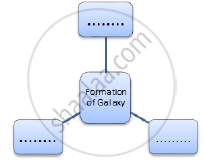
(A3)
(a) Find out similar words from the passage. 01
(i) mass (ii) happenings
(b) Give the verb form of the given words. 01
(i) classified (ii) directions
(A4) Identify and name the clause. 02
Scientists believe that the galaxies were formed from the lumps of matter.
(A5) Can there be life in another galaxy? Give reasons for your answer. 02
(B) Read the passage given in Q. 4 (A) and write the summary of it. Suggest a suitable title to your summary. (05)
Read the extract and do the activities that follow :
‘Your father was my enemy,’ said Frederick. ‘I would have been better pleased by your brave deed if you had told me of another father?’
‘I am proud to be Sir Rowland's son,’ answered Orlando angrily,’ and I would not change my place to be the heir of this dukedom.’
The Duke and his lords went away, leaving Orlando alone with Rosalind and Celia. Celia was angry with her father for speaking so unkindly to Orlando. ‘Would I have done this in my father’s place?’ she said to Rosalind.
‘My father loved Sir Rowland as much as his own soul,’ Rosalind said to Celia, ‘and all the world agreed with him. If I had known that his young man was Sir Rowland’s son I should have begged him with tears not to take so great a risk.’
‘Let us go and speak to Orlando,’ said gentle Celia. ‘I am ashamed of my father’s rude and angry words.’
The two girls went up to Orilando and praised him for his bravery. Rosalind took a gold chain from her neck and gave it to him. ‘I would like to give you more’, she said, ‘but I am not rich.’ Then she and Celia went away.
Orlando, however, could not forget them. He had already fallen in love with the fair Rosalind, but he could not stay at the Duke’s palace. His friends warned him that Frederick was angry and jealous of him. They told Orlando to leave the dukedom, because the Duke meant to do him harm.
A1. Match -
Match the characters and their attributes:
| A | B | ||
| i. | Celia | a. | fair |
| ii. | Orlando | b. | rude and unkind |
| iii. | Frederick | c. | gentle |
| iv. | Rosalind | d. | brave |
A2. Write an imaginary paragraph:
Write an imaginary paragraph in about 50 words in continuation with the given extract.
Read the passage given below and answer the questions that follow:
| 1 | Even before the independence of India, father of the nation, Mahatma Gandhi had said that, “Sanitation is more important than Independence.” He had emphasized the importance of cleanliness and sanitation in daily lives. However, he failed in his aim because of the incomplete participation of the people. After many years of independence of India, a most effective campaign of cleanliness has been launched to call people for their active participation and complete the mission of cleanliness. The President of India, Pranab Mukherjee while addressing the Parliament in June 2014 said, “For ensuring hygiene, waste management and sanitation across the nation, a Swachh Bharat Mission will be launched. This will be our tribute to Mahatma Ghandhi on his 150 birth anniversary to be celebrated in the year 2019.” In order to fulfil the vision of Mahatma Gandhi and make India an ideal country in the world, the Government of India initiated a campaign called ‘Swachh Bharat Abhiyan’ on the birthday of Mahatma Gandhi (2" of October). This campaign aims at completing the mission by 2019. |
| 2 | Through this campaign the Government of India would solve the problem of lack of sanitation by improving the waste management techniques. Clean India movement is completely linked with the economic strength of the country. The basic goal behind the launch of the ‘Swachh Bharat Abhiyan’ is to provide the country with enough sanitation facilities as well as to eliminate all the unhealthy practices of people in their daily routine. The completion of this mission would indirectly draw the attention of business investors to India, enhance the GDP growth, draw tourists from all over the world, create a variety of avenues of employment, reduce health costs, reduce death rate, and reduce fatal disease rate and many more. It has been requested that every Indian devote at least 100 hours per year to cleanliness in India which is sufficient to make this country a clean country by 2019. The cleanliness drive also ensures cleanliness in the official buildings. Spitting paan, gutka and other tobacco products in the government offices has been banned. |
On the basis of your understanding of the above passage, answer any eight of the following questions:
- What is the passage about?
- What was the result of incomplete participation of the people in the mission?
- Why has 2019 been kept as the target year of completion?
- What did Gandhiji say about sanitation?
- How can the problem of lack of sanitation be solved?
- How will it impact our economy?
- What has been banned in the offices?
- What request has been made to Indians to accomplish it?
- What does ‘Swachh Bharat Abhiyan’ aim at?
Read the following extract and answer the questions given below:
In 1945 in Bay Roberts, Canada, a 12- year old boy saw something in a shop window that set his heart racing. But the price - five dollars- was far beyond Reuben Earle's means. Five dollars would buy almost a week's groceries for his family.
Reuben couldn't ask his father for the money. everything Mark Earle made fishing. Reuben's mother. Dora, stretched like elastic to feed and clothe their five children.
Nevertheless, he opened the shop's weathered door and went inside. Standing proud and straight in his flour-sack shirt and washed out trousers, he told the shopkeeper what he wanted, adding, "but I don't have the money now. can you please hold it for me?"
"I will try," the shopkeeper smiled. "Folks around here don't usually have that kind of money to spend on things. It should keep for a while."
Reuben respectfully touched his worn cap and walked out into the May sunlight. The bay rippled in a freshening wind that ruffled his short hair. There was purpose in his loping stride. He would raise the five dollars and not tell anybody.
Hearing the sound of hammering from a side street. Reuben had an idea.
He ran towards the sound and stopped at a construction site. People built their own homes in Bay Roberts, using nails purchased in burlap sacks from a local factory. Sometimes the sacks were discarded is the flurry of building, and Reuben knew he could sell them back to the factory for five cents apiece.
Questions:
(1) What is the passage about?
(2) What did Reuben ask the shopkeeper? What was the shopkeeper's reply?
(3) Why could not Reuben ask his father for five dollars?
(4) How do you express your love and respect for your parents?
(5) Rewrite the following sentences in the ways instructed:
i. He opened the shop's weathered door and went inside. (Make it simple)
ii. "I will try."
(Rewrite the sentence using another modal Auxiliary showing 'obligation'.)
iii. People built their own homes in Bay Roberts.
(Frame a Wh question to get the underlined part as ita answer)
(6) Give the opposite words of:
(i) respectfully
(ii) Usually
Read the following extract and answer the questions given below :
Reuben arrived at the factory. The sack buyer was about to lock up.
"Mister! Please don't close up yet." The man turned and saw Reuben, dirty and sweat-stained.
"Come back tomorrow, boy."
"Please, Mister. I have to sell the sacks now-please." The man heard a tremor in Reuben's voice and could tell he was close to tears.
"Why do you need this money so badly?"
"It's a secret."
The man took the sacks, reached into his pocket and put four nickels into Reuben's hand. Reuben murmured a quiet thank-you and ran home.
Then, clutching the tin can, he headed for the store.
"I have the money" he solemnly told the owner, pouring his coins onto the counter.
The man went to the window and retrieved Reuben's treasure. He wiped the dust off and gently wrapped it in brown paper. Then he placed the parcel in Reuben's hands.
Racing home, Reuben burst through the front door. His mother was scrubbing the kitchen range. "Here Mum!Here!" Reuben exclaimed as he ran to her side. He placed a small box in her work-roughened hand.
She unwrapped it carefully, to save the paper. A blue-velvet jewel box appeared. Dora lifted the did, tears beginning to blur her vision.
In gold tettering on a small, almond-shaped brooch was the word 'Mother'
It was Mother's Day, 1946
Dora had never received such a gift; she had no finery except her wedding ring. Speechless, she smiled radiantly and gathered her son into her arms.
(1) Why did Reuben insist on the sack buyer to buy his sacks that day only?
(2) How did the mother react when Reuben gave her the gift?
(3) In what way was Reuben's gift special to his mother?
(4) What do you plan to do on Mother's Day?
(5) Rewrite the following sentences in the ways instructed :
(i) I have to sell the sacks.
(Rewrite it replacing the underlined part with the modal auxiliary showing 'compulsion'.)
(ii) She smiled radiantly and gathered her son into her arms. (Use 'As soon as'.)
(iii) She unwrapped it carefully.
(Rewrite the sentences using the noun form of the underlined word.)
(6) Find out the words/phrases from the extract which mean:
(i) showing joy (ii) got back
Read the first activity, read the extract and then do all the activities:
A1. Correct the following statements with the help of the facts from the extract :
(1) Everybody in every part of the globe would have access to administration and social care services because he or she would not be able to afford them.
(2) We would avoid boom and bust cycles and be able to surmount natural disaster with great ease.
|
To me, a world without poverty means that every person would have the ability to take care of his or her own basic life needs. In such a world, nobody would die of hunger or suffer from malnutrition. This is a goal world leaders have been calling for decades, but have never set out any way of achieving it. Today 40,000 children die each day around the world from hunger-related diseases. In a poverty-free world, no children would die of such causes. Everybody in every part of the globe would have access to education and health-care services because he or she would be able to afford them. Unlike today, the state would not be required to provide free or subsidized health-care or schooling. All state organizations created to provide free or subsidized services for the poor would no longer be required and welfare agencies, or the national welfare department. No free schools, no free hospital care, no begging in the streets. State-run safety-net programmers would have no rationale for existence because no one would live on charity anymore. State-run social security programmers, income-support programmes would be unnecessary. Social structures in a poverty-free world would, of course, be quite different from those that exist in a poverty-ridden world. But nobody would be at the mercy of anyone else, and that is what would make all the difference between a world without poverty and one riddled with it. Finally, a poverty-free world would be economically much Stronger and far more stable than the world today. one-fifth of the world's inhabitants who today live a life of extreme poverty would become income earners and income spenders. They would generate extra demand in the market to make the world economy grow. They would bring their creativity and innovations into the market-place to increase the world's productive capacity. Since nobody would ever become poor, except on a temporary and limited basis, the economy would probably not go through extreme swings. We would avoid boom-and-bust cycles and be able to surmount man-made disasters with greater ease. |
A2.
Complete the following statement :
The situation in the world without poverty would be different, because -
(1) the state need not ___________
(2) nobody __________
A3. Find out :
Find and write in the blank boxes :
One-fifth of the world's inhabitants today live a life of extreme poverty. How would they economically Stand in a poverty-free world?
| They would be income earners and income spenders |
A4. Vocabulary :
Find out the words from the extract that mean the following :
(1) calamity (2) overcome
(3) bringing new ideas (4) financially
A5. Personal Response :
Suggest at least four solutions to overcome the problems of increasing poverty.
A6. Grammar :
Rewrite the following sentences in the ways instructed :
(1) Nobody would die of hunger or suffer from malnutrition.
(Remove the negative and rewrite.)
(2) Everybody in every part of the globe would have accessed education and health-care services.
(Rewrite the above sentences beginning with 'Education'.)
A Read the first activity, read the extract and then do all the activities :
A1. Complete :
Complete the following sentences :
(1) The two organizations that conducted the research to develop a smartphone-based optical bio-sensor are _______ and __________ .
(2) The _________ and _________ methods were used in the research instead of the differential method.
|
Urea is a major product of nitrogen metabolism in humans. It is eliminated from the body mainly by the kidneys through urine. Urea levels in body fluids, such as blood and saliva, rise drastically under certain kidney dysfunctions. Heart failure, hypovolemic shock, gastrointestinal bleeding, and severe infections can also lead to a rise. Thus urea in blood and saliva provides key information on renal function and helps diagnose various disorders. Most methods for estimating urea in body fluids are based on colorimetry. These methods are time-consuming and involve painful blood extraction. Collecting saliva is non-evasive and research has correlated salivary and blood urea levels. Recently scientists from the IIT-D and the AIIMS, New Delhi successfully developed a smartphone-based optical biosensor to detect urea in saliva. To fabricate the sensor, they directly immobilised the urease enzyme with a pH indicator on a filter paper-based strip. As a response to the urea on saliva, the paper strip changes colour. The red, green and blue levels help measure urea concentration. The scientists used the slope method, sensor response change per unit time, instead of the differential method, the difference in sensor response between two-time intervals, to increase sensitivity and eliminate interference by variations in ambient light. The team clinically validated spiked saliva samples and samples from healthy volunteers. The smartphone application with paper strip can even be operated by non-professional with limited training. This saves time and cost spent on bulky spectroscopic procedures. The report can revolutionise the medical screening of large populations. And such mass screening of diseases would boost national health. |
A2. Complete the following sentence using the correct alternatives from those given below :
Two objectives to conduct the research are ___________ .
(i) The colorimetry method used to estimate urea in body fluids consumes more time.
(ii) Information obtained from the presence of urea in blood and saliva is not helpful to diagnose various diseases.
(iii) Collecting samples of saliva is a non-invasive procedure.
(iv) Blood extraction is the easiest and less painful exercise.
A3. Write two benefits of the smartphone-based optical biosensor.
A4. Find out similar-meaning words from the extract for the following words :
(1) specimen (2) extremely (3) focus (4) remove
A5. Personal Response :
'Research revolutionises the lifestyle of people in all spheres of life'-
Do you agree? Explain with an example in about 25 words.
A6. Grammar :
Rewrite the following sentences in the ways instructed :
(1) These methods are time consuming and painful.
(Rewrite the sentence using 'as well as'.)
(2) The smartphone application with paper-strip can be operated.
(Begin the sentence with 'They ___ .)
(B) Summerise the above extract with the help of the points given and suggest a suitable title::
Research by the organisations - methods adopted - reasons for the research - advantages.
Read the extract and do the activities that follow :
When Rosalind heard about Orlando's wound and saw the handkerchief stained with his blood, she also fainted; and later she told Oliver that she was really Rosalind, and loved Orlando dearly. Oliver had already fallen in love with gentle Celia, and he persuaded the two girls to accompany him to Duke Senior's court. Rosalind, however, wanted to play one more trick as Ganymede, so she made Oliver promise not to tell anyone that the young shepherd boy and his sister Aliena were really Rosalind and Celia.
And so Aliena and Ganymede were introduced to the old Duke, and he did not recognize his daughter, although he remarked on Ganymede's likeness to Rosalind.
Then the "shepherd boy" told Orlando and the Duke that he could find Rosalind and would bring her to them, making the Duke promise that he would allow his daughter to marry Orlando. she and Celia ran quickly to the shepherd's cottage, changed into their own clothes and removed the brown stains from their faces. Then they returned to the Duke, where they were welcomed with great rejoicing.
'To you, I give myself, for I am yours,' Rosalind said to the Duke, her father. Then she turned to Orlando and said: 'To you, I give myself, for I am yours.'
Rosalind and Orlando were married at once in the forest and on the same day Oliver who was no longer selfish and wicked, married Celia. Just as they were going to be married, a messenger came to ask Duke Senior to go back to his dukedom. Celia's father, Duke Frederick, had mended his wicked ways and asked his brother to return.
A1. True/False :
Choose the true statements from those given below and write them down :
(i) Rosalind played the role of a shepherd boy Ganymede.
(ii) Senior Duke recognised his daughter, Celia.
(iii) Oliver married Rosalind.
(iv) Duke Frederick had mended his wicked ways.
A2. Convert into a dialogue :
Convert the above extract into a dialogue form.
Read the following extract and answer the questions given below :
I was 33 at the time, a doctor in the West End of London. I had been lucky)' in advancing through severed arduous Welsh mining assistantships to my own practice- acquired on the installment plan from a dear old family physician who, at our first interview, gazed at my cracked boots and frayed cuffs and trusted me.
I think I wasn't a bad doctor. My patients seemed to like me not only 1he nice old ladies with nothing wrong with them, who lived near the Park and paid handsomely for my cheerful bedside manner but the cabbies, porters, and deadbeats in the mews and back streets of Bayswater, who paid nothing and often had a great deal wrong with them. Yet there was something- though I treated everything that came my way, read all Ille medical journals, attended scientific meetings, and even found time to take complex postgraduate diplomas - I wasn't quite sure of myself. I didn't stick at anything for long. I had successive ideas of specializing in dermatology, in aural surgery, in pediatrics, but discarded them all. While I worked all day and half of most nights, I really lacked perseverance, stability. One day I developed indigestion. After resisting my wife's entreaties for several weeks, I went casually to consult a friendly colleague. I expected a bottle of bismuth and an invitation to a bridge. I received instead of the shock of my life: a sentence to six months' complete rest in the country on a milk diet. I had a gastric ulcer.
(I) What does the doctor tell us about his profession?
(2) What sort of patients did the doctor handle?
(3) What shock of life did the doctor receive when he visited his doctor colleague?
(4) What qualities of the doctor appeal you the most?
(5) Rewrite the following sentences in the ways instructed:
(i) I read all the medical journals.
(Rewrite it using the past perfect continuous tense.)
(ii) I treated everything that came n1y way.
(Rewrite the sentence beginning with "Everything ... ")
(iii) I received the shock of my life.
(Make it a Rhetorical question.)
(6) Find out the words from the extract which mean :
(i) involving a lot of effort and energy.
(ii) serious requests
Read the passage given below :
Globalization
Globalization is the way to open businesses, improve technological growth, economy, etc, at the international level for all countries. It is the way in which manufacturers and producers of the products or goods sell their products globally without any restriction. It provides huge profits to the businessmen as they get 1ow cost labor in poor countries easily. It provides a big opportunity for companies to„ deal with the worldwide market.
Globalization helps to consider the whole world 'as a single market. Traders are extending their areas of business by treating the world as a global village. Earlier till the 1990s, there was a restriction on importing certain products that were already manufactured in India like agricultural products, engineering goods, food items, and toiletries. However, during the 1990s there was pressure from. the rich countries on the poor and developing countries to allow them to spread their businesses by opening their markets. In India, the globalization and liberalization process was started in 1991.
After many years, globalization brought about a major revolution in the Indian market when multinational brands came to India and started delivering a wide range of quality products at cheap prices. Prices of good quality products came down because of the cutthroat competition in the market.
Globalization and liberalization of the businesses in India have flooded the market with quality foreign products but have affected the local Indian industries adversely to a great extent resulting in job loss to poor and uneducated workers. Globalization has been a bonanza for the consumers, however, a loss to the small-scale Indian producers.
Globalization has had some very positive effects on the Indian consumer in all sectors of society. It has affected the Indian students and education sector to a great extent by making study books and a lot of information available over the internet. The collaboration of foreign universities with Indian universities has brought about a huge change in the field of education.
Globalization of trade in the agricultural sector has brought varieties of quality seeds that have disease resistati8e; property. However, it is not good for the poor Indian farmers because the seeds and agricultural technologies are costly.
It has brought about a huge revolution in the employment sector by the spread of businesses like cottage, handloom, carpet, artisan carving, ceramic, jewelry, and glassware, etc
(a) What is globalization?
(b) Write any two advantages of globalization.
(c) What was the pressure from the rich countries in the 1990s?
(d) What is the effect of multinational brands entering the Indian market?
(e) How are the prices of quality products affected due to globalization?
(f) How have foreign products affected the local industry adversely?
(g) What has been the impact of globalization on Indian students?
(h) Why has globalization had a negative effect on the poor Indian farmer?
(i) How has the cottage industry benefited from globalization?
Read the passage given below :
Success
Everybody wants to succeed in life. For some, success means achieving whatever they desire or dream. For many, it is the name, fame, and social position. Whatever be the meaning of success, it is a success that makes a man popular.
All great men have been successful. They are remembered for their great achievements. But it is certain that success comes to those who are sincere, hardworking, loyal, and committed to their goals.
Success has been man's greatest motivation. It is very important for all. Success has a great effect on life. It brings pleasure and pride. It gives a sense of fulfillment. It means all-around development. Everybody hopes to be successful in life. But success smiles on those who have a proper approach, planning, vision, and stamina. A proper and timely application of all these things is bound to bear fruit. One cannot be successful without cultivating these certain basic things in life. It is very difficult to set out on a journey without knowing one's goals and purposes. The clarity of the objective is a must to succeed in life. A focused approach with proper planning is certain to bring success. Indecision and insincerity are big obstacles on the path to success.
One should have the capability, capacity, and resources to turn one's dreams into reality. Mere desire cannot bring you success. The desire should be weighed against factors like capability and resources. This is the basic requirement of success. The next important thing is the eagerness, seriousness, and the urge to be successful. It is the driving force that decides success. It is the first step on the ladder of success.
One needs to pursue one's goals with all one's sincerity and passion. One should always be in high spirits. Lack of such spirit leads to an inferiority complex which is a big obstruction on the path to success. Time is also a deciding factor. Only the punctual and committed have succeeded in life. The lives of great men are examples of this. They had all these qualities in plenty which helped them rise to the peak of success.
Hard labor is one of the basic requirements of success. There is no substitute for hard labor. It alone can take one to the peak of success. Every success has a ratio of five percent inspiration and ninety-five percent perspiration. It is patience, persistence, and perseverance which play a decisive role in achieving success. Failures are the pillars of success as they are our stepping-stones and we must get up and start again and be motivated.
2.1 On the basis of your reading of the passage, answer any four of the following questions in 30-40 words each:
(a) To whom does success come certainly?
(b) What are the basic things in life we need to achieve success?
(c) What did great men have in plenty to rise to the peak of success? Give any two examples
(d) What is the one basic requirement of success?
(e) Explain: "Failures are pillars of success."
2.2 On the basis of your reading of the passage, fill in any two of the following blanks with appropriate words/phrase :
(a) ________________ plays a decisive role in achieving success.
(b) Goals have to be pursued with ________________ and ________________
(c) Ratio of success is ________________ inspiration.
2.3 Find out the words from the passage that mean the same as the following :
(a) endurance (para 2)
(b) obstruction (para 4)
(c) motivation (para 5)
Read the following passage carefully:
|
On the basis of your reading of the above passage, answer the following question:
- The Dancing Girl belongs to:
- Mohenjo-Daro
- Greek culture
- Homo sapiens
- Tibet
- In the museum she’s kept among:
- dancing figures
- bronze statues
- terracotta animals
- books
- Which information is not given in the passage?
- The girl is caged behind glass.
- She is a rare artefact.
- School books communicate the wealth of our heritage.
- She cannot be rediscovered as she’s bronze.
- ‘Great Art’ has power because:
- It appeals to us despite the passage of time.
- It is small and can be understood.
- It’s seen in pictures and sketches.
- It’s magnified a million times.
- The jewellery she wears:
- consists of only bangles of shell or ivory or thin metal.
- is a necklace with two pendants.
- both (i) and (ii) are correct.
- neither (i) nor (ii) is correct.
- She reminds us:
- of the never-say-die attitude of humans.
- why museums in our country are exciting.
- why she will make us come into money.
- of dancing figures.
- The synonym of the word “among” in para 1 is ______.
- The size of the dancing girl is equal to the length of the human palm. (True/False)
Read the passage given below.
Then all the windows of the grey wooden house (Miss Hilton used to live here. She expired last week.), were thrown open, a thing I had never seen before.
At the end of the day a sign was nailed on the mango tree: FOR SALE.
Nobody in the street knew Miss Hilton. While she lived, her front gate was always locked and no one ever saw her leave or saw anybody go in. So even if you wanted to, you couldn't feel sorry and say that you missed Miss Hilton.
When I think of her house I see just two colours. Grey and green. The green of the mango tree, the grey of the house, and the grey of the high iron fence that prevented you from getting at the mangoes.
If your cricket ball fell in Miss Hilton's courtyard you never got it back. It wasn't the mango season when Miss Hilton died. But we got back about ten or twelve of our cricket balls.
The house was sold and we were prepared to dislike the new owners ever before they came. I think we were a little worried. Already we had one resident of the street who kept on complaining about us to our parents. He complained that we played cricket on the pavment; and if we were not playing cricket he complained that we were making too much noise anyway.
One afternoon, when I came back from school Pal, said, "Is a man and a woman. She pretty pretty, but he ugly like hell". I didn't see much. The front gate was open, but the windows were shut again. I heard a dog barking in an angry way.
One thing was settled pretty quickly. Whoever these people were they would never be the sort of people to complain that we were making noise and disturbing their sleep.
A lot of noise came from the house that night. The radio was going at full volume until midnight when the radio station closed down. The dog was barking and the man was shouting. I didn't hear the woman.
On the basis of your understanding the above passage complete the following statements :
(a) Nobody went into Miss Hilton's house because her front __________.
(b) Her house had only two colours, (i) __________ and (ii) __________.
(c) High iron fence did not let the boys get __________.
(d) They never got it back if their __________ fell into her courtyard.
(e) The boys were ready to dislike the __________.
(f) One resident of the street always __________.
(g) New owners of Miss Hilton's house were (i) __________ and (ii) __________.
(h) A man was shouting, a dog was barking, only __________.
Read the passage given below:
During our growing up years we as children were taught both at home and school-to worship the photos and idols of the gods of our respective religions. When we grow a little older, we were to read holy books like The Bhagwad Gita, Bible, and Quran; we were told that there are a lot of life lessons to be learned from these holy books. We were then introduced to stories from our mythologies which taught us about ethics and morality-what is good and what is bad I also learned to be respectful towards my parents who made my life comfortable with their hard work and love and care, and my teachers who guided me to become a good student and a responsible citizen.
Much later in life, I realised that though we learn much from our respective holy books, there is a lot to learn from our surroundings. This realization dawned upon me when I learned to enquire and explore. Everything around us- the sun, the moon, the stars, rain, rivers, stones, rocks, birds, plants, and animals-teach us many valuable life lessons.
No wonder that besides the scriptures in many cultures nature is also worshipped. The message that we get is to save our environment and maintain ecological balance. People are taught to live in harmony with nature and recognize that there is God in all aspects of nature.
Nature is a great teacher. A river never stops flowing. If it finds an obstacle in its way in the form of heavy rock, the river water fights to remove it from its path or finds an alternative path to move ahead. This teaches us to be progressive in life, and keep the fighting spirit alive.
Snakes are worshipped as they eat insects in the field that can hurt our crops, thus protecting the grains for us. In fact, whatever we worship is our helper and makes our lives easy for us. There are many such examples in nature, but we are not ready to learn a lesson, Overcome with greed, we are destroying nature. As a result, we face natural disasters like drought, floods, and landslides. We don't know that nature is angry with us.
However, it is never too late to learn. If we learn to respect nature the quality of our life will improve.
2.1 Answer briefly the following questions:
(a) What are we taught in our childhood and growing up years?
(b) Why should we respect our parents and teachers?
(c) What message do we get when we worship nature?
(d) How does a river face an obstacle that comes in its way?
2.2 Choose meanings of the words given below with the help of options that follow:
(e) guided
(i) answered
(ii) advised
(iii) fought
(iv) polished
(f) explore
(i) search
(ii) frequent
(iii) describe
(iv) request
(g) valuable
(i) proper
(ii) desirable
(iii) available
(iv) useful
(ii) friendship
(iii) discomfort
(iv) honesty
A. Read the following passage and do the given activities:
A1. List the benefits of Yoga (02)
- ______
- ______
- ______
- ______
We give undue importance to our health and the treatment of diseases. A large number of medicines treat only the symptoms of the disease, and not the root cause. In fact, the cause of many chronic ailments is still being researched. It is here that Yoga therapy comes to our assistance. Yoga emphasizes the treatment of the root cause of an ailment. It works in a slow, subtle and miraculous manner. Modern medicine can claim to save a life at a critical stage, but, for complete recovery and regaining of normal health, one must believe in the efficiency of Yoga therapy.
The Yogic way of life includes a code of ethics, regulations, discipline, combined with prayer and meditation. Even a discussion of these subjects helps one relieve mental tensions and change attitudes. Simple Asana has helped to stretch and relax the whole body and release tensions. The sincere practice of Yoga postures is beneficial, for the mind and body.
The continued practice of Yoga has a profound effect on the inner dimensions of life. Yoga aims at developing mental, physical, spiritual, and emotional facilities. Other forms of physical exercises, like aerobics, assure only physical well-being. They have little to do with the development of the soul and mind.
A2. Complete the following statement according to the passage: (02)
- One must believe in the ________
- Aerobics assure only __________
A3. Fill up the word-formation chart: (02)
| Noun | Verb | Adjective |
| development | ______ | ______ |
| ______ | believe | ______ |
A4.
- Yoga emphasizes the treatment of the root cause of an ailment.
(Frame ‘Wh-‘ Question to get the underlined part as an answer) (02) - We give undue importance to our health.
(Begin with Undue importance......) (02)
A5. Do you believe Yoga Asanas are better than physical exercises? Justify your answer.
B. Summary Writing (5)
Write a short summary of the passage given in above and suggest a suitable title.
Read the passage given below and answer the questions that follow:
| 1. | A fisherman, enfeebled with age, could no longer go out to sea so he began fishing in the river. Every morning he would go down to the river and sit there fishing the whole day long. In the evening he would sell whatever he had caught, buy food for himself and go home. It was a hard life for an old man. One hot afternoon while he was trying to keep awake and bemoaning his fate, a large bird with silvery feathers alighted on a rock near him. It was Kaha, the heavenly bird. “Have you no one to care for you, grandpa?” asked the bird. “Not a soul.” “You should not be doing such work at your age,” said the bird. “From now on I will bring you a big fish every evening. You can sell it and live in comfort.” True to her word, the bird began to drop a large fish at his doorstep every evening. All that the fisherman had to do was take it to the market and sell it. As big fish were in great demand, he was soon rolling in money. He bought a cottage near the sea, with a garden around it and engaged a servant to cook for him. His wife had died some years earlier. He had decided to marry again and began to look for a suitable woman. |
| 2. | One day he heard the royal courtier make an announcement. Our king has news of a great bird called Kaha,” said the courtier. “Whoever can give information about this bird and help catch it, will be rewarded with half the gold in the royal treasury and half the kingdom!” The fisherman was sorely tempted by the reward. Half the kingdom would make him a prince! |
| 3. | “Why does the king want the bird,” he asked. “He has lost his sight,” explained the courtier. “A wise man has advised him to bathe his eyes with the blood of Kaha. Do you know where she can be found?” “No…I mean …no, no…” Torn between greed and his sense of gratitude to the bird, the fisherman could not give a coherent reply. The courtier, sensing that he knew something about the bird, informed the king. The king had him brought to the palace. |
| 4. | “If you have information about the bird, tell me”, urged the king. “I will reward you handsomely and if you help catch her, I will personally crown you king of half my domain.” “I will get the bird for you,” cried the fisherman, suddenly making up his mind. “But Kaha is strong. I will need help. The king sent a dozen soldiers with him. That evening when the bird came with the fish, the fisherman called out to her to wait. “You drop the fish and go and I never get a chance to thank you for all that you‘ve done for me," he said. “Today I have laid out a feast for you inside. Please alight and come in. Kaha was reluctant to accept the invitation but the fisherman pleaded so earnestly that she finally gave in, and alighted. The moment she was on the ground, the fisherman grabbed one of her legs and shouted to the soldiers hiding in his house to come out. They rushed to his aid but their combined effort could not keep Kaha down. |
| 5. | She rose into the air with the fisherman still clinging to her leg. By the time he realised he was being carried away, the fisherman was too high in the air to let go. He hung on grimly, and neither he nor Kaha was ever seen again. |
Based on your understanding of the above passage, answer the questions.
- Why did the fisherman start fishing in the river?
- How did the fisherman spend the day before he met Kaha?
- How did the fisherman betray Kaha?
- Why was the fisherman doubtful about revealing information about Kaha to the courtier?
Read the given case-based passage carefully and answer the questions that follow.
|
Case study of museums |
|
| 1. |
We don’t go to museums. We prefer malls, cinema halls, and restaurants. Visiting a museum is best left to schools which makes it mandatory. After all, it is an academic exercise. And what entertainment can these places possibly offer? India doesn’t boast the greatest of museums, but one can’t doubt the collection of artefacts in these repositories of heritage, even for a second. Our eventful history has handed down us numerous masterpieces, but unfortunately, we don’t find them compelling enough. A cultural historian and museologist Jyotindra Jain says that the habit of going to museums has just not been inculcated in us. One of the best museums in the country, the National Museum in Delhi charges a mere Rs. 20. According to Joyoti Roy, outreach consultant, National Museum, it receives between 6,00,000 to 7,00,000 visitors each year and anything between 2,500 and 3,000 per day. The mix includes Indians, foreigners, and school students. For an Indian museum, it is an astounding figure, but still nowhere close to the footfalls museums, we consider the finest, get. |
| 2. | It has not been many days since the National Gallery of Modern Art, Bangalore, hosted A. Ramachandran’s expansive retrospective covering five decades of his artistic journey. As we sat outside the first-floor gallery after Ramachandran walked me through his sketches, sculptures, and paintings, the senior artist, a bit disappointed said, “Had an exhibition of this scale taken place abroad, people would have come in thousands.” There were about three-five visitors inside the gallery at that time. Jain, who has also helmed institutions like the Crafts Museum and Indira Gandhi National Centre for the Arts in Delhi, puts the onus on museums. “We developed the museums but didn’t evolve the infrastructure around it. And it is the museum’s responsibility to do it. When you know, people are not going to come to you, you must go to them. Crafts Museum shares its wall with India Trade Promotion Organisation. It receives lakhs of people during the trade fair. I fought tooth and nail to get that door opened during my tenure (1984-89) so that the visitors spill over to the Crafts Museum as well. Museums need to rethink their strategies and outreach should be a major point of concern for them.” |
| 3. | In 2010, UNESCO brought out a report on the terrible conditions at India’s top eight museums, citing substandard maintenance, lighting, and signage, among other issues. The Ministry of Culture put together a 14 - point museum reforms agenda and things have moved forward since then. Dr Bhau Daji Lad Museum, the oldest museum in Mumbai has received 3,00,000 visitors over the past year. On average, the museum witnesses 500 visitors every day, with an average of 2,000 visitors over weekends. Not big numbers again, but impressive enough in the Indian context. And this is when the museum re-emerged after a revamp in 2008 with an extensive exhibition programme. Collaborations, screenings of movies of different genres, and workshops for adults and children contributed to the increase in the number of footfalls. The public-private partnership model of the museum is unique and can be replicated in other cases as well. |
| 4. | Robust publicity of exhibitions and creating links between different art spaces can also fetch the audience. Different art institutions located in proximity can host a series of events to be held in each one of them simultaneously. Museums also need to transform their cafes, upgrade their museum shops, and most importantly, invest in their human resource. So, what do we do until then? Let’s go and explore these storehouses of history, culture, and knowledge because unless and until we claim them, they will remain indifferent to our needs. |
After studying the case study of museums, answer the following questions.
- What according to the author is the reason for fewer footfalls in the museums in India?
- What measures are suggested in the passage to multiply the visitors to the museums?
- What was the proposition given by A. Ramachandran during his tenure at Crafts Museum?
- Between the National Museum of Delhi and Dr. Bhau Daji Lad Museum, which museum has more footfall on daily basis? Justify using statistics provided in the study.
Read the passage given below.
|
5 |
Technology is making advancements at a rapid rate but at the cost of a valued tradition - the crafts industry. The traditional crafts industry is losing a lot of its trained and skilled craftsmen. With that, the art of embellishing brass and copper utensils with fine engravings is also disappearing. The government has identified around 35 crafts as a languishing craft. |
|
10 |
The speciality of handcrafted items is their design, an association with long traditions belonging to a specific region. The word ‘handcrafted’ does not imply the involvement of dexterous human fingers or an agile mind with a moving spirit anymore. Lessening drudgery, increasing production and promoting efficiency have taken precedence. The labour-saving devices are taking the place of handcrafted tools and this has jeopardized the skills of these artisans. |
|
15 |
Mechanisation has made its way into everything - cutting, polishing, edging, designing etc. Ideally, the use of machinery should be negligible and the handicrafts should be made purely by hand with a distinguishable artistic appeal. However, with the exception of small-scale industries, the export units are mostly operated by machines. The heavily computerised designs contribute to faster production at lower costs. |
|
20 |
Although mechanization of crafts poses a challenge to safeguarding traditional crafts, the artisans are lured with incentives in order to impart handicrafts training. Some makers do see machines as a time-saving blessing since they are now able to accomplish difficult and demanding tasks with relative ease. These machines might give a better 25finesse to these products but they don’t stand out as handcrafted. The quantity has overtaken quality in this industry. |
|
30 |
A need to highlight the importance of the handmade aspect is required by both the government and private sectors, in order to amplify awareness and also support the culture of making handicrafts. A few artisans are still trying their best to rejuvenate and revive their culture and heritage but it’s an uphill task competing with the machine-made goods. A multitude of artisans have changed their professions and are encouraging their progeny to follow suit. There are others who have stayed their ground but are clearly inclined towards buying machines. |
|
35 |
Nearly two decades ago, there were around 65 lakh artisans in the country. Three years ago, when the government started the process of granting a unique number to the artisans based on the Aadhaar card, 25 lakhs were identified. Loss of traditional crafts is clearly a worrying issue, but it stands to reason that forcing any artisan to follow old ways when concerns of livelihood overrule other considerations, is unfair. |
Based on your understanding of the passage, answer the questions given below.
- What does the writer mean by calling handicrafts a ‘valued tradition’?
- Rewrite the following sentence by replacing the underlined phrase with a word that means the same from lines 5-15.
If it continues, the workcation (work + vacation) trend will be a powerful boost to domestic tourism operators failing to make progress in the economic slump caused due to the pandemic. - State any two reasons why artisans are choosing to work via machines rather than handcrafted tools.
- Why do the artisans need to be ‘lured with incentives’ to impart handicrafts training?
- List one likely impact of the support of government and private sectors towards the culture of making handicrafts.
- How does the writer justify an artist’s act of abandoning her/his traditional craft for a more lucrative option?
Read the following passage and complete the activities:
A1. Complete the chart on the life stages of fireflies: (2)

|
Fireflies are beetles and go through several life stages, starting out as an egg, then hatching into larvae. At the juvenile stage, they turn into pupae and then, finally adults. Fireflies spend most of their lives in a larval stage, hidden away. There are 2000 different species of fireflies. But they all go through a long juvenile stage and a short adult life, which is mainly about courtship, mating and reproduction. The juveniles living underground or underwater, are very different though-they're hunters, they eat snails and soft-bodied insects and they have very different habitats. Conserving them is essential for human life as fireflies are a key part of the food web. They are predators of agricultural pests. In turn, they are prey for spiders and other insects. They are completely enmeshed in the web of life. In addition, about 70 years ago, scientists unravelled the mystery of fireflies' light-producing talents. Since then, the bio-chemical reactions that fireflies experience have been used in detecting bacterial contamination in foods, testing drugs against cancer, developing drought-resistant crops. They have been used in space exploration. So fireflies give us beauty and inventions. Fireflies carry oxygen, calcium, magnesium and a natural chemical called luciferin. These react together to produce the photons. This is how the fireflies glow. Firefly tourism is growing across the world. In Maharashtra, for example, a particular species monsoon fireflies, emerge before the rains. They're beautiful and a festival is held in Purushwadi, encouraging firefly tourism. Its wonderful that people around the world go to see fireflies in their natural habitat. We need to be cautious. Too many people can disturb adult and larval habitats. Fireflies need darkness to communicate with each other and we need fireflies because they are harbingers of hope. |
A2. Write two reasons for the conservation of fireflies. (2)
A3. Make antonyms of the following words using prefix: (2)
- different × ______
- experience × ______
- bacterial × ______
- natural × ______
A4. Do as directed: (2)
(i) Too many people can disturb adult and larval habitat.
(Rewrite using 'as well as')
(ii) These react together to produce photons.
(Pick out the infinitive from the given sentence)
A5. Can you think of any other insect that teaches us some values of life? Explain with examples. (2)
Read the following passage and do the activities.
A1. Fill in the blanks.
- ______ is the effect of excessive humour.
- ______ and ______ are the qualities of a humorous person.
|
You are endowed with certain naughtiness as a child. Keep it alive. Humour will lighten all tough situations. One who has humour can sail through any conflict. Humour is buffer that saves you from humiliation. Humour brings everyone together, while humiliation tears them apart. In a society tom with humiliation and inSult, humour is like a breath of fresh air. Humour should be coupled with care and concern. Humour can keep the spirit high, yet if overdone, it leaves a bad taste. Humour without wisdom is shallow. Humour without sensitivity is satire-it comes back to you with more problems. The wise use humour to bring wisdom and to lighten situations. The intelligent use humour as a sword to insult others. The irresponsible use humour to escape from responsibility. And fools take humour too seriously! How does one cultivate a sense of humour? Humour is not just words, it is the lightness of your being. You do not have to read and repeat jokes. Humour can be cultivated by taking life not too seriously (because you will never come out of it alive), having a sense of belonging with everybody, including those who are not friendly, practising Yoga and meditation, having unshakable faith in the Divine and in the laws of Karma, being in the company of those who live in knowledge and have a sense of humour. |
A2. How does humour help in building harmony in society?
A3. State the meaning of the following:
- Satire
- To be shallow
A4. Add a question tag to the following sentences.
- You are endowed with certain naughtiness as a child.
- Humour can be cultivated by taking life not too seriously.
A5. How do you think can humour help you to develop a better personality?
Based on the careful reading of the passage given below, answer any four out of five questions that follow:
|
Climate change and global warming are the biggest threats of the present time and how the world manages to control pollution will define our future. Rising industrialization, urbanization, deforestation etc., are endangering the natural ecosystem. Since 1880, the earth’s temperature has been rising at a rate of 0.14° F (0.08° C) per decade and the rate of increase has doubled since 1981 at 0.32° F (0.18° C) per decade. The 10 warmest years on record have occurred since 2015, with 2020 recorded as the second-warmest year as per the National Oceanic and Atmospheric Administration (NOAA). With growing economies, global carbon measurements have been rapidly rising for the last 15 years. As per recent data, in January 2022, carbon dioxide (CO2) measurement stood at 418 parts per million, up around 11% from 378 parts per million recorded since 2007. |
(a) What is the key to defining our future?
- The means employed to control pollution.
- The means employed to control resources.
- The means employed to control state policies.
- The means employed to educate masses.
(b) Which of the following elements are not responsible for endangering natural ecosystem?
- Deforestation
- Inflation
- Industrialization
- Urbanization
(c) According to the passage, economy, and carbon emissions have been ______ to each other for last 15 years.
- Inversely proportionate
- Directly proportionate
- Not related
- Disproportionate
(d) Name the institution responsible for observing and recording earth’s temperature over the years.
- National Organic and Atmospheric Administration
- National Oceanic and Atmospheric Administration
- North Organic and Atmospheric Administration
- National Offshore and Atmospheric Administration
(e) Carbon dioxide measurement stood at ______ parts per million in 2007.
- 387
- 378
- 481
- 418
Read the following extract and complete the activities given below:
|
The government of India is encouraging medical tourism in the country by offering tax benefits and export incentives to the participating hospitals. Medical visas are being cleared quickly without any hassles. With a view to facilitating the growth of medical tourism industry, the Ministry of Health and Family Welfare along with the Ministry of Tourism has set up a task force to evaluate the opportunities in the industry. Efforts are being made to standardise procedures and to guide foreign patients to select the hospitals most suited to their needs. Meanwhile, several private hospitals are seeking to take advantage of the booming medical tourism industry and are investing hugely in acquiring equipments and skills. However, medical tourism carries some risks that locally provided medical care does not. Some countries like India, Malaysia and Thailand have very different infectious diseases rarely found in Europe and North America. Exposure to disease without having built-up natural immunity can be a hazard for weak individuals specially with respect to gastrointestinal diseases like Hepatitis A, amoebic dysentery etc., which could slow down the recovery process. Also, medical tourists may be at risk from mosquito-transmitted diseases, influenza and tuberculosis. The quality of post-operative care can also vary dramatically depending on the hospital and the country. Finally, after returning home, a patient has limited contact with their surgeon. This may make it difficult to deal with any complications that may arise later, such as a delayed infection. The concept of medical tourism raises some important questions regarding accessibility, affordability and ethics in medical care. It is unfortunate that a large section of the Indian population has little or no access to private health care. Public health care system is inadequate and lacks proper infrastructure and facilities. One wonders if it is sensible to make provisions for medical tourism in a democratic country like India, which has failed to provide nourishment, sanitation and health care to its masses. |
A1. Complete the web: (2)

A2. Complete the following statements with the help of information provided in the extract: (2)
- Building up natural immunity is must for all because ______.
- The concept of medical tourism can not be much successful in India because _______.
A3. Complete the following table with reference to the statement ‘Medical Tourism is a mixed blessing’: (2)
| Positive aspects of Medical Tourism | Hazard/Nagative aspects of Medical Tourism |
||
| 1. | 1. | ||
| 2. | 2. | ||
A4. ‘We need to promote the concept of Wildlife Tourism in India’. State whether you agree or disagree with the statement. Mention any two arguments. (2)
A5. Language study: (2)
(i) ‘Govt. of India is encouraging medical tourism in the country’. ...(Choose the correct present perfect form of the given statement.)
- Govt. of India is encouraged medical tourism in the country.
- Govt. of India had encouraged medical tourism in the country.
- Govt. of India has been encouraged medical tourism in the country.
- Govt. of India has encouraged medical tourism in the country.
(ii) ‘This may make it difficult to deal with any complication’. ...(Identify the replaced version of the statement using the auxiliary of certainty or definiteness.)
- This can make it difficult to deal with any complication.
- This might make it difficult to deal with any complication.
- This will make it difficult to deal with any complication.
- This have made it difficult to deal with any complication.
A6. Identify the words from the passage with the following meaning: (2)
- growing immensely
- threat
- obtaining
- able to approach/possible to approach
Read the following text.
| (1) | Reduction in green areas has caused various environmental problems. People squeezed between concrete structures are looking for various ways to meet their longing for green. One of the ways to do so, is vertical gardens and green walls. Vertical gardening is a unique method of gardening where plants are grown in a vertical position or upward, rather than in the traditional method of planting them on the ground. | ||||||||||||||||||||||||||||||||||||||||||||||||||||||||||||||||||||||||||||||||||||||||||||||||||||||||||||||||||||||||||||||
| (2) | The purpose of vertical gardens and green walls, which arises from the studies of different disciplines (landscape architects, architects, engineers, etc.), is to close the cold image of concrete and increase the visual value. In these systems, nature and structures are integrated, and thus, urban areas and the desired environment have become intertwined. | ||||||||||||||||||||||||||||||||||||||||||||||||||||||||||||||||||||||||||||||||||||||||||||||||||||||||||||||||||||||||||||||
| (3) | Vertical garden case studies often show that, though functionality should be in the foreground when vertical gardens are planned, they are generally made as aesthetic elements in the city's underpasses and city squares and decorative elements in residences without seeking functionality. | ||||||||||||||||||||||||||||||||||||||||||||||||||||||||||||||||||||||||||||||||||||||||||||||||||||||||||||||||||||||||||||||
| (4) | Experts support that the visual quality and evaluation of landscape architecture are determined based on the satisfaction of the users. Hence, a survey questionnaire was prepared for residents of varied age groups from of a metropolitan city. The given Table 1, displays these responses: | ||||||||||||||||||||||||||||||||||||||||||||||||||||||||||||||||||||||||||||||||||||||||||||||||||||||||||||||||||||||||||||||
|
|||||||||||||||||||||||||||||||||||||||||||||||||||||||||||||||||||||||||||||||||||||||||||||||||||||||||||||||||||||||||||||||
| (5) | The study acknowledged that vertical gardening has the potential to transform urban spaces into green, sustainable areas, and further research should explore the impact of vertical gardening on the environment and human well-being. | ||||||||||||||||||||||||||||||||||||||||||||||||||||||||||||||||||||||||||||||||||||||||||||||||||||||||||||||||||||||||||||||
Answer the following questions, based on the passage above.
i. Complete the following analogy appropriately, based on your understanding of paragraphs 1 & 2. (1)
We can say that the situation of people living in concrete structures is comparable with a fish living in a fishbowl, and the need for vertical gardens to the need for decorations in the fishbowl because ______.
ii. Fill the blanks with the appropriate option from those given in brackets, based on your understanding of paragraph 2. (1)
The statement that urban spaces have become more closely connected with the desired natural surroundings through the incorporation of nature and structures in vertical gardens and green walls is a _______ (fact/ opinion) because it is a _______ (subjective judgement/ objective detail).
iii. Justify the following, in about 40 words. (2)
While the survey results suggest that vertical gardens may be effective in improving the quality of life in urban areas, further research and evaluation may be necessary to fully understand their effectiveness and potential drawbacks.
iv. Based on the survey results, which two concerns should a city government, looking to install vertical gardens, address? (1)
v. In Table 1, statement 3, "Vertical gardens increase air quality - indoors and outdoors," received the most neutral responses from participants, with 51 respondents indicating a neutral stance. State any one inference that can be drawn from this. (1)
vi. Select the option that correctly displays what ‘intertwined’ signifies. (Reference-Paragraph 2) (1)
 |
 |
 |
 |
 |
| (i) | (ii) | (iii) | (iv) | (v) |
- (i), (iv) and (v)
- Only (ii)
- Only (iii)
- (ii) and (v)
vii. Infer one benefit and one drawback of vertical gardening in comparison to other solutions, such as community gardens or parks. (Answer in about 40 words) (2)
viii. Which of the following is the main takeaway from the study mentioned in the passage? (1)
- Vertical gardening has minimal impact on the environment or human well-being.
- Vertical gardening is a sustainable practice that can transform urban spaces into green areas.
- The impact of vertical gardening on the environment and human well-being has already been thoroughly explored.
- The study needs to include experts from horticultural firms to offer any recommendations for further research.
Read the following passage and answer the questions that follow:
| (1) | Hiking is a great source of pleasure to us besides being beneficial for health. Once we leave the crowded streets of a city and go out for a walking tour away from the mad world, we really feel free. The open air has a bracing effect on the mind. The congestion of the city, the uproar and tumult, the intolerable noise of traffic, the hectic daily routine, all these are forgotten and the mind is at ease. We then feel like running, leaping, singing and laughing. We travel merrily mile after mile in the company of friends and associates. |
| (2) | Hiking takes us in the midst of nature. The sight of waterfalls, flowers, streams, trees and bushes is pleasing. A connect is established between us and nature. Various sounds of nature, like the murmur of a brook or the song of a bird, acquire a new meaning and significance of us. |
| (3) | You enjoy the beauty of nature. Minute observations like a snake casting its slough, a mouse peeping out of its hole, a squirrel leaping about on the branches of a tree, a bird flying past as, all these are noticed and they arouse our interest. We have no business worries, no fear of the examination, no anxiety about the home. We have leisure to stand, to walk and talk. It is more thrilling and pleasurable to hike. in a mountainous region than in the plains. The excitement of climbing up to the top of a hill, the adventure of corning down a slope, the grandeur of sunset behind a mountain - All these sights. lend a rare charm and interest to our journey. |
| (4) | We walk along a zigzag motor road or cut across a mountain path in search of adventure. We may have bright sunny weather or might get caught in a shower of rain. We may look below us into the yawning chasm or up at the mountain peak. The feeling of unlimited freedom makes our hearts leap with joy. |
| (5) | Hiking is one of the healthiest sports. It ensure a complete escape from the urgent and busy activities of life and therefore gives solace to our brain. It regains its lost energy and is able to do twice as much work as before. |
| (6) | The fresh air, beautiful mountains, majestic trees, chirping sound of birds make one's mind and soul at peace with nature. |
Based on your understanding of the passage, answer the questions below:
- To go out for a walking tour is ______. (1)
- to stroll.
- to ramble.
- to hike.
- to saunter.
- Why does the writer say that the mind is at ease when you hike? (1)
- because hiking is an inexpensive activity.
- because it brings families together
- because of intolerable noise of traffic.
- because the depressing daily routine is forgotten.
- Complete the following with a phrase: (1)
The various sounds of nature acquire ______. - Infer one reason for the following based on information in paragraph 2. (1)
A contact is established between us and nature. - Complete the following analogy correctly with a word from paragraph 2. (1)
Aroma : cooking : fragrance : ______. - Given one reason why it is a pleasure to hike in the mountains than in the plains. (1)
- because observation is sharpened.
- because of the excitement of climbing up and adventure of coming down.
- because it is leisure to stand, to walk.
- because there are no worries.
- Hiking gives the brain, the rest it needs because ______. (1)
- it is a short time activity.
- it is one of the heathiest sports.
- it makes up sleep peacefully.
- it is an escape from our busy schedule.
- List any two example of minute observations you make while on a hike. (1)
- Supply one point to justify the following: (1)
Hiking gives us a feeling of unlimited joy. - Substitute the word 'leap with joy' with one word similar in meaning in the following sentence from the passage. (1)
The feeling of unlimited freedom makes our hearts leap with joy.
Read the following text.
|
|
Arthur lay in his cabin, still trying to piece together the events of the last few hours. He had watched his home planet of Earth be demolished to make way for a hyperspace bypass, been saved by his friend Ford, and then whisked away on a ship that was powered by an "infinite improbability drive." It was all too much for him. |
|
5. |
Just then, Ford stuck his head around the door. |
|
10 |
"What's that?" asked Arthur. |
|
15 |
"I don't know," said Arthur. "I don't think I really understand anything anymore. Why is a mouse the ship's computer?" |
|
20 |
Arthur was about to say something, but at that moment the ship's intercom crackled to life. |
|
25 |
"Eddie, would you mind shutting up?" said Arthur. |
|
30 |
"It's me," said the voice. "Marvin." |
|
35 |
Arthur looked down and saw a small, metal figure shuffling across the floor. It was about three feet tall, with a round head and a body that looked like it had been cobbled together from spare parts. Its eyes were a dull red, and its voice was a monotone. |
Answer the following questions, based on the passage above.
- Select the option that classifies Arthur's confusion about drastic events such as the destruction of his home planet and the introduction of new technologies, correctly. (1)
- Routine and boredom
- Adventure and excitement
- Loss and change
- Calm and relaxation
- What is the significance of the white lab mouse in the control room of the Heart of Gold spaceship? (1)
- It is the captain of the ship
- It serves as the ship's computer
- It is a pet of the crew
- It is used for scientific experiments
- Share evidence from the text, in about 40 words to support the view that the writer’s writing style is descriptive and humourous. (2)
- Complete the sentence appropriately with a characteristic or its description. (1)
Based on the information given in the excerpt, one can infer that the mice who built the Earth are ______. - Select the option that is similar in meaning to Ford’s expression, “Pretty neat, huh?". (1)
- Easy, isn’t it?
- Could be worse, no?
- Impressive, yes?
- Too difficult for you?
- Explain, in about 40 words, why the name "The Paranoid Android" is considered ironic. (2)
- In the line, “…a body that looked like it had been cobbled together from spare parts…”, what comparison does the word “cobbled” refer to? (1)
- How does the following, impact the reader, even though they know Marvin is just an android? (2)
"I've been waiting for someone to talk to me for over two million years," said Marvin. Answer in about 40 words. - Read the five headlines (a) -(e), given below: (1)
(a) HUMANITY'S JOURNEY WITNESSED BY A DEPRESSED ROBOT
(b) HITCHHIKING THROUGH SPACE: A COMICAL TAKE ON THE END OF THE WORLD
(c) NEW STUDY FINDS ALIENS LIVING AMONG US
(d) GROUNDBREAKING TECHNOLOGY WILL SOON ENABLE TIME TRAVEL
(e) INTERGALACTIC TRAVEL VIA NEW INFINITE IMPROBABILITY DRIVE
Identify the option that displays the headline/s that DOES/ DO NOT correspond with occurrences in the passage.- Only (a)
- (b) (c) and (d)
- Only (e)
- (a) and (e)
Read the passage given below and answer the questions that follow:
| 1. | The man with the white face entered the carriage at Rugby. He moved slowly in spite of the urgency of his porter, and even while he was still on the platform I noted how ill he seemed. He dropped into the corner over against me with a sigh, made an incomplete attempt to arrange his travelling shawl and became motionless, with his eyes staring vacantly. Presently he was moved by a sense of my observation, looked up at me, and put out a spiritless hand for his newspaper. Then he glanced again in my direction. I feigned to read. I feared I had unwittingly embarrassed him, and in a moment I was surprised to find him speaking. |
| 2. | "I beg your pardon?" said I. "That book," he repeated, pointing a lean finger, "is about dreams." "Obviously," I answered, for it was Fortnum Roscoe's Dream States, and the title was on the cover. He hung silent for a space as if he sought words. "Yes," he said at last, "but they tell you nothing." I did not catch his meaning for a second. "They don't know," he added. I looked a little more attentively at his face. "There are dreams," he said, "and dreams." That sort of proposition I never dispute. "I suppose--" he hesitated. "Do you ever dream? I mean vividly." "I dream very little," I answered. "I doubt if I have three vivid dreams in a year." "Ah!" he said and seemed for a moment to collect his thoughts. "Your dreams don't mix with your memories?" he asked abruptly. "You don't find yourself in doubt; did this happen or did it not?" "Hardly ever. Except just for a momentary hesitation now and then. I suppose few people do." "Does he say--?" He indicated the book. "Says it happens at times and gives the usual explanation about intensity of impression and the like to account for its not happening as a rule. I suppose you know something of these theories--" "Very little--except that they are wrong." |
| 3. | His emaciated hand played with the strap of the window for a time. I prepared to resume reading, and that seemed to precipitate his next remark. He leant forward almost as though he would touch me. "Isn't there something called consecutive dreaming--that goes on night after night?" "I believe there is. There are cases given in most books on mental trouble." "Mental trouble! Yes. I daresay there are. It's the right place for them. But what I mean--" He looked at his bony knuckles. "Is that sort of thing always dreaming? Is it dreaming? Or is it something else? Mightn't it be something else?" |
| 4. | I should have snubbed his persistent conversation but for the drawn anxiety of his face. I remember now the look of his faded eyes and the lids red stained--perhaps you know that look. "I'm not just arguing about a matter of opinion," he said. "The thing's killing me." "Dreams?" "If you call them dreams. Night after night. Vivid!—so vivid . . . this--" (he indicated the landscape that went streaming by the window) "seems unreal in comparison! I can scarcely remember who I am, what business I am on . . . ."He paused. "Even now--" "The dream is always the same--do you mean?" I asked. "It's over." "You mean?" "I died." "Died?" |
| 5. | "Smashed and killed, and now, so much of me as that dream was, is dead. Dead forever. I dreamt I was another man, you know, living in a different part of the world and in a different time. I dreamt that night after night. Night after night I woke into that other life. Fresh scenes and fresh happenings--until I came upon the last--" "When you died?" "When I died." "And since then--" "No," he said. "Thank God! That was the end of the dream.. . " |
| 6. | It was clear I was in for this dream. And after all, I had an hour before me, the light was fading fast, and Fortnum Roscoe has a dreary way with him. "Living in a different time," I said: "do you mean in some different age?" "Yes." "Past?" "No, to come--to come." "The year three thousand, for example?" "I don't know what year it was. I did when I was asleep, when I was dreaming, that is, but not now--not now that I am awake. There's a lot of things I have forgotten since I woke out of these dreams, though I knew them at the time when I was--I suppose it was dreaming. They called the year differently from our way of calling the year . . . What did they call it?" He put his hand to his forehead. "No," said he, "I forget." He sat smiling weakly. For a moment I feared he did not mean to tell me his dream. As a rule, I hate people who tell their dreams, but this struck me differently. I proffered assistance even. "It began--" I suggested. |
| 7. | "It was vivid from the first. I seemed to wake up in it suddenly. And it's curious that in these dreams I am speaking of I never remembered this life I am living now. It seemed as if the dream life was enough while it lasted. Perhaps--But I will tell you how I find myself when I do my best to recall it all. I don't remember anything clearly until I found myself sitting in a sort of loggia looking out over the sea. I had been dozing, and suddenly I woke up--fresh and vivid--not a bit dreamlike—because the girl had stopped fanning me." |
On the basis of your reading of the above excerpt, choose the correct option to answer the following questions:
- How did the man with the white face behave as he entered the carriage? (1)
- Excited and enthusiastic
- Scared
- Excited and nervous
- showed no enthusiasm
- What was the name of the book which the narrator was reading? (1)
- Fortnum Roscoe's Dream States
- Dream States
- Dreams of the States
- State of the Dream
- What was the man’s opinion about the theory of dreams given in the narrator’s book? (1)
- He felt that it was all correct.
- He felt the book painted a wrong picture.
- He felt that the book explained nothing.
- He felt that the book was confusing.
- Statement 1: The narrator couldn’t snub the man’s conversation.
Statement 2: The man with the white face looked anxious. (1)
- Both 1 & 2 are correct and 2 is the reason for 1.
- Both 1 & 2 are correct and 2 is not the reason for 1.
- 1 is correct and 2 is incorrect.
- Both 1 & 2 are incorrect.
- What is NOT the reason for narrator being interested in listening to the man’s description of his last dream? (1)
- The man’s dream was about an alien.
- It was getting dark.
- The narrator had still an hour’s journey left.
- His book was getting boring.
- What did the man NOT say about the last dream which he had? (1)
- It was a dream which wasn’t clear.
- He was sitting in the loggia.
- His last dream was very clear.
- He would wake up in these dreams suddenly.
- Which of the following is NOT true for the Man with the white face? (1)
- He moved around slowly.
- He looked sickly.
- He didn’t want to talk about his dream.
- He didn’t believe in theories of Fortnum Roscoe's Dream States.
- "I dream very little," I answered. "I doubt if I have three vivid dreams in a year. This line highlights that the narrator did not – (1)
- Have normal dreams.
- Good sleep pattern.
- Give much importance to the science behind dreams.
- like talking to the man with the white face.
- How does the use of vivid and descriptive language in the passage enhance the reader's understanding of the man's experience? (1)
- Complete the sentence appropriately. (1)
It is fair to say that the man's experience of consecutive dreaming is similar with being lost in a maze because ______. - Choose the right answer which explains the phrase: (1)
He hung silent for a space as if he sought words.
- he was at a loss of words.
- he was indecisive.
- he was left hanging because of his indecisiveness.
- he stayed silent for some time as if he searched for words.
- State whether the following opinion is TRUE or FALSE. (1)
The author implies that memory and consciousness are not objective, but rather are shaped by our subjective experiences and perceptions. - What does the man with the white face, most likely mean by "there are dreams, and dreams"? (Reference - paragraph 2) (1)
- What do the man's "vacant" stare and "spiritless" hand suggest about his condition? (1)
- In paragraph 2, the narrator says, “I did not catch his meaning for a second.”
Which of the following expressions correctly display the usage of “catch”? (1)- catch a glimpse
- catch a hunger
- catch an anger
- catch a skill
Read the passage given below.
|
Most cities, may not be prohibit hawking as a profession, but do place restrictions on the use of urban space. Therefore, a comprehensive study was conducted in 1998-99 on street vending, to provide concrete data for furthering the cause of the hawkers. Eight cities were selected - Mumbai, Ahmedabad, Kolkata, Imphal, Patna, Bhubaneswar and Bangalore. Three points were important while selecting respondents –hawkers were from different parts of a city; sold a variety of goods and adequate numbers of women were covered. The questionnaire was included questions on personal details, details regarding the work and the hazards faced. Table: Results of the survey
It is fair to say that hawkers cannot be removed, because apart from their own livelihood, their services benefit the common urban dweller. |

Based on your understanding of the passage, answer the given questions.
- Fill in the blank by selecting the appropriate option. 1
The study aims to ______ the practice of street vending in urban spaces.
- support
- discourage
- understand
- prove
- Jagan goes door to door with his basket of goods to sell bananas in the city. What action from his end would lead to a prohibition on hawking? 1
- State TRUE or FALSE. 1
The following question could have been a part of the study survey.
What are the challenges presented by the security guards? - Complete the sentence appropriately. 1
The most preferred form of source of capital, according to the survey table, exposes the hawkers to exploitation because ______. - State a point in support for the given opinion: 1
Street vending must be legalised as a profession.
Read the passage given below:
| (1) | Seagulls, as you know, never falter, never stall. To stall in the air is for them a disgrace and a dishonour. But Jonathan Livingston Seagull, unashamed, stretching his wings again in that trembling hard curve – slowing, slowing, and stalling once more –was no ordinary bird. Most gulls don't bother to learn more than the simplest facts of flight – how to get from shore to food and back again. For most gulls, it is not flying that matters, but eating. For this gull, though, it was not eating that mattered, but flight. More than anything else, Jonathan Livingston Seagull loved to fly. |
| (2) | This kind of thinking, he found, is not the way to make oneself popular with other birds. Even his parents were dismayed as Jonathan spent the whole day alone, making hundreds of low-level gliders, experimenting. "Why, Jon, why?" his mother asked. "Why is it so hard to be like the rest of the flock, Jon? Why can't you leave low flying to the pelicans, the albatross? Why don't you eat? Son, you're bone and feathers!" "I don't mind being bone and feathers, Mom. I just want to know what I can do in the air and what I can't, that's all. I just want to know." "See here Jonathan," said his father, not unkindly. "Winter isn't far away. Boats will be few, and the surface fish will be swimming deep. If you must study, then study food, and how to get it. This flying business is all very well, but you can't eat a glide, you know. Don't you forget that the reason you fly is to eat?" |
| (3) | Jonathan nodded obediently. For the next few days, he tried to behave like the other gulls; he really tried, screeching and fighting with the flock around the piers and fishing boats, diving on scraps of fish and bread. But he couldn't make it work. It wasn't long before Jonathan Gull was off by himself again, far out at sea, hungry, happy, learning. The subject was speed and in a week's practice he learned more about speed than the fastest gull alive. Time after time it happened. Careful as he was, working at the very peak of his ability, he lost control at a high speed. The key, he thought at last, dripping wet, must be to hold the wings still at high speeds – to flap up to fifty and then hold the wings still. |
| (4) | From two thousand feet he tried again, rolling into his dive, beak straight down, wings full out and stable from the moment he passed fifty miles per hour. It took tremendous strength, but it worked. In ten seconds he had blurred ninety miles per hour. Jonathan had set a world speed record for seagulls! But victory was short-lived. The instant he began his pullout, the instant he changed the angle of his wings, he snapped into the same uncontrollable disaster, and at ninety miles per hour, it hit him like dynamite. Jonathan Seagull exploded in midair and smashed down into a brick-hard sea. As he sank low in the water, a strange hollow voice sounded within him. There's no way around it. I am a seagull. I am limited by my nature. If I were meant to learn so much about flying, I'd have charts for brains. If I were meant to fly at speed, I'd have a falcon's short wings. Short wings. A falcon's short wings! That's the answer! What a fool I've been! All I need is a tiny little wing, all I need is to fold most of my wings and just fly on the tips along. Short wings! |
Based on your understanding of the passage, answer the questions given below:
- Complete the sentence by choosing an appropriate option: (1)
Majority of seagulls fly only short distances as ______.- they are more interested in food than flight
- they don't have energy
- they are not meant to fly low
- food is not available at high speed
- Why were Jonathan Livingston's parents' dismayed? (1)
- Give two reasons for Jonathan's unconventional behaviour. (1)
(Clue: think about Jonathan's point of view.) - Select the option that conveys the opposite of 'glory' from the words used in paragraph 1. (1)
- disgrace
- dishonour
- learning
- unashamed
- The writer would not agree with the given statements based on paragraph 2, EXCEPT (1)
- Jonathan could not fly but only glide.
- Jonathan wanted to be popular with other birds.
- Jonathan realised that even the albatross flew at high altitudes.
- The reason seagulls flew was to find food.
- Jonathan was different, from other seagulls. Based on your understanding of paragraph 2, list what Jonathan wanted to know. (1)
- What was the mother's concern about Jonathan? (1)
- Complete the given sentence with an appropriate inference with respect to the following: (1)
Father reminds Jonathan that he 'can't eat a glide' in order to ______. - It, wasn't long before Jonathan Gull was off by himself again, far out at sea. Which trait of Jonathan does this statement reveal? (1)
- practical bird
- persistent learner
- lonely and sad
- carefree and irresponsible
- Was it fair to fly like a falcon when he was just a seagull? Why does he say so? (1)
Read the following extract and Complete the activities given below:
|
Love is a great force in Private life; it is indeed the greatest of all things, but love in public affairs does not work. It has been tried again and again; by the people of the Middle Ages, and also by the French Revolution, a secular movement which reasserted the Brotherhood of Man, And it has always failed. The idea that nations should love one another, or that business concerns or marketing boards should love one another or that a man in Portugal should love a man in Peru of whom he has never heard — it is absurd, unreal, dangerous. ‘Love is what is needed,” we chant, and then sit back and the world goes on as before. The fact is we can only love what we know personally. And we cannot know much. In public affairs, in the rebuilding of civilization, something much less dramatic and emotional is needed, namely tolerance. Tolerance is a very dull virtue. It is boring. It is negative. It merely means putting up with people, being able to stand things. No one has ever written an ode to tolerance or raised a statute to her. Yet this is the quality which will be most needed after the war. This is the sound state of mind which we are looking for. This is the only force which will enable different races and classes and interests to settle down together to the work of reconstruction. The world is very full of people— appallingly full; it has never been so full before and they are all tumbling over each other. Most of these people one doesn’t know, and some of them doesn't like. Well, what is one to do? If you don't like people, put up with them as well as you can. Don't try to love them; you can't. But try to tolerate them. On the basis of that tolerance, a civilized future may be built. Certainly, I can see no other foundation for the post-war world. |
A1. Choose two correct alternatives which define the theme of the extract: (2)
- Love is a greater force in private as well as in public affairs.
- To rebuild civilization we need tolerance more than love.
- Patience is the solution in any sort of confrontation.
- When you do not like people, nations or civilizations, you need to love them to change them.
A2. Complete the following table with the help of the extract: (2)
Give one merit and one demerit of ‘Love’ and ‘Patience.’
| Love | (i) ______ |
| (ii) ______ | |
| Patience | (i) ______ |
| (ii) ______ |
A3. Write how we can build up a civilized society; with the help of the extract: (2)
A4. ‘Love and tolerance are the true indicators of a civilized person.’ Justify. (2)
A5. Do as directed: (2)
- It has been tried again and again.
(Identify the Active Voice of the above sentence from the given options and rewrite.)
- They had tried it again and again.
- They has tried it again and again.
- They tried it again and again.
- They have tried it again and again.
- It is the sound state of mind which we are looking for.
(Identify the correct simple sentence from the given options and rewrite.)- It is the sound state of mind and we are looking for it.
- We are looking for the sound state of mind.
- We are looking for it but it is the sound state of mind.
- The sound state of mind is looked for.
A6. Match the words in column ‘A’ with their meanings in column ‘B’. (2)
| Column ‘A’ | Column ‘B’ |
| (i) Secular | (a) feeling of great friendship and understanding between people. |
| (ii) Absurd | (b) a society which has its own highly developed culture and ways of life. |
| (iii) Civilization | (c) not connected with any religion. |
| (iv) Brotherhood | (d) not at all logical or sensible. |
Read the following passage carefully:
|
(1) Plastic pollution has become one of the most pressing environmental issues, as rapidly increasing production of disposable plastic products overwhelms the world’s ability to deal with them. Plastic pollution is most visible in developing Asian and African nations, where garbage collection systems are often inefficient or nonexistent. But the developed world, especially in countries with low recycling rates, also has trouble properly collecting discarded plastics. Plastic trash has become so ubiquitous that it has prompted efforts to write a global treaty negotiated by the United Nations. (2) Plastics made from fossil fuels are just over a century old. Production and development of thousands of new plastic products accelerated after World War II. It transformed the modern age so much that life without plastics is unrecognizable today. Plastics revolutionized medicine with life-saving devices, made space travel possible, lightened cars and jets-saving fuel and pollution- and saved lives with helmets, incubators, and equipment for clean drinking water. (3) The conveniences plastics offer, however, led to a throw-away culture that reveals the material’s dark side: today, single-use plastics account for 40 percent of the plastic produced every year. Many of these products, such as plastic bags and food wrappers, have a lifespan of mere minutes to hours, yet they may persist in the environment for hundreds of years. (4) Most of the plastic trash in the oceans, Earth’s last sink, flows from land. Trash is also carried to sea by major rivers, which act as conveyor belts, picking up more and more trash as they move downstream. Once at sea, much of the plastic trash remains in coastal waters. But once caught up in ocean currents, it can be transported around the world. (5) Millions of animals are killed by plastics every year, from birds to fish to other marine organisms. Nearly 700 species, including endangered ones, are known to have been affected by plastics. Nearly every species of seabirds eats plastics. Most of the deaths of animals are caused by entanglement or starvation. Seals, whales, turtles, and other animals are strangled by abandoned fishing gear or discarded six-pack rings. (6) The solution is to prevent plastic waste from entering rivers and seas in the first place, many scientists and conservationists – including the National Geographic Society – say. This could be accomplished with improved waste management systems and recycling, better product design that takes into account the short life of disposable packaging, and reduction in manufacturing of unnecessary single-use plastics. |
Answer the following questions, based on the above passage:
- Which of the following statements best describes the reason why plastic pollution has become one of the most pressing environmental issues?
- Plastic trash collection systems have become inefficient or nonexistent.
- Rapidly increasing production of disposable plastic products overwhelms the world’s ability to deal with them.
- Some plastics have a lifespan of mere minutes to hours, yet they may persist in the environment for hundreds of years.
- The developed world, especially in countries with low recycling rates, has trouble properly collecting plastics.
- What is the tone of the writer in the given lines from paragraph 2? Rationalise your response in about 40 words.
‘It transformed the modern age so much that life without plastics is unrecognizable today.' - The passage includes some words that are opposites of each other. From the sets (A) – (E) below, identify two sets of synonyms.
- garbage and trash
- starvation and strangled
- disposable and reductio
- persist and downstream
- transformed and revolutionized
- Complete the sentence appropriately:
The writer says that most of the plastic trash is found in the Earth’s last sink and the reason it is transported around the world is _______. - Based on the reading of the passage, examine, in about 40 words, the downside of the convenience that plastic offers.
- Complete the sentence appropriately:
According to conservationists, the two ways in which most of the deaths of animals are caused are _______. - Based on the passage, how can we contribute to the reduction of plastic waste?
- by internationalising the waste management system
- by minimizing the use of single-use plastics
- by not abandoning fishing gear
- by not using helmets made of plastic
- State one reason why plastic pollution is most visible in developing Asian and African nations.
