Advertisements
Advertisements
Question
Read the following passage and do the given activities.
A1. State whether the following statements are true or false:
i. The narrator writes comics.
ii. Sudhir qualified as a friend.
iii. The narrator met Sudhir in Dehra.
iv. Friendship is all about disintegration.
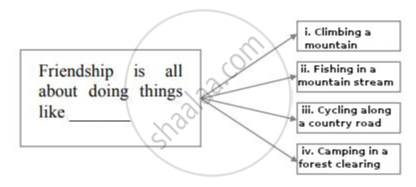
FRIENDSHIP IS ALL ABOUT DOING THINGS TOGETHER. IT MAY BE Climbing a mountain, fishing in a mountain stream, cycling along a country road, camping in a forest clearing or simply traveling together and sharing the experiences that a new place can bring.
On at least two of these counts, Sudhir qualified as a friend, albeit a troublesome one, given to involving me in his adolescent escapades.
I met him in Dehra soon after my return from England. He turned up at my room, saying he’d heard I was a writer and did I have any comics to lend him?
“I don’t write comics”, I said; but there were some comics lying around, leftover from my own boyhood collection. So I gave these to the lanky youth who stood smiling in the doorway, and he thanked me and said he’d bring them back. From my window, I saw him cycling off in the general direction of Dalanwala.
He turned up again a few days later and dumped a large pile of new-looking comics on my desk. “Here are all the latest”, he announced. “You can keep them for me. I’m not allowed to read comics at home”.
A2. Complete the web chart with the information from the passage:

A3. Find out four compound words from the passage.
A4. Do as directed:
i. I am not allowed to read comics at home.
(Pick out the infinitive)
ii. From my window, I saw him cycling.
(Use ‘when’ and rewrite the sentence)
A5. According to you, what are the qualities of a good friend?
Advertisements
Solution
A1
i.False
ii.True
iii.True
iv.False
A2
A3
Together, Friendship, Doorway, Country.
A4
i. not allowed to read
ii. When I saw him cycling from my window
A5
Good friends will tell you the truth always. Even if it may displease you, she/ he will tell you the truth. An honest friend is a great asset in your life. A good friend is one on whom you can rely for help anytime. A friend who breaks trust will lose credibility Friendship will not survive widout trust. We should keep the confidentiality of what our friends share with us. Never degrade your friends in front of others.
APPEARS IN
RELATED QUESTIONS
He holds him with his skinny hand,
“There was a ship,” quoth he.
i. Who does ‘He’ refer to in the above extract?
ii. What do we know about the speaker’s feelings?
iii. Why is his hand called ‘skinny’?
Read the passage given below and answer the questions that follow:
The most alarming of man’s assaults upon the environment is the contamination of air, earth, rivers, and sea with lethal materials. This pollution is for the most part irrevocable; the chain of evil it initiates is for the most part irreversible. In this contamination of the environment, chemicals are the sinister partners of radiation in changing the very nature of the world; radiation released through nuclear explosions into the air, comes to the earth in rain, lodges into the soil, enters the grass or corn, or wheat grown there and reaches the bones of a human being, there to remain until his death. Similarly, chemicals sprayed on crops lie long in soil, entering living organisms, passing from one to another in a chain of poisoning and death. Or they pass by underground streams until they emerge and combine into new forms that kill vegetation, sicken cattle, and harm those who drink from once pure wells.
It took hundreds of millions of years to produce the life that now inhabits the earth and reached a stage of adjustment and balance with its surroundings. The environment contained elements that were hostile as well as supporting. Even within the light of the sun, there were short wave radiations with power to injure. Given time, life has adjusted and a balance reached. For time is the essential ingredient, but in the modern world is no time.
The rapidity of change and the speed with which new situations are created follow the heedless pace of man rather than the deliberate pace of nature. Radiation is no longer the bombardment of cosmic rays; it is now the unnatural creation of man’s tampering with the atom. The chemicals to which life is asked to make adjustments are no longer merely calcium and silica and copper and all the rest of the minerals washed out of the rocks and carried in the rivers to the sea; they are the synthetic creations of man’s inventive mind, brewed in his laboratories, and having no counterparts in nature.
(a) On the basis of your understanding of the above passage make notes on it using headings and sub-headings. Use recognizable abbreviations (wherever necessary-minimum four) and a format you consider suitable. Also supply a title to it.
(b) Write a summary of the passage in about 80 words
Read the following extract and answer the questions given below :
Early risers clearly have the edge in life. By the time most of us wake up, they've been through their morning rituals, enjoyed their walk, had their tea and read the daily news. They're also likely to have made long-distance calls before dawn to those similarly inclined. Thus, by the time the sun warms up they're likely to have discussed all varieties of 'men, matters, and affairs' with a dozen people.
The upshot of these varying tendencies is that such extreme contrasts often exist in the same household. Weeks pass before the younger lot (typically late risers) and the older lot (normally early birds) come face to face. It's almost as if they live in different time zones and different countries.
All over the country, things are likely to be pretty much the same in this respect, one would think. If the man of the house, any house, decides to take a day off from work, he'd probably find his son emerging from his room at about I0 a.m. and that too in a 'rubbing-eyes' mode. After fooling around for a while the lad would probably dash off to college in a rush whilst simultaneously zipping up his jeans and sending text messages on his phone. His father would undoubtedly be left shaking his head and burying himself deeper into his newspaper.
(1) What is the extract about?
(2) How do the early risers get a headstart in life?
(3) What kind of lifestyle of the young son is reflected in the extract?
(4) According to you, why do the youngsters rise up late?
(5) Rewrite the following sentences in the ways instructed:
(i) He goes for his morning walk at 1 p.m.
(Rewrite it in the Present Perfect Continuous Tense.)
(ii) They live in different time zones.
(Make it a complex sentence.)
(iii) The man decides to take a day off from work.
(Rewrite it using the noun form of the underlined word.)
(6) Find out the words from the extract which mean:
(i) have a slight advantage over
(ii) coming out
Read the extract and do the activities that follow :
‘Your father was my enemy,’ said Frederick. ‘I would have been better pleased by your brave deed if you had told me of another father?’
‘I am proud to be Sir Rowland's son,’ answered Orlando angrily,’ and I would not change my place to be the heir of this dukedom.’
The Duke and his lords went away, leaving Orlando alone with Rosalind and Celia. Celia was angry with her father for speaking so unkindly to Orlando. ‘Would I have done this in my father’s place?’ she said to Rosalind.
‘My father loved Sir Rowland as much as his own soul,’ Rosalind said to Celia, ‘and all the world agreed with him. If I had known that his young man was Sir Rowland’s son I should have begged him with tears not to take so great a risk.’
‘Let us go and speak to Orlando,’ said gentle Celia. ‘I am ashamed of my father’s rude and angry words.’
The two girls went up to Orilando and praised him for his bravery. Rosalind took a gold chain from her neck and gave it to him. ‘I would like to give you more’, she said, ‘but I am not rich.’ Then she and Celia went away.
Orlando, however, could not forget them. He had already fallen in love with the fair Rosalind, but he could not stay at the Duke’s palace. His friends warned him that Frederick was angry and jealous of him. They told Orlando to leave the dukedom, because the Duke meant to do him harm.
A1. Match -
Match the characters and their attributes:
| A | B | ||
| i. | Celia | a. | fair |
| ii. | Orlando | b. | rude and unkind |
| iii. | Frederick | c. | gentle |
| iv. | Rosalind | d. | brave |
A2. Write an imaginary paragraph:
Write an imaginary paragraph in about 50 words in continuation with the given extract.
Read the extract and do the activities that follow :
When Rosalind heard about Orlando's wound and saw the handkerchief stained with his blood, she also fainted; and later she told Oliver that she was really Rosalind, and loved Orlando dearly. Oliver had already fallen in love with gentle Celia, and he persuaded the two girls to accompany him to Duke Senior's court. Rosalind, however, wanted to play one more trick as Ganymede, so she made Oliver promise not to tell anyone that the young shepherd boy and his sister Aliena were really Rosalind and Celia.
And so Aliena and Ganymede were introduced to the old Duke, and he did not recognize his daughter, although he remarked on Ganymede's likeness to Rosalind.
Then the "shepherd boy" told Orlando and the Duke that he could find Rosalind and would bring her to them, making the Duke promise that he would allow his daughter to marry Orlando. she and Celia ran quickly to the shepherd's cottage, changed into their own clothes and removed the brown stains from their faces. Then they returned to the Duke, where they were welcomed with great rejoicing.
'To you, I give myself, for I am yours,' Rosalind said to the Duke, her father. Then she turned to Orlando and said: 'To you, I give myself, for I am yours.'
Rosalind and Orlando were married at once in the forest and on the same day Oliver who was no longer selfish and wicked, married Celia. Just as they were going to be married, a messenger came to ask Duke Senior to go back to his dukedom. Celia's father, Duke Frederick, had mended his wicked ways and asked his brother to return.
A1. True/False :
Choose the true statements from those given below and write them down :
(i) Rosalind played the role of a shepherd boy Ganymede.
(ii) Senior Duke recognised his daughter, Celia.
(iii) Oliver married Rosalind.
(iv) Duke Frederick had mended his wicked ways.
A2. Convert into a dialogue :
Convert the above extract into a dialogue form.
Read the passage given below :
Globalization
Globalization is the way to open businesses, improve technological growth, economy, etc, at the international level for all countries. It is the way in which manufacturers and producers of the products or goods sell their products globally without any restriction. It provides huge profits to the businessmen as they get 1ow cost labor in poor countries easily. It provides a big opportunity for companies to„ deal with the worldwide market.
Globalization helps to consider the whole world 'as a single market. Traders are extending their areas of business by treating the world as a global village. Earlier till the 1990s, there was a restriction on importing certain products that were already manufactured in India like agricultural products, engineering goods, food items, and toiletries. However, during the 1990s there was pressure from. the rich countries on the poor and developing countries to allow them to spread their businesses by opening their markets. In India, the globalization and liberalization process was started in 1991.
After many years, globalization brought about a major revolution in the Indian market when multinational brands came to India and started delivering a wide range of quality products at cheap prices. Prices of good quality products came down because of the cutthroat competition in the market.
Globalization and liberalization of the businesses in India have flooded the market with quality foreign products but have affected the local Indian industries adversely to a great extent resulting in job loss to poor and uneducated workers. Globalization has been a bonanza for the consumers, however, a loss to the small-scale Indian producers.
Globalization has had some very positive effects on the Indian consumer in all sectors of society. It has affected the Indian students and education sector to a great extent by making study books and a lot of information available over the internet. The collaboration of foreign universities with Indian universities has brought about a huge change in the field of education.
Globalization of trade in the agricultural sector has brought varieties of quality seeds that have disease resistati8e; property. However, it is not good for the poor Indian farmers because the seeds and agricultural technologies are costly.
It has brought about a huge revolution in the employment sector by the spread of businesses like cottage, handloom, carpet, artisan carving, ceramic, jewelry, and glassware, etc
(a) What is globalization?
(b) Write any two advantages of globalization.
(c) What was the pressure from the rich countries in the 1990s?
(d) What is the effect of multinational brands entering the Indian market?
(e) How are the prices of quality products affected due to globalization?
(f) How have foreign products affected the local industry adversely?
(g) What has been the impact of globalization on Indian students?
(h) Why has globalization had a negative effect on the poor Indian farmer?
(i) How has the cottage industry benefited from globalization?
A. Read the following passage and do the given activities:-
A1. Answer in one word or two:- (02)
- The Queen of the spices.
- The areas of cultivation of the first type of cardamom.
- Anyone area of cultivation of the second type of cardamom
- The small variety of cardamom is known for-
Cardamom, the Queen of all spices, has a history as old as the human race. It is the dried fruit of a herbaceous perennial plant. Warm humid climate, loamy soil rich in organic matter, distributed rainfall and special cultivation and processing methods all combine to make Indian cardamom truly unique in aroma, flavour, size and it has a parrot green colour.
Two types of cardamom are produced in India. The first type is the large one, which has not much significance as it is not traded in the international market. It is cultivated in the North-eastern area of the country. The second type is produced in the Southern states and these are traded in the international market. These are mainly cultivated in Kerala, Tamil Nadu, and Karnataka. As per the international market rules, only 7 mm quality was previously traded in exchanges. But later, it relaxed its norms, and now 6 mm quality is also traded in the exchanges. Special to Indian taste buds, cardamom is not only unique to our land but also to our senses. The addition of this fragrant spice can add layers of taste to your tea, food, and overall dining experience.
The small variety is known for its exotic quality throughout the world. Traditional auction markets also exist for trading in small cardamom in the country.
A2. Provide information: Indian cardamom is said to be unique in aroma, flavor, size, and colour due to -- (02)
- ______
- ______
- ______
- ______
A3. Write the synonyms for the following from the passage :- (02)
- unusual
- pleasant smell
- importance
- holding moisture
A4. Do as directed:- (02)
- The first type is the large one, which has not much significance.
(Identify the subordinate clause) - Cardamom is not only unique to our land but also to our senses.
(Rewrite the sentence using ‘as well as’)
A5. Indian food is incomplete without spices. State your view. (02)
B. Write a short summary of the passage given in above and suggest a suitable title. (05)
Read the extract and complete the activities given below :
Luxurious houses on the edge of a big city which one promoter sold with the tagline ‘‘Where Nature peeps through every window.’’ All the advantages of a modern lifestyle but with the added bonus of fresh air. But nature isn’t greenery alone; it also includes wild animals.
While the view from the picture windows was easy on the eye, occasionally, it made them gulp with nervousness. At dusk, wild cats leaped out of the adjoining forest on to the top of the peripheral walls and strolled nonchalantly. Sometimes, they lounged on ledges with their long tails swinging freely, oblivious of the many worried human eyes pinned on them. Their cold yellow aggressive eyes turned black as their pupils dilated with failing light.
Some Mumbaikars paid a lot of money to see leopards on safari in Africa. But to watch them from one’s own home was disconcerting. These predators were out of line, stepping off nature into the city. Why did the leopards not stay within the 100-square kilometre Sanjay Gandhi National Park? Perhaps, the leopards thought that if people could venture into nature to jog, walk and picnic, why couldn’t they hang around apartment blocks? If people could enjoy nature, couldn’t nature savour humanity’s offerings?
Capturing leopards is extraordinarily simple. These curious cats seem incapable of resisting a free meal, walking into baited traps without hesitation. The reason the felines are attracted to their residential community is prey : stray dogs that live on rubbish heaps. Taking care of the food source is the best course of action, the volunteers said.
A1. Rewrite the following sentences as per their occurrence in the extract :
- Instead of capturing leopards we can take care of their food.
- Leopards leave their habitat and enter the human habitat.
- Modern lifestyle and nature both attract the dwellers.
- Leopards can enjoy human surroundings by leaving nature.
A2. Complete the following sentences :
- Nature is a combination of ______ and ______
- The best of both the worlds include ______ and ______
- The wild animals are out of line as ______
- The wild cats are attracted towards residential areas because ______
A3. Find out the words for leopards used in the extract :
- ____________
- ____________
- ____________
- ____________
A4. ‘‘If people could venture into nature to jog, walk, and picnic, why couldn’t the wild animals hang around apartment blocks?’’ Express your opinion.
A5. Rewrite the following sentences in the ways instructed :
- Taking care of the food source is the best course of action.
(Use infinitive form of the underlined word and rewrite.) -
Nature isn’t greenery alone; it also includes wild animals.
(Rewrite it by using ‘not only ... but also’.)
A6. Find a word for each of the following expressions from the extract :
- Enjoy the taste of something
- Embarrassing and confusing to watch
- Not conscious or aware of something or someone
- Relaxed and in an unworried manner
Read the passage given below.
| 5 | Changing food preferences have brought about rapid changes in the structure of the Indian diet. The rapid proliferation of multinational fast food companies and the influence of Western culture have replaced traditional home-cooked meals with ready-to-eat, processed foods thus increasing the risk of chronic diseases in urban Indians. Therefore, nurturing healthy eating habits among Indians from an early age would help to reduce health risks. |
| 10 | To date, little is known about the quality and quantity of foods and beverages consumed by urban Indian adolescents. This lack of evidence is a significant barrier to the development of effective nutrition promotion and disease prevention measures. |
|
15
20
|
Therefore, a self-administered, semi-quantitative, 59-item meal-based food frequency questionnaire (FFQ) was developed to assess the dietary intake of adolescents. A total of 1026 students (aged 14-16 years) attending private, English-speaking schools in Kolkata completed the survey. A sample percentage of the food consumption pattern is displayed.
The survey results report poor food consumption patterns and highlight the need to design healthy eating initiatives. Interestingly, while there were no gender differences in the consumption of legumes and fried snacks, the survey found more females consumed cereals, vegetables and fruits than their male counterparts. |
| 25 | In conclusion, the report suggested that schools ought to incorporate food literacy concepts into their curriculum as they have the potential of increasing the fruit and vegetable intake of teenagers. Additionally, healthy school canteen policies with improved availability, accessibility, variety and affordability of healthy food choices would support the consumption of nutritious food in students. |

Based on your understanding of the passage, answer the questions given below.
- What does the researcher mean by ‘changing food preferences'?
- Why was this survey on the food consumption of adolescents undertaken?
- With reference to the above figure, write one conclusion about students' consumption of energy-dense drinks.
- What can be concluded from the ‘no intake’ data of fruit consumption versus energy-dense snacks, with reference to the above figure?
- There were gender differences observed in the consumption of healthy foods, according to the survey. Substantiate.
- Why is ‘affordability’ recommended as a significant feature of a school canteen policy?
- Identify a word from lines 9-18 indicating that the questionnaire was specifically designed to be completed by a respondent without the intervention of the researcher collecting the data.
Read the following passage and do the activities:
A1. Complete the following sentences from the passage: (2)
- Kalam earned a degree in ______ engineering.
- DRDO stands for ______.
- Kalam was ______ of the SLV-III, the first satellite launch vehicle.
- Kalam served as lecturer at ______.
|
A.P.J. Abdul Kalam, in full Avul Pakir Jainulabdeen Abdul Kalam, (born October 15, 1931, Rameshwaram, India - died July 27, 2015, Shillong), Indian scientist who played a leading role in the development of India's missile and nuclear weapons programmes. He was President of India from 2002 to 2007. Kalam earned a degree in aeronautical engineering from the Madras Institute of Technology and in 1958 joined the Defence Research and Development Organisation (DRDO). In 1969, he moved to the Indian Space Research Organisation, where he was project director of the SLV-III, the first satellite launch vehicle that was both designed and produced in India. Rejoining DRDO in 1982, Kalam planned the programme that produced a number of successful missiles, which helped earn him the nickname “Missile Man”. Among those successes was Agni, India's first intermediate-range ballistic missile, which incorporated aspects of the SLVIII and was launched in 1989. Kalam remained committed using science and technology to transform India into a developed country and served as lecturer at several universities. Kalam wrote several books, including an autobiography, Wings of Fire (1999). He received the Padma Bhushan (1981), Padma Vibhushan (1990), Indira Gandhi award for National Integration (1997) and the India's highest civilian award Bharat Ratna (1997). |
A2. Complete the web diagram: (2)

A3. Fill in the blanks by using the suitable phrases/words from the bracket: (2)
[moved to, served as, launched, autobiography]
- Mr. Gunaji has ______ a Principal in this college.
- “The Story of My Experiments with Truth” is the ______ of Mahatma Gandhi.
- My teacher ______ to England for further studies.
- ISRO successfully ______ Chandrayaan-3 mission.
A4. Do as directed: (2)
- Kalam wrote several books. (Frame a Wh-type question to get the underlined part as answer)
- Kalam earned a degree in aeronautical engineering. (Begin the sentence with “A degree in…….)
A5. Who is your role model? Write few lines about him/her. (2)
