Advertisements
Advertisements
प्रश्न
Read the following passage and do the given activities.
A1. State whether the following statements are true or false:
i. The narrator writes comics.
ii. Sudhir qualified as a friend.
iii. The narrator met Sudhir in Dehra.
iv. Friendship is all about disintegration.
FRIENDSHIP IS ALL ABOUT DOING THINGS TOGETHER. IT MAY BE Climbing a mountain, fishing in a mountain stream, cycling along a country road, camping in a forest clearing or simply traveling together and sharing the experiences that a new place can bring.
On at least two of these counts, Sudhir qualified as a friend, albeit a troublesome one, given to involving me in his adolescent escapades.
I met him in Dehra soon after my return from England. He turned up at my room, saying he’d heard I was a writer and did I have any comics to lend him?
“I don’t write comics”, I said; but there were some comics lying around, leftover from my own boyhood collection. So I gave these to the lanky youth who stood smiling in the doorway, and he thanked me and said he’d bring them back. From my window, I saw him cycling off in the general direction of Dalanwala.
He turned up again a few days later and dumped a large pile of new-looking comics on my desk. “Here are all the latest”, he announced. “You can keep them for me. I’m not allowed to read comics at home”.
A2. Complete the web chart with the information from the passage:

A3. Find out four compound words from the passage.
A4. Do as directed:
i. I am not allowed to read comics at home.
(Pick out the infinitive)
ii. From my window, I saw him cycling.
(Use ‘when’ and rewrite the sentence)
A5. According to you, what are the qualities of a good friend?
Advertisements
उत्तर
A1
i.False
ii.True
iii.True
iv.False
A2
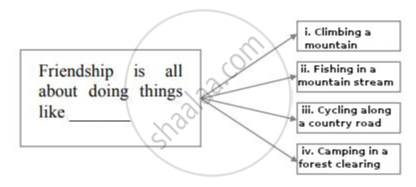
A3
Together, Friendship, Doorway, Country.
A4
i. not allowed to read
ii. When I saw him cycling from my window
A5
Good friends will tell you the truth always. Even if it may displease you, she/ he will tell you the truth. An honest friend is a great asset in your life. A good friend is one on whom you can rely for help anytime. A friend who breaks trust will lose credibility Friendship will not survive widout trust. We should keep the confidentiality of what our friends share with us. Never degrade your friends in front of others.
APPEARS IN
संबंधित प्रश्न
B1. Choose
Choose the correct alternatives and complete the sentences (2)
(1) The narrator is :
(a) an astronaut
(b) an engineer studying in BITS Pilani
(c) in the team of astronauts.
(2) Armstrong said, 'That's one small step for a man, one giant leap for mankind which means:
(a) one step on the moon means, many steps on the earth.
(b) he felt like a giant on the moon.
(c) one moon mission had opened up many avenues in science and technology for mankind.
It was late evening of July 20. 1969, when we turned up the hostel radio. I was an engineering student at BITS, Pilani. I still remember the feverish excitement that gripped us from July 16 when Apollo 11. the US space rocket, took off from Cape Kennedy, Florida. Neil Armstrong and his team of astronauts, Edwin "Buzz" Aldrin and Michael Collins, were to land on moon, for the first time in human history. We listened 'with rapt attention when Armstrong declared: "That's one small step for a man, one giant leap for mankind."
His death on Saturday, August 25, is a moment to salute the romance of space science that Apollo 11 unleashed. It has changed forever the way we look at our planet Earth and its satellite, the moon.
Standing on powdery moondust, Armstrong put up his thumb, shut one eye and found his thumb blotting out the Earth. "It suddenly struck me that that tiny pea, pretty and blue, was the Earth” he said later. "I felt very, very small." But behind that humbling realisation stood a giant truth:
The effort to explore the universe united mankind in technology and knowledge. Each moon mission, about 110 till date, provided more confidence to take on bolder projects.
B2. Complete (2)
(1) Armstrong describes the earth as ……………
(2) The effort to explore the universe has ………………
(3) Apollo 11 unleashed and changed forever ………………
(4) The author came to know about Apollo 11 mission when he …………..
B3. Solve
Solve the crossword with the clues given below. Refer to the passage for your answers: (2)

Down : (1) The area beyond the earth's atmosphere .
(2) The name of the spacecraft that Armstrong travelled.
Across : (3) A person trained to travel in space.
(4) Y A natural satellite of the earth.
B4. Begin the sentence
(i) With-For the first time .......and rewrite [1]
Neil Armstrong, Edwin Aldrin and Michael Collins were, to land on the moon for the first time.
(ii) Insert 'that' appropriately and rewrite. [1]
Armstrong found his thumb blotting out the Earth.
B5. Personal Response
Would you like to be an astronaut? Give reasons.
1. Read the passage given below :
1. Maharana Pratap ruled over Mewar only for 25 years. However, he accomplished so much grandeur during his reign that his glory surpassed the boundaries of countries and time turning him into an immortal personality. He along with his kingdom became a synonym for valour, sacrifice and patriotism. Mewar had been a leading Rajput kingdom even before Maharana Pratap occupied the throne. Kings of Mewar, with the cooperation of their nobles and subjects, had established such traditions in the kingdom, as augmented their magnificence despite the hurdles of having a smaller area under their command and less population. There did come a few thorny occasions when the flag of the kingdom seemed sliding down. Their flag once again heaved high in the sky thanks to the gallantry and brilliance of the people of Mewar.
On the basis of your understanding of the above passage answer each of the questions given below with the help of options that follow :
(ii) he added a lot of grandeur to Mewar.
(iii) of his valour, sacrifice and patriotism.
(iv) both (ii) and (iii)
(b) Difficulties in the way of Mewar were :
(ii) ancient traditions of the kingdom.
(iii) its small area and small population.
(iv) the poverty of the subjects.
(c) During thorny occasions :
(ii) the flag of Mewar was hoisted high.
(iii) the people of Mewar showed gallantry.
(iv) most of the rulers heaved a sigh of relief.
(d) Mewar was lucky because :
(ii) most of its people were competent.
(iii) most of its rulers were competent.
(iv) only a few of its people were incompetent.
Answer the following questions briefly:
(e) Who is the earliest king of Mewar mentioned in the passage?
(f) What was Rana Kumbha's contribution to the glory of Mewar?
(g) What does the writer find worth admiration in the people of Mewar?
(h) How could art and literature flourish in Mewar?
(i) How did the rulers show that they cared for their subjects?
(j) What does the erection of Vijaya Stambha and Kirti Stambha in the same fort signify ?
(k) Find words from the passage which mean the same as each of the following:
(ii) evidence (para 4)
(A) Read the fo llowing extract and answer the questions given below :
Kalpana Chawla was extremely proud other birth-place and made every effort to bring it into the lime-light. During space flights she vit, (mid prondk point it out to her Fellow-astronauts. Once, during the second Hight she remembered her closest friend, Dais Chawla, who died in a road accident. In fact, despite her celebrity status, she took pains to track down her former teachers, classmates and friends in India and showed a keen desire to stay in touch with them.
Her affectionate and humble nature won the hearts of all who came in contact with her. Although Kalpana had a strong desire to go to Mars, fly over its canyons she was equally concerned about the well-being of the earth. She always urged young people to listen to the sounds of nature and take care of our fragile planet. During, her space trips, she took many breatlitakilig photographs of the earth for various terrestrial studies later on the ground. When she was in space, she always felt a sense of connection with everyone on the earth.
It was Kalpana's cherished desire to visit India again. But that was not to be. A few months after her tragic death, Harrison visited India. He went to her school and college, met her family, teachers and friends and scattered her ashes over the Himalayas.
(1) What is the extract about? (1)
(2) How was Kalpana connected with India and Indians? (2)
(3) How was Kalpana concerned about the well-being of the earth? (2)
(4) What would you like to do For India? (2)
(5) Rewrite the following sentences in the ways instructed:
(i) She took many breathtaking photographs of the earth.
(Rewrite it using the Present Perfect Continuous tense.) (1)
(ii) He scattered her ashes over the Himalayas.
(Rewrite it beginning with 'Her ashes ...... ')(1)
(iii) Kalpana was extremely proud of her birth-place and made every effort to bring it into limelight.
(Rewrite it using 'not only ...... but also'.)(1)
( 6) Give the antonyms from the extract for -
(i) collected (1/2)
(ii) forgot (1/2)
(B) Summary :
Write a summary of the above extract with the help of the following
points and suggest a suitable title :
Points : Kalpana's affection towards India and Indians her humble - nature her love for the earth Harrison's visit to India. (4)
Read the following extract and answer the questions given below:
Researchers recently announced the earth could actually withstand up to 200,000 times the current population. They arrived at this figure by calculating the amount of heat a human body emits, and only at 1·3 million billion would the earth be too hot to be habitable. And though it would feel like being ina can of sardines if that figure were ever reached, the earth is capable of comfortably sustaining a population several times the current 6·5 billion.
In fact, fertility is actually on the decline worldwide. Though the population has grown, the rate of growth has fallen sharply. Twenty years ago, the UN projected that the population would reach 11·I6 billion in 2050, today they say it will reach only 9·3 billion. Moreover, the human population will stabilize at about 11·5 billion. While this figure is almost twice the current one, it is hardly claustrophobic.
True, the demands on resources are heavy even now, but this is more due to the manner in which these resources are being used. In fact, figures show that a bigger population does not amount to greater consumption. Over 20% of the world's people in the highest-income countries account for 86% of total private consumption expenditure - the poorest 20% a tiny 1·3%. With just 5% of the world's population, the US consumes about 40% of the world's resources. Would you say the US is overpopulated?
Concerns on the scarcity of food are equally baseless. In fact, global food production has actually kept up with population growth. If people starve in many countries it is not because food is becoming scarce; it is because those people cannot afford it.
Questions:
(1) What conclusions did the researchers arrive at?
(2) How does the writer explain that fertility is on the decline?
(3) What does the extract predict about the fear of scarcity of food?
(4) How will the population become a gift in the global market scene?
(5) Rewrite the following sentences in the ways instructed:
(i) The earth could withstand up to 200,000 times the current population.
(Rewrite the sentence using the modal auxiliary showing 'certainty'.)
(ii) The earth would be too hot to be habitable.
(Remove 'too' and rewrite the sentence.)
(iii) These resources are being used.
(Rewrite the sentence beginning with, 'We ........... .')
(6) Write the antonyms of:
(i) habitable
(ii) stabilize
Read the following extract and answer the questions given
below:
Today, at 29, \.1.ichael has discovered the power of another good idea that has helped him rise in just a few years from teen to tycoon.He has become the fourth largest manufacturerof personal computers in America and the youngest man ever to head Fortune 500 Corporation.
Growing up in Houston, Texas. Michael and his two brothers were imbued by their parents. Alexander and Lorraine - he anorthodontist, she a stockbroker- with the desire to learn and the drive to work hard. Even so, stories about the middle boy began to be told early.
Like the time a saleswoman came asking to speak to "Mr. Michael Dell" about his getting a high school equivalency diploma. Moments later. eight-year-old Michael was explaining that he thought it might be a good idea to get high school out of the way.
A few years later Michael had another good idea, to trade stamps by advertising in stamp magazines. With the $2000 he made, he bought his first personal computer. Then he took it apart to figure out how it worked.
In high school Michael had a job selling newspaper subscriptions. Newlyweds, he figured, were the best prospects, so he hired friends to copy rhe names and addresses of recent recipients of marriage licences. These he entered into his computer, then sent a personalized letter offering each couple a free two-week subscription.
This time Dell made $ 18,000 and bought an expensive BMW car. The car salesman was flabbergasted when the 17-ycar-oJd paid cash.
(I) What details does the writer give about Dell's family in the
extract? (1)
(2) How did Dell succeed in earning S2QOQ? (2)
(3) Why was the car salesman flabbergasted? (2)
(41 What do you think you can learn from Dell's story? (2)
{5) Rewrite the following sentences in the ways instmcted:
{i) "He has discovered the power of another good idea."
(Rewrite it beginning with 'The power of another good
idea ...... ... .'.) (1)
.(if) "If you think you have a good idea, try it. "
(Use 'Unless' .) (1)
(iii) '"This time Dell made $18,000 and bought an expensive
BMW car." (1)
(Make it a simple sentence.)
CM Find out the words from the extract which mean :
(i) filled with a quality. (1/2)
(ii) understand. (1/2)
Read the first activity, read the extract and then do all the activities:
A1. Correct the following statements with the help of the facts from the extract :
(1) Everybody in every part of the globe would have access to administration and social care services because he or she would not be able to afford them.
(2) We would avoid boom and bust cycles and be able to surmount natural disaster with great ease.
|
To me, a world without poverty means that every person would have the ability to take care of his or her own basic life needs. In such a world, nobody would die of hunger or suffer from malnutrition. This is a goal world leaders have been calling for decades, but have never set out any way of achieving it. Today 40,000 children die each day around the world from hunger-related diseases. In a poverty-free world, no children would die of such causes. Everybody in every part of the globe would have access to education and health-care services because he or she would be able to afford them. Unlike today, the state would not be required to provide free or subsidized health-care or schooling. All state organizations created to provide free or subsidized services for the poor would no longer be required and welfare agencies, or the national welfare department. No free schools, no free hospital care, no begging in the streets. State-run safety-net programmers would have no rationale for existence because no one would live on charity anymore. State-run social security programmers, income-support programmes would be unnecessary. Social structures in a poverty-free world would, of course, be quite different from those that exist in a poverty-ridden world. But nobody would be at the mercy of anyone else, and that is what would make all the difference between a world without poverty and one riddled with it. Finally, a poverty-free world would be economically much Stronger and far more stable than the world today. one-fifth of the world's inhabitants who today live a life of extreme poverty would become income earners and income spenders. They would generate extra demand in the market to make the world economy grow. They would bring their creativity and innovations into the market-place to increase the world's productive capacity. Since nobody would ever become poor, except on a temporary and limited basis, the economy would probably not go through extreme swings. We would avoid boom-and-bust cycles and be able to surmount man-made disasters with greater ease. |
A2.
Complete the following statement :
The situation in the world without poverty would be different, because -
(1) the state need not ___________
(2) nobody __________
A3. Find out :
Find and write in the blank boxes :
One-fifth of the world's inhabitants today live a life of extreme poverty. How would they economically Stand in a poverty-free world?
| They would be income earners and income spenders |
A4. Vocabulary :
Find out the words from the extract that mean the following :
(1) calamity (2) overcome
(3) bringing new ideas (4) financially
A5. Personal Response :
Suggest at least four solutions to overcome the problems of increasing poverty.
A6. Grammar :
Rewrite the following sentences in the ways instructed :
(1) Nobody would die of hunger or suffer from malnutrition.
(Remove the negative and rewrite.)
(2) Everybody in every part of the globe would have accessed education and health-care services.
(Rewrite the above sentences beginning with 'Education'.)
Read the extract and do the activities that follow :
Two weeks later, I wrote: "Dear Mum, thanks for the socks. But I wish you had sent me a food parcel instead. How about some guava cheese? And some mango pickle. They don't give us pickle in school. Headmaster's wife says it heats the blood."
"About that skeleton. If a dead body was hidden in that cupboard after 1930- must have been, if the newspapers of that year were under the skeleton - it must have been someone who disappeared around that time or a little later. Must have been before Tirloki joined the hotel, or he'd remember. What about the registers- would they give us a clue?"
Received a parcel containing guava cheese, strawberry jam, and mango pickle. HEadmaster confiscated the pickle. Maybe he needed it to heat his blood.
A note enclosed with parcel read: "Old hotel registers missing. Must have been thrown out. Or perhaps Mr. Green took them away when he left. Tirloki says a German spy stayed in the hotel just before the War broke out. The spy used to visit the Gurkha Lines and the armaments factory. He was passing information on to a dentist who visited Germany every year. When war broke out, the dentist was kept in a prisoner-of-war camp. The spy disappeared-some say to Tibet. Could the spy have been silenced and put away in the cupboard? But I keep forgetting it was a woman's skeleton. Tirloki says the spy was a man. But a clever spy may have been a woman dressed as a man. But a clever spy may have been a woman dressed as a man. what do you think? "
It was the football season, and I wasn't doing much thinking. Chasing a football in the monsoon mist and slush called for single-minded endurance, especially when we were being beaten 5-0 by Simla Youngs, a team of junior clerks from the government offices. Not the ideal training for a boy-detective. The winter holidays were still four months distant, and the case of the unidentified skeleton appeared to be resolving itself with a little help from my mother and her friends.
B1. Complete :
Complete the following sentences :
(1) The narrator's football team was beaten 5-0 by ___________ .
(2) Headmaster's wife says that ___________ .
(3) Things that the narrator received in the parcel are __________ .
(4) The German spy was passing information ___________ .
B2. Write a gist :
Write a gist of the extract in about 50 words.
Read the following passage and complete the activities:
|
Time is the most valuable resource available to every individual. Time is a resource to measure quantitatively but its nature is unclear. Time is a fleeting, limited, and intangible human resource which is always calculated and used accordingly. The time of the day is as shown on the clock or announced on the media like radio, television constantly guides us in carrying out daily activities, distribution of time for work, rest, entertainment and checking the progress during the day. |
A1. State whether the following statements are True or False. (02)
- Time is the most valueless resource.
- The importance of time management is self-evident.
- Allow the time to flow and pass away.
- Time’s nature is clear.
A2. What are the secrets of a good time manager? (02)
A3.
- Pick out two adverbs from the given passage.
- Write the root word for the following:
- utilization
- entertainment
A4. Do as Directed: (02)
- Rewrite the sentence using ‘Not only ……. But also’
For the achievement of goals, proper planning and utilization of time are important. - Do not allow the time to flow. (Make the sentence assertive)
A5. “Time once lost, is lost forever.” Justify (02)
Read the passage given below.
| 1 | Mountains have always been held in great awe by mankind. They have been a challenge to humans. Those brave among us have always wanted to conquer them. You see, the more incredible the mountains, the greater the thrill – a challenge to the bravery of the human race. Climbing mountains is an experience that is hard to put into words. You are in a beautiful environment and, when you reach the top, you feel incredible. But you also have to climb down, which is when most accidents happen – people are tired, it gets dark, it’s harder. So, mountain climbing is undoubtedly one of the most popular adventure sports along with being challenging and risky for the climber. |
| 2 | Without any perceived risk, there can’t be a feeling that any significant challenge has been surmounted. Fair, but we have to bear in mind that mountaineering is not a sport that can be embraced without preparation. The enthusiasts must develop in themselves the spirit of adventure, willingness to undertake hardships and risks, extraordinary powers of perseverance, endurance, and keenness of purpose before climbing a mountain. They should also know how to handle mountaineering equipment. Then comes the penance of the rigorous training. This could very well be the lifeline up there. It helps inculcate and hone survival instincts that allow the climber to negotiate perilous situations. There are numerous institutes in India and abroad that offer such training. |
| 3 | Mountain climbers are unanimous in agreeing that unpredictable weather is what they fear the most. There may be sunshine one moment and a snowstorm the other. At higher altitudes, snow is a regular feature and being decisive about setting up camps or proceeding further is crucial. The icy sheets after ice storms make walking treacherous, while the powdery snow makes a mountaineer sink deep into the snow. Up there, where the intention is to embrace Nature’s wonder, one realizes that it cannot be done without facing its formidable glory. A true mountaineer may challenge the mountain, yet is always respectful of the powerful forces of nature. |
| 4 | Summiting mountains carries its own health risks such as oxygen and altitude sickness problems, frost bites, swelling of hands and feet, fluid collection in brain or lungs and exhaustion. Yet, the gratification mountaineers feel from mastering something that is so frightening, urges them to undertake these endeavors. We may think that the mountaineers are fearless, experts say, “Not at all. It’s fear that keeps them so intrigued with such arduous journeys.” Impulse and brazenness can be deadly foes. In the words of the Indian mountaineer, Bachendri Pal, “The biggest risk ... is to not to take the risk at all. Remember that.” |
i. Why does the writer say that mountains inspire ‘awe’ in humans? (Paragraph 1) (1)
- They present us with opportunities for exciting sports.
- They evoke the wish in us, to master them.
- They inspire in us, deeds of valour.
- They represent peace and calm, to us.
ii. Select the option that corresponds to the following relation below: (1)
The more incredible the mountains - the greater the thrill (Paragraph 1)
- The higher the stamina - the lower the food intake
- The more you laugh - the lesser your illness
- The smaller the car - the bigger the advantage
- The heavier the luggage - the higher the penalty
iii. Select the option that displays what the writer projects, with reference to the following: (1)
So, mountain climbing is undoubtedly one of the most popular adventure sports (Paragraph 1)
- doubt
- caution
- conviction
- denial
iv. Complete the following with a phrase from paragraph 1. (1)
| Opinion | Reason |
| ______ | Best experienced rather than described |
v. The writer compares training to penance in the line - Then comes the penance of the rigorous training. (Paragraph 2) (1)
State 1 point of similarity between training and penance.
vi. Based on your reading of the text, list 2 reasons why the writer says that
“mountaineering is not a sport that can be embraced without preparation”. (Paragraph 2) (1)
- ____________
- ____________
vii. What connect does the writer draw out between unpredictable weather and setting up of camps? (Paragraph 3) (1)
viii. The writer says, “A true mountaineer may challenge the mountain, yet is always respectful to the powerful forces of nature.” (Paragraph 3) (1)
Select the reason the mountaineer is respectful to the forces of nature, up in the mountains.
- survival
- experience
- tradition
- directive
ix. justify the following: (1)
While mountain climbing, an impulsive mountaineer is either disaster-prone or as good as dead.
x. Evaluate the Inappropriate reason for the feeling of exhilaration on reaching a summit, that the mountain-climbers experience. (1)
- Achievement of a seemingly impossible feat
- Spectacular panoramic view
- Application of the inculcated survival instincts
- Opportunity to use sophisticated mountaineering equipment
Read the passage given below:
| (1) | When we think of the game of cricket, we come to the conclusion that it is primarily a game that depends on outstanding physical activities, good hand-eye coordination, speed, skill and strength. It provides entertainment and generates strong feelings of excitement. A good match of cricket or of any other game neither adds to the existing stock of human knowledge nor reveals any secret of existence. It does not carry any deep meaning but most people, particularly the lover of sports attach deep emotions and numerous meanings to it. Games are thought of as a metaphor for life. They are supposed to teach many lessons. In fact, more is said and written about a cricket match than about scientific findings or great philosophy. |
| (2) | This is because games, like a morality play, in which settings and rules are made by us, can easily make people test their fair and foul conduct, principles of reward and punishment, and emotions of joy and disappointment. They can make us experience the thrill of war without exposing us to its dangers. A man watching a cricket match on T.V. and munching popcorn is like a surrogate warrior. In fact, games provide us with a safe outlet for our aggressiveness. If games become aggressive, they lose the very purpose of providing entertainment and purging us of our aggressiveness. They can calm our impatience without creating any conflict. |
| (3) | Commentators, journalists, politicians and analysts can do a great favour to the competing teams by keeping the excitement within limits. The teams should play without being dominated by feelings of national honour and shame. Excellent performance of the players of both teams should be enjoyed and appreciated. Winning or losing in a game should not be taken seriously. A game is fun if it is played with true spirit of sportsmanship. |
Based on your understanding of the passage, answer the questions given below:
- Complete the sentence by choosing an appropriate option: (1)
Most people conclude that cricket is primarily a game because ______.- it is played as a match
- it requires two teams
- it includes physical activity
- it depends only on skill and strength.
- Comment on the writer's reference to 'that cricket does not reveal any secret of existence. (1)
- List two responses to which watching a game of cricket gives rise to. (1)
- Select the option that conveys the opposite of 'destroy' from words used in the passage. (1)
- reveals
- experience
- generate
- purging
- The writer would not agree with the given statements based on paragraph 2, EXCEPT (1)
- Rules of any game are made by people.
- Watching a cricket match makes the viewer believe that he is fighting a battle.
- It is necessary for a game to be aggressive in order to build excitement.
- A game can test people's sense of fair judgement.
- With reference to the passage, a spectator is compared to a 'surrogate warrior'. (1)
Choose the option that best describes this phrase:- a spectator who is paid to watch.
- a spectator who is in pain while watching the match.
- a spectator who enjoys the match as an armchair soldier.
- a spectator who makes judgments about reward and punishment.
- Why does the writer compare games to a morality play? (1)
- Complete the given sentence with an appropriate inference with respect to the following: (1)
The writer says that games can calm our impatience without creating any conflict by ______. - The writer advises the players that games should not become aggressive because ______. (1)
- Select the most suitable title for the above passage. (1)
- Excellent Performance by Cricketers
- The Benefits of Playing Cricket
- Cricket - The King of Games
- The True Spirit of Playing Games
