English
Maharashtra State BoardSSC (English Medium) 10th Standard

Sachin Ramesh Tendulkar who was born on 24th April 1973 in Mumbai is a former Indian International Cricketer and a former captain of the Indian National Team. - English (Second/Third Language)

Advertisements
Advertisements

Question

Read the following passage and do the activities:

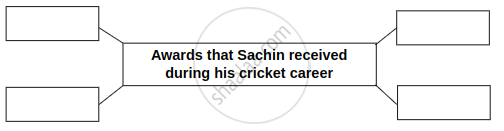
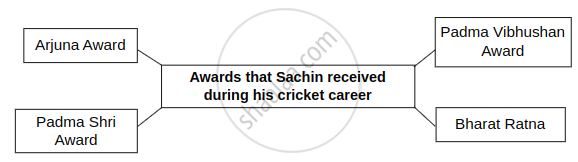
Sachin Ramesh Tendulkar who was born on 24th April 1973 in Mumbai is a former Indian International Cricketer and a former captain of the Indian National Team. He is regarded as one of the greatest batsmen of all time and is often referred as the ‘God of cricket’ by Indian Cricket followers. He made his debut on 15th November 1989 against Pakistan in ‘Karachi’ at the age of sixteen. He is the only player to have scored one hundred international centuries and only player to complete more than 30,000 runs in international cricket. He was trained under the able guidance of Ramakant Achrekar Sir. He received the Arjuna Award in 1994, Rajiv Gandhi Khel Ratna Award in 1997, Padma Shri and Padma Vibhushan Awards in 1999 and 2008 respectively, fourth and second highest civilian awards of India. He was also awarded the Bharat Ratna, highest civilian award of India in 2013. He is a devotee of the deity Ganesha.

A1. Complete the following sentences from the passage:  (2)

  1. Sachin was born on _____.
  2. Sachin is a devotee of the deity ______.
  3. He was trained under the able guidance of ______.
  4. He made debut on ______.

A2. Complete the web diagram:  (2)
A3. Match the ‘Synonyms’:  (2)

  ‘A’   ‘B’
i. debut a. previous
ii. received b. God
iii. former c. got
iv. deity d. first performance

A4. Do as directed:  (2)

  1. He made his debut. (Make ‘Simple Future Tense’.)
  2. He received the Arjuna Award. (Choose the correct Q-tag.)
    1. did he?
    2. didn’t he?
    3. doesn’t he?

A5. Do you like to play games? Why?  (2)

Comprehension
Advertisements

Solution

A1. 

  1. Sachin was born on 24th April 1973.
  2. Sachin is a devotee of the deity Ganesha.
  3. He was trained under the able guidance of Ramakant Achrekar Sir.
  4. He made debut on 15th November 1989.

A2. 
A3. 

  ‘A’   ‘B’
i. debut d. first performance
ii. received c. got
iii. former a. previous
iv. deity b. God

A4. 

  1. He will make his debut.
  2. didn’t he?

A5. Yes, I like to play games. Because playing sports increases physical strength. Sports can also serve as a form of stress relief and relaxation.

shaalaa.com
Unseen Passage Comprehension
  Is there an error in this question or solution?
2022-2023 (March) Official

RELATED QUESTIONS

Look at the balloons. Which are the qualities inculcated in the author by her teacher? Write them. (2)

Sister Monica, however, wasn't quite as lenient as that, and spent most of the time telling me about the importance of regularity and hard work. She made me realise that success is, like genius, 99 per cent perspiration and 1 per cent inspiration. It's a lesson that has stood me in good stead.
The teachers I'm most grateful to, though, are not those who have taught me the most, but those who have simply been friends to me, believed me and believed in me. Prominent among them is Sudha Ramasubramanium-Rambo, as we used to call her. I didn't know her too well. She taught me in college, and apart from being incredible in class unless one missed class, she also believed that I actualIy had a Problem when I developed an injury (which several doctors found difficult to diagnose). Despite my missing an exam-the HSC, of all exams- she was the only person who told me to concentrate on my health and assured me that I could take the exam off the top of my head any time I wanted to.
I'm not even certain she remembers it, but at the time, it felt like one of the only rays of hope in an extremely dark tunnel. Perhaps few teachers realize how far their influence extends or how much of a difference their actions and words can make. A number of my teachers have unfortunately taught me kindness and tolerance and patience by being precisely the opposite, and quite obviously, they aren't the people I like to think about. But many of my teachers have been extraordinary people, who have not only taught me in class but also helped mould me and my character in every other way. I only hope that I live up to what their endeavors were undoubtedly mean to create.

B2.Answer
(1) What kind of teachers are disliked by the author?                                                                (1)
(2) What was Sudha Ramasubramanium's advice to the author when she was going to miss her HSC exam. ?                                                                                                                                 (1)

B3. Match :
Match the words with their appropriate meanings :                                                                     (2)

‘A’ ‘B’
(i) Prominent (a) Treatment
(ii) Incredible (b) Natural
(iii) Diagnose (c) Unbelievable
(iv) Endeavours (d) Noticeable
  (e) Efforts
  (f) Identify a disease

B.4(i) ‘Wh question’
She made me realize that success is, like genius.                                                                  (1)
(Frame a ‘Wh’ question to get the underlined part as an answer)

(ii) She taught me in college.                                                                                                (1)
(Begin the sentence with ‘I’ and rewrite).

B5. Personal Response
Do you agree that a teacher should also be your good friend? Justify your answer.                    (2)


A1. Guess
Select the correct alternatives from the boxes : (2)

(1) The Olympic Games were originally held in honour of:
(a) The Priests (b) The Greeks
(c) The Spartans (d) Zeus

(2) The Olympics were held after every …………..
(a) Year (b) Four years
(c) Three years (d) Two years

(3) All came to know of Olympia from the:
(a) Olympics (b) Spartans
(c) Syracusans (d) Athenians

(4) Altis was the name of a :
(a) God (b) Race
(c) Festival (d) Enclosure

Olympia, the original site of Olympic Games in ancient Greece is situated in a quiet, beautiful valley. The old ruins are shaded by evergreen oaks, pines and poplars, as well as olive trees. Olympia was never a city but a sacred ground occupied by temples and dwellings for the priests. At the centre was the enclosure known as Altis, dedicated to Zeus, the god of gods. It was in honour of Zeus that the quadrennial festival and the games were held.

The fame of Olympia rests largely upon Olympic Games. They were a great national festival of the entire Greek race. During the week of the festival the Athenians, the Spartans, the Syracusans and other groups, all forgot their narrow identities. They regarded an Olympic victory as the highest honour. The simple reward of a twig of wild olive immortalized the victor and his family.
The Olympic Games were held regularly in peace and in war at an interval of four years for over a thousand years from 776 B.C. till 393 A.D. Originally, men who spoke Greek as their mother tongue were allowed to compete in the Olympic Games. No married women were allowed to be present. The athletic programme was varied by the presence of historians, orators and writers. After each event a herald announced the victor's name and handed him a palm. On the last day the successful competitors were each given a garland of wild olive.

A2. Select
Select the word each from the circle which mean the following:                                              (2)
(1) Occurring at the interval of four years
(2) Wreckage
(3) Take part in a game
(4) One who wins.

A3. Complete :
Complete the table and frame your sentence with anyone word : (2)

Noun Adjective Verb
  beautiful  

A4. (i) The old ruins are, shaded by evergreen oaks, pines and .poplars as well as olive trees.
(Insert not only ……. but also and rewrite).                                                                            (1)
(ii) No married women were allowed to be present. (Remove 'No' and rewrite the sentence without changing its meaning)                                                                                                         (1)

A5. Personal response
How are the winners in Olympics rewarded today?                                                                 (2)


AI. Who said to whom 
(i) "Is he going to live, sir?"
(ii) "______ the struggle is too hard at the end ______.”

The doctor said to himself, "If my word can save his life, he shall not die.
The will be damned." He called, "Gopal, listen." This was the first time he was going to do a piece of acting before a patient, simulate a feeling and conceal his Judgement. He stooped over the patient and said, with deliberate emphasis, "Don't worry about the will now. You are going to live. Your heart is absolutely sound."
A new glow suffused the patient's face as he heard it. Be asked in a tone of relief,
"Do you say so? If it comes from your lips it must be true............ . "
The doctor said, "Quite right. You are improving ever second. Sleep in peace. You must not exert yourself on any account. You must sleep very soundly.
I will see you in the morning." The patient looked at him gratefully for a moment and then closed his eyes. The doctor picked up his bag and went out, shutting the door softly behind him.
On his way home he stopped for a moment at his hospital, called out his assistant and said, "That Lawley Extension case. You might expect the collapse any second now. Go there with a tube of .....................................'in hand, and give it in case the struggle is too hard at the end. Hurry up.”
Next morning he was back at Lawley Extension at ten. From his car he made a dash for the sick bed. The patient was awake and looked very well. The assistant reported satisfactory pulse. The doctor put his tube to his heart, listened for a while and told the sick man's wife, "Don't look so unhappy, lady. Your husband will live to be a ninety.’’ When they were going back to the hospital, the assistant sitting beside him in the car asked, "Is he going to live, sir?"
"I will bet on it. He will live to be ninety. He has turned at corner. How he has survived this attack will be a puzzle to me all my life," replied the doctor.

A2. Web
Complete the web:

A3. Personal Response 
What is your opinion about the doctor and his behaviour?


The natural life span of a domesticated horse is about 25 – 30 years, 10 years down from what it was in the wild. You can tell a horse’s age from the number of teeth he has. They get all their teeth by the age of 5, after which those teeth just get longer. Horses have close to 360 degree all round vision. The only place they cannot see is directly behind or right in front of themselves, which is why it’s dangerous to stand behind a horse. If they later I it also means that they cannot see a jump once they are about four feet from it, and have to rely on memory as to its height and shape! Each of the horse’s two eyes work independently wherever a horse’s ear points is where the horse is looking. A horse is able to sleep standing up as he is able to lock his leg muscles so that he dosen’t fall asleep. Nor do all horses in the same field ever lie down at once – one animal always stands “on look out” duty.

1) What is the life span of a wild horse?
(2) Why do the horse owners cover their horse’s eyes with blinkers?
(3) What prevents a horse from falling while asleep?
(4)
(a) Falls /shorter/ the mane/ on the/ side/ legged.[Rearrange the words to make a meaningful sentence]
(b) Form antonyms by adding a prefix :
(i) able
(ii) direct 
(5)
(a) They get all their teeth by the age of five. [Pick out the prepositions]
(b) If they feel something behind them they may kick. [Rewrite using ‘unless’]
(6) How have horses helped man through the ages?


The Perfect Dog
In the summer of 1967, when I was ten years old, my father caved into my persistent pleas and took me to get my own dog. Together we drove in the family station wagon far into the Michigan countryside to a farm run by a rough-hewn woman and her ancient mother. The farm produced just one commodity—dogs. Dogs of every imaginable size and shape and age and temperament. They had only two things in common: each was a mongrel of unknown and distinct ancestry, and each was free to a good home.
I quickly decided the older dogs were somebody else’s charity case. I immediately raced to the puppy cage. “You want to pick one that’s not timid,” my father coached. “Try rattling the cage and see which ones aren’t afraid.”

I grabbed the chain-link gate and yanked on it with a loud clang. The dozen or so puppies reeled backward, collapsing on top of one another in a squiggling heap of fur. Just one remained. He was gold with a white blaze on his chest, and he charged at the gate, yapping fearlessly. He jumped up and excitedly licked my fingers through the fencing. It was love at first sight.
I brought him home in a cardboard box and named him Shaun. He was one of those dogs that give dogs a good name. He effortlessly mastered every command I taught him and was naturally well-behaved. I could drop a crust on the floor and he would not touch it until I gave the okay.
Relatives would visit for the weekend and returned home determined to buy a dog of their own, so impressed were they with Shaun – or “Saint Shaun”, as I came to call him. Born with the curse of an uncertain lineage, he was one of the tens of thousands of unwanted dogs in America. Yet by some stroke of almost providential good fortune, he became wanted. He came into my life and I into his – and in the process, he gave me the childhood every kid deserves.

The love affair lasted fourteen years, and by the time he died I was no longer the little boy who had brought him home on that summer day. I was a man, out of college and working across the state in my first real job. Saint Shaun had stayed behind when I moved on. It was where he belonged. My parents, by then retired, called to break the news to me. My mother would later tell me, “In fifty years of marriage, I’ve only seen your father cry twice. The first time was when we lost Mary Ann” – my sister, who was still-born. “The second time was the day Shaun died.”

Saint Shaun of my childhood. He was a perfect dog. At least that’s how I will always remember him. It was Shaun who set the standard by which I would judge all other dogs to come.
(Marley and Me by John Grogan)

1.1 Based on your reading of the passage, complete the following statements. 

(a) The dog farm was run by ________________________________.

(b) The author did not want an old dog because ______________________________.

(c) He fell in love with the dog the moment the latter _______________________.

(d) Shaun became so obedient that he ______________________ until the author allowed him.

(e) After visiting them, their relatives wanted ________________________.

(f) When Shaun died even _______________________.

1.2 Find words from the passage which mean the same as the following. 

(a) urgent requests (para 1)

(b) falling (para 3)


He holds him with his skinny hand,

“There was a ship,” quoth he.

i. Who does ‘He’ refer to in the above extract?

ii. What do we know about the speaker’s feelings?

iii. Why is his hand called ‘skinny’?


Read the passage given below and answer the questions that follow:

If you are addicted to coffee, and doctors warn you to quit the habit, don’t worry and just keep relishing the beverage, because it’s not that bad after all! In fact, according to a new study, the steaming cup of Java can beat fruits and vegetables as the primary source of antioxidants. Some studies state that coffee is the number one source of antioxidants in American diet, and both caffeinated and decaf versions appear to provide similar antioxidant levels.

Antioxidants in general have been linked to a number of potential health benefits, including protection against heart diseases and cancer, but Vinson, a dietitian said that their benefits ultimately depend on how they are absorbed and utilized in the body. The research says that coffee outranks popular antioxidant sources like tea, milk, chocolate and cranberries. Of all the foods and beverages studied, dates actually have the most antioxidants based solely on serving size, but since dates are not consumed anywhere near the level of coffee, the drink comes as the top source of antioxidants, Vinson said.

Besides keeping you alert and awake, coffee has been linked to an increasing number of potential health benefits, including protection against liver and colon cancer, type 2 diabetes, and Parkinson’s disease, according to some recently published studies. The researchers, however, advise that one should consume coffee in moderation, because it can make you jittery and cause stomach pains

(a) What do doctors advise us about the habit of drinking coffee?
 
(b) What are the two versions of coffee that are drunk in America?
 
(c) State any two benefits of antioxidants.
 
(d) What does Vinson say about the consumption of antioxidants?
 
(e) Name any two popular sources of antioxidants.
 
(f) How does coffee outrank dates in the level of antioxidants?
 
(g) Mention any two benefits of coffee.
 
(h) What do researchers warn us about the excessive use of coffee?


Read the extract given below and answer the questions that follow :

When I got to New Mullion, my eager expectations of a sweet and simple country village were severely disappointed. Its streets were rivers of mud, with rows of wooden shops, either painted a sour brown, or bare of any paint at all.

(a) Who is 'I'?

(b) Why was 'I' disappointed?

(c) What does the word 'expectations' mean ?


Read the passage given below :

1. When you grow up in a place where it rains five months a year, wise elders help you to get acquainted with the rain early. They teach you that it is ignorant to think that it is the same rain falling every day. Oh no, the rain is always doing different things at different times. There is rain that is gentle, and there is also rain that falls too hard and damages the crops. Hence, the prayer for the sweet rain that helps the crops to grow.

2. The monsoon in the Naga hills goes by the native name, khuthotei (which means the rice-growing season). It lasts from May to early or mid-October. The local residents firmly believe that Durga Puja in October announces the end of rain. After that, one might expect a couple of short winter showers, and the spring showers in March and April. Finally, comes the "big rain" in May; proper rainstorms accompanied by heart-stopping lightning and ear-splitting thunder. I have stood out in storms looking at lightning are across dark skies, a light-and-sound show that can go on for hours.

3. This is the season when people use the word sezuo or süzu to refer to the week-long rains, when clothes don't dry and smell of mould, when fungus forms on the floor and when you can't see the moon or the stars because of the rainclouds. But you learn not to complain. Rain, after all, is the farmer's friend and brings food to the table. Rituals and festivals centre around the agricultural rhythm of life, which is the occupation of about 70 percent of the population.

4. The wise learn to understand its ways. I grew up hearing my grandfather say. "It's very windy this year. We'll get good rain." If the windy season was short and weak, he worried there might not be enough rain for the crops. I learned the interconnectedness of the seasons from childhood, and marvelled at how the wind could bring rain. Another evening, many rainy seasons ago, my paternal aunt observed the new moon and worried, "Its legs are in the air, we're in for some heavy rain." She was right. That week, a storm cut off power lines and brought down trees and bamboos.

5. Eskimos boast of having a hundred names for snow. Norwegians in the north can describe all kinds of snow by an equal amount of names : pudder, powder snow, wet snow, slaps, extra wet snow, tight snowfall, dry snow, and at least 95 more categories of snow. Likewise, in India we have names and names for rain. Some are common, some are passing into history.

6. The rains are also called after flowering plants and people believe that the blossoming of those plants draws out rain. Once the monsoons set in, field work is carried out in earnest and the work of uprooting and transplanting paddy in flooded terrace fields is done. The months of hard labour are June, July and August. In August, as the phrogü plant begins to bloom, a rain will fall. this August rain, also called phrogü, is a sign that the time for cultivation is over. If any new grain seeds are sown, they may not sprout; even if they do sprout, they are not likely to bear grain. The rain acts as a kind of farmer's almanac.

7. The urban population of school-goers and office-goers naturally dislikes the monsoon and its accompanying problems of landslides, muddy streets and periodic infections. For non-farmers, the month of September can be depressing, when the rainfall is incessant and the awareness persists that the monsoons will last out till October. One needs to have the heart of a farmer to remain grateful for the watery days, and be able to observe – from what seems to the inexperienced as a continuous downpour – the many kinds of rain. Some of the commonly known rain-weeks are named after the plants that alternately bloom in August and September. The native belief is that the flowers draw out the rain.
8. Each rain period has a job to fulfil : October rain helps garlic bulbs to form, while kümünyo rain helps the rice bear grain. Without it, the ears of rice cannot form properly. End October is the most beautiful month in the Naga hills, as the fields turn gold and wild sunflowers bloom over the slopes, all heralding the harvest. Prayers go up for protecting the fields from storms, and the rains to retreat because the grain needs to stand in the sun and ripen. The cycle nears completion a few weeks before the harvest, and the rain does retreat so thoroughly from the reaped furrows that the earth quickly turns hard. The months of rain become a distant memory until it starts all over again.

On the basis of your understanding of the above passage, complete the statements given below with the help of options that follow:
a) The rains are called after flowering plants because

(i) heavy rains kill plants.
(ii) flowers grow in the rainy season.
(iii) it is believed that the plants bring the rain.
(iv) flowers grow all the year round.


b) The rain is like a calendar for farmers because

(i) it tells them when to sow and when to harvest.
(ii) it tells them the birthdays of their children.
(iii) each month has a time for plantation.
(iv) different kinds of rain tell different things.


c) People who live in cities don't like rain because

(i) it brings mud and sickness with it.
(ii) they are not bothered about the farmers.
(iii) they don't like the plants that grow during the rain.
(iv) going shopping becomes difficult.


d) People pray asking the rain the retreat because

(i) the fungus and mould need to dry.
(ii) children don't get a chance to play.
(iii) the crops need the sun and heat to ripen.
(iv) they like to pray.


Answer the following questions briefly:
e) Why do the elders want you to understand the rains in the Naga hills?

f) What does Durga Puja mean to the farmers of the Naga hills?

g) What kind of rain is called sezuo?

h) What is the occupation of more than half the population of the Naga hills?

i) How is the heart of the farmer different from that of the city person?

j) When does rain becomes a memory in the minds of the of the Naga hills?

k) Find words from the passage which mean the same as the following:

(i) flowering (para 6)
(ii) nonstop (para 7)

Read the passage given below:

Keeping cities clean is essential for keeping their residents healthy. Our health depends not just on personal hygiene and nutrition, but critically also on how clean we keep our cities and their surroundings. The spread of dengue and chikungunya are intimately linked to the deteriorating state of public health conditions in our cities.

The good news is that waste management to keep cities clean is now getting attention through the Swachh Bharat Mission. However, much of the attention begins and stops with the brooms and the dustbins, extending at most to the collection and transportation of the mixed waste to some distant or not so distant place, preferably out of sight.

The challenge of processing and treating the different streams of solid waste, and safe disposal of the residuals in scientific landfills, has received much less attention in municipal solid waste management than is expected from a health point of view.

One of the problems is that instead of focusing on waste management for health, we have got sidetracked into "waste for energy". If only we were to begin by not mixing the biodegradable component of solid waste (close to 60 percent of the total) in our cities with the dry waste, and instead use this stream of waste for compositing and producing a gas called methane.

City compost from biodegradable waste provides an alternative to farmyard manure (like cow-dung). It provides an opportunity to simultaneously clean up our cities and help improve agricultural productivity and quality of the soil. Organic manure or compost plays a very important role as a supplement to chemical fertilisers in enriching the nutrient-deficient soils. City compost can be the new player in the field.

Benefits of compost on the farm are well-known. The water holding capacity of the soil which uses compost helps with drought-proofing, and the requirement of less water per crop is a welcome feature for a water-stressed future. By making the soil porous, use of compost also makes roots stronger and resistant to pests and decay. Farmers using compost, therefore, need less quantity of pesticides. There is also evidence to suggest that horticulture corps grown with compost have better flavour, size, colour and shelf-life.

City compost has the additional advantage of being weed-free unlike farmyard manure which brings with it the seeds of undigested grasses and requires a substantial additional labour cost for weeding as the crops grow. City compost is also rich in organic carbon, and our soils are short in this.

Farmers clearly recognize the value of city compost. If city waste was composted before making it available to the farmers for applying to the soil, cities would be cleaned up and the fields around them would be much more productive.

Quite apart from cleaning up the cities of biodegradable waste, this would be a major and sustainable contribution to improving the health of our soil without further damage by excessive chemical inputs. What a marvellous change from waste to health!

The good news is that some states are regularly laying plastic roads. Plastic roads will not only withstand future monsoon damage but will also solve a city's problem of disposing of non-recyclable plastic. It is clear that if the mountains of waste from our cities were to be recycled into road construction material, it would tackle the problem of managing waste while freeing up scarce land.

(a) On the basis of your understanding of the above passage, make notes on it using headings and sub-headings. Use recognisable abbreviations wherever necessary (minimum four) and a format you consider suitable. Also supply an appropriate title to it.

(b) Write a summary of the passage in about 80 words.


Read the passage given below :

1. To ensure its perpetuity, the ground is well held by the panther both in space and in time. It enjoys a much wider distribution over the globe than its bigger cousins and procreates sufficiently profusely to ensure its continuity for all time to come.

2. There seems to be no particular breeding season of the panther, although its sawing and caterwauling is more frequently heard during winter and summer. The gestation period is about ninety to a hundred days (Whipsnade, ninety-two days). The litter normally consists of four cubs, rarely five. Of these, generally, two survive and not more than one reaches maturity. I have never come across more than two cubs at the heels of the mother. Likewise, graziers in the forest have generally found only two cubs hidden away among rocks, hollows of trees, and other impossible places.
 
3. Panther cubs are generally in evidence in March They are born blind. This is a provision of Nature, against, their drifting away from the place of safety in which they are lodged by their mother, and exposing themselves to the danger of their being devoured by hyenas, jackals, and other predators. They generally open their eyes in about three to four weeks.
 
4. The mother alone rears its cubs in seclusion. It keeps them out of the reach of the impulsive and impatient male. As a matter of fact, the mother separates from the male soon after mating and forgets all about their tumultuous union. The story that the male often looks in to find out how the mother is progressing with her cubs has no foundation except in what we wish it should do at least.
 
5. The mother carries its cubs about by holding them by the scruff of their neck in its mouth. It trains them to stalk and teaches them how to deliver the bite of death to the prey. The cubs learn to treat all and sundry with suspicion at their mother’s heels. Instinctively the cubs seek seclusion, keep to cover and protect their flanks by walking along the edge of the forest.
 
6. I have never had an opportunity to watch mother panther train its cubs. But in Pilibhit forests, I once saw a tigress giving some lessons to its little ones. I was sitting over its kill at Mala. As the sunset, the tigress materialized in the twilight behind my machan. For about an hour, it scanned and surveyed the entire area looking and listening with the gravest concern. It even went to the road where my elephant was awaiting my signal. The mahout spotted it from a distance and drove the elephant away.
 
7. When darkness descended upon the scene and all was well and safe, the tigress called its cubs by emitting a low haa-oon. The cubs, two in number and bigger than a full-grown cat, soon responded. They came trotting up to their mother and hurried straight to the kill in indecent haste. The mother spitted at them so furiously that they doubled back to its heels immediately. Thereafter, the mother and its cubs sat undercover about 50 feet (15 m) away from the kill to watch, wait, look, and listen. After about half an hour’s patient and fidget less vigil the mother seemed to say ‘paid for’. At this signal, the cubs cautiously advanced, covering their flanks, towards the kill. No longer did they make a beeline for it, as they had done before.
 
8. The mother sat watching its cubs eat. and mounted guard on them. She did not partake of the meal.
 
On the basis of your understanding of the above passage complete the statements given below with the help of options that follow :
 
(a) To protect its cubs the mother panther hides them
(i) among rocks
(ii) in the branches of the trees
(iii) behind the tree trunks
(iv) at its heels
 
(b) The male panther :
(i) is protective of its cubs
(ii) trains its cubs
(iii) watches the progress of the mother
(iv) is impulsive and impatient

Answer the following questions briefly :
 
(c) How many cubs does the mother panther rarely deliver?
 
(d) What may happen if the panther cubs are not born blind?
 
(e) Why did the mahout drive his elephant away?
 
(f) Why did the tigress spit at its cubs?
 
(g) From the narrator's observation, what do we learn about the nature of the tigress?
 
(h) Why does the panther not face the risk of extinction?
 
(i) Find words from the passage which mean the same as each of the following :
(i) moving aimlessly (para 3)
(ii) came down / fell (para 7)

Read the passage given below:

People tend to amass possessions, sometimes without being aware of doing so. They can have a delightful surprise when they find something useful which they did not know they owned. Those who never have to change house become indiscriminate collectors of what can only be described as clutter. They leave unwanted objects in drawers, cupboards, and attics for years in the belief that they may one day need them. Old people also accumulate belongings for two other reasons, lack of physical and mental energy, and sentiment. Things owned for a long time are full of associations with the past, perhaps with the relatives who are dead, and so they gradually acquire a sentimental value.

Some things are collected deliberately in an attempt to avoid wastage. Among these are string and brown paper, kept by thrifty people when a parcel has been opened. Collecting small items can be mania. A lady cuts out from newspaper sketches of model clothes that she would like to buy if she had money. As she is not rich, the chances are that she will never be able to afford such purchases. It is a harmless habit, but it litters up her desk.

Collecting as a serious hobby is quite different and has many advantages. It provides relaxation for leisure hours, as just looking at one’s treasure is always a joy. One doesn’t have to go out for amusement as the collection is housed at home. Whatever it consists of - stamps, records, first editions of books, china – there is always something to do in connection with it, from finding the right place for the latest addition to verifying facts in reference books. This hobby educates one not only in the chosen subject but also in general matters which have some bearing on it.

There are other benefits also. One gets to meet like-minded collectors to get advice, compare notes, exchange articles, to show off one’s latest find. So one’s circle of friends grows. Soon the hobby leads to traveling, perhaps a meeting in another town, possibly a trip abroad in search of a rare specimen, for collectors are not confined to one country. Over the years one may well become an authority on one’s hobby and will probably be asked to give informal talks to little gatherings and then, if successful, to larger audiences.

(a) On the basis of your understanding of the above passage make notes on it using headings and sub-headings. Use recognizable abbreviations (wherever necessary-minimum four) and a format you consider suitable. Also, supply an appropriate title to it.

(b) Write a summary of the passage in about 80 words.


Read the passage given below :

1. We often make all things around us the way we want them. Even during our pilgrimages we have begun to look for whatever makes our heart happy, gives comfort to our body and peace to the mind. It is as if external solutions will fulfil or needs, and we do not want to make any special efforts even in our spiritual search. Our minds is resourceful − it works to find shortcuts in simple and easy ways.

2. Even pilgrimages have been converted into tourism opportunities. Instead, we must awaken our conscience and souls and understand the truth. Let us not tamper with either our own nature of that of the Supreme.

3. All our cleverness is rendered ineffective when nature does a dance of destruction. Its fury can and will wash away all imperfection. Indian culture, based on Vedic treatises, assists in human evolution, but we are not using our entire energy in distorting these traditions according to our convenience instead of making efforts to make ourselves worthy of them.

4. The irony is that humans are not even aware of the complacent attitude they have allowed themselves to sink to. Nature is everyone's Amma and her fierce blows will sooner or later corner us and force us to understand this truth. Earlier, pilgrimages to places of spiritual significance were rituals that were undertaken when people became free from their worldly duties. Even now some seekers take up this pious religious journey as a path to peace and knowledge. Anyone travelling with this attitude feels and travels with only a few essential items that his body can carry. Pilgrims traditionally travelled light, on foot, eating light, dried chickpeas and fruits, or whatever was available. Pilgrims of olden days did not feel the need to stay in special AC bedrooms, or travel by luxury cars or indulge themselves with delicious food and savouries.

5. Pilgrims traditionally moved ahead, creating a feeling of belonging towards all, conveying a message of brotherhood among all they came across whether in small caves, ashrams or local settlements. They received the blessings and congregations of yogis and mahatmas in return while conducting the dharma of their pilgrimage. A pilgrimage is like penance or sadhana to stay near nature and to experience a feeling of oneness with it, to keep the body healthy and fulfilled with the amount of food, while seeking freedom from attachments and yet remaining happy while staying away from relatives and associates.

6. This is how a pilgrimage should be rather than making it like a picnic by taking a large group along and living in comfort, packing in entertainment, and tampering with environment. What is worse is giving a boost to the ego of having had a special darshan. Now alms are distributed, charity done while they brag about their spiritual experiences!

7. We must embark on our spiritual journey by first understanding the grace and significance of a pilgrimage and following it up with the prescribed rules and rituals − this is what translates into the ultimate and beautiful medium of spiritual evolution. There is no justification for tampering with nature.

8. A pilgrimage is symbolic of contemplation and meditation and acceptance, and is a metaphor for the constant growth or movement and love for nature that we should hold in our hearts.

9. This is the truth!
One the basis of your understanding of the above passage answer the questions that follow with the help of given options:

(a) How can a pilgrim keep his body healthy?
(i) By travelling light
(ii) By eating small amount of food
(iii) By keeping free from attachments
(iv) Both (i) and (ii)

(b) How do we satisfy our ego?
(i) By having a special darshan
(ii) By distributing alms
(iii) By treating it like a picnic
(iv) Both (i) and (ii)

Answer the following as briefly as possible:
(c) What change has taken place in our attitude towards pilgrimages?
(d) What happens when pilgrimages are turned into picnics?
(e) Why are we complacent in our spiritual efforts?
(f) How does nature respond when we try to be clever with it?
(g) In olden days with what attitude did people go on a pilgrimage?
(h) What message does the passage convey to the pilgrims?
(i) Find words from the passage which mean the same as the following:
(i) made/turned (para 3)
(ii) very satisfied (para 4)


Read the following extract and answer the questions given below:
The Jahangir Art Gallery, the State Bank of lndia building and the canteen close by which offered affordable fare, the amazing street fare, bhelpuri and vadapav. The joy of reading Bombay Times with its page 3 people one would never meet but who seemed like old friends. The Strand bookstore where one could browse for hours. And just when a book was longingly but firmly put down from nowhere, Mr Shanbagh would materialise magically at one's elbow with a special price. Not to forget the joys of trawling the booklined pavements at Fountain, where one could watch the world go by. And wherever I chose to go, there was always my friend, the sea, oh. I loved her, in all her moods, but especially in the monsoon when violent and enraged she splattered Worli seaface with walls of sea spray. My friends are lost, some passed away, some moved away, there were many whose names I never found out, though we took the train together, or met in the lift, every day.

Like every migrant, I promise myself, someday I will return. I may, perhaps, return sometime, but even so, I know, "that one cannot step into the same river twice." You seduced me steadily, o Mumbai, with your glamour and bright lights. City of dreams, tinsel town. I pay tribute to you. Today, I say good-bye with a heavy heart.

(1) What does this extract focus on?

(2) Which mood of the sea did the writer like the most?

(3) How would the writer spend her free time?

( 4) According to you, how can you make your locality clean and beautiful?

(5) Rewrite the following sentences in the ways instructed :
(i) She splattered Worli seaface with walls of sea spray.
(Rewrite it using the Simple Present tense.)

(ii) I never found out their names though we took the train together
(Make it a Compound Sentence.)

(iii) I promise myself, someday I will return.
(Rewrite it using the modal auxiliary 'must'.)

(6) Find out the words from the extract which mean -

(i) courageously

(ii) attracted


Read the following extract and answer the questions given below :

  Early risers clearly have the edge in life. By the time most of us wake up, they've been through their morning rituals, enjoyed their walk, had their tea and read the daily news. They're also likely to have made long-distance calls before dawn to those similarly inclined. Thus, by the time the sun warms up they're likely to have discussed all varieties of 'men, matters, and affairs' with a dozen people.
The upshot of these varying tendencies is that such extreme contrasts often exist in the same household. Weeks pass before the younger lot (typically late risers) and the older lot (normally early birds) come face to face. It's almost as if they live in different time zones and different countries.
All over the country, things are likely to be pretty much the same in this respect, one would think. If the man of the house, any house, decides to take a day off from work, he'd probably find his son emerging from his room at about I0 a.m. and that too in a 'rubbing-eyes' mode. After fooling around for a while the lad would probably dash off to college in a rush whilst simultaneously zipping up his jeans and sending text messages on his phone. His father would undoubtedly be left shaking his head and burying himself deeper into his newspaper.

(1) What is the extract about?

(2) How do the early risers get a headstart in life?

(3) What kind of lifestyle of the young son is reflected in the extract?

(4) According to you, why do the youngsters rise up late?

(5) Rewrite the following sentences in the ways instructed:
(i) He goes for his morning walk at 1 p.m.
(Rewrite it in the Present Perfect Continuous Tense.)
(ii) They live in different time zones.
(Make it a complex sentence.)
(iii) The man decides to take a day off from work.
(Rewrite it using the noun form of the underlined word.)

(6) Find out the words from the extract which mean:
(i) have a slight advantage over
(ii) coming out


Read the following extract and answer the questions given below:

So what is a city? It's a dense amalgamation of buildings and people. A city must provide equity and also be sustainable. As an architect who has been closely connected with Delhi and its planning, my wish list is more about the direction we need to take so that future generations don 't end up living in chaotic dysfunctional cities.
       The first requirement for a city is a pragmatic plan. Many of our cities such.as Delhi and Bhubaneswar and even Port Blair in the Andamans have reasonably good master plans. Many also have City Development Plans which have been made an essential requirement to draw funds. from the government's Urban Renewal Programme (JNNURM). But they should be updated frequently based on the changing needs of its people.
        And let's not forget its citizens - they need to be more pro-actively involved when evolving master plans. But often, there's lack of planning and inadequate implementation systems. This applies to all essential components of a city-streets, public transport system, traffic management, affordable housing, cars and parking, drainage. water supply, sewerage, and garbage. Any deficiency in these will lead to poor quality cities that won't be able to handle the pressure of increased population and changing needs.
      The second require1nent of a good city is good social infrastructure such as parks and places for leisure such as rivers and seafronts. It needs to preserve and protect its heritage. We are a nation with a rich diversity in culture, arts, and crafts.

Questions:
(1) What issue is raised in the above extract?
(2) What are the requirements for a good city?
(3) Why is it necessary to update our city development plan?
(4) Do you think unplanned cities make the life of its people
miserable? How?
(5) Rewrite the following sentences in the ways instructed :
(i) A city must provide equity and also be sustainable.
(Rewrite the sentence using 'not only ...... but also'.)
(ii) Many of our cities have good master plans.
(Frame a Wh-question to get the underlined part as its answer.)
(iii) It needs to preserve and protect its heritage.
(Identify the tense used in the sentence.)
(6) Find out from the extract the words which mean:
(i) practical
(ii) blend


Read the following extract and answer the question given below:    (11)
Researchers· recently announced the earth could actually
withstand up to 200,000 times the current population. They arrived at this figure by calculating the amount of heat a human body emits. and only at l ·3 million billion would the earth be too hot to be habitable. And though it would feel like being in a can of sardines if that figure were ever reached, the earth is capable of comfortably sustaining a population several times the current 6·5 billion.
In fact, fertility is actually on the decline worldwideThough
population has grown, the rate of growth has fallen sharply. Twenty years ago, the UN projected that population would reach l l · 16  billion in 2050, today they say it will reach only 9·37 billion. Moreover, human population will stabilize at about 11 ·5 billion.While this figure is almost twice the current one, it is hardly claustrophobic.
         True, the demands on resources are heavy even now, but this is more due to the manner in which these resources are being used. In fact, figures show that a bigger population does not amount to greater consumption. Over 20% of the world 's people in the highest income countries account for 86% of total private consumption expenditure - the poorest 20% a tiny 1 ·3%. With just 5% of the world's population, the US consumes about 40% of the world's resources. Would you say the US is overpopulated? 
     Concerns on scarcity of food are equally baseless. In fact, global food production has actually kept up with population growth . If people starve in many countries it is not because food is becoming scarce; it is because those people cannot afford it.

Questions: 
(1)  What conclusions did the researchers arrive at? (1)
( 2) How does the writer explain that the fertility is  on the
decline?   (2) 

(3) What does the extract predict about the fear-, of scarcity of food? (2)
( 4) How will population become a gift in the global market
scene? (2) 
(5) Rewrite the following sentences in the ways instructed:
(i) The earth could withstand upto 200,000 times the
current population.
(Rewrite the sentence using the modal auxiliary showing 'certainty'.)  (I)
(ii) The earth would be too hot to be habitable.
(Remove ' too' and rewrite the sentence.) (1) 
(iii) These resources are being used. 
(Rewrite the sentence beginning with, 'We ............ ') (I)
( 6) Write the antonyms of:
(i) habitable      (1/2)
.
(ii) stabilize       ( 1/2 )


Read the following extract and answer the questions given
below: 

        Today, at 29, \.1.ichael has discovered the power of another good idea that has helped him rise in just a few years from teen to tycoon.He has become the fourth largest manufacturerof personal computers in America and the youngest man ever to head Fortune 500 Corporation.
             Growing up in Houston, Texas. Michael and his two brothers were imbued by their parents. Alexander and Lorraine - he anorthodontist, she a stockbroker- with the desire to learn and the drive to work hard. Even so, stories about the middle boy began to be told early.
                 Like the time a saleswoman came asking to speak to "Mr. Michael Dell" about his getting a high school equivalency diploma. Moments later. eight-year-old Michael was explaining that he thought it might be a good idea to get high school out of the way. 
               A few years later Michael had another good idea, to trade stamps by advertising in stamp magazines. With the $2000 he made, he bought his first personal computer. Then he took it apart to figure out how it worked.
             In high school Michael had a job selling newspaper subscriptions. Newlyweds, he figured, were the best prospects, so he hired friends to copy rhe names and addresses of recent recipients of marriage licences. These he entered into his computer, then sent a personalized letter offering each couple a free two-week subscription.
              This time Dell made $ 18,000 and bought an expensive BMW car. The car salesman was flabbergasted when the 17-ycar-oJd paid cash. 

(I) What details does the writer give about Dell's family in the
extract?   (1)
(2) How did Dell succeed in earning S2QOQ? (2)
(3) Why was the car salesman flabbergasted?  (2)
(41 What do you think you can learn from Dell's story? (2)
{5) Rewrite the following sentences in the ways instmcted:
{i) "He has discovered the power of another good idea."
(Rewrite it beginning with 'The power of another good 
idea ...... ... .'.) (1)
.(if) "If you think you have a good idea, try it. "
(Use 'Unless' .) (1)
(iii) '"This time Dell made $18,000 and bought an expensive
BMW car."     (1)
(Make it a simple sentence.)
CM Find out the words from the extract which mean :
(i) filled with a quality.    (1/2)
(ii) understand.        (1/2)


Read the following extract and answer the questions given below.

Once upon a time the animals decided they must do something heroic to meet the problems of a “new world” so they organized a school. They had adopted an activity  curriculum consisting of running, climbing, swimming and flying. To make it easier to administer the curriculum, all the animals took all the subjects.
 
The duck was excellent in swimming. In fact, better than his instructor. But he made only passing grades in flying and was very poor in running. Since he was slow in running, he had  to stay after school and also drop swimming in order to practice running. This was kept up until his webbed feet were badly worn and he was only average in swimming.
 
But average was acceptable in school so nobody worried about that, except the duck.
 
The rabbit started at the top of the class in running but had a nervous breakdown because of so much makeup work in swimming. The squirrel was excellent in climbing until he developed frustration in the flying class where his teacher made him start from the ground up instead of the treetop down. He also developed a “charlie horse” from overexertion and then got a C in climbing and D in running.
The eagle was a problem child and was disciplined severely. In the climbing class, he beat all the others to the top of the tree but insisted on using his own way to get there.
 
1. What were the special features of animal school?
2. Why was the duck, an excellent swimmer, average in swimming?
3. Why was the experience of the squirrel miserable?
4. What efforts will you take to score good marks in your examination?
5. Rewrite the following sentences in the ways instructed.
(i) The duck was excellent in swimming.
(Frame a Wh – type question to get the underlined part as an answer)
(ii) The duck was better than his instructor.
(Change the sentence into positive degree)
(iii) The squirrel was excellent in climbing. (1)
(Mention the function of the underlined gerund.)
6. Match the words in column ‘A’ with their meanings in column ‘B’
A B
(i) valedictorian (a) feeling of annoyance
(ii) frustration (b) dunce
  (c) school topper
 
(d) validity

Read the following passage and do the activities.

In the early days of farming, people did not understand how plants obtained essential nutrients. It so happened that wood ash, fish remains and slaughterhouse waste were thrown on vacant land just to get rid of them. Then, people started to notice that the grass, bushes and shrubs on this vacant land began to grow very well. They reasoned that if their farmland were similarly treated, the growth of their crops would also improve. People gradually began to realize that the nutrients required by plants came from the soil and that the amount of nutrients could be increased by the application of such organic remains to the soil. Thus started the manuring process in farming.
The practice of manuring has been practised as early since the seventeenth century. However, the importance of manuring was not properly understood until scientists began to study the nutritional needs of plants and gave birth to fertilizers. Thus, gradually, the use of fertilizers became accepted by farmers.
There are many types of manure and fertilizer currently being used. Manure is a substance derived from animals and plants. The most important advantage of using manure is the fact that they not only supply a wide range of plant
nutrients, but also improve the structure of the soil. It cements together the soil particles to form soil crumbs. The crumb structure is a desirable condition of cultivated soil. The addition of manure to soil will increase the inorganic and humus content which helps to prevent soil erosion and loss of plant nutrients when it rains. The common manure used in farming consists of farmyard manure, compost, blood meal, bone meal and fish meal.
Unlike manure, fertilizers are inorganic substances which do not improve the structure of the soil. They only supply extra amounts of nutrients to the growing plants when applied to the soil. The commercial fertilizers commonly used today
can be classified into three major categories; namely, nitrogen (N), phosphate and potash fertilizers.
Besides knowing the type of fertilizer to use, a farmer also needs to know when to apply the fertilizer and how to apply it. The fertilizer should be applied at the time when the plants need a particular nutrient most. The time and method
of application will determine how profitably the fertilizers have been used in farming. Fertilizers which have not been properly applied cannot be absorbed in large quantities by plant roots. These fertilizers may be washed away by rain
or they may kill the plants. This would mean a definite financial loss for the farmer.

(A1) Choose the correct option and rewrite the sentences.
(a) What did the people not understand in the early days of farming ? (1/2)
(i) how farming is done
(ii) how plants obtained essential nutrients
(iii) how grass, shrubs and bushes grow.

(b) What is manure ? (1/2)
(i) a substance derived from animals and plants.
(ii) the soil particles to form soil crumbs.
(iii) a combination of nitrogen, phosphate and potash.

(c) When should fertilizers be applied ? (1/2)
(i) When the plants get dried.
(ii) When the plants need a particular nutrient most.
(iii) In the early days of farming.

(d) What determines the profitability of the fertilizers ? (1/2)
(i) grass, bushes and shrubs
(ii) nitrogen, phosphate and potash.
(iii) The time and method of application.

(A2) How did the process of adding manure to the soil begin? (2)

(A3) Find out similar words from the passage. (2)
(i) necessary (ii) comprise
(iii) step by step (iv) ascertain

(A4)
(i) They supply extra amount of nutrients to the growing plants (Begin the sentence with ‘Extra amount of.......... ’.)(1)

(ii) It cements together the soil particles to form soil crumbs.
(Choose the correct option to name the tense.)(1)
(i) Simple present tense
(ii) Simple past tense
(iii) Simple future tense

(A5) ‘Agriculture plays important role in Indian economy’. Explain. (2)

(B) Read the passage given in Q. 4 (A) and write the summary of it. Suggest a suitable title to your summary. (5)


Read the following passage and do the activities.

The Delhi Metro is a metro system serving Delhi and its satellite cities of Bahadurgarh, Ballabhgarh, Faridabad, Ghaziabad, Gurgaon and Noida in the National Capital Region of India. Delhi Metro Rail Corporation Limited
(DMRC), a State-owned company with equal equity participation from the Government of India and the Government of Delhi, built and operates the Delhi
Metro. It is the second oldest metro in India after the Kolkata Metro.
The Delhi Metro is the largest and busiest metro in India, and the world’s 9th longest metro system in length and 16th largest in ridership. A member of CoMET, the network consists of eight colour-coded regular lines, with a total
length of 317 kilometres, serving 231 stations including 6 on Airport Express line and interchange stations. The system has a mix of underground, at-grade, and elevated stations using both broad-gauge and standard-gauge. DMRC operates over 2,700 trips daily. In the financial year 2016–17, the Delhi Metro had an average daily ridership of 2.76 million passengers and served 100 crore (1.0 billion) riders.
         The Delhi Metro Rail Corporation was certified by the United Nations in 2011 as the first metro rail and rail-based system in the world to get “carbon credits for reducing greenhouse gas emissions” and helping in reducing pollution levels in the city by 630,000 tonnes every year. Planning for the metro started in 1984 when the Delhi Development Authority and the Urban Arts Commission came up with a proposal for developing a multi-modal transport system for the city. Delhi Metro Rail Corporation (DMRC) was incorporated in May 1995, construction started in 1998, and the first section, on the Red Line, opened in 2002. The development of the network was divided into phases, Phase I containing 3 lines was completed by 2006, and Phase II in 2011. Phase III is scheduled to be mostly complete by 2018.

(A1) Name the following.
(a) The Government authority which built and operates the Delhi Metro -
(b) The first and the oldest Metro in India -
(c) The satellite cities nearby Delhi -
(d) The largest and busiest metro in India -

(A2) The salient features of Delhi Metro are -

(A3) Find out antonyms from the passage for the following.
(i) shortest ´ (ii) increasing ´
(iii) irregular ´ (iv) ended ´

(A4) The Delhi Metro is the largest and busiest metro in India.
(Complete the following sentences with the help of the given sentence.)
(i) No other metro................................
(ii) The Delhi Metro is larger.......................

(A5) “Transportation is the backbone of Indian economy’’ - Elaborate

(B) Read the passage given in Q. 4 (A) and write the summary of it. Suggest a suitable title to your summary.


Read the extract and do the activities that follow:
“And that skeleton,” I asked. “ What about the skeleton in the cupboard? Did you know about it?”
“Yes, I knew about it. But I have no idea whose skeleton it was. You see, back in the twenties, when Green took over this hotel, he had one of his sudden enthusiasms and was convinced this town needed a medical school or college, and he set about preparing the ground for one. He was ready to finance the project, or part of it. And of course medical students need a skeleton. So he acquired one from the Lady Hardinge Medical College in New Delhi. It was a medical school skeleton you found. And if you’d looked closely you'd have noticed that it was varnished.”
“Why was it varnished?” I asked.
“To help preseve it, of course. It was also articulated”
“Articulated?”
“That means the joints were connected up, so that the whole thing wouldn't fall apart. Want to be a doctor, young man?”
“No,” I said. “A detective.”
“Well, you didn't solve this case”.
“I wasn't here. And now we'll never be able to identify the skeleton.”
“Some poor woman of the streets, no doubt. Unclaimed, unwanted. But in the end you gave her a decent burial-even if she wan't a Cristian. Padre Duett is a bit embarrassed, but I've told him I don’t mind my name on the tombstone. I’ll be returning to Africa shortly, and when I die I shall have another tombstone there. Not everyone is lucky enough to have two tombstones! “

B1. True/False - (2)
State whether the following statements are true or false:
(i) The narrator wanted to be a doctor.
(ii) Mrs. Green counted herself lucky to have two tombstones.
(iii) The skeleton was varnished to preserve it for a longer time.
(iv) Mrs. Green was embarrased to see her name on the tombstone.

B2. Provide a different ending: (2)
Provide a different ending to the above given extract in about 50 words.


Read the following extract and answer the questions given below :

I was 33 at the time, a doctor in the West End of London. I had been lucky)' in advancing through severed arduous Welsh mining assistantships to my own practice- acquired on the installment plan from a dear old family physician who, at our first interview, gazed at my cracked boots and frayed cuffs and trusted me.  
I think I wasn't a bad doctor. My patients seemed to like me not only 1he nice old ladies with nothing wrong with them, who lived near the Park and paid handsomely for my cheerful bedside manner but the cabbies, porters, and deadbeats in the mews and back streets of Bayswater, who paid nothing and often had a great deal wrong with them. Yet there was something- though I treated everything that came my way, read all Ille medical journals, attended scientific meetings, and even found time to take complex postgraduate diplomas - I wasn't quite sure of myself. I didn't stick at anything for long. I had successive ideas of specializing in dermatology, in aural surgery, in pediatrics, but discarded them all. While I worked all day and half of most nights, I really lacked perseverance, stability.  One day I developed indigestion. After resisting my wife's entreaties for several weeks, I went casually to consult a friendly colleague. I expected a bottle of bismuth and an invitation to a bridge. I received instead of the shock of my life: a sentence to six months' complete rest in the country on a milk diet. I had a gastric ulcer. 

(I) What does the doctor tell us about his profession?

(2) What sort of patients did the doctor handle? 

(3) What shock of life did the doctor receive when he visited his doctor colleague? 

(4) What qualities of the doctor appeal you the most? 

(5) Rewrite the following sentences in the ways instructed: 

(i) I read all the medical journals.
(Rewrite it using the past perfect continuous tense.) 

(ii) I treated everything that came n1y way. 
(Rewrite the sentence beginning with "Everything ... ") 

(iii) I received the shock of my life. 
(Make it a Rhetorical question.) 

(6) Find out the words from the extract which mean : 

(i) involving a lot of effort and energy. 

(ii) serious requests   


Read the following extract and answer the questions given below :

But being named an 'AdarshGaon · is far from easy. Villages had to give a proposal after Which a committee headed by Mr. Pawar inspected the villages. "The villages had to show dedication in the struggle to fight mediocrity. They had to follow all the conditions of becoming an 'AdarshGaon '. We chose villages with a revolutionary spark." Mr. Pawar says. 

Villages need to follow strict rules. The process begins with effective water managc1nent through the watershed technique and Water auditing. taking responsibility for the village's natural resources -phmting trees and stopping grazing, contributing labour for the village Work, and then expanding to bring about behavioral changes in the people for harbouring social change. Hiware Bazaar is free of any kind of addiction and there are no liquor or tobacco shops in the village. Vasectomy has been made co1npulsory. as is the pre-marital HIV test. 

The 'AdarshGaon · n1odcl prides itself of being based on the joint decisions made by the (Gram Sabha, Where all the villagers are present. Even while selecting the new villages under the scheme, Mr. Pawar made sure that the decision to become an ideal village was taken by the entire village together. 

The greatest victory for Hiware Bazaar so far has been the reverse migration that the village has witnessed since 1989. As many as 93 families have come back to the village, "from the slums in Mumbai and Pune." Mr. Pawar says. 

(1) What features of 'AdarshGaon' are given in this extract?
(2) What is the procedure for selecting 'AdarshGaon'?
(3) What is the greatest victory for Hiware Bazaar? 
(4) Do you think all villages in Maharashtra should follow the ideals of Hiware Bazaar? Why? 
(5) Rewrite the following sentences in the Ways instructed : 

(i) Mr. Pawar inspected the villages. 
(Rewrite it using the noun form of the word underlined.)
(ii) Vasectomy has been made compulsory by the villagers.
(Rewrite it beginning with -"The villagers ........ ".) 
(iii) There are no liquor or tobacco shops in the village. 
(Rewrite it using 'neither ........ nor'.)

(6) Find out the words from the extract which mean : 

(i) causing a great change 
(ii) the quality of being average


Read the following passage carefully.
1. Few guessed that this quiet, parentless girl growing up in New York City would one day become the First Lady of the United States. Even fewer thought she would become an author and lecturer and a woman much admired and loved by people throughout the world.

2. Born Anna Eleanor Roosevelt in 1884 to wealthy, but troubled parents who both died while she was young, Roosevelt was cared for by her grandmother and sent to school in England. In 1905, she married her distant cousin, Franklin Delano Roosevelt. She and her husband had six children. Although they were wealthy, her life was not easy and she suffered several personal tragedies. Her second son died when he was a baby. In 1921, her strong athletic husband was stricken with polio, which left him physically disabled for life.

3. Eleanor Roosevelt was a remarkable woman who had great intelligence and tremendous strength of character. She never let things get her down. She nursed her husband back to good health and encouraged him to remain in politics. She then helped him to become Governor of New York, and in 1933, President of the United States.

4. While her husband was President, she took a great interest in all the affairs of the country. She became her husband's legs and eyes; she visited prisons and hospitals; she went down into mines, up scaffoldings, and into factories. Roosevelt was tireless and daring. During the depression, she travelled all over the country bringing goodwill, reassurance, and help to people without food and jobs. During World War II she visited American soldiers in camps all over the world. The United States had never known a First Lady like her.

5. Roosevelt also kept in touch with the American people through a daily newspaper column called 'My Day'. She broadcast on the radio and delivered lectures, all first for a First Lady.

1.1 On the basis of your understanding of the above passage answer the following questions: (any eight)

(a) How was Eleanor Roosevelt's personality in contrast to what she became?
(b) Apart from being the First Lady what else did she have to her credit?
(c) What challenges did she face in her personal life but remained unfazed?
(d) Eleanor was a strong woman who helped her husband become the President of America. How?
(e) What does the statement: 'she became her husband's legs and eyes' mean?
(f) What was her special contribution during the depression?
(g) How did she motivate soldiers during World War II?
(h) What did she do for the first time for a First Lady?
(i) What side of her personality is reflected in this passage?


Read the extract and complete the activities given below :

    Luxurious houses on the edge of a big city which one promoter sold with the tagline ‘‘Where Nature peeps through every window.’’ All the advantages of a modern lifestyle but with the added bonus of fresh air. But nature isn’t greenery alone; it also includes wild animals.
   While the view from the picture windows was easy on the eye, occasionally, it made them gulp with nervousness. At dusk, wild cats leaped out of the adjoining forest on to the top of the peripheral walls and strolled nonchalantly. Sometimes, they lounged on ledges with their long tails swinging freely, oblivious of the many worried human eyes pinned on them. Their cold yellow aggressive eyes turned black as their pupils dilated with failing light.
   Some Mumbaikars paid a lot of money to see leopards on safari in Africa. But to watch them from one’s own home was disconcerting. These predators were out of line, stepping off nature into the city. Why did the leopards not stay within the 100-square kilometre Sanjay Gandhi National Park? Perhaps, the leopards thought that if people could venture into nature to jog, walk and picnic, why couldn’t they hang around apartment blocks? If people could enjoy nature, couldn’t nature savour humanity’s offerings?
   Capturing leopards is extraordinarily simple. These curious cats seem incapable of resisting a free meal, walking into baited traps without hesitation. The reason the felines are attracted to their residential community is prey : stray dogs that live on rubbish heaps. Taking care of the food source is the best course of action, the volunteers said.

A1. Rewrite the following sentences as per their occurrence in the extract :

  1. Instead of capturing leopards we can take care of their food.
  2. Leopards leave their habitat and enter the human habitat.
  3. Modern lifestyle and nature both attract the dwellers.
  4. Leopards can enjoy human surroundings by leaving nature.

A2. Complete the following sentences :

  1. Nature is a combination of ______ and ______
  2. The best of both the worlds include ______ and ______
  3. The wild animals are out of line as ______
  4. The wild cats are attracted towards residential areas because ______

A3. Find out the words for leopards used in the extract :

  1. ____________
  2. ____________
  3. ____________
  4. ____________

A4. ‘‘If people could venture into nature to jog, walk, and picnic, why couldn’t the wild animals hang around apartment blocks?’’ Express your opinion.

A5. Rewrite the following sentences in the ways instructed :

  1. Taking care of the food source is the best course of action.
    (Use infinitive form of the underlined word and rewrite.)
  2. Nature isn’t greenery alone; it also includes wild animals.
    (Rewrite it by using ‘not only ... but also’.)

A6. Find a word for each of the following expressions from the extract :

  1. Enjoy the taste of something
  2. Embarrassing and confusing to watch
  3. Not conscious or aware of something or someone
  4. Relaxed and in an unworried manner

Read the passage given below.

1 Mountains have always been held in great awe by mankind. They have been a challenge to humans. Those brave among us have always wanted to conquer them. You see, the more incredible the mountains, the greater the thrill – a challenge to the bravery of the human race. Climbing mountains is an experience that is hard to put into words. You are in a beautiful environment and, when you reach the top, you feel incredible. But you also have to climb down, which is when most accidents happen – people are tired, it gets dark, it’s harder. So, mountain climbing is undoubtedly one of the most popular adventure sports along with being challenging and risky for the climber.
2 Without any perceived risk, there can’t be a feeling that any significant challenge has been surmounted. Fair, but we have to bear in mind that mountaineering is not a sport that can be embraced without preparation. The enthusiasts must develop in themselves the spirit of adventure, willingness to undertake hardships and risks, extraordinary powers of perseverance, endurance, and keenness of purpose before climbing a mountain. They should also know how to handle mountaineering equipment. Then comes the penance of the rigorous training. This could very well be the lifeline up there. It helps inculcate and hone survival instincts that allow the climber to negotiate perilous situations. There are numerous institutes in India and abroad that offer such training.
3 Mountain climbers are unanimous in agreeing that unpredictable weather is what they fear the most. There may be sunshine one moment and a snowstorm the other. At higher altitudes, snow is a regular feature and being decisive about setting up camps or proceeding further is crucial. The icy sheets after ice storms make walking treacherous, while the powdery snow makes a mountaineer sink deep into the snow. Up there, where the intention is to embrace Nature’s wonder, one realizes that it cannot be done without facing its formidable glory. A true mountaineer may challenge the mountain, yet is always respectful of the powerful forces of nature.
4 Summiting mountains carries its own health risks such as oxygen and altitude sickness problems, frost bites, swelling of hands and feet, fluid collection in brain or lungs and exhaustion. Yet, the gratification mountaineers feel from mastering something that is so frightening, urges them to undertake these endeavors. We may think that the mountaineers are fearless, experts say, “Not at all. It’s fear that keeps them so intrigued with such arduous journeys.” Impulse and brazenness can be deadly foes. In the words of the Indian mountaineer, Bachendri Pal, “The biggest risk ... is to not to take the risk at all. Remember that.”

i. Why does the writer say that mountains inspire ‘awe’ in humans? (Paragraph 1)  (1)

  1. They present us with opportunities for exciting sports.
  2. They evoke the wish in us, to master them.
  3. They inspire in us, deeds of valour.
  4. They represent peace and calm, to us.

ii. Select the option that corresponds to the following relation below:  (1)

The more incredible the mountains - the greater the thrill (Paragraph 1)

  1. The higher the stamina - the lower the food intake
  2. The more you laugh - the lesser your illness
  3. The smaller the car - the bigger the advantage
  4. The heavier the luggage - the higher the penalty

iii. Select the option that displays what the writer projects, with reference to the following:  (1)

So, mountain climbing is undoubtedly one of the most popular adventure sports (Paragraph 1)

  1. doubt
  2. caution
  3. conviction
  4. denial

iv. Complete the following with a phrase from paragraph 1.  (1)

Opinion Reason
______ Best experienced rather than described

v. The writer compares training to penance in the line - Then comes the penance of the rigorous training. (Paragraph 2)  (1)

State 1 point of similarity between training and penance.

vi. Based on your reading of the text, list 2 reasons why the writer says that
“mountaineering is not a sport that can be embraced without preparation”. (Paragraph 2)  (1)

  1. ____________
  2. ____________

vii. What connect does the writer draw out between unpredictable weather and setting up of camps? (Paragraph 3)  (1)

viii. The writer says, “A true mountaineer may challenge the mountain, yet is always respectful to the powerful forces of nature.” (Paragraph 3)  (1)

Select the reason the mountaineer is respectful to the forces of nature, up in the mountains.

  1. survival
  2. experience
  3. tradition
  4. directive

ix. justify the following:  (1)

While mountain climbing, an impulsive mountaineer is either disaster-prone or as good as dead.

x. Evaluate the Inappropriate reason for the feeling of exhilaration on reaching a summit, that the mountain-climbers experience.  (1)

  1. Achievement of a seemingly impossible feat
  2. Spectacular panoramic view
  3. Application of the inculcated survival instincts
  4. Opportunity to use sophisticated mountaineering equipment

II. Read the passage given below.

1 The North-East of India is a melting pot of variegated cultural mosaic of people and races, an ethnic tapestry of many hues and shades. Yet, these states are lesser explored as compared to the rest of the country. The new generations of travellers who are ‘money rich and time poor’ are increasingly looking for unique experiences --a phenomenon being called the emergence of the ‘experience economy’. For this new and growing breed of tourists, the North-East with its variety and uniqueness holds immense attraction.
2 A study conducted in 2020 by Dr. Sherap Bhutia, revealed that the foreign tourist arrival in the North-East increased from 37,380 persons in 2005 to 118,552 in 2014. The overall growth rate of tourists (both domestic and foreign) in the North-East was as high as 26.44% during 2005-06. High and positive growth of 12.53% was registered in foreign tourist visits to North-East States of India during 2012 from 2011, which further rose to register a growth of 27.93% during 2013 from 2012. Foreign tourist arrivals in the North-East witnessed a growth of 39.77% during 2014 from 2013, according to data provided from the Ministry of Tourism, Government of India.
3 The study recommendations for tourism planners included the need to concentrate on some key areas like enhancement of tourist facilities, tourism financing, focus on community involvement and others for the formulation of a sustainable tourism strategy in the North-East States of India.

i. Infer one reason for the following, based on information in paragraph 1.  (1)

The rate of tourism in the North-East of India puzzles tourism officials.

ii. Select the appropriate option to fill in the blanks.  (1)

From paragraph 1, we can infer that the ______ and ______ of the North-Eastern states aid attracting the ‘money rich and time poor’ tourists.

1. distinctiveness
2. conventionality
3. diversity
4. uniformity
5. modernity

  1. 1 & 3
  2. 2 & 4
  3. 2 & 5
  4. 1 & 4

iii. Complete the following analogy correctly with a word/ phrase from paragraph 1:  (1)

aroma : cooking : : ______ : painting
(Clue: Just like aroma is integral to cooking, similarly, ______ is/ are integral to painting)

iv. Select the correct option to complete the following sentence:  (1)

Travellers advocating the ‘experience economy’ seek a holiday package with ______ (Paragraph 1)

  1. grand facilities, expensive hotels and excellent services to pamper them.
  2. a wholesome experience within the budget they have planned for.
  3. places and cities to buy things from and opportunities to spend money.
  4. cost-effective services, affordable accommodation and many days of touring.

v. Select the chart that appropriately represents the trend of foreign tourist travels in the North-East, from 2011-2014, as per paragraph 2.  (1)

(1) (2) (3) (4)
  1. Option 1
  2. Option 2
  3. Option 3
  4. Option 4

vi. Fill in the blank by selecting the correct option.  (1)

The study of tourist travel statistics in the North-East, from 2005 to 2014 showed ______ results.

  1. expected
  2. encouraging
  3. inconsistent
  4. questionable

vii. Substitute the word ‘witnessed’ with one word similar in meaning, in the following, sentence from paragraph 2:  (1)

Foreign tourist arrivals in the North-East witnessed a growth of...

viii. List any 2 examples of ‘tourist facilities’ as referred to, in Paragraph 3.  (1)

ix. List one reason why the researchers recommend that the formulation of a tourism strategy in the North-Eastern States of India be sustainable.  (1)

x. Select the option that titles paragraphs 1-3 appropriately, with reference to information in the text.  (1)

  1. 1. Full Speed Ahead!
    2. Ups and Downs
    3. Cause for Concern
  2. 1. Winds of Change
    2. Numbers Don't Lie
    3. Time for Action
  3. 1. Inspecting Trends
    2. Statistically Speaking
    3. Let's Investigate
  4. 1. Cause and Effect
    2. Dynamic Data
    3. Dependable Facts

Read the passage given below:

(1) Ratan, a global brand in Dairy products, works on a business model popularly known as, 'The Ratan Model'. This model aims to provide value for money to the customers and protect the interests of farmers simultaneously.
(2) The Ratan model is a three-tiered structure that is implemented in its Dairy production: Firstly, Ratan acts as a direct link between milk producers and consumers that removes the middlemen. Secondly, farmers (milk producers) control procurement, processing and marketing. Thirdly, it is a professionally managed organization.
(3) One can understand the Ratan Model better by taking cognizance of 'Ratan's Target Audience', where it has targeted the mass market of India with no premium offerings and works on providing the best quality products at affordable prices.
(4) So Ratan formulates its pricing policy on the low cost price strategy which has attracted a lot of customers in the past and it continues to do so.
(5) Another stance used by Ratan's Target Audience is based on customer-wise targeting and industry wise targeting. This strategy divides the target audience on the following two bases :
(6)
Segment wise break down of Customer -
Based Target Audience
Customers Ratan products
Kids Chocolate, Ratan cool, Ratan milk.
Youth Ratan Pizza Cheese, Cheese spread,
Health Conscious Ratan Shakti, Ratan Lite, Butter.

The above table showcases how Ratan has a diversified customer base.

(7) Industry Based Target Audience: Ratan has segmented milk for various industries such as ice-cream manufacturers, restaurants, coffee shops, and many similar industries. Further, it has segmented butter, ghee and cheese for bakeries, snack retailers, confectioneries, and many more.
(8) The target audience study tells us that Ratan has a strong presence in both Business to Business and Businessto-Customers.
(9) Ratan's marketing campaigns and strategies are implemented in a very attractive way. For example, the story of the 'Ratan Girl' is a popular 'ad' icon. It is a hand drawn cartoon of a young girl.

Based on your understanding of the passage answer any Six out of the Seven questions given below:

  1. What does 'The Ratan Model' aim at?
  2. In dairy production how many tiers are there?
  3. Ratan acts as a direct link...? Explain.
  4. "Ratan Target audience is described as a diversified market. Explain with reference to the given table.
  5. Name the two basis on which Ratan divides the target audience.
  6. In which two spheres does Ratan have a strong presence?
  7. Which is the most loved ad icon of Ratan?

Read the passage given below:

  1. Starting Monday, the country's low-cost Mars mission with the red planet for an extended period will enter the "blackout" phase snapping communication with the satellite. From June 8 to 22 the Sun will block Mars from the Earth snapping communication with the satellite.
  2. A senior Indian Space Research Organisation official said. "This will be for the first time that there will be a communication break for such a long period of about 15 days. During this period, there will be no communication with the satellite", he added.
  3. Expressing confidence about regaining control over the satellite once the blackout phase is over, he said, "the scenario has been tested and the line of communication will be established." The spacecraft's life has been extended for another six months in March due to surplus fuel.
  4. Stating that the spacecraft has been "configured" for the blackout, the ISRO official said, "we are not sending any commands to the spacecraft now, till 8th June few hours of signals will be sent by the spacecraft that will be for about two to three hours per day". In May next year, the mission will have to go through a similar phase once again, if there is another extension of mission life when the Earth will come between the Sun and Mars.
  5. Scripting space history, India on September 24 last successfully placed its low-cost Mars spacecraft in orbit around the red planet in its very first attempt, breaking into an elite club of three countries.
  1. Infer one reason for the following based on information in paragraph 1.  (1)
    The 'blackout' phase is significant ______.
  2. Choose the appropriate option to fill in the blank.    (1)
    From paragraph 1 & 2, we can infer that there will be ______.
    1. no communication with the people.
    2. blackout phase.
    3. satellite will get no communication.
    4. the moon will block the earth.
    5. the communication break will be for 15 days.
    1. 1, 2 & 3
    2. 1, 3 & 4
    3. 2, 3 & 5
    4. 3, 4 & 5
  3. The communication with the satellite will break for approximately ______ days.    (1)
    1. 10
    2. 15
    3. 20
    4. 25
  4. Complete the following analogy correctly with a word/phrase from paragraph 2:     (1)
    aroma : cooking : : ______ : space research
    (Clue - just like aroma is integral to cooking, similarly __ is/are integral to space research.)
  5. According to ISRO official till 8th July, when Sun will block Mars, ______ signal/signals per day will be sent to the spacecraft.     (1)
    1. no
    2. considerable
    3. indefinite
    4. only for few
  6. Select the correct option to complete the following sentence:    (1)
    The ISRO officials are ______ about their control over the spacecraft after the blackout phase.
    1. doubtful
    2. apprehensive
    3. confident
    4. jittery
  7. The spacecraft's life was extended by six months because of ______.       (1)
    1. extra fuel
    2. incomplete work
    3. lack of communication amongst ISRO officials
    4. technical problems in its landing
  8. Read the following sentences:    (1)
    (A) The blackout was a sudden development.
    (B) Because of this, the officials are very nervous about the success of the spacecraft.
    1. Both (A) & (B) are true.
    2. Both (A) & (B) are false.
    3. (A) is true and (B) is false.
    4. (A) is false and (B) is true.
  9. Substitute the word 'nonpareil' with one word similar in meaning in the following sentence from paragraph 5.    (1)
    India managed to get into the nonpareil club of Mars spacecraft in orbit.
  10. The word 'fascination' in the opening sentence means the same as:    (1)
    1. enchantment
    2. boredom
    3. disinterest
    4. ugliness

Read the following table displaying the details of five House Captains.

Name Motto Participation in activities Achievements Awards Personal Qualities Drawbacks Other notable things
Rohit "Together we can achieve greatness" Debate club, Quiz club 1st prize in Science Olympiad Best Student Diligent, confident, empathetic Sometimes tends to be overly competitive Volunteer at a local NGO
Sanya "Service before self" Social service club, Drama club 1st prize in Debate competition Best Orator Compassionate, organized, responsible Can be overly self critical at times Participated in a Model United Nations conference
Rajat "Never give up, always rise up" Sports club, Music club 2nd position in Chess competition Best Sportsperson Perseverant, team player, adaptable Can sometimes be indecisive Plays in a local band
Aryan "Success through hard work" Photography club, Science club 1st prize in a Photography competition Budding Innovator Creative, curious, detail oriented Can sometimes procrastinate Built a working model of a wind turbine for a science fair
Ananya "Strive for excellence" "Dance club, Art club 1st prize in Art competition Creative Mind Confident, hardworking, imaginative Tends to overthink things Published her own poetry collection

Answer the following questions, based on the table above.

(i) Identify the person who is likely to ask many "why" questions, and support your choice with one reason.    (2)

(ii) Which house captain is most likely to struggle the most with handling stress during the school's annual inter-house sports tournament?   (1)

  1. Rohit
  2. Sanya
  3. Rajat
  4. Ananya

(iii) Give two justifications for Sanya being the best fit to lead a school-wide initiative to promote mental health and well-being among students.   (2)

(iv) Select the correct option to fill the blank and complete the analogy.   (1)

______ : paint brush :: Rajat : tabla

  1. Rohit
  2. Sanya
  3. Aryan
  4. Ananya

(v) Based on the personal qualities of the House Captains, why is Rajat the most likely to be a collaborative worker?   (1)

(vi) Complete the given sentence with the appropriate reason, with reference to the information in the table.   (1)

We can infer that Aryan’s overall performance may be negatively impacted by his weakness in time management because ______.

(vii) Explain briefly why situation (b), from the three situations given below, showcases Ananya's motto, "Lead by example"?   (1)

  1. During a group project, Ananya assigns each team member specific tasks and sets a high standard for the project's quality. She tells them to actively participate in the project and take it to fruition.
  2. During a house debate competition, Ananya notices that a few of her house members are struggling to articulate their arguments effectively. Ananya takes the time to listen to their concerns and provides constructive feedback and support.
  3. During a fundraising event, Ananya volunteers to be in charge of organizing and coordinating the event but she frequently delegates tasks to others and attends to her school assignment while her team completes the task successfully.

(viii) Select the option that correctly matches the House Captains (a) -(c), to the trophies (i)-(v).     (1)

House Captains (a) Rajat (b) Ananya (c) Aryan


(i) (ii) (iii) (iv) (v)
  1. (a) - (ii) , (b) - (i) , (c) - (iii)
  2. (a) - (i) , (b) - (v) , (c) - (iv)
  3. (a) - (v) , (b) - (iii) , (c) - (ii)
  4. (a) - (iii) , (b) - (iv) , (c) - (i)

Read the extract given below:

(1) Necessity is indeed the mother of invention. When areas in and around Leh began to experience water shortages, life didn't grind to a halt. Why? Because a retired civil engineer in the Jammu and Kashmir Government came up with the idea of artificial glaciers.
(2) Ladakh, a cold desert at an altitude of 3,000 - 3,500 meters above sea level, has a low average annual rainfall rate of 50 mm. Glaciers have always been the only source of water. Agriculture is completely dependent on glacier melt, unlike the rest of river/monsoon-fed India. But over the years, with increasing effects of climate change, rainfall and snowfall patterns have been changing, resulting in severe shortage and drought situations. Given the extreme winter conditions, the window for farming is usually limited to one harvest season.
(3) It is located between the natural glacier above and the village below. The one closer to the village and lowest in altitude melts first, providing water during April-May, the crucial sowing season. Further, layers of ice above melt with the increasing temperature, thus ensuring continuous supply to the fields. 

Therefore, farmers have been able to manage two crops instead of one. It costs about 1,50,000 and above to create a glacier.

(4)

Fondly called the glacier man, he has designed over 15 artificial glaciers in and around Leh since 1987. In recognition of his pioneering effort, he was conferred the Padma Shri by The President of India.

(5)

There are a few basic steps followed while creating an artificial glacier. River or stream water at high altitude is diverted to a shaded area of the hill, facing north, where the winter sun is blocked by a ridge or a mountain range. At the start of winter ie., in November, the diverted water is made to flow on sloping hills facing distribution channels. Stone embankments are built at regular intervals which impede the flow of water, making shallow pools which freeze, forming a cascade of ice along the slope. Ice formation continues for 3-4 months resulting in a large accumulation of ice which is referred to as an ‘artificial glacier’.

Based on your understanding of the extract, answer the questions below:

  1. Infer one reason for, the following, based on information in paragraph 1.       (1)
    Areas in and around Leh began to experience water shortage but life didn't grind to a halt.
  2. Select from the passage the appropriate option to fill in the blanks:     (1)
    Agriculture is completely dependent on ______ unlike the rest of river/monsoon-fed India.
    1. rainfall pattern
    2. climate change
    3. glaciers melt
    4. extreme winter conditions
  3. Complete the following analogy correctly with a word/phrase from paragraph 3:       (1)
    Icing : cake :: layers : ______.
  4. Select the correct option to complete the following sentence:       (1)
    At the start of winter the diverted water is made to flow ______.
    1. on sloping hills facing distribution channels.
    2. on high altitude.
    3. on ice-cold water level.
    4. on mountain range.
  5. From the chart select the months of water surplus.    (1)
    1. January, February.
    2. November, December.
    3. July, August, September.
    4. March, April
  6. Fill in the blank by selecting from the passage the correct option:     (1)
    The ______ have been the only source of water in areas in and around Ladakh.
    1. glaciers
    2. rivers
    3. streams
    4. water springs
  7. The word 'located' in paragraph 3 means:       (1)
    1. found
    2. locally found
    3. situated
    4. adapted
  8. Write any two steps followed while creating the glaciers.      (1)
  9. List one reason why artificial glaciers seem the best option.      (1)
  10. Select the most suitable title from the following for the passage:    (1)
    1. Water Shortage.
    2. New Ways Pool Water.
    3. Artificial Glacier.
    4. River Beds.

Read the passage given below:

  1. Starting Monday, the country's low-cost Mars mission with the red planet for an extended period will enter the "blackout" phase snapping communication with the satellite. From June 8 to 22 the Sun will block Mars from the Earth snapping communication with the satellite.
  2. A senior Indian Space Research Organisation official said. "This will be for the first time that there will be a communication break for such a long period of about 15 days. During this period, there will be no communication with the satellite", he added.
  3. Expressing confidence about regaining control over the satellite once the blackout phase is over, he said, "the scenario has been tested and the line of communication will be established." The spacecraft's life has been extended for another six months in March due to surplus fuel.
  4. Stating that the spacecraft has been "configured" for the blackout, the ISRO official said, "we are not sending any commands to the spacecraft now, till 8th June few hours of signals will be sent by the spacecraft that will be for about two to three hours per day". In May next year, the mission will have to go through a similar phase once again, if there is another extension of mission life when the Earth will come between the Sun and Mars.
  5. Scripting space history, India on September 24 last successfully placed its low-cost Mars spacecraft in orbit around the red planet in its very first attempt, breaking into an elite club of three countries.
  1. Infer one reason for the following based on information in paragraph 1.  (1)
    The 'blackout' phase is significant ______.
  2. Choose the appropriate option to fill in the blank.    (1)
    From paragraph 1 & 2, we can infer that there will be ______.
    1. no communication with the people.
    2. blackout phase.
    3. satellite will get no communication.
    4. the moon will block the earth.
    5. the communication break will be for 15 days.
    1. 1, 2 & 3
    2. 1, 3 & 4
    3. 2, 3 & 5
    4. 3, 4 & 5
  3. The communication with the satellite will break for approximately ______ days.    (1)
    1. 10
    2. 15
    3. 20
    4. 25
  4. Complete the following analogy correctly with a word/phrase from paragraph 2:     (1)
    aroma : cooking : : ______ : space research
    (Clue - just like aroma is integral to cooking, similarly __ is/are integral to space research.)
  5. According to ISRO official till 8th July, when Sun will block Mars, ______ signal/signals per day will be sent to the spacecraft.     (1)
    1. no
    2. considerable
    3. indefinite
    4. only for few
  6. Select the correct option to complete the following sentence:    (1)
    The ISRO officials are ______ about their control over the spacecraft after the blackout phase.
    1. doubtful
    2. apprehensive
    3. confident
    4. jittery
  7. The spacecraft's life was extended by six months because of ______.       (1)
    1. extra fuel
    2. incomplete work
    3. lack of communication amongst ISRO officials
    4. technical problems in its landing
  8. Read the following sentences:    (1)
    (A) The blackout was a sudden development.
    (B) Because of this, the officials are very nervous about the success of the spacecraft.
    1. Both (A) & (B) are true.
    2. Both (A) & (B) are false.
    3. (A) is true and (B) is false.
    4. (A) is false and (B) is true.
  9. Substitute the word 'nonpareil' with one word similar in meaning in the following sentence from paragraph 5.    (1)
    India managed to get into the nonpareil club of Mars spacecraft in orbit.
  10. The word scarcity in the passage means the opposite of:    (1)
    1. excess
    2. plenty
    3. inadequacy
    4. surplus

Read the passage given below:

  1. Starting Monday, the country's low-cost Mars mission with the red planet for an extended period will enter the "blackout" phase snapping communication with the satellite. From June 8 to 22 the Sun will block Mars from the Earth snapping communication with the satellite.
  2. A senior Indian Space Research Organisation official said. "This will be for the first time that there will be a communication break for such a long period of about 15 days. During this period, there will be no communication with the satellite", he added.
  3. Expressing confidence about regaining control over the satellite once the blackout phase is over, he said, "the scenario has been tested and the line of communication will be established." The spacecraft's life has been extended for another six months in March due to surplus fuel.
  4. Stating that the spacecraft has been "configured" for the blackout, the ISRO official said, "we are not sending any commands to the spacecraft now, till 8th June few hours of signals will be sent by the spacecraft that will be for about two to three hours per day". In May next year, the mission will have to go through a similar phase once again, if there is another extension of mission life when the Earth will come between the Sun and Mars.
  5. Scripting space history, India on September 24 last successfully placed its low-cost Mars spacecraft in orbit around the red planet in its very first attempt, breaking into an elite club of three countries.
  1. Infer one reason for the following based on information in paragraph 1.  (1)
    The 'blackout' phase is significant ______.
  2. Choose the appropriate option to fill in the blank.    (1)
    From paragraph 1 & 2, we can infer that there will be ______.
    1. no communication with the people.
    2. blackout phase.
    3. satellite will get no communication.
    4. the moon will block the earth.
    5. the communication break will be for 15 days.
    1. 1, 2 & 3
    2. 1, 3 & 4
    3. 2, 3 & 5
    4. 3, 4 & 5
  3. The communication with the satellite will break for approximately ______ days.    (1)
    1. 10
    2. 15
    3. 20
    4. 25
  4. Complete the following analogy correctly with a word/phrase from paragraph 2:     (1)
    aroma : cooking : : ______ : space research
    (Clue - just like aroma is integral to cooking, similarly __ is/are integral to space research.)
  5. According to ISRO official till 8th July, when Sun will block Mars, ______ signal/signals per day will be sent to the spacecraft.     (1)
    1. no
    2. considerable
    3. indefinite
    4. only for few
  6. Select the correct option to complete the following sentence:    (1)
    The ISRO officials are ______ about their control over the spacecraft after the blackout phase.
    1. doubtful
    2. apprehensive
    3. confident
    4. jittery
  7. The spacecraft's life was extended by six months because of ______.       (1)
    1. extra fuel
    2. incomplete work
    3. lack of communication amongst ISRO officials
    4. technical problems in its landing
  8. Read the following sentences:    (1)
    (A) The blackout was a sudden development.
    (B) Because of this, the officials are very nervous about the success of the spacecraft.
    1. Both (A) & (B) are true.
    2. Both (A) & (B) are false.
    3. (A) is true and (B) is false.
    4. (A) is false and (B) is true.
  9. Substitute the word 'nonpareil' with one word similar in meaning in the following sentence from paragraph 5.    (1)
    India managed to get into the nonpareil club of Mars spacecraft in orbit.
  10. The word 'instinct' in the passage means the same as:    (1)
    1. lack
    2. impulse
    3. inability
    4. incapacity

Read the following text.

(1) In recent years, there has been a surge in both group and solo travel among young adults in India. A survey conducted among young adults aged 18-25 aimed to explore the reasons behind their travel preferences and recorded the percentage variation for 10 common points that influence travel choices.
(2) Among those who prefer solo travel, the most common reason cited was the desire for independence and freedom (58%), followed closely by the opportunity for introspection and self-discovery (52%). Additionally, solo travellers appreciated the ability to customize their itinerary to their preferences (44%) and the chance to meet new people on their own terms (36%).
(3) On the other hand, those who prefer group travel often cited the desire for socializing and making new friends (61%) as their primary reason. Group travel also provided a sense of security and safety in unfamiliar places (52%) and allowed for shared experiences and memories with others (48%). Additionally, group travellers enjoyed the convenience of having pre-planned itineraries and organized transportation (38%).
(4) Interestingly, both groups had similar levels of interest in exploring new cultures and trying new experiences (40% for solo travellers, 36% for group travellers). Similarly, both groups valued the opportunity to relax and escape from the stresses of everyday life (36% for solo travellers, 32% for group travellers).
(5) However, there were also some notable differences between the two groups. For example, solo travellers placed a higher priority on budget-friendly travel options (38%) compared to group travellers (24%). Conversely, group travellers were more likely to prioritize luxury and comfort during their travels (28%) compared to solo travellers (12%).
(6) Overall, the survey results suggest that both group and solo travel have their own unique advantages and appeal to different individuals, based on their preferences and priorities.

Answer the following questions, based on given passage.

  1. Infer two possible ways that the survey, mentioned in paragraph (1) could be beneficial. Answer in about 40 words.     (2)
  2. Which travel choice point of the survey would influence tour operators to incorporate group dinners, social events, and shared accommodations in their itinerary?    (1)
    1. Freedom to customise itinerary
    2. Luxury and comfort
    3. Security and safety
    4. Desire for making new friends
  3. What do the top choices in the survey, for travelling solo and in a group suggest about young adults?   (1)
  4. Identify the solo traveller from the following three travellers:      (1)
    1. Reshma- I don’t want to keep hunting for rickshaws or taxis. A pre-booked vehicle is perfect.
    2. Nawaz-I’m happy sharing a room in a hostel. I don’t need hotel accommodation.
    3. Deepak-I’m not worried about my well-being, even while exploring remote areas.
  5. Which of the following is an example of an opportunity for self-discovery, as mentioned in paragraph 2?      (1)
    1. Trying new cuisine
    2. Hiring a tour guide
    3. Purchasing local artifacts
    4. Advance booking travel tickets
  6. How might the differences in budget priorities between solo and group travellers impact the types of accommodations and activities offered by the travel industry in India?      (2)
  7. Complete the sentence appropriately. The similarities in the percentage of both solo and group travellers who are interested in exploring new cultures and trying new experiences may be due to ______.     (1)
  8. State TRUE or FALSE.    (1)
    The title, "Wanderlust: The Solo Travel Trend Among Young Adults in India", is appropriate for this passage.

Read the following passage carefully:

(1) Rotation of crops is a universal phenomenon which is practised by most of the farmers of the tropical and temperate countries. The main objective of rotation of crops is to obtain higher agricultural returns on the one hand, and to maintain the soil fertility on the other.

(2) In other words, the rotation of crops helps in making agriculture more sustainable. The importance of crop rotation is more in the areas where farmers grow two, or more than two crops in the same field in a year. Irrigation facilities have also been appreciably developed in the country during the last three decades. The availability of water to the arable land has helped in the intensification of agriculture.

(3) In the areas such as Punjab and Haryana, where the Green Revolution is a big success, one soil exhaustive crop (rice) is followed by another soil exhaustive crop (wheat). Subsequently, the field vacated by wheat is devoted to either rice or maize or cotton. Thus, in one year, the farmers are harvesting three soil exhaustive crops from the same field. Such a rotation of crops may fetch more income to the farmers, but depletes the soil fertility at a faster pace.

(4) A number of field studies were conducted to assess the traditional crop rotation pattern. One such field study about the changes in the rotation of crops was conducted in the village Banhera (Tanda), Haridwar district. The main rotation of crops of the village is shown in the table below.


Traditional Rotation of Crops (1960-65) in Banhera (Tanda)
Year Kharif (mid-June to mid-October) Rabi (mid-October mid-April) Zaid (April to June) No. of days land left fallow
1960 Millet/fodder/rice Gram Fallow 90
1961 Fallow Wheat Fallow 210
1962 Millet/fodder/rice Gram Fallow 90
1963 Fallow Wheat Fallow 210
1964 Millet mixed with urad/fodder/rice Gram Fallow 90
1965 Fallow Wheat Fallow 210

Answer the following questions, based on the above passage:

  1. Fill in the blanks with the appropriate option from those given in brackets, based on your understanding of para 2.
    One of the reasons that there has been an intensification of agriculture in the country is the development of irrigation facilities is a/an ______ (fact/opinion) because it is a/an ______ (subjective judgement/objective detail).
  2. Based on your understanding of paras 1 and 2, state whether the following statement is true or false.
    If proper irrigation facility is provided, higher agricultural returns can be obtained by making crop rotation more sustainable.
  3. Justify the following in about 40 words.
    Crop rotation may fetch more income to the farmers, but depletes the soil fertility at a faster pace.
  4. Based on the table, mention the years when the land was left fallow for maximum number of days.
  5. The study conducted in village Banhera (Tanda) reflects that during the years 1960 to 1965, from April to June, the land was left fallow or uncultivated throughout. State any one inference that can be drawn from this.
  6. Select the option that correctly states the significance of crop rotation as given below:
    1. Crop rotation is done to obtain higher agricultural returns.
    2. Higher agricultural returns can be obtained by harvesting soil-exhaustive crops.
    3. Crop rotation demands that land should be left fallow for a few months to increase the fertility of soil.
    4. Better irrigation facility to the arable land has helped in the intensification of agriculture.
    5. If crops to be harvested are chosen wisely, crop rotation can help in maintaining fertility of soil.
      1. (1), (2) and (4)
      2. (1) only
      3. (3) and (5)
      4. (1) and (5)
  7. Crop rotation is helping in making agriculture more sustainable. Mention one benefit and one drawback of crop rotation. (Answer in about 40 words)
  8. Which of the following is the main takeaway from the study mentioned in the passage?
    1. The study needs to include more valid data to support the practice of crop rotation
    2. Crop rotation is a sustainable practice that can transform the agricultural sector.
    3. The impact of crop rotation on farmer’s upliftment has been thoroughly explained.
    4. Crop rotation is independent of the type of crops harvested and availability of water for irrigation.

Read the following passage and do the activities:

A1. Complete the following sentences from the passage: (2)

  1. Kalam earned a degree in ______ engineering.
  2. DRDO stands for ______.
  3. Kalam was ______ of the SLV-III, the first satellite launch vehicle.
  4. Kalam served as lecturer at ______.

A.P.J. Abdul Kalam, in full Avul Pakir Jainulabdeen Abdul Kalam, (born October 15, 1931, Rameshwaram, India - died July 27, 2015, Shillong), Indian scientist who played a leading role in the development of India's missile and nuclear weapons programmes. He was President of India from 2002 to 2007.

Kalam earned a degree in aeronautical engineering from the Madras Institute of Technology and in 1958 joined the Defence Research and Development Organisation (DRDO). In 1969, he moved to the Indian Space Research Organisation, where he was project director of the SLV-III, the first satellite launch vehicle that was both designed and produced in India. Rejoining DRDO in 1982, Kalam planned the programme that produced a number of successful missiles, which helped earn him the nickname “Missile Man”. Among those successes was Agni, India's first intermediate-range ballistic missile, which incorporated aspects of the SLVIII and was launched in 1989.

Kalam remained committed using science and technology to transform India into a developed country and served as lecturer at several universities. Kalam wrote several books, including an autobiography, Wings of Fire (1999). He received the Padma Bhushan (1981), Padma Vibhushan (1990), Indira Gandhi award for National Integration (1997) and the India's highest civilian award Bharat Ratna (1997).

A2. Complete the web diagram: (2)

A3. Fill in the blanks by using the suitable phrases/words from the bracket: (2)
[moved to, served as, launched, autobiography]

  1. Mr. Gunaji has ______ a Principal in this college.
  2. “The Story of My Experiments with Truth” is the ______ of Mahatma Gandhi.
  3. My teacher ______ to England for further studies.
  4. ISRO successfully ______ Chandrayaan-3 mission.

A4. Do as directed: (2)

  1. Kalam wrote several books. (Frame a Wh-type question to get the underlined part as answer)
  2. Kalam earned a degree in aeronautical engineering. (Begin the sentence with “A degree in…….)

A5. Who is your role model? Write few lines about him/her. (2)


Share
Notifications

Englishहिंदीमराठी


      Forgot password?
Use app×