मराठी
महाराष्ट्र राज्य शिक्षण मंडळएस.एस.सी (इंग्रजी माध्यम) इयत्ता १० वी

Sachin Ramesh Tendulkar who was born on 24th April 1973 in Mumbai is a former Indian International Cricketer and a former captain of the Indian National Team. - English (Second/Third Language)

Advertisements
Advertisements

प्रश्न

Read the following passage and do the activities:

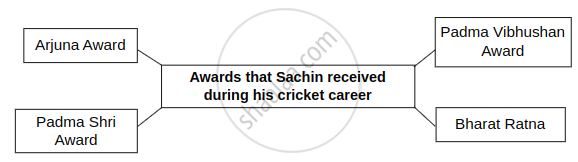
Sachin Ramesh Tendulkar who was born on 24th April 1973 in Mumbai is a former Indian International Cricketer and a former captain of the Indian National Team. He is regarded as one of the greatest batsmen of all time and is often referred as the ‘God of cricket’ by Indian Cricket followers. He made his debut on 15th November 1989 against Pakistan in ‘Karachi’ at the age of sixteen. He is the only player to have scored one hundred international centuries and only player to complete more than 30,000 runs in international cricket. He was trained under the able guidance of Ramakant Achrekar Sir. He received the Arjuna Award in 1994, Rajiv Gandhi Khel Ratna Award in 1997, Padma Shri and Padma Vibhushan Awards in 1999 and 2008 respectively, fourth and second highest civilian awards of India. He was also awarded the Bharat Ratna, highest civilian award of India in 2013. He is a devotee of the deity Ganesha.

A1. Complete the following sentences from the passage:  (2)

  1. Sachin was born on _____.
  2. Sachin is a devotee of the deity ______.
  3. He was trained under the able guidance of ______.
  4. He made debut on ______.

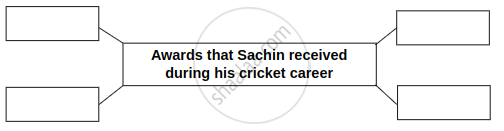
A2. Complete the web diagram:  (2)
A3. Match the ‘Synonyms’:  (2)

  ‘A’   ‘B’
i. debut a. previous
ii. received b. God
iii. former c. got
iv. deity d. first performance

A4. Do as directed:  (2)

  1. He made his debut. (Make ‘Simple Future Tense’.)
  2. He received the Arjuna Award. (Choose the correct Q-tag.)
    1. did he?
    2. didn’t he?
    3. doesn’t he?

A5. Do you like to play games? Why?  (2)

आकलन
Advertisements

उत्तर

A1. 

  1. Sachin was born on 24th April 1973.
  2. Sachin is a devotee of the deity Ganesha.
  3. He was trained under the able guidance of Ramakant Achrekar Sir.
  4. He made debut on 15th November 1989.

A2. 
A3. 

  ‘A’   ‘B’
i. debut d. first performance
ii. received c. got
iii. former a. previous
iv. deity b. God

A4. 

  1. He will make his debut.
  2. didn’t he?

A5. Yes, I like to play games. Because playing sports increases physical strength. Sports can also serve as a form of stress relief and relaxation.

shaalaa.com
Unseen Passage Comprehension
  या प्रश्नात किंवा उत्तरात काही त्रुटी आहे का?
2022-2023 (March) Official

संबंधित प्रश्‍न

B1. Choose
Choose the correct alternatives and complete the sentences (2)
(1) The narrator is :
(a) an astronaut
(b) an engineer studying in BITS Pilani
(c) in the team of astronauts.

(2) Armstrong said, 'That's one small step for a man, one giant leap for mankind which means:
(a) one step on the moon means, many steps on the earth.
(b) he felt like a giant on the moon.
(c) one moon mission had opened up many avenues in science and technology for mankind.

It was late evening of July 20. 1969, when we turned up the hostel radio. I was an engineering student at BITS, Pilani. I still remember the feverish excitement that gripped us from July 16 when Apollo 11. the US space rocket, took off from Cape Kennedy, Florida. Neil Armstrong and his team of astronauts, Edwin "Buzz" Aldrin and Michael Collins, were to land on moon, for the first time in human history. We listened 'with rapt attention when Armstrong declared: "That's one small step for a man, one giant leap for mankind."
His death on Saturday, August 25, is a moment to salute the romance of space science that Apollo 11 unleashed. It has changed forever the way we look at our planet Earth and its satellite, the moon.
Standing on powdery moondust, Armstrong put up his thumb, shut one eye and found his thumb blotting out the Earth. "It suddenly struck me that that tiny pea, pretty and blue, was the Earth” he said later. "I felt very, very small." But behind that humbling realisation stood a giant truth:

The effort to explore the universe united mankind in technology and knowledge. Each moon mission, about 110 till date, provided more confidence to take on bolder projects.

B2. Complete                                                                                                                         (2)
(1) Armstrong describes the earth as ……………
(2) The effort to explore the universe has ………………
(3) Apollo 11 unleashed and changed forever ………………
(4) The author came to know about Apollo 11 mission when he …………..

B3. Solve
Solve the crossword with the clues given below. Refer to the passage for your answers:              (2)

Down :   (1) The area beyond the earth's atmosphere .
             (2) The name of the spacecraft that Armstrong travelled.
Across : (3) A person trained to travel in space.
             (4) Y A natural satellite of the earth.

B4. Begin the sentence
(i) With-For the first time .......and rewrite                                                                               [1]
Neil Armstrong, Edwin Aldrin and Michael Collins were, to land on the moon for the first time.
(ii) Insert 'that' appropriately and rewrite.                                                                               [1]
Armstrong found his thumb blotting out the Earth.

B5. Personal Response
Would you like to be an astronaut? Give reasons.


Nicholas chorier is not your usual photographer. He is a kite aerial photographer. He uses a kite to hoist his camera into the skies and clicks photographs while the camera dangles precariously mid – air.
As a teenager, Nicholas had two passions – photography and kite flying. During’ a trip to India to make a photo report on kite making, he learnt about this unique style of photography. Fascinated, he literally tied his two hobbies together for a living.
Nicholas learnt to make a strong modelled on the Japanese kites, Rokkaku that could endure harsh winds. A novice in his chosen field, he then set out to train himself. Today he is one of the most well – known aerial photographers in the world.
The technique is to tie a cradle containing the photography equipment to the string of the kite and then fly it, thus launching the camera into air. From the ground, Nicholas manipulates the angles of the camera with a remote. An air – to – ground video link enables him to see the view from the kite’s vantage point. Once satisfied with the frame, he clicks a picture.
However, the job does have its pitfalls too. Once, his kite disappeared in the Yamuna river, with his expensive camera in tow.
He is especially fond of India, having made a couple of trips and taken many spectacular photos. “India is too vast and beautiful a country to be captured through the lenses in one life” he says.
He recently released a book, Kite’s Eye View: India between Earth and sky. Though it includes photographs of oft takes sites like the Taj Mahal, it shows them from a totally different perspective.

(1) What were Nicholas’s two passions?
(2) How does Nicholas take aerial photographs?
(3) What is ‘Rokkaku’?
(4)
    (a) Pick out words from the passage which mean :
        (i) To tolerate
        (ii) Costly
    (b) Nicholas has two passions. [Start the sentence with ‘Nicholas was …….using the adjective form of passion]
   (a) India is too vast a country to be captured through the lenses. [Remove too ………. And rewrite]      (b) Nicholas learnt to make strong kites. [Rewrite using past perfect tense]
(6) What risks do aerial photographers face?


Q1 Read the following passage and answer the questions that follow:

1. Too many parents these days can't say no, As a result, they find themselves raising 'children' who respond greedily to the advertisements aimed right at them. Even getting what they want doesn't satisfy some kids; they only want more. Now, a growing number of psychologists, educators, and parents think it's time to stop the madness and start teaching kids about what's really important: values like hard work, contentment, honesty, and compassion. The struggle to set limits has never been tougher ‒ and the stakes have never been higher. One recent study of adults who were overindulged as children paints a discouraging picture of their future: when given too much too soon, they grow up to be adults who have difficulty coping with life's disappointments. They also have a distorted sense of entitlement that gets in the way of success in the workplace and in relationships.

2. Psychologists say that parents who overindulge their kids set them up to be more vulnerable to future anxiety and depression. Today's parents themselves raised on values of thrift and self-sacrifice, grew up in a culture where no was a household word. Today's kids want much more, partly because there is so much more to want. The oldest members of this generation were born in the late 1980s, just as PCs and video games were making their assault on the family room. They think of MP3 players and flat-screen TV as essential utilities, and they have developed strategies to get them. One survey of teenagers found that when they crave something new, most expect to ask nine times before their parents give in. By every measure, parents are shelling out record amounts. In the heat of this buying blitz, even parents who desperately need to say no find themselves reaching for their credit cards.

3. Today's parents aren't equipped to deal with the problem. Many of them, raised in the 1960s and '70s, swore they'd act differently from their parents and have closer relationships with their own children. Many even wear the same designer clothes as their kids and listen to the same music. And they work more hours; at the end of a long week, it's tempting to buy peace with 'yes' and not mar precious family time with conflict. Anxiety about the future is another factor. How do well-intentioned parents say no to all the sports gear and arts and language lessons they believe will help their kids thrive in an increasingly competitive world? Experts agree: too much love won't spoil a child. Too few limits will.

4. What parents need to find, is a balance between the advantages of an affluent society and the critical life lessons that come from waiting, saving, and working hard to achieve goals. That search for balance has to start early. Children need limits on their behaviour because they feel better and more secure when they live within a secure structure. Older children learn self-control by watching how others, especially parents act. Learning how to overcome challenges is essential to becoming a successful adult. Few parents ask kids to do chores. They think their kids are already overburdened by social and academic pressures. Every individual can be of service to others, and life has meaning beyond one's own immediate happiness. That means parents eager to teach values have to take a long, hard look at their own.

(a) Answer the following:

  1. What values do parents and teachers want children to learn?
  2. What are the results of giving the children too much too soon?
  3. Why do today's children want more?
  4. What is the balance which the parents need to have in today's world?
  5. What is the necessity to set limits for children?

(b) Pick out words from the passage that mean the same as the following:

  1. a feeling of satisfaction (para 1)
  2. valuable (para 3)
  3. important  (para 4)

1. Why does a person become overconfident? The reason lies in over assessment of his capabilities. Sometimes people over assess their competence and jump into situations that are beyond their control.

2. Napoleon Bonaparte who became Emperor of France would say that the word 'impossible' was common only amongst fools. The overconfident Napoleon invaded Russia in the winter of 1812. This proved to be a big disaster.

3. Overconfidence generally leads people into misadventures, endangering their chances in life. It is wisely said that any achievement is a result of two factorsone's personal planning and support from the external world. People, take into account only their planning, generally ignoring external factors. As a result they are unable to foresee future developments. Hence, a great risk of failure.

4. Then there is the question: how can one manage overconfidence? The formula is very simple. Before taking a decision discuss the matter with other informed people with an objective mind and when it is proved that you are about to go off the path, accept reality and say without delay, "I was wrong'.

5. Overconfidence is a flaw characterizing people who lack the virtue of modesty. Modesty makes you a realist; you become a person who is cut down to size. People of this kind become very cautious; before taking an action they assess the whole situation. They adopt a realistic approach.

6. Overconfident people live within their own thoughts. They know themselves but they are unaware of others. Living inside their own cell they are unable to make use of the experiences of others. This kind of habit is highly damaging to all concerned

7. There is a saying that the young man sees the rule and the old man sees the exception, with a slight change, I would like to say that the overconfident person sees the rule and the confident person sees the exception. Overconfident people are always at risk. It is said that taking risk is good but it must be well calculated otherwise it becomes very dangerous.


1) Answer the following :(8)

a. Why does a person become overconfident? 

b. What does overconfidence generally lead people into? 

c. How can one manage overconfidence? 

d. What kind of person does 'modesty' make you? 


2)Find meanings of the words given below with the help of the options that follow :(4)

a. Misadventure (Para 3) 

   (i) Mishap    (ii) Unlucky    (iii) Unhappy    (iv) Unpleasant

b. Endangering (Para 3) 

   (i) Reckless   (ii) Imperil   (iii) Risky   (iv) Threatening

c. Assess (Para 5) 

   (i) Assemble   (ii) Acquire   (iii) Evaluate   (iv) Accept

d. Objective (Para 4) 

   (i) Obedient   (ii) Servile   (iii) Honest   (iv) Impartial


Read the passage given below and answer the questions that follow:

If you are addicted to coffee, and doctors warn you to quit the habit, don’t worry and just keep relishing the beverage, because it’s not that bad after all! In fact, according to a new study, the steaming cup of Java can beat fruits and vegetables as the primary source of antioxidants. Some studies state that coffee is the number one source of antioxidants in American diet, and both caffeinated and decaf versions appear to provide similar antioxidant levels.

Antioxidants in general have been linked to a number of potential health benefits, including protection against heart diseases and cancer, but Vinson, a dietitian said that their benefits ultimately depend on how they are absorbed and utilized in the body. The research says that coffee outranks popular antioxidant sources like tea, milk, chocolate and cranberries. Of all the foods and beverages studied, dates actually have the most antioxidants based solely on serving size, but since dates are not consumed anywhere near the level of coffee, the drink comes as the top source of antioxidants, Vinson said.

Besides keeping you alert and awake, coffee has been linked to an increasing number of potential health benefits, including protection against liver and colon cancer, type 2 diabetes, and Parkinson’s disease, according to some recently published studies. The researchers, however, advise that one should consume coffee in moderation, because it can make you jittery and cause stomach pains

(a) What do doctors advise us about the habit of drinking coffee?
 
(b) What are the two versions of coffee that are drunk in America?
 
(c) State any two benefits of antioxidants.
 
(d) What does Vinson say about the consumption of antioxidants?
 
(e) Name any two popular sources of antioxidants.
 
(f) How does coffee outrank dates in the level of antioxidants?
 
(g) Mention any two benefits of coffee.
 
(h) What do researchers warn us about the excessive use of coffee?


Read the extract given below and answer the questions that follow:

These meadows aren't worth much to me. They only come to five dessiatins, and are worth perhaps 300 roubles, but I can't stand unfairness. Say what you will, I can't stand unfairness.

(a) Who speaks the above lines and to whom?

(b) How much are the meadows worth?

(c) Find a word in the extract the means 'not based on what is just.'


Read the following extract and answer the questions given below :
One day, I saw the tree was being cut. I rushed to the site and begged the tree cutters to spare the trunk as it wast the home of many a parrot. But I was laughed at and the tree fell with a great thud. I ran to the top end to see two just hatched chicks thrown out of their nest and smashed to death. I looked into all the nests and saw smashed eggs in two of them and one little chick in the other one. Fortunately, the little one survived the fall. I brought it home. The chick can be identified as a parrot only by the shape and colour of its beak. No feathers had come out. 1 carefully fed it with milk and within two weeks it began to eat bananas; and two months later, it started to fly and I let him fly away. But he would not fly long. He used to liner on the coconut trees in our compound and when I reached home from school, he would fly down and land on my head!
I would show him my finger and he would jump on to it from my head and drink the milk I offered him in a little plate. By putting the sharp end of the upper beak stationaty in the plate, he would drink the milk by moving his tongue and lower beak to and fro. Then he would fly on to my shoulder and eat paddy from mypahn.

(1) What is the extract about? (1)

(2) Describe how did the boy save the life of a chick ? (2)

(3) What was the parrot's daily routine at the author's home? (2)

(4) Do you think, we have deprived the birds of their natural habitats? What are its effects? (2)

(5) Rewrite the following sentences in the ways instructed :
(i) I rushed to the site. (Rewrite the sentence using 'used to'.) (1)

(ii) The tree was being cut. (Rewrite it beginning with 'They .... .' (1)

(iii) I looked into all the nests and saw smashed eggs in two of them. (Rewrite the sentence using the word 'when'.  (1)

(6) Find out the words from the extract which mean -
(i) neatly                      (1/2)
(ii) stay for longer        (1/2)


Read the following extract and answer the questions given below:

One day, King Amrit and Chandan were taking a walk on the terrace of the palace. The terrace offered a beautiful view of the surroundings, and they could see far into the distance. They spotted the weekly market from up there, with people in colourful clothes buying and selling all kinds of things. There was plenty to buy and people had money to buy too. There were no poor people to be seen anywhere. The King watched with a smile on his face. He was delighted to see the prosperity of his kingdom. Like any good ruler, he was happy ·when his people were happy.
       He turned to Chandan and said, ''See how contented my people are. But I want to check this first-hand by talking to them. Tomorrow, summon people from all walks of life to the court, and I will ask them myself how they are doing.'' Chandan was used to the king's strange requests and went off to carry out this order.

       The next day, the King arrived in the court humming a happy tune to himself. Seeing all the people gathered there waiting for him, he was even more pleased. He cleared his throat and said in a loud voice, ''I have called you here to ask you a very important question. As your king, I need to know if all of you are contented. Do you have enough for your needs? Do you know anyone who is not happy about anything?''.

(1) What do you understand about the King from this extract?
(2) Why did the King want to talk to his people?
(3) How did the King come to know about the prosperity of his kingdom?
(4) According to you, what should the Government do for the bettennent of the poor people?
(5) Rewrite the following sentences in the ways instructed :
(i) He was delighted to see the prosperity of his kingdom.
(Make it a rhetorical question.)
(ii) Summon people from all walls of life to the court
(Rewrite it beginning with 'Let ..... ')
(iii) As soon as the King arrived in the court humming a
happy tune to himself, he cleared his throat.
(Rewrite it using 'No sooner .... than'.)

(6) Find out the words from the extract which mean:
(i) development
(ii) examine


Read the following extract and answer the questions given below:

I was 33 at the time, a doctor in the West End of London. I had been lucky in advancing through several arduous Welsh mining assistantships to my own practice - acquired on the installment plan from a dear old family physician who, at our first interview, gazed at my cracked boots and frayed cuffs and trusted me.
I think I wasn't a bad doctor. My patients seemed to like me - not only the nice old ladies with nothing wrong with them, who lived near the park and paid handsomely for my cheerful bedside manner but the cabbies, porters, and deadbeats in the mews and backstreets of Bayswater, who paid nothing and often had a great deal wrong with them.
Yet there was something-though I treated everything that came my way, read all the medical journals, attended scientific meetings, and even found time to take complex postgraduate diplomas-I wasn't quite sure of myself. I didn't stick at anything for long. I had successive ideas of specializing in dermatology, in aural surgery, in pediatrics, but discarded them all. While I worked all day and half of most nights, I really lacked perseverance, stability.
One day I developed indigestion. After resisting my wife's entreaties for several weeks, I went casually to consult a friendly colleague. I expected a bottle of bismuth and an invitation to a bridge. I received instead of the shock of my life: a sentence to six months’ complete rest in the country on a milk diet. I had a gastric ulcer.
Questions :
(1) What makes the writer think that he was a good doctor?
(2) What sort of patients did the doctor have?
(3) What were the reasons for the doctor's indigestion?
(4) “A doctor should have a pleasing personality and good manners.” Do you agree? Explain.
(5) Rewrite the following sentences in the ways instructed:
(i) A dear old family physician gazed at my cracked boots and frayed cuffs. (Rewrite the sentence using not only...... but also.)
(ii) I didn't stick at anything for long. (Rewrite the sentence as a rhetorical question.)
(iii) I had successive ideas of specializing in dermatology, in aural Surgery, in pediatrics, but discarded them all. (Rewrite the sentence using Though.)
(6) Find out from the extract the words which mean the following:
(i) serious requests
(ii) unsewn

(A) Read the following extract and answer the questions given below:
   Chronic floods during the monsoon, on average, affect more than 30 million Indians annually Ironically, 60% of India's farmland, 66% of its livestock and its entire forest area depend on rains for survival.
   According to a recently released Central Water Commission (CWC) report, on an average, 7·21 million hectares (roughly 72,000 sq. km.) go under floodwater. This water typically ravages 3·78 million hectares of agricultural land, damaging crops worth Rs. 1, 118 crores annually.
   Heavy rains and floods account for nearly 1,700 lives lost annually. Apart from this, I ·25 lakh houses are annually damaged by torrential rains that also wipe out nearly 96,000 livestock.
   Floods are the most recurrent natural calamity, hitting India almost every year. According to the CWC's report on financial aspects of flood control, anti-sea erosion and drainage projects, it is not possible to provide absolute protection instantly to all flood-prone areas. It says that such an attempt will neither be practical nor economically viable.
   The CWC's analysis of floods in India from 1953 to 2011 shows a marginal decline in flood-affected areas over the years, the data shows 1977 1978 and 1979 were the worst-hit. The 1977 floods killed over 11,000 people, six-time the average for the 59 years, between 1953 and 2011. In terms of area and population affected, the floods of 1978 were the most destructive.
  In terms off the financial loss, recent floods have been far more destructive. The total loss of crops, houses and public utilities in 2009 was Rs. 32541 crores, the highest for any year.

Question
(1) What is the above extract about?

(2) How do floods adversely affect India?

(3) Why is it not possible to provide absolute protection to all flood-prone areas?

(4) How would you help the flood-affected people?

(5) Rewrite the following sentences in the ways instructed :
(i) The floods of 1978 were the most destructive.
(Change the sentence into the 'positive degree'.)
(ii) Floods are the most recurrent natural calamity hitting India almost every year.
(Make it a complex sentence.)
(iii) Floods have been far more destructive.
(Rewrite the sentence using the Simple Present tense.)

(6) Give the meanings of:
(i) entire
(ii) calamity

(B) Write a brief summary of the above extract with the help of the points given below and suggest a suitable title.
Floods - natural, recurrent calamity in India - destroy life and property - no absolute protection - neither practical nor economically viable- floods in 1977 and 1978. 


Read the following extract and answer the questions given below.

Once upon a time the animals decided they must do something heroic to meet the problems of a “new world” so they organized a school. They had adopted an activity  curriculum consisting of running, climbing, swimming and flying. To make it easier to administer the curriculum, all the animals took all the subjects.
 
The duck was excellent in swimming. In fact, better than his instructor. But he made only passing grades in flying and was very poor in running. Since he was slow in running, he had  to stay after school and also drop swimming in order to practice running. This was kept up until his webbed feet were badly worn and he was only average in swimming.
 
But average was acceptable in school so nobody worried about that, except the duck.
 
The rabbit started at the top of the class in running but had a nervous breakdown because of so much makeup work in swimming. The squirrel was excellent in climbing until he developed frustration in the flying class where his teacher made him start from the ground up instead of the treetop down. He also developed a “charlie horse” from overexertion and then got a C in climbing and D in running.
The eagle was a problem child and was disciplined severely. In the climbing class, he beat all the others to the top of the tree but insisted on using his own way to get there.
 
1. What were the special features of animal school?
2. Why was the duck, an excellent swimmer, average in swimming?
3. Why was the experience of the squirrel miserable?
4. What efforts will you take to score good marks in your examination?
5. Rewrite the following sentences in the ways instructed.
(i) The duck was excellent in swimming.
(Frame a Wh – type question to get the underlined part as an answer)
(ii) The duck was better than his instructor.
(Change the sentence into positive degree)
(iii) The squirrel was excellent in climbing. (1)
(Mention the function of the underlined gerund.)
6. Match the words in column ‘A’ with their meanings in column ‘B’
A B
(i) valedictorian (a) feeling of annoyance
(ii) frustration (b) dunce
  (c) school topper
 
(d) validity

Read the following extract and answer the questions given below:
Dairy farming is a major livelihood followed by many households in rural areas. This includes rearing milk cattle - cows, buffaloes, goats, and sheep. There is a shortage of milk in the country as consumption in both urban and rural areas has risen sharply.
 
Dairying is an important source of subsidiary income to marginal farmers and agricultural labours. They play a very important role in milk production of the country. In 1986 - 87, about 73 percent of rural households owned livestock. According to the National Sample Survey of 1993 - 94, the livestock sector produces regular employment to about 9.8 million persons in principal status and 8.6 million in subsidiary status, which constitutes about 5 percent of the total workforce.
 
The Manure from animals provides a good source of organic matter for improving soil fertility and crop yields. The gas obtained by processing dung is used as a fuel for domestic purposes and also for running engines to draw water from wells. The surplus fodder and agricultural by-products are gainfully utilized for feeding the animals. Since agriculture is mostly seasonal, there is a possibility of finding employment throughout the year for many persons through dairy farming.
 
The milk processing industry is a small one. Only 10 percent of all the milk produced is delivered to some 400 dairy plants. A specific Indian phenomenon is the unorganized sector of milkmen and vendors, which handles around 65 - 70 percent of the national milk production. They collect milk from local producers and sell it in both urban and non - urban areas.
1. What is the main theme of the extract?
2. How is dairy farming beneficial for farmers besides getting milk?
3. What information does the National Sample Survey of 1993 - 94 provide?
4. How, according to you, can dairy farming improve the financial condition of farmers?
5. Rewrite the following sentences in the ways instructed:
(i) The gobar gas obtained by processing dung is used as fuel.
(Rewrite the sentence beginning with 'People…………')
(ii) The consumption of milk in both urban and rural areas has risen sharply.
(Rewrite the sentence using the past perfect tense)
(iii) The milk processing industry is a small one.
(Make is a complex sentence)
6. Form the antonyms of the following words by adding prefixes.
(i) fertility x 
(ii) possibility x 

Read the following extract and answer the questions given
below : 

          In 1945 in Bay Roberts, Canada, a 12-year-old boy saw something in a shop window that set his heart racing. But the price -five dollars-was far beyond Reuben Earle's means. Five dollars would buy almost a week's groceries for his family.
         Reuben couldn't ask his father for the money. Everything Mark Earle made by fishing, Reuben's mother, Dora, stretched like elastic to feed and clothe their five children.
      Nevertheless, he opened the shop's weathered door and went inside. Standing proud and straight in his flour-sack shirt and washed out trousers, he told the shopkeeper what he wanted, adding, "but I don't have the money now. Can you please hold it for me?" ·
    "I will try," the shopkeeper smiled. ''Folks around here don't usually have that kind of money to spend on things. It should keep for a while.,.
     Reuben respectfully touched his worn cap and walked out into the May sunlight. The bay rippled in a freshening wind that ruffled his short hair. There was purpose in his loping stride. He
would raise the five dollars and not tell anybody.
     Hearing the sound of hammering from a side street, Reuben had an idea.

     He ran towards the sound and stopped at a construction site. People built their own homes in Bay Roberts, using nails purchased in burlap sack from a local factory. Sometimes the sacks were discarded in the flurry of buildings, and Reuben knew he could sell them back to the factory for five cents a piece.

(1) What did Reuben decide to do to raise the required amount?
(2) How much money did Reuben need? Why?
(3) Why couldn't Reuben ask his father for the money?
(4) What is special about the gifts which are given on special occasions?
(5) Rewrite the following sentences as directed :
(i) Reuben couldn't ask his father for the money.
(Rewrite the sentence using ' be able to'.)
(ii) Hearing the sound of hammering from a side street, Reuben had an idea. 
(Rewrite the sentence using 'and'.)
(iii) He could sell them back to the factory.
·(Rewrite the sentence beginning with: 'They ..... ')

(6) Match the words in column 'A' with their meanings in
column 'B':

column 'A' column 'B'
folk natural harbour
bay sticks
  people

Read the following passage and do the activities.

The Delhi Metro is a metro system serving Delhi and its satellite cities of Bahadurgarh, Ballabhgarh, Faridabad, Ghaziabad, Gurgaon and Noida in the National Capital Region of India. Delhi Metro Rail Corporation Limited
(DMRC), a State-owned company with equal equity participation from the Government of India and the Government of Delhi, built and operates the Delhi
Metro. It is the second oldest metro in India after the Kolkata Metro.
The Delhi Metro is the largest and busiest metro in India, and the world’s 9th longest metro system in length and 16th largest in ridership. A member of CoMET, the network consists of eight colour-coded regular lines, with a total
length of 317 kilometres, serving 231 stations including 6 on Airport Express line and interchange stations. The system has a mix of underground, at-grade, and elevated stations using both broad-gauge and standard-gauge. DMRC operates over 2,700 trips daily. In the financial year 2016–17, the Delhi Metro had an average daily ridership of 2.76 million passengers and served 100 crore (1.0 billion) riders.
         The Delhi Metro Rail Corporation was certified by the United Nations in 2011 as the first metro rail and rail-based system in the world to get “carbon credits for reducing greenhouse gas emissions” and helping in reducing pollution levels in the city by 630,000 tonnes every year. Planning for the metro started in 1984 when the Delhi Development Authority and the Urban Arts Commission came up with a proposal for developing a multi-modal transport system for the city. Delhi Metro Rail Corporation (DMRC) was incorporated in May 1995, construction started in 1998, and the first section, on the Red Line, opened in 2002. The development of the network was divided into phases, Phase I containing 3 lines was completed by 2006, and Phase II in 2011. Phase III is scheduled to be mostly complete by 2018.

(A1) Name the following.
(a) The Government authority which built and operates the Delhi Metro -
(b) The first and the oldest Metro in India -
(c) The satellite cities nearby Delhi -
(d) The largest and busiest metro in India -

(A2) The salient features of Delhi Metro are -

(A3) Find out antonyms from the passage for the following.
(i) shortest ´ (ii) increasing ´
(iii) irregular ´ (iv) ended ´

(A4) The Delhi Metro is the largest and busiest metro in India.
(Complete the following sentences with the help of the given sentence.)
(i) No other metro................................
(ii) The Delhi Metro is larger.......................

(A5) “Transportation is the backbone of Indian economy’’ - Elaborate

(B) Read the passage given in Q. 4 (A) and write the summary of it. Suggest a suitable title to your summary.


     We were an argrarian people. And my main hobby in my early teens was to wander through paddy field to see the different kinds of birds and how they nest. On the outskirts of the paddy fields, there had been many coconut trees and black palm trees. Beautifully crafted nests of the weaver-birds thookkanaam kuruvikal-would be seen dangling from the ends of palm leaves. Hundreds of these little birds would land on the paddy to squeeze the milk from the tender rice. They would come to the fields when the young stalks come out of the rise-plants. At this stage of the paddy, my father would send me to our field with a tin drum to scare these birds away. But often I have enjoyed the sight of these little birds balancing on the tender stalks and squeezing the milk out of the green rice. When the paddy is ripe enough to harvest, flocks of parrots would land there and cut the ripe stalks with their sharp beaks and fly away with the stalks dangling in their beaks. I have always liked to see this sight also.
       The nest of parrots were neatly crafted holes in the trunks of palm trees. I continued to wonder how they made chose holes on the hard trunks until I saw the patient work of the woodpeckers. They were the carpenters and their long, sharp and strong beaks, chisels. They make the holes (in search of worms inside the weak spots of the trunks) and the parrots occupy them. If I heard the sound tak, tak, tak. I knew it was a woodpeckers chiselling a had trunk. I would go after him. It seems that the woodpecker is the only bird which can walk perpendicularly on the tree trunks! How beautiful the sight was! Its strong legs, red crest, the dark red stripe on the face and black beak and the tak, tak, tak sound used to captivate me

A1. Complete the following table :Choose two sentence that appropriately mention the theme of the passage :

(i) The extract deals with the techniques to scare the birds away.
(ii) The extract depicts how parrots make holes on the tree trunks.
(iii) The extract depicts the writer’s love towards the birds.
(iv) The extract deals with the activities of different birds.

A2. Complete the flow-chart : 

A3. Complete the following table :

A4. Vocabulary -

Match the pairs of the words in column ‘A’ with their meaning in column ‘B’ :

Column ‘A’ Column ‘B’
(i) dangling (a) connected with farming
(ii) squeezing (b) attract the attention
(iii) agrarian (c) hanging freely
(iv) captivate (d) pressing firmly

A5. Personal response - 

Suggest two measures to increase the number of birds.

A6. Grammer -

Rewrite the following sentences in the way instructed
(i) The paddy is ripe enough to harvest
(Remove ‘enough’ and rewrite the sentence.)
(ii) How beautiful the sight was!
(Rewritte as an assertive sentence)


Read the extract and do the activities that follow:
“And that skeleton,” I asked. “ What about the skeleton in the cupboard? Did you know about it?”
“Yes, I knew about it. But I have no idea whose skeleton it was. You see, back in the twenties, when Green took over this hotel, he had one of his sudden enthusiasms and was convinced this town needed a medical school or college, and he set about preparing the ground for one. He was ready to finance the project, or part of it. And of course medical students need a skeleton. So he acquired one from the Lady Hardinge Medical College in New Delhi. It was a medical school skeleton you found. And if you’d looked closely you'd have noticed that it was varnished.”
“Why was it varnished?” I asked.
“To help preseve it, of course. It was also articulated”
“Articulated?”
“That means the joints were connected up, so that the whole thing wouldn't fall apart. Want to be a doctor, young man?”
“No,” I said. “A detective.”
“Well, you didn't solve this case”.
“I wasn't here. And now we'll never be able to identify the skeleton.”
“Some poor woman of the streets, no doubt. Unclaimed, unwanted. But in the end you gave her a decent burial-even if she wan't a Cristian. Padre Duett is a bit embarrassed, but I've told him I don’t mind my name on the tombstone. I’ll be returning to Africa shortly, and when I die I shall have another tombstone there. Not everyone is lucky enough to have two tombstones! “

B1. True/False - (2)
State whether the following statements are true or false:
(i) The narrator wanted to be a doctor.
(ii) Mrs. Green counted herself lucky to have two tombstones.
(iii) The skeleton was varnished to preserve it for a longer time.
(iv) Mrs. Green was embarrased to see her name on the tombstone.

B2. Provide a different ending: (2)
Provide a different ending to the above given extract in about 50 words.


Read the following extract and answer the questions given below:

        But being named an 'AdarshGaon' is far from easy. Villages had to give a proposal after which a committee headed by Mr. Pawar inspected the villages. "The Villages had to show dedication in the struggle to fight mediocrity. They had to follow all the conditions of becoming an 'AdarshGaon'. We chose villages with a revolutionary spark, "Mr. Pawar says.

        Villages need to follow strict rules. The process begins with effective water management through the watershed technique and water auditing. taking responsibility for the village's natural resources-planting trees and stopping grazing. contributing labour for the village work, and then expanding to bring about behavioral changes in the people for harboring social change. Hiware Bazaar is free of any kind of addiction and there are no liquor or tobacco shops in the village. Vasectomy has been made compulsory, as is the pre-marital HIV test. 

        The 'AdarshGaon' model prides itself on being based on the joint decisions made by the Gram Sabha, where all the villagers are present. Even while selecting the new villages under the scheme, Mr. Pawar made sure that the decision to become an ideal village was taken by the entire village together.

        The greatest victory for Hiware Bazaar so far has been the reverse migration that the village has witnessed since 1989. As many as 93 families have come back to the village," from the slums in Mumbai and Pune," Mr. Pawar says.

Questions:

(1) What features of 'Adarsh Gaon' are given in this extract? 

(2) What is the procedure for selecting 'Adarsh Gaon'?

(3) What is the greatest victory for Hiware Bazaar?        

(4) Do you think all villages in Maharashtra should follow the ideals of Hiware Bazaar? why?

(5) Rewrite the following sentences in the ways instructed :

 i.  Mr. Pawar inspected the villages. 

    (Rewrite it using the noun form of the word underlined.)     

ii. Vasectomy has been made compulsory by the villagers.

   (Rewrite it beginning with-"The villagers........".)

iii. There are no liquor or tobacco shops in the village.

   (Rewrite it using 'neither......nor'.)

(6) Find out the words from the extract which mean: 

(i) causing a great change 

(ii) the quality of being average


Read the following extract and answer the questions given below:

Researchers recently announced the earth could actually withstand up to 200,000 times the current population. They arrived at this figure by calculating the amount of heat a human body emits, and only at 1.3 million billion would the earth be too hot to be habitable. And though it would feel like being in a can of sardines if that figure were ever reached, the earth is capable of comfortably sustaining a population several times the current 6.5 billion.
In fact, fertility is actually on the decline worldwide. Though the population has grown, the rate of growth has fallen sharply. Twenty years ago, the UN projected that the population would reach 11.16 billion in 2050, today they say it will reach only 9.3 billion. Moreover, the human population will stabilize at about 11.5 billion. While this figure is almost twice the current one, it is hardly claustrophobic.
True, the demands on resources are heavy even now, but this is more due to the manner in which these resources are being used. In fact, figures show that a bigger population does not amount to greater consumption. Over 20% of the world's people in the highest-income countries account for 86% of total private consumption expenditure - the poorest 20% a tiny 1.3%. With just 5% of the world's population, the US consumes about 40% of the world's resources. Would you say the US is overpopulated?
  Concerns on the scarcity of food are equally baseless. In fact, global food production has actually kept up with population growth.

(1) What is the main idea of the first paragraph?
(2) What is the relationship between the population and the available resources?
(3) Why do the researchers claim that the earth is capable of sustaining a bigger population?
(4) What, according to you, are the problems caused by the increasing population?
(5) Rewrite the following sentences in the ways instructed :
(i) The earth would be too hot to be habitable. (Remove 'too'.)
(ii) Though the population has grown, the rate of growth has fallen sharply. (Rewrite it using 'but')
(iii) Moreover, the human population will stabilize at about 11.5 billion. (Make it 'less definite'.)
(6) Find out the words from the extract which mean :
(i) natural capacity to produce  (ii) shortage


Read the first activity, read the extract and then do all the activities:

A1. Correct the following statements with the help of the facts from the extract :

(1) Everybody in every part of the globe would have access to administration and social care services because he or she would not be able to afford them.

(2) We would avoid boom and bust cycles and be able to surmount natural disaster with great ease.

To me, a world without poverty means that every person would have the ability to take care of his or her own basic life needs. In such a world, nobody would die of hunger or suffer from malnutrition. This is a goal world leaders have been calling for decades, but have never set out any way of achieving it.

Today 40,000 children die each day around the world from hunger-related diseases. In a poverty-free world, no children would die of such causes.

Everybody in every part of the globe would have access to education and health-care services because he or she would be able to afford them. Unlike today, the state would not be required to provide free or subsidized health-care or schooling.

All state organizations created to provide free or subsidized services for the poor would no longer be required and welfare agencies, or the national welfare department. No free schools, no free hospital care, no begging in the streets.

State-run safety-net programmers would have no rationale for existence because no one would live on charity anymore. State-run social security programmers, income-support programmes would be unnecessary.

Social structures in a poverty-free world would, of course, be quite different from those that exist in a poverty-ridden world. But nobody would be at the mercy of anyone else, and that is what would make all the difference between a world without poverty and one riddled with it.

Finally, a poverty-free world would be economically much Stronger and far more stable than the world today.

one-fifth of the world's inhabitants who today live a life of extreme poverty would become income earners and income spenders. They would generate extra demand in the market to make the world economy grow. They would bring their creativity and innovations into the market-place to increase the world's productive capacity.

Since nobody would ever become poor, except on a temporary and limited basis, the economy would probably not go through extreme swings. We would avoid boom-and-bust cycles and be able to surmount man-made disasters with greater ease.

A2.

Complete the following statement :

The situation in the world without poverty would be different, because -

(1) the state need not ___________
(2) nobody __________

A3. Find out :

Find and write in the blank boxes :

One-fifth of the world's inhabitants today live a life of extreme poverty. How would they economically Stand in a poverty-free world?

They would be income earners and income spenders    

A4. Vocabulary :

Find out the words from the extract that mean the following : 

(1) calamity (2) overcome
(3) bringing new ideas (4) financially

A5. Personal Response :

Suggest at least four solutions to overcome the problems of increasing poverty.

A6. Grammar :

Rewrite the following sentences in the ways instructed :

(1) Nobody would die of hunger or suffer from malnutrition.
(Remove the negative and rewrite.)

(2) Everybody in every part of the globe would have accessed education and health-care services.
(Rewrite the above sentences beginning with 'Education'.)


Read the passage given below :

Globalization

Globalization is the way to open businesses, improve technological growth, economy, etc, at the international level for all countries. It is the way in which manufacturers and producers of the products or goods sell their products globally without any restriction. It provides huge profits to the businessmen as they get 1ow cost labor in poor countries easily. It provides a big opportunity for companies to„ deal with the worldwide market. 

Globalization helps to consider the whole world 'as a single market. Traders are extending their areas of business by treating the world as a global village. Earlier till the 1990s, there was a restriction on importing certain products that were already manufactured in India like agricultural products, engineering goods, food items, and toiletries. However, during the 1990s there was pressure from. the rich countries on the poor and developing countries to allow them to spread their businesses by opening their markets. In India, the globalization and liberalization process was started in 1991. 

After many years, globalization brought about a major revolution in the Indian market when multinational brands came to India and started delivering a wide range of quality products at cheap prices. Prices of good quality products came down because of the cutthroat competition in the market. 

Globalization and liberalization of the businesses in India have flooded the market with quality foreign products but have affected the local Indian industries adversely to a great extent resulting in job loss to poor and uneducated workers. Globalization has been a bonanza for the consumers, however, a loss to the small-scale Indian producers. 

Globalization has had some very positive effects on the Indian consumer in all sectors of society. It has affected the Indian students and education sector to a great extent by making study books and a lot of information available over the internet. The collaboration of foreign universities with Indian universities has brought about a huge change in the field of education.

Globalization of trade in the agricultural sector has brought varieties of quality seeds that have disease resistati8e; property. However, it is not good for the poor Indian farmers because the seeds and agricultural technologies are costly.

It has brought about a huge revolution in the employment sector by the spread of businesses like cottage, handloom, carpet, artisan carving, ceramic, jewelry, and glassware, etc

(a) What is globalization?

(b) Write any two advantages of globalization.

(c) What was the pressure from the rich countries in the 1990s?

(d) What is the effect of multinational brands entering the Indian market?

(e) How are the prices of quality products affected due to globalization?

(f) How have foreign products affected the local industry adversely?

(g) What has been the impact of globalization on Indian students?

(h) Why has globalization had a negative effect on the poor Indian farmer?

(i) How has the cottage industry benefited from globalization?


Read the following passage carefully.
1. Few guessed that this quiet, parentless girl growing up in New York City would one day become the First Lady of the United States. Even fewer thought she would become an author and lecturer and a woman much admired and loved by people throughout the world.

2. Born Anna Eleanor Roosevelt in 1884 to wealthy, but troubled parents who both died while she was young, Roosevelt was cared for by her grandmother and sent to school in England. In 1905, she married her distant cousin, Franklin Delano Roosevelt. She and her husband had six children. Although they were wealthy, her life was not easy and she suffered several personal tragedies. Her second son died when he was a baby. In 1921, her strong athletic husband was stricken with polio, which left him physically disabled for life.

3. Eleanor Roosevelt was a remarkable woman who had great intelligence and tremendous strength of character. She never let things get her down. She nursed her husband back to good health and encouraged him to remain in politics. She then helped him to become Governor of New York, and in 1933, President of the United States.

4. While her husband was President, she took a great interest in all the affairs of the country. She became her husband's legs and eyes; she visited prisons and hospitals; she went down into mines, up scaffoldings, and into factories. Roosevelt was tireless and daring. During the depression, she travelled all over the country bringing goodwill, reassurance, and help to people without food and jobs. During World War II she visited American soldiers in camps all over the world. The United States had never known a First Lady like her.

5. Roosevelt also kept in touch with the American people through a daily newspaper column called 'My Day'. She broadcast on the radio and delivered lectures, all first for a First Lady.

1.1 On the basis of your understanding of the above passage answer the following questions: (any eight)

(a) How was Eleanor Roosevelt's personality in contrast to what she became?
(b) Apart from being the First Lady what else did she have to her credit?
(c) What challenges did she face in her personal life but remained unfazed?
(d) Eleanor was a strong woman who helped her husband become the President of America. How?
(e) What does the statement: 'she became her husband's legs and eyes' mean?
(f) What was her special contribution during the depression?
(g) How did she motivate soldiers during World War II?
(h) What did she do for the first time for a First Lady?
(i) What side of her personality is reflected in this passage?


Read the passage given below.
Then all the windows of the grey wooden house (Miss Hilton used to live here. She expired last week.), were thrown open, a thing I had never seen before.
At the end of the day a sign was nailed on the mango tree: FOR SALE.
Nobody in the street knew Miss Hilton. While she lived, her front gate was always locked and no one ever saw her leave or saw anybody go in. So even if you wanted to, you couldn't feel sorry and say that you missed Miss Hilton.
When I think of her house I see just two colours. Grey and green. The green of the mango tree, the grey of the house, and the grey of the high iron fence that prevented you from getting at the mangoes.
If your cricket ball fell in Miss Hilton's courtyard you never got it back. It wasn't the mango season when Miss Hilton died. But we got back about ten or twelve of our cricket balls.
The house was sold and we were prepared to dislike the new owners ever before they came. I think we were a little worried. Already we had one resident of the street who kept on complaining about us to our parents. He complained that we played cricket on the pavment; and if we were not playing cricket he complained that we were making too much noise anyway.
One afternoon, when I came back from school Pal, said, "Is a man and a woman. She pretty pretty, but he ugly like hell". I didn't see much. The front gate was open, but the windows were shut again. I heard a dog barking in an angry way.
One thing was settled pretty quickly. Whoever these people were they would never be the sort of people to complain that we were making noise and disturbing their sleep.
A lot of noise came from the house that night. The radio was going at full volume until midnight when the radio station closed down. The dog was barking and the man was shouting. I didn't hear the woman.

On the basis of your understanding the above passage complete the following statements :

(a) Nobody went into Miss Hilton's house because her front __________.

(b) Her house had only two colours, (i) __________ and (ii) __________.

(c) High iron fence did not let the boys get __________.

(d) They never got it back if their __________ fell into her courtyard.

(e) The boys were ready to dislike the __________.

(f) One resident of the street always __________.

(g) New owners of Miss Hilton's house were (i) __________ and (ii) __________.

(h) A man was shouting, a dog was barking, only __________.


Read the passage given below:
During our growing up years we as children were taught both at home and school-to worship the photos and idols of the gods of our respective religions. When we grow a little older, we were to read holy books like The Bhagwad Gita, Bible, and Quran; we were told that there are a lot of life lessons to be learned from these holy books. We were then introduced to stories from our mythologies which taught us about ethics and morality-what is good and what is bad I also learned to be respectful towards my parents who made my life comfortable with their hard work and love and care, and my teachers who guided me to become a good student and a responsible citizen.
Much later in life, I realised that though we learn much from our respective holy books, there is a lot to learn from our surroundings. This realization dawned upon me when I learned to enquire and explore. Everything around us- the sun, the moon, the stars, rain, rivers, stones, rocks, birds, plants, and animals-teach us many valuable life lessons.
No wonder that besides the scriptures in many cultures nature is also worshipped. The message that we get is to save our environment and maintain ecological balance. People are taught to live in harmony with nature and recognize that there is God in all aspects of nature.
Nature is a great teacher. A river never stops flowing. If it finds an obstacle in its way in the form of heavy rock, the river water fights to remove it from its path or finds an alternative path to move ahead. This teaches us to be progressive in life, and keep the fighting spirit alive.
Snakes are worshipped as they eat insects in the field that can hurt our crops, thus protecting the grains for us. In fact, whatever we worship is our helper and makes our lives easy for us. There are many such examples in nature, but we are not ready to learn a lesson, Overcome with greed, we are destroying nature. As a result, we face natural disasters like drought, floods, and landslides. We don't know that nature is angry with us.
However, it is never too late to learn. If we learn to respect nature the quality of our life will improve.

2.1 Answer briefly the following questions:
(a) What are we taught in our childhood and growing up years?
(b) Why should we respect our parents and teachers?
(c) What message do we get when we worship nature?
(d) How does a river face an obstacle that comes in its way?

2.2 Choose meanings of the words given below with the help of options that follow:
(e) guided
(i) answered
(ii) advised
(iii) fought
(iv) polished

(f) explore
(i) search
(ii) frequent
(iii) describe
(iv) request

(g) valuable
(i) proper
(ii) desirable
(iii) available
(iv) useful

(h) harmony
(i) beauty
(ii) friendship
(iii) discomfort
(iv) honesty

A. Read the following passage and do the given activities:-

A1. Answer in one word or two:- (02)

  1. The Queen of the spices.
  2. The areas of cultivation of the first type of cardamom.
  3. Anyone area of cultivation of the second type of cardamom
  4. The small variety of cardamom is known for-

Cardamom, the Queen of all spices, has a history as old as the human race. It is the dried fruit of a herbaceous perennial plant. Warm humid climate, loamy soil rich in organic matter, distributed rainfall and special cultivation and processing methods all combine to make Indian cardamom truly unique in aroma, flavour, size and it has a parrot green colour.

Two types of cardamom are produced in India. The first type is the large one, which has not much significance as it is not traded in the international market. It is cultivated in the North-eastern area of the country. The second type is produced in the Southern states and these are traded in the international market. These are mainly cultivated in Kerala, Tamil Nadu, and Karnataka. As per the international market rules, only 7 mm quality was previously traded in exchanges. But later, it relaxed its norms, and now 6 mm quality is also traded in the exchanges. Special to Indian taste buds, cardamom is not only unique to our land but also to our senses. The addition of this fragrant spice can add layers of taste to your tea, food, and overall dining experience.

The small variety is known for its exotic quality throughout the world. Traditional auction markets also exist for trading in small cardamom in the country.

A2. Provide information: Indian cardamom is said to be unique in aroma, flavor, size, and colour due to -- (02)

  1. ______
  2. ______
  3. ______
  4. ______

A3. Write the synonyms for the following from the passage :- (02)

  1. unusual
  2. pleasant smell
  3. importance
  4. holding moisture

A4. Do as directed:- (02)

  1. The first type is the large one, which has not much significance.
    (Identify the subordinate clause)
  2. Cardamom is not only unique to our land but also to our senses.
    (Rewrite the sentence using ‘as well as’)

A5. Indian food is incomplete without spices. State your view. (02)

B. Write a short summary of the passage given in above and suggest a suitable title. (05)


Read the passage given below.

5

Technology is making advancements at a rapid rate but at the cost of a valued tradition - the crafts industry. The traditional crafts industry is losing a lot of its trained and skilled craftsmen. With that, the art of embellishing brass and copper utensils with fine engravings is also disappearing. The government has identified around 35 crafts as a languishing craft.

10

The speciality of handcrafted items is their design, an association with long traditions belonging to a specific region. The word ‘handcrafted’ does not imply the involvement of dexterous human fingers or an agile mind with a moving spirit anymore. Lessening drudgery, increasing production and promoting efficiency have taken precedence. The labour-saving devices are taking the place of handcrafted tools and this has jeopardized the skills of these artisans.

15

Mechanisation has made its way into everything - cutting, polishing, edging, designing etc. Ideally, the use of machinery should be negligible and the handicrafts should be made purely by hand with a distinguishable artistic appeal. However, with the exception of small-scale industries, the export units are mostly operated by machines. The heavily computerised designs contribute to faster production at lower costs.

20

Although mechanization of crafts poses a challenge to safeguarding traditional crafts, the artisans are lured with incentives in order to impart handicrafts training. Some makers do see machines as a time-saving blessing since they are now able to accomplish difficult and demanding tasks with relative ease. These machines might give a better 25finesse to these products but they don’t stand out as handcrafted. The quantity has overtaken quality in this industry.

30

A need to highlight the importance of the handmade aspect is required by both the government and private sectors, in order to amplify awareness and also support the culture of making handicrafts. A few artisans are still trying their best to rejuvenate and revive their culture and heritage but it’s an uphill task competing with the machine-made goods. A multitude of artisans have changed their professions and are encouraging their progeny to follow suit. There are others who have stayed their ground but are clearly inclined towards buying machines.

35

Nearly two decades ago, there were around 65 lakh artisans in the country. Three years ago, when the government started the process of granting a unique number to the artisans based on the Aadhaar card, 25 lakhs were identified. Loss of traditional crafts is clearly a worrying issue, but it stands to reason that forcing any artisan to follow old ways when concerns of livelihood overrule other considerations, is unfair.

Based on your understanding of the passage, answer the questions given below.

  1. What does the writer mean by calling handicrafts a ‘valued tradition’?
  2. Rewrite the following sentence by replacing the underlined phrase with a word that means the same from lines 5-15.
    If it continues, the workcation (work + vacation) trend will be a powerful boost to domestic tourism operators failing to make progress in the economic slump caused due to the pandemic.
  3. State any two reasons why artisans are choosing to work via machines rather than handcrafted tools.
  4. Why do the artisans need to be ‘lured with incentives’ to impart handicrafts training?
  5. List one likely impact of the support of government and private sectors towards the culture of making handicrafts.
  6. How does the writer justify an artist’s act of abandoning her/his traditional craft for a more lucrative option?

Read the following excerpt from a case study.

Impacts of Festivities on Ecology
5 Festivals are synonymous with celebration, ceremony and joy. However, festivals bring to the fore the flip side of celebrations – pollution – air, water, soil and noise. This led to the need of assessing the awareness level among people about ecological pollution during festivals. So, a study was conducted by scholars of an esteemed university in India. This study was titled Awareness Towards Impact of Festivals on Ecology.
10 There were two main objectives of the study. The first one was to assess the awareness level among people about ecological protection during festivities. Exploring solutions to bring awareness about celebrating festivals without harming ecology was the second objective. The method used to collect data was a simple questionnaire containing 6 questions, shared with 50 respondents across four selected districts of a state in the southern region of India.
15

The research began by understanding the socio-economic conditions of the respondents before sharing the questionnaire. Once the responses were received, the data collected were tabulated (Table 1), for analysis. 

Table-1: Awareness level among respondents

QUESTIONS YES % NO % CAN’T SAY%
1. Do you feel that bursting crackers is a must during festivities? 46 54 0
2. Do you think most people abuse environmental resources during the celebration of festivals? 72 28 0
3. Do you think that celebrations & festivities result in uniting people? 64 32 4
4. Do you enjoy bursting crackers for amusement? 68 32 0
5. Do you feel pressured to burst crackers during festivals as an expectation of your social status? 82 12 6
6. Are you aware of waste segregation & disposal guidelines for better ecology? 56 40 4
20 The study recommended the imposition of strict rules and regulations as opposed to a total ban on all festive activities which have a drastic impact on our environment. The researchers believed that such measures would help in harnessing some ill-effects that add to the growing pollution and suggested further studies be taken up across the country to assess awareness about ecological degradation.
25  The observations made in the study pointed to the environmental groups and eco-clubs fighting a losing battle due to city traffic issues, disposal of plastics, garbage dumping and all sorts of ecological degradation. The researchers stressed that the need of the hour is increasing awareness among people to reduce environmental pollution which can be facilitated by celebrating all festivals in an eco-friendly manner.

On the basis of your understanding of the passage, answer the questions given below.

  1. Why do the researchers call pollution the ‘flip side’ of festivals?
  2. Comment on the significance of the second objective of the study with reference to lines 7-12.
  3. Justify the researchers’ recommendation for limiting the drastic impact of festival pollution on the environment with reference to lines 16-21.
  4. Why do the researchers feel that environmental groups and eco-clubs are fighting a losing battle in the given scenario?
  5. Even though a larger number of people say ‘no’ to bursting crackers than those who say ‘yes’, festival pollution persists. How does evidence from table 1 support this statement?
  6. What purpose does the ‘Can’t Say’ column serve in the questionnaire (table 1)?

Read the passage given below.

1 Mountains have always been held in great awe by mankind. They have been a challenge to humans. Those brave among us have always wanted to conquer them. You see, the more incredible the mountains, the greater the thrill – a challenge to the bravery of the human race. Climbing mountains is an experience that is hard to put into words. You are in a beautiful environment and, when you reach the top, you feel incredible. But you also have to climb down, which is when most accidents happen – people are tired, it gets dark, it’s harder. So, mountain climbing is undoubtedly one of the most popular adventure sports along with being challenging and risky for the climber.
2 Without any perceived risk, there can’t be a feeling that any significant challenge has been surmounted. Fair, but we have to bear in mind that mountaineering is not a sport that can be embraced without preparation. The enthusiasts must develop in themselves the spirit of adventure, willingness to undertake hardships and risks, extraordinary powers of perseverance, endurance, and keenness of purpose before climbing a mountain. They should also know how to handle mountaineering equipment. Then comes the penance of the rigorous training. This could very well be the lifeline up there. It helps inculcate and hone survival instincts that allow the climber to negotiate perilous situations. There are numerous institutes in India and abroad that offer such training.
3 Mountain climbers are unanimous in agreeing that unpredictable weather is what they fear the most. There may be sunshine one moment and a snowstorm the other. At higher altitudes, snow is a regular feature and being decisive about setting up camps or proceeding further is crucial. The icy sheets after ice storms make walking treacherous, while the powdery snow makes a mountaineer sink deep into the snow. Up there, where the intention is to embrace Nature’s wonder, one realizes that it cannot be done without facing its formidable glory. A true mountaineer may challenge the mountain, yet is always respectful of the powerful forces of nature.
4 Summiting mountains carries its own health risks such as oxygen and altitude sickness problems, frost bites, swelling of hands and feet, fluid collection in brain or lungs and exhaustion. Yet, the gratification mountaineers feel from mastering something that is so frightening, urges them to undertake these endeavors. We may think that the mountaineers are fearless, experts say, “Not at all. It’s fear that keeps them so intrigued with such arduous journeys.” Impulse and brazenness can be deadly foes. In the words of the Indian mountaineer, Bachendri Pal, “The biggest risk ... is to not to take the risk at all. Remember that.”

i. Why does the writer say that mountains inspire ‘awe’ in humans? (Paragraph 1)  (1)

  1. They present us with opportunities for exciting sports.
  2. They evoke the wish in us, to master them.
  3. They inspire in us, deeds of valour.
  4. They represent peace and calm, to us.

ii. Select the option that corresponds to the following relation below:  (1)

The more incredible the mountains - the greater the thrill (Paragraph 1)

  1. The higher the stamina - the lower the food intake
  2. The more you laugh - the lesser your illness
  3. The smaller the car - the bigger the advantage
  4. The heavier the luggage - the higher the penalty

iii. Select the option that displays what the writer projects, with reference to the following:  (1)

So, mountain climbing is undoubtedly one of the most popular adventure sports (Paragraph 1)

  1. doubt
  2. caution
  3. conviction
  4. denial

iv. Complete the following with a phrase from paragraph 1.  (1)

Opinion Reason
______ Best experienced rather than described

v. The writer compares training to penance in the line - Then comes the penance of the rigorous training. (Paragraph 2)  (1)

State 1 point of similarity between training and penance.

vi. Based on your reading of the text, list 2 reasons why the writer says that
“mountaineering is not a sport that can be embraced without preparation”. (Paragraph 2)  (1)

  1. ____________
  2. ____________

vii. What connect does the writer draw out between unpredictable weather and setting up of camps? (Paragraph 3)  (1)

viii. The writer says, “A true mountaineer may challenge the mountain, yet is always respectful to the powerful forces of nature.” (Paragraph 3)  (1)

Select the reason the mountaineer is respectful to the forces of nature, up in the mountains.

  1. survival
  2. experience
  3. tradition
  4. directive

ix. justify the following:  (1)

While mountain climbing, an impulsive mountaineer is either disaster-prone or as good as dead.

x. Evaluate the Inappropriate reason for the feeling of exhilaration on reaching a summit, that the mountain-climbers experience.  (1)

  1. Achievement of a seemingly impossible feat
  2. Spectacular panoramic view
  3. Application of the inculcated survival instincts
  4. Opportunity to use sophisticated mountaineering equipment

Read the passage given below and answer the questions that follow:

1. The Higgs boson has been called, or miscalled, the God particle, enabling it to pass into the realm of popular scientific lore, like the discovery of the smallpox vaccine, the structure of DNA, or the theory of relativity. It would be difficult for most people to understand its significance, just as it would be to comprehend the notion of relativity, but such problems are overcome by locating science in personalities as well as cultural and national traditions. The first thing that you and I know about the Higgs boson is that it’s named after Peter Higgs, a physicist at Edinburgh University who made the discovery - although the original insight, in one of those recurrent back stories of science, was Philip Anderson’s.

2. Still, we have Higgs, and Edinburgh, and western civilisation to fall back on. The rest - “the Higgs boson is a hypothetical elementary particle predicted by the Standard Model of particle physics. It belongs to a class of particles known as bosons ...” - we needn’t worry too much about. But maybe we should worry just enough to ask, “What is a boson?” since the word tends to come up as soon as Higgs does. Is it, an ignoramus such myself would ask, akin to an atom or a molecule? It is, in fact, along with the fermion (named after Enrico Fermi), one of the two fundamental classes of subatomic particles.

3. From Bose

The word must surely have some European genealogy. In fact, “boson” is derived from Satyendra Nath Bose, an Indian physicist from Kolkata who, in 1924, realised that the statistical method used to analyse most 19th-century work on the thermal behaviour of gases was inadequate. He first sent off a paper on quantum statistics to a British journal, which turned it down. He then sent it to Albert Einstein, who immediately grasped its immense importance, and published it in a German journal. Bose’s innovation came to be known as the Bose-Einstein statistics and became a basis of quantum mechanics. Einstein saw that it had profound implications for physics; that it had opened the way for this subatomic particle, which he named, after his Indian collaborator, “boson.” Still, science and the West are largely synonymous and coeval: they are words that have the same far-reaching meaning. Just as Van Gogh and Toulouse-Lautrec’s paintings digest the Japanese prints they were responding to so we don’t need to be aware of Japanese prints when viewing the post-impressionists, western science is pristine, and bears no mark of what’s outside itself.

4. Other Indian contributions

The last Indian scientific discovery that is universally acknowledged is zero. Indians are very strong at maths, and the only modern Indian who’s remotely part of the western mythology of science is Srinivasa Ramanujan, equally well known for his Hindu idiosyncrasies and his agonised stay in Cambridge as he is for his mathematical genius.

5. Indians can be excellent geeks, as demonstrated by the tongue-tied astrophysicist Raj Koothrappalli in the U.S. sitcom Big Bang Theory; but the Nobel prize can only be aspired to by Sheldon Cooper, the super-geek and genius in the series, for whom Raj’s country of origin is a diverting enigma, and miles away from the popular myth of science on which Big Bang Theory is dependent. Bose didn’t get the Nobel Prize; nor did his contemporary and namesake, J.C. Bose, whose contribution to the fashioning of wireless predates Marconi’s. The only Indian scientist to get a Nobel Prize is the physicist C.V. Raman, for his work on a light at Kolkata University. Other Indians have had to become Americans to get the award.

6. Conditions have always been inimical to science in India, from colonial times to the present day; and despite that, its contributions have occasionally been huge. Yet non-western science (an ugly label engendered by the exclusive nature of western popular imagination) is yet to find its Rosalind Franklin, its symbol of paradoxical success. Unlike Franklin, however, scientists were never in a race that they lost; they simply came from another planet.

Based on your reading of the passage, answer twelve out of fifteen questions that follow:

(a) What is the first thing which the narrator knows about Higgs Boson?

(b) What is Bose-Einstein statistics?

(c) How does Sheldon view Raj’s country of origin?

(d) What do Van Gogh’s paintings do to Japanese prints?

(e) Has India always got credit for its merit?

(f) What do Higgs Boson have in common with Smallpox vaccine?

  1. Both are used in medical radiography.
  2. Both are part of scientific myth and legends now.
  3. Both were met with scepticism on their discovery.
  4. Both fetched their teams a Nobel prize.

(g) Which statement is not true about Boson?

  1. They were not discovered by Enrico Fermi.
  2. They constitute one class of subatomic particle.
  3. It is named after an Indian Physicist.
  4. It was discovered by Satyendra Nath Bose.

(h) Choose the word which is an apt synonym of the word Ignoramus. (used in para 2)

  1. Idiot
  2. Intelligent
  3. Idealist
  4. Ingenious

(i) How are esoteric scientific concepts made understandable for people?

  1. By printing short introductory courses.
  2. By comparing it with other scientific discoveries.
  3. By locating science in personalities, social and cultural traditions. iv. By revising the country’s educational structure.

(j) Based on the reading of the passage, which statements are correct about Higgs Boson.

  1. They are called God’s particle.
  2. Philip Anderson’s study provided the original insight.
  3. This concept is easily understood by common people.
  4. A physicist from Edinburgh University made the discovery.
  5. It was discovered by Albert Einstein.
  1. 1, 2 & 3
  2. 2, 3 & 5
  3. 1, 4 & 5
  4. 1, 2 & 4

(k) Which field of Physics was SN Bose working on?

  1. Quantum Mechanics
  2. Electromagnetism
  3. Geophysics
  4. Acoustic

(l) Which scientist/mathematician out of the following won the Nobel prize?

  1. J C Bose
  2. C V Raman
  3. Srinivasa Ramanujan
  4. S N Bose

(m) What is Srinivasa Ramanujan known for in popular culture?

  1. Mathematical genius.
  2. For formulation of game theory.
  3. Hindu Idiosyncrasies.
  4. Troubled stay in Cambridge.
  5. For devising another explanation for chaos theory.
  1. 1, 2 & 3
  2. 1, 3 & 5
  3. 1, 3 & 4
  4. 1, 4 & 5

(n) The conclusion of third paragraph highlights that ______.

  1. Western art grants recognition to all its inspirations.
  2. Van Gogh painted Japanese prints.
  3. Western art subsumes all the influences under it.
  4. Van Gogh and Toulouse-Lautrec are post-impressionist painters.

(o) Why did JC Bose deserve a Nobel?

  1. He was an Indian physicist.
  2. He was the only one researching on wireless.
  3. His research & findings on wireless started before Marconi.
  4. He acquired American citizenship.

Read the passage given below-

(1) Milkha Singh, also known as The Flying Sikh, was an Indian track and field sprinter who was introduced to the sport while serving in the Indian Army. He is the only athlete to win gold in 400 metres at the Asian Games as well as the Commonwealth Games. He also won gold medals in the 1958 and 1962 Asian Games. He represented India in the 1956 Summer Olympics in Melbourne, the 1960 Summer Olympics in Rome and the 1964 Summer Olympics in Tokyo. He was awarded the Padma Shri, India's fourth-highest civilian honour, in recognition of his sporting achievements.
(2) The race for which Singh is best remembered is his fourth-place finish in the 400 metres final at the 1960 Olympic Games. He led the race till the 200 m mark before easing off, allowing others to pass him. Singh's fourth-place time of 45.73 seconds was the Indian national record for almost 40 years.
(3) From beginning that saw him orphaned and displaced during the partition of India, Singh became a sporting icon in the country. In 2008, journalist Rohit Brijnath described Singh as "the finest athlete India has ever produced".
(4) He was disappointed with his debut performance at the 1956 Melbourne Olympics. "I returned to India, chastened by my poor performance in Melbourne. I had been so excited by the prospects of being part of the Indian Olympics team, but, hadn't realized how strong and professional the competition would be. My success in India had filled me with a false sense of pride and it was only when I was on the track that I saw how inconsequential my talents were when pitted against superbly fit and seasoned athletes. It was then that I understood what competition actually meant, and that if I wanted to succeed on the international arena, I must be prepared to test my mettle against the best athletes in the world."
(5) Then he decided to make sprinting the sole focus of his life.
"Running had thus become my God, my religion and my beloved".
"My life during those two years was governed by strict rules and regulations and a self-imposed penance. Every morning I would rise at the crack of dawn, get into my sports kit and dash off to the track, where I would run two or three miles cross-country in the company of my coach."
(6) On how he pushed himself through the tough days of vigorous training. "I practiced so strenuously that often I was drained of all energy, and there were times when I would increase my speed to such an extent that after my rounds, I would vomit blood or drop down unconscious through sheer exercise. My doctors and coaches warned me, asked me to slow down to maintain my health and equilibrium but my determination was too strong to give up. My only focus was to become the best athlete in the world. But then images of a packed stadium filled with cheering spectators, wildly applauding me as I crossed the finishing line, would flash across my mind and I would start again, encouraged by visions of victory."

Based on your reading answer any five questions from the six given below:   (5)

  1. What is Milkha Singh known as? What realization did Milkha Singh have when he was on the track during the Melbourne Olympics? 
  2. List any two of Milkha Singh's achievements.
  3. What strict rules and regulations did Milkha Singh follow?
  4. State two consequences of his hard and strenuous practice.
  5. What motivated Milkha Singh to become the best athlete in the world?
  6. Explain the phrase 'I would start again' in the last sentence.

Read the following passage and do the given activities:

A1. Match the columns A with B correctly:  (2)

A B
(i) Rocket programming (a) IIT (Bombay)
(ii) Graduation (b) ISRO
(iii) Masters in Engineering (c) S. T. Hindu College
(iv) Ph.D (d) IISC


The humble son of a farmer from Sarakkalvilai village in Tamil Nadu's Kanyakumari district, Dr. K. Sivan as Indian Space Research Organization (ISRO) chairman was leading the Chandrayaan-2 mission to the moon. Sivan studied in a Tamil medium government school. After graduating from S.T. Hindu College in Nagercoil, Sivan completed a Master's in Engineering from IISC in 1982. In 2006, he received Ph.D in Aerospace Engineering from IIT Bombay.

Sivan is the first graduate in his family. His brother and two sisters were unable to complete higher education due to their poverty.  "When I was in college, I used to help my father in the field. That was the reason he got me admitted to a college near our house." Sivan told TOI, "Only when I had completed my B.Sc. (Mathematics) with 100% marks his mind changed." Sivan said he had spent his childhood days without a shoe or sandal. I continued wearing a vesti (dhoti) till college. I wore pants for the first time when I entered MIT." He joined ISRO in 1982 and worked on almost all rocket programmes. Before taking charge as an ISRO chairman in January 2018, he was the director, of Vikram Sarabhai Space Centre (VSSC) which develops rockets. He is known as ISRO's 'Rocket Man'.

A2. Answer the following questions in a few words. (One or two words)    (2)

  1. What is Dr. Sivan known as?
  2. In which subject Dr. Sivan scored 100% marks in B.Sc.?
  3. When did Dr. Sivan join ISRO?
  4. In which space centre Dr. Sivan was the director?

A3. Match the word connectors from the passage and use one of the connectors in your own sentence:  (2)

A B
(i) Tamil (a) School
(ii) Government (b) Medium
  (c) Centre

A4. Do as directed:   (2)

  1. Sivan is the first graduate in his family.    (Rewrite as a negative sentence)
  2. His brother and two sister were unable to complete higher education due to their poverty.
    (Rewrite the above sentence using 'neither ____nor')

A5. Personal Response:   (2)

What inspiration can we draw from Dr. Sivan's success?


Read the passage given below:

  1. Starting Monday, the country's low-cost Mars mission with the red planet for an extended period will enter the "blackout" phase snapping communication with the satellite. From June 8 to 22 the Sun will block Mars from the Earth snapping communication with the satellite.
  2. A senior Indian Space Research Organisation official said. "This will be for the first time that there will be a communication break for such a long period of about 15 days. During this period, there will be no communication with the satellite", he added.
  3. Expressing confidence about regaining control over the satellite once the blackout phase is over, he said, "the scenario has been tested and the line of communication will be established." The spacecraft's life has been extended for another six months in March due to surplus fuel.
  4. Stating that the spacecraft has been "configured" for the blackout, the ISRO official said, "we are not sending any commands to the spacecraft now, till 8th June few hours of signals will be sent by the spacecraft that will be for about two to three hours per day". In May next year, the mission will have to go through a similar phase once again, if there is another extension of mission life when the Earth will come between the Sun and Mars.
  5. Scripting space history, India on September 24 last successfully placed its low-cost Mars spacecraft in orbit around the red planet in its very first attempt, breaking into an elite club of three countries.
  1. Infer one reason for the following based on information in paragraph 1.  (1)
    The 'blackout' phase is significant ______.
  2. Choose the appropriate option to fill in the blank.    (1)
    From paragraph 1 & 2, we can infer that there will be ______.
    1. no communication with the people.
    2. blackout phase.
    3. satellite will get no communication.
    4. the moon will block the earth.
    5. the communication break will be for 15 days.
    1. 1, 2 & 3
    2. 1, 3 & 4
    3. 2, 3 & 5
    4. 3, 4 & 5
  3. The communication with the satellite will break for approximately ______ days.    (1)
    1. 10
    2. 15
    3. 20
    4. 25
  4. Complete the following analogy correctly with a word/phrase from paragraph 2:     (1)
    aroma : cooking : : ______ : space research
    (Clue - just like aroma is integral to cooking, similarly __ is/are integral to space research.)
  5. According to ISRO official till 8th July, when Sun will block Mars, ______ signal/signals per day will be sent to the spacecraft.     (1)
    1. no
    2. considerable
    3. indefinite
    4. only for few
  6. Select the correct option to complete the following sentence:    (1)
    The ISRO officials are ______ about their control over the spacecraft after the blackout phase.
    1. doubtful
    2. apprehensive
    3. confident
    4. jittery
  7. The spacecraft's life was extended by six months because of ______.       (1)
    1. extra fuel
    2. incomplete work
    3. lack of communication amongst ISRO officials
    4. technical problems in its landing
  8. Read the following sentences:    (1)
    (A) The blackout was a sudden development.
    (B) Because of this, the officials are very nervous about the success of the spacecraft.
    1. Both (A) & (B) are true.
    2. Both (A) & (B) are false.
    3. (A) is true and (B) is false.
    4. (A) is false and (B) is true.
  9. Substitute the word 'nonpareil' with one word similar in meaning in the following sentence from paragraph 5.    (1)
    India managed to get into the nonpareil club of Mars spacecraft in orbit.
  10. The word 'fascination' in the opening sentence means the same as:    (1)
    1. enchantment
    2. boredom
    3. disinterest
    4. ugliness

Read the following text.

(1) Reduction in green areas has caused various environmental problems. People squeezed between concrete structures are looking for various ways to meet their longing for green. One of the ways to do so, is vertical gardens and green walls. Vertical gardening is a unique method of gardening where plants are grown in a vertical position or upward, rather than in the traditional method of planting them on the ground.
(2) The purpose of vertical gardens and green walls, which arises from the studies of different disciplines (landscape architects, architects, engineers, etc.), is to close the cold image of concrete and increase the visual value. In these systems, nature and structures are integrated, and thus, urban areas and the desired environment have become intertwined.
(3) Vertical garden case studies often show that, though functionality should be in the foreground when vertical gardens are planned, they are generally made as aesthetic elements in the city's underpasses and city squares and decorative elements in residences without seeking functionality.
(4) Experts support that the visual quality and evaluation of landscape architecture are determined based on the satisfaction of the users. Hence, a survey questionnaire was prepared for residents of varied age groups from of a metropolitan city. The given Table 1, displays these responses:
 
Table 1 - Total number of participants : 400
No. Survey statements Strongly agree Agree Neutral Disagree Strongly disagree
Vertical gardens -
1 improve quality of life of people in urban areas 191 138 43 9 19
2 reduce noise pollution 128 164 77 25 6
3 increase air quality -indoors and outdoors 172 147 51 28 2
4 reduce energy and water consumption 58 47 125 68 2
5 positively impact global warming 114 144 106 30 6
6 have a relaxing and calming effect 161 177 44 7 11
7 cost too much 86 107 152 42 13
8 make plants look beautiful 195 139 44 6 16
9 add naturalness to the environs 135 173 55 25 12
10 are among the determining factor to visiting a place 59 133 141 54 13
11 are inconvenient indoors 9 84 123 126 48
12 can be applied in every place 71 132 97 77 23
13 have a functional feature 81 207 100 10 2
14 distract drivers 34 101 106 131 28
15 funds are best used for social issues 57 72 100 130 41
(5) The study acknowledged that vertical gardening has the potential to transform urban spaces into green, sustainable areas, and further research should explore the impact of vertical gardening on the environment and human well-being.

Answer the following questions, based on the passage above.

i. Complete the following analogy appropriately, based on your understanding of paragraphs 1 & 2.   (1)

We can say that the situation of people living in concrete structures is comparable with a fish living in a fishbowl, and the need for vertical gardens to the need for decorations in the fishbowl because ______.

ii. Fill the blanks with the appropriate option from those given in brackets, based on your understanding of paragraph 2.   (1)

The statement that urban spaces have become more closely connected with the desired natural surroundings through the incorporation of nature and structures in vertical gardens and green walls is a _______ (fact/ opinion) because it is a _______ (subjective judgement/ objective detail).

iii. Justify the following, in about 40 words.   (2)

While the survey results suggest that vertical gardens may be effective in improving the quality of life in urban areas, further research and evaluation may be necessary to fully understand their effectiveness and potential drawbacks.

iv. Based on the survey results, which two concerns should a city government, looking to install vertical gardens, address?   (1)

v. In Table 1, statement 3, "Vertical gardens increase air quality - indoors and outdoors," received the most neutral responses from participants, with 51 respondents indicating a neutral stance. State any one inference that can be drawn from this.   (1)

vi. Select the option that correctly displays what ‘intertwined’ signifies. (Reference-Paragraph 2)   (1)

(i) (ii) (iii) (iv) (v)
  1. (i), (iv) and (v)
  2. Only (ii)
  3. Only (iii)
  4. (ii) and (v)

vii. Infer one benefit and one drawback of vertical gardening in comparison to other solutions, such as community gardens or parks. (Answer in about 40 words)      (2)

viii. Which of the following is the main takeaway from the study mentioned in the passage?     (1)

  1. Vertical gardening has minimal impact on the environment or human well-being.
  2. Vertical gardening is a sustainable practice that can transform urban spaces into green areas.
  3. The impact of vertical gardening on the environment and human well-being has already been thoroughly explored.
  4. The study needs to include experts from horticultural firms to offer any recommendations for further research.

Read the passage given below:

  1. Starting Monday, the country's low-cost Mars mission with the red planet for an extended period will enter the "blackout" phase snapping communication with the satellite. From June 8 to 22 the Sun will block Mars from the Earth snapping communication with the satellite.
  2. A senior Indian Space Research Organisation official said. "This will be for the first time that there will be a communication break for such a long period of about 15 days. During this period, there will be no communication with the satellite", he added.
  3. Expressing confidence about regaining control over the satellite once the blackout phase is over, he said, "the scenario has been tested and the line of communication will be established." The spacecraft's life has been extended for another six months in March due to surplus fuel.
  4. Stating that the spacecraft has been "configured" for the blackout, the ISRO official said, "we are not sending any commands to the spacecraft now, till 8th June few hours of signals will be sent by the spacecraft that will be for about two to three hours per day". In May next year, the mission will have to go through a similar phase once again, if there is another extension of mission life when the Earth will come between the Sun and Mars.
  5. Scripting space history, India on September 24 last successfully placed its low-cost Mars spacecraft in orbit around the red planet in its very first attempt, breaking into an elite club of three countries.
  1. Infer one reason for the following based on information in paragraph 1.  (1)
    The 'blackout' phase is significant ______.
  2. Choose the appropriate option to fill in the blank.    (1)
    From paragraph 1 & 2, we can infer that there will be ______.
    1. no communication with the people.
    2. blackout phase.
    3. satellite will get no communication.
    4. the moon will block the earth.
    5. the communication break will be for 15 days.
    1. 1, 2 & 3
    2. 1, 3 & 4
    3. 2, 3 & 5
    4. 3, 4 & 5
  3. The communication with the satellite will break for approximately ______ days.    (1)
    1. 10
    2. 15
    3. 20
    4. 25
  4. Complete the following analogy correctly with a word/phrase from paragraph 2:     (1)
    aroma : cooking : : ______ : space research
    (Clue - just like aroma is integral to cooking, similarly __ is/are integral to space research.)
  5. According to ISRO official till 8th July, when Sun will block Mars, ______ signal/signals per day will be sent to the spacecraft.     (1)
    1. no
    2. considerable
    3. indefinite
    4. only for few
  6. Select the correct option to complete the following sentence:    (1)
    The ISRO officials are ______ about their control over the spacecraft after the blackout phase.
    1. doubtful
    2. apprehensive
    3. confident
    4. jittery
  7. The spacecraft's life was extended by six months because of ______.       (1)
    1. extra fuel
    2. incomplete work
    3. lack of communication amongst ISRO officials
    4. technical problems in its landing
  8. Read the following sentences:    (1)
    (A) The blackout was a sudden development.
    (B) Because of this, the officials are very nervous about the success of the spacecraft.
    1. Both (A) & (B) are true.
    2. Both (A) & (B) are false.
    3. (A) is true and (B) is false.
    4. (A) is false and (B) is true.
  9. Substitute the word 'nonpareil' with one word similar in meaning in the following sentence from paragraph 5.    (1)
    India managed to get into the nonpareil club of Mars spacecraft in orbit.
  10. The word scarcity in the passage means the opposite of:    (1)
    1. excess
    2. plenty
    3. inadequacy
    4. surplus

Read the passage given below:

(1) When we think of the game of cricket, we come to the conclusion that it is primarily a game that depends on outstanding physical activities, good hand-eye coordination, speed, skill and strength. It provides entertainment and generates strong feelings of excitement. A good match of cricket or of any other game neither adds to the existing stock of human knowledge nor reveals any secret of existence. It does not carry any deep meaning but most people, particularly the lover of sports attach deep emotions and numerous meanings to it. Games are thought of as a metaphor for life. They are supposed to teach many lessons. In fact, more is said and written about a cricket match than about scientific findings or great philosophy.
(2) This is because games, like a morality play, in which settings and rules are made by us, can easily make people test their fair and foul conduct, principles of reward and punishment, and emotions of joy and disappointment. They can make us experience the thrill of war without exposing us to its dangers. A man watching a cricket match on T.V. and munching popcorn is like a surrogate warrior. In fact, games provide us with a safe outlet for our aggressiveness.
If games become aggressive, they lose the very purpose of providing entertainment and purging us of our aggressiveness. They can calm our impatience without creating any conflict.
(3) Commentators, journalists, politicians and analysts can do a great favour to the competing teams by keeping the excitement within limits. The teams should play without being dominated by feelings of national honour and shame. Excellent performance of the players of both teams should be enjoyed and appreciated.
Winning or losing in a game should not be taken seriously. A game is fun if it is played with true spirit of sportsmanship.

Based on your understanding of the passage, answer the questions given below:

  1. Complete the sentence by choosing an appropriate option: (1)
    Most people conclude that cricket is primarily a game because ______.
    1. it is played as a match
    2. it requires two teams
    3. it includes physical activity
    4. it depends only on skill and strength.
  2. Comment on the writer's reference to 'that cricket does not reveal any secret of existence. (1)
  3. List two responses to which watching a game of cricket gives rise to. (1)
  4. Select the option that conveys the opposite of 'destroy' from words used in the passage. (1)
    1. reveals
    2. experience
    3. generate
    4. purging
  5. The writer would not agree with the given statements based on paragraph 2, EXCEPT (1)
    1. Rules of any game are made by people.
    2. Watching a cricket match makes the viewer believe that he is fighting a battle.
    3. It is necessary for a game to be aggressive in order to build excitement.
    4. A game can test people's sense of fair judgement.
  6. With reference to the passage, a spectator is compared to a 'surrogate warrior'. (1)
    Choose the option that best describes this phrase:
    1. a spectator who is paid to watch.
    2. a spectator who is in pain while watching the match.
    3. a spectator who enjoys the match as an armchair soldier.
    4. a spectator who makes judgments about reward and punishment.
  7. Why does the writer compare games to a morality play? (1)
  8. Complete the given sentence with an appropriate inference with respect to the following: (1)
    The writer says that games can calm our impatience without creating any conflict by ______.
  9. The writer advises the players that games should not become aggressive because ______. (1)
  10. Select the most suitable title for the above passage. (1)
    1. Excellent Performance by Cricketers
    2. The Benefits of Playing Cricket
    3. Cricket - The King of Games
    4. The True Spirit of Playing Games

Read the passage given below:

(1) Seagulls, as you know, never falter, never stall. To stall in the air is for them a disgrace and a dishonour. But Jonathan Livingston Seagull, unashamed, stretching his wings again in that trembling hard curve – slowing, slowing, and stalling once more –was no ordinary bird. Most gulls don't bother to learn more than the simplest facts of flight – how to get from shore to food and back again. For most gulls, it is not flying that matters, but eating. For this gull, though, it was not eating that mattered, but flight. More than anything else, Jonathan Livingston Seagull loved to fly.
(2) This kind of thinking, he found, is not the way to make oneself popular with other birds. Even his parents were dismayed as Jonathan spent the whole day alone, making hundreds of low-level gliders, experimenting. "Why, Jon, why?" his mother asked. "Why is it so hard to be like the rest of the flock, Jon? Why can't you leave low flying to the pelicans, the albatross? Why don't you eat? Son, you're bone and feathers!" "I don't mind being bone and feathers, Mom. I just want to know what I can do in the air and what I can't, that's all. I just want to know." "See here Jonathan," said his father, not unkindly. "Winter isn't far away. Boats will be few, and the surface fish will be swimming deep. If you must study, then study food, and how to get it. This flying business is all very well, but you can't eat a glide, you know. Don't you forget that the reason you fly is to eat?"
(3) Jonathan nodded obediently. For the next few days, he tried to behave like the other gulls; he really tried, screeching and fighting with the flock around the piers and fishing boats, diving on scraps of fish and bread. But he couldn't make it work. It wasn't long before Jonathan Gull was off by himself again, far out at sea, hungry, happy, learning. The subject was speed and in a week's practice he learned more about speed than the fastest gull alive. Time after time it happened. Careful as he was, working at the very peak of his ability, he lost control at a high speed. The key, he thought at last, dripping wet, must be to hold the wings still at high speeds – to flap up to fifty and then hold the wings still.
(4) From two thousand feet he tried again, rolling into his dive, beak straight down, wings full out and stable from the moment he passed fifty miles per hour. It took tremendous strength, but it worked. In ten seconds he had blurred ninety miles per hour. Jonathan had set a world speed record for seagulls! But victory was short-lived. The instant he began his pullout, the instant he changed the angle of his wings, he snapped into the same uncontrollable disaster, and at ninety miles per hour, it hit him like dynamite. Jonathan Seagull exploded in midair and smashed down into a brick-hard sea. As he sank low in the water, a strange hollow voice sounded within him. There's no way around it. I am a seagull. I am limited by my nature. If I were meant to learn so much about flying, I'd have charts for brains. If I were meant to fly at speed, I'd have a falcon's short wings. Short wings. A falcon's short wings! That's the answer! What a fool I've been! All I need is a tiny little wing, all I need is to fold most of my wings and just fly on the tips along. Short wings!

Based on your understanding of the passage, answer the questions given below:

  1. Complete the sentence by choosing an appropriate option: (1)
    Majority of seagulls fly only short distances as ______.
    1. they are more interested in food than flight
    2. they don't have energy
    3. they are not meant to fly low
    4. food is not available at high speed
  2. Why were Jonathan Livingston's parents' dismayed? (1)
  3. Give two reasons for Jonathan's unconventional behaviour. (1)
    (Clue: think about Jonathan's point of view.)
  4. Select the option that conveys the opposite of 'glory' from the words used in paragraph 1. (1)
    1. disgrace
    2. dishonour
    3. learning
    4. unashamed
  5. The writer would not agree with the given statements based on paragraph 2, EXCEPT (1)
    1. Jonathan could not fly but only glide.
    2. Jonathan wanted to be popular with other birds.
    3. Jonathan realised that even the albatross flew at high altitudes.
    4. The reason seagulls flew was to find food.
  6. Jonathan was different, from other seagulls. Based on your understanding of paragraph 2, list what Jonathan wanted to know. (1)
  7. What was the mother's concern about Jonathan? (1)
  8. Complete the given sentence with an appropriate inference with respect to the following: (1)
    Father reminds Jonathan that he 'can't eat a glide' in order to ______.
  9. It, wasn't long before Jonathan Gull was off by himself again, far out at sea. Which trait of Jonathan does this statement reveal? (1)
    1. practical bird
    2. persistent learner
    3. lonely and sad
    4. carefree and irresponsible
  10. Was it fair to fly like a falcon when he was just a seagull? Why does he say so? (1)

Read the passage given below:

(1) Fast-Moving Consumer Goods (FMCG) are products that sell quickly at relatively low cost. FMCG is the fourth-largest sector in the Indian economy. There are three main segments in the sector – food and beverages, which accounts for 19% of the sector; healthcare, which accounts for 31% of the share; and household and personal care, which accounts for the remaining 50% share. The urban segment contributes to about 55% of the revenue share, while the rural segment accounts for 45%. Rise in rural consumption will drive the FMCG market. The Indian processed food market is projected to expand to US\[\$\] 470 billion by 2025, up from US\[\$\] 263 billion in 2019-20.
(2) The Indian FMCG industry grew by 16% in 2021, a 9-year high, despite nationwide lockdowns, supported by consumption-led growth and value expansion from higher product prices, particularly for staples. Real household spending is projected to increase 9.1% after 2021, after a decrease of 9.3% in 2020 due to the economic impact of the pandemic. Price increases across product categories will offset the impact of rising raw material prices, along with volume growth and a resurgence of demand for discretionary items.
(3) The FMCG sector has received good investments and support from the Government in the recent past. The sector witnessed healthy FDI inflows from April 2000-March 2022. Furthermore, as per the Union Budget 2022-23, a substantial amount has been allocated to the Department of Consumer Affairs, and an increased amount has been allocated to the Department of Food and Public Distribution. In 2021-22, the Government approved the Production-Linked Incentive Scheme for the Food Processing Industry (PLISFPI) with an outlay of a larger amount to help Indian brands of food products in the international markets.
(4) The Government's Production-Linked Incentive (PLI) Scheme gives companies a major opportunity to boost exports. The future outlook of the FMCG rural sector looks on track now. Rural consumption has increased, led by a combination of increasing income and higher aspiration levels. There is an increased demand for branded products in rural India. The growth of the organised sector in FMCG is expected to rise with an increased level of brand consciousness, augmented by the growth in modem retail.
Table. FMCG Products
1. Processed foods: Cheese products, cereals
2. Prepared meals: Ready-to-eat meals
3. Beverages: Bottled water, aerated drinks, and juices
4. Baked goods: Biscuits, bread
5. Fresh foods, frozen foods, and dry goods: Fruits, vegetables, milk, butter, frozen food, and nuts
6. Medicines: Aspirin, pain relievers, and over-the-counter medication that can be purchased without a prescription
7. Cleaning products: Baking soda, washing powder
8. Cosmetics and toiletries: Beauty products, soaps, toothpaste
9. Office supplies: Pens, pencils

Based on your understanding of the passage, answer the questions given below:

  1. Does the following statement agree with the information given in para 1? (1)
    Food and beverages segment dominates the Global FMCG market and is expected to retain its dominance.
    Select from the following:
    1. True - If the statement agrees with the information.
    2. False - If the statement contradicts the information.
    3. Not Given - If there is no information on this.
  2. What do you think gives opportunities to boost exports? (1)
  3. Select the option that displays the most likely reason for FMCG rural sector being on track. (1)
    1. FMCG sector has been unable to get investments from the government.
    2. PLI schemes don't reach the rural sector.
    3. Gross Merchandise Value (GMV) of the online grocery segment in India is expected to double in the next five years.
    4. There is a desire to buy branded products in the villages too.
  4. Complete the sentence based on the following statement: (1)
    The Indian FMCG industry grew by 16% in 2021, a 9-year high, despite nationwide lockdowns because ______.
  5. From the given pie chart, which segment of FMCG accounts for the maximum percentage of the sector? (1)
  6. Complete the given sentence by selecting the most appropriate option: (1)
    The combination of increasing income and higher aspiration levels in the rural areas has led to ______.
    1. the Government taking a direct interest
    2. the demand for branded products
    3. price increases across product categories
    4. the fall of supply in urban areas
  7. How is the Government trying to help Indian brands of food products in the international markets? (1)
  8. Complete the given sentence by selecting the most appropriate option: (1)
    The concluding paragraph of the passage makes a clear case ______.
    1. that the rural people also want branded products
    2. that the FMCG industry will not focus on brand consciousness
    3. for the role of data analytics in the FMCG industry
    4. for the Government's role by providing incentives
  9. What will be the impact of the increased level of brand consciousness? (1)
  10. Based on the reading of the passage, correct the following statement: (1)
    The urban segment contributes to about 45% of the revenue share, while the rural segment accounts for 55%.

Read the following passage carefully:

(1) Plastic pollution has become one of the most pressing environmental issues, as rapidly increasing production of disposable plastic products overwhelms the world’s ability to deal with them. Plastic pollution is most visible in developing Asian and African nations, where garbage collection systems are often inefficient or nonexistent. But the developed world, especially in countries with low recycling rates, also has trouble properly collecting discarded plastics. Plastic trash has become so ubiquitous that it has prompted efforts to write a global treaty negotiated by the United Nations.

(2) Plastics made from fossil fuels are just over a century old. Production and development of thousands of new plastic products accelerated after World War II. It transformed the modern age so much that life without plastics is unrecognizable today. Plastics revolutionized medicine with life-saving devices, made space travel possible, lightened cars and jets-saving fuel and pollution- and saved lives with helmets, incubators, and equipment for clean drinking water.

(3) The conveniences plastics offer, however, led to a throw-away culture that reveals the material’s dark side: today, single-use plastics account for 40 percent of the plastic produced every year. Many of these products, such as plastic bags and food wrappers, have a lifespan of mere minutes to hours, yet they may persist in the environment for hundreds of years.

(4) Most of the plastic trash in the oceans, Earth’s last sink, flows from land. Trash is also carried to sea by major rivers, which act as conveyor belts, picking up more and more trash as they move downstream. Once at sea, much of the plastic trash remains in coastal waters. But once caught up in ocean currents, it can be transported around the world.

(5) Millions of animals are killed by plastics every year, from birds to fish to other marine organisms. Nearly 700 species, including endangered ones, are known to have been affected by plastics. Nearly every species of seabirds eats plastics. Most of the deaths of animals are caused by entanglement or starvation. Seals, whales, turtles, and other animals are strangled by abandoned fishing gear or discarded six-pack rings.

(6) The solution is to prevent plastic waste from entering rivers and seas in the first place, many scientists and conservationists – including the National Geographic Society – say. This could be accomplished with improved waste management systems and recycling, better product design that takes into account the short life of disposable packaging, and reduction in manufacturing of unnecessary single-use plastics.

Answer the following questions, based on the above passage:

  1. Which of the following statements best describes the reason why plastic pollution has become one of the most pressing environmental issues?
    1. Plastic trash collection systems have become inefficient or nonexistent.
    2. Rapidly increasing production of disposable plastic products overwhelms the world’s ability to deal with them.
    3. Some plastics have a lifespan of mere minutes to hours, yet they may persist in the environment for hundreds of years.
    4. The developed world, especially in countries with low recycling rates, has trouble properly collecting plastics.
  2. What is the tone of the writer in the given lines from paragraph 2? Rationalise your response in about 40 words.
    ‘It transformed the modern age so much that life without plastics is unrecognizable today.'
  3. The passage includes some words that are opposites of each other. From the sets (A) – (E) below, identify two sets of synonyms.
    1. garbage and trash
    2. starvation and strangled
    3. disposable and reductio
    4. persist and downstream
    5. transformed and revolutionized
  4. Complete the sentence appropriately:
    The writer says that most of the plastic trash is found in the Earth’s last sink and the reason it is transported around the world is _______.
  5. Based on the reading of the passage, examine, in about 40 words, the downside of the convenience that plastic offers.
  6. Complete the sentence appropriately:
    According to conservationists, the two ways in which most of the deaths of animals are caused are _______.
  7. Based on the passage, how can we contribute to the reduction of plastic waste?
    1. by internationalising the waste management system
    2. by minimizing the use of single-use plastics
    3. by not abandoning fishing gear
    4. by not using helmets made of plastic
  8. State one reason why plastic pollution is most visible in developing Asian and African nations.

Share
Notifications

Englishहिंदीमराठी


      Forgot password?
Use app×