हिंदी

Sachin Ramesh Tendulkar who was born on 24th April 1973 in Mumbai is a former Indian International Cricketer and a former captain of the Indian National Team. - English (Second/Third Language)

Advertisements
Advertisements

प्रश्न

Read the following passage and do the activities:

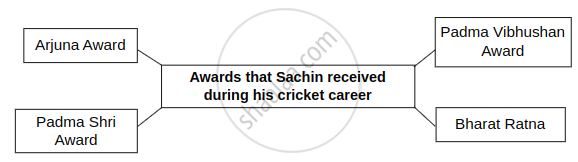
Sachin Ramesh Tendulkar who was born on 24th April 1973 in Mumbai is a former Indian International Cricketer and a former captain of the Indian National Team. He is regarded as one of the greatest batsmen of all time and is often referred as the ‘God of cricket’ by Indian Cricket followers. He made his debut on 15th November 1989 against Pakistan in ‘Karachi’ at the age of sixteen. He is the only player to have scored one hundred international centuries and only player to complete more than 30,000 runs in international cricket. He was trained under the able guidance of Ramakant Achrekar Sir. He received the Arjuna Award in 1994, Rajiv Gandhi Khel Ratna Award in 1997, Padma Shri and Padma Vibhushan Awards in 1999 and 2008 respectively, fourth and second highest civilian awards of India. He was also awarded the Bharat Ratna, highest civilian award of India in 2013. He is a devotee of the deity Ganesha.

A1. Complete the following sentences from the passage:  (2)

  1. Sachin was born on _____.
  2. Sachin is a devotee of the deity ______.
  3. He was trained under the able guidance of ______.
  4. He made debut on ______.

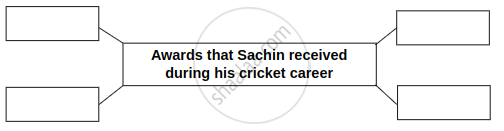
A2. Complete the web diagram:  (2)
A3. Match the ‘Synonyms’:  (2)

  ‘A’   ‘B’
i. debut a. previous
ii. received b. God
iii. former c. got
iv. deity d. first performance

A4. Do as directed:  (2)

  1. He made his debut. (Make ‘Simple Future Tense’.)
  2. He received the Arjuna Award. (Choose the correct Q-tag.)
    1. did he?
    2. didn’t he?
    3. doesn’t he?

A5. Do you like to play games? Why?  (2)

आकलन
Advertisements

उत्तर

A1. 

  1. Sachin was born on 24th April 1973.
  2. Sachin is a devotee of the deity Ganesha.
  3. He was trained under the able guidance of Ramakant Achrekar Sir.
  4. He made debut on 15th November 1989.

A2. 
A3. 

  ‘A’   ‘B’
i. debut d. first performance
ii. received c. got
iii. former a. previous
iv. deity b. God

A4. 

  1. He will make his debut.
  2. didn’t he?

A5. Yes, I like to play games. Because playing sports increases physical strength. Sports can also serve as a form of stress relief and relaxation.

shaalaa.com
Unseen Passage Comprehension
  क्या इस प्रश्न या उत्तर में कोई त्रुटि है?
2022-2023 (March) Official

संबंधित प्रश्न

During the devastating July 2005 floods that hit Mumbai, Rajen Dutia received an urgent call from a relative, Lopa Vyas late in the evening. “A friend’s mother is stranded near your home, Rajen. Can you please take her home? Her name is Rashmi,” Vyas told him.
Mumbai had come to a halt and people were trapped everywhere. Despite power failure and raging rain, Dutia stepped out and made his way to the spot, where he found Rashmi as well as a dozen other people. They were stranded in the dark, shivering in the rain. They all lived far away and had no place to go for the night.
Rajen took all of them to his one-bedroom flat, where he served them dinner and invited them to spend the night.
"By doing so," says Rajen, "I was simply fulfilling my karma, paying the universe back for the good it had done for me."

"God is kind. My daughter had just started her new job that day, and had gone for her training. She was stranded too. While she was trying to get to our relatives, she almost drowned, but a young stranger saved her. He and his friends even dropped her to my relative's place and phoned me to say she was safe. One good turn deserves another."

A2. Order
Look at the following sentences from the passage and put them in the correct sequence: (2)
(a) He took them to his one-bedroom flat.
(b) Rajen found Rashmi as well as a dozen other people shivering in the rain.
(c) Mumbai had come to a halt and people were trapped everywhere.
(d) Rajen Dutia received an urgent call.

A3

During the devastating July 2005 floods that hit Mumbai, Rajen Dutia received an urgent call from a relative, Lopa Vyas late in the evening. “A friend’s mother is stranded near your home, Rajen. Can you please take her home? Her name is Rashmi,” Vyas told him.
Mumbai had come to a halt and people were trapped everywhere. Despite power failure and raging rain, Dutia stepped out and made his way to the spot, where he found Rashmi as well as a dozen other people. They were stranded in the dark, shivering in the rain. They all lived far away and had no place to go for the night.
Rajen took all of them to his one-bedroom flat, where he served them dinner and invited them to spend the night.
"By doing so," says Rajen, "I was simply fulfilling my karma, paying the universe back for the good it had done for me."

"God is kind. My daughter had just started her new job that day, and had gone for her training. She was stranded too. While she was trying to get to our relatives, she almost drowned, but a young stranger saved her. He and his friends even dropped her to my relative's place and phoned me to say she was safe. One good turn deserves another."

A2. Order
Look at the following sentences from the passage and put them in the correct sequence: (2)
(a) He took them to his one-bedroom flat.
(b) Rajen found Rashmi as well as a dozen other people shivering in the rain.
(c) Mumbai had come to a halt and people were trapped everywhere.
(d) Rajen Dutia received an urgent call.

A3(i). Fill in the blanks :
Select the words given in the passage (1)
(i) Thousands Of pilgrims were …………….. due to the cloud burst in Uttarakhand.
(ii) The tiger was ……………… by the hunter.

(ii). Antonyms:
Select the correct antonyms for the given words from the alternatives :
(1) Please :
(a) unplease (b) displease (c) misplease
(2) Safe: '
(a) insafe (b) safeless (c) unsafe

A4(i) Tags :
Select the correct tag for the alternatives given below :
One good turn deserves another.
(a) Doesn’t it? (b) don’t it (c) does it?

(ii). Guess:
Choose the correct answer : (1)
Rajen can you please take her home? ‘Can’ indicates :
(a) Obligation (b) ability (c) permission

A5. Personal Response :
‘ one good turn
Deserves another.’
Explain with an
example of your own.


Look at the balloons. Which are the qualities inculcated in the author by her teacher? Write them. (2)

Sister Monica, however, wasn't quite as lenient as that, and spent most of the time telling me about the importance of regularity and hard work. She made me realise that success is, like genius, 99 per cent perspiration and 1 per cent inspiration. It's a lesson that has stood me in good stead.
The teachers I'm most grateful to, though, are not those who have taught me the most, but those who have simply been friends to me, believed me and believed in me. Prominent among them is Sudha Ramasubramanium-Rambo, as we used to call her. I didn't know her too well. She taught me in college, and apart from being incredible in class unless one missed class, she also believed that I actualIy had a Problem when I developed an injury (which several doctors found difficult to diagnose). Despite my missing an exam-the HSC, of all exams- she was the only person who told me to concentrate on my health and assured me that I could take the exam off the top of my head any time I wanted to.
I'm not even certain she remembers it, but at the time, it felt like one of the only rays of hope in an extremely dark tunnel. Perhaps few teachers realize how far their influence extends or how much of a difference their actions and words can make. A number of my teachers have unfortunately taught me kindness and tolerance and patience by being precisely the opposite, and quite obviously, they aren't the people I like to think about. But many of my teachers have been extraordinary people, who have not only taught me in class but also helped mould me and my character in every other way. I only hope that I live up to what their endeavors were undoubtedly mean to create.

B2.Answer
(1) What kind of teachers are disliked by the author?                                                                (1)
(2) What was Sudha Ramasubramanium's advice to the author when she was going to miss her HSC exam. ?                                                                                                                                 (1)

B3. Match :
Match the words with their appropriate meanings :                                                                     (2)

‘A’ ‘B’
(i) Prominent (a) Treatment
(ii) Incredible (b) Natural
(iii) Diagnose (c) Unbelievable
(iv) Endeavours (d) Noticeable
  (e) Efforts
  (f) Identify a disease

B.4(i) ‘Wh question’
She made me realize that success is, like genius.                                                                  (1)
(Frame a ‘Wh’ question to get the underlined part as an answer)

(ii) She taught me in college.                                                                                                (1)
(Begin the sentence with ‘I’ and rewrite).

B5. Personal Response
Do you agree that a teacher should also be your good friend? Justify your answer.                    (2)


B1. Choose
Choose the correct alternatives and complete the sentences (2)
(1) The narrator is :
(a) an astronaut
(b) an engineer studying in BITS Pilani
(c) in the team of astronauts.

(2) Armstrong said, 'That's one small step for a man, one giant leap for mankind which means:
(a) one step on the moon means, many steps on the earth.
(b) he felt like a giant on the moon.
(c) one moon mission had opened up many avenues in science and technology for mankind.

It was late evening of July 20. 1969, when we turned up the hostel radio. I was an engineering student at BITS, Pilani. I still remember the feverish excitement that gripped us from July 16 when Apollo 11. the US space rocket, took off from Cape Kennedy, Florida. Neil Armstrong and his team of astronauts, Edwin "Buzz" Aldrin and Michael Collins, were to land on moon, for the first time in human history. We listened 'with rapt attention when Armstrong declared: "That's one small step for a man, one giant leap for mankind."
His death on Saturday, August 25, is a moment to salute the romance of space science that Apollo 11 unleashed. It has changed forever the way we look at our planet Earth and its satellite, the moon.
Standing on powdery moondust, Armstrong put up his thumb, shut one eye and found his thumb blotting out the Earth. "It suddenly struck me that that tiny pea, pretty and blue, was the Earth” he said later. "I felt very, very small." But behind that humbling realisation stood a giant truth:

The effort to explore the universe united mankind in technology and knowledge. Each moon mission, about 110 till date, provided more confidence to take on bolder projects.

B2. Complete                                                                                                                         (2)
(1) Armstrong describes the earth as ……………
(2) The effort to explore the universe has ………………
(3) Apollo 11 unleashed and changed forever ………………
(4) The author came to know about Apollo 11 mission when he …………..

B3. Solve
Solve the crossword with the clues given below. Refer to the passage for your answers:              (2)

Down :   (1) The area beyond the earth's atmosphere .
             (2) The name of the spacecraft that Armstrong travelled.
Across : (3) A person trained to travel in space.
             (4) Y A natural satellite of the earth.

B4. Begin the sentence
(i) With-For the first time .......and rewrite                                                                               [1]
Neil Armstrong, Edwin Aldrin and Michael Collins were, to land on the moon for the first time.
(ii) Insert 'that' appropriately and rewrite.                                                                               [1]
Armstrong found his thumb blotting out the Earth.

B5. Personal Response
Would you like to be an astronaut? Give reasons.


The natural life span of a domesticated horse is about 25 – 30 years, 10 years down from what it was in the wild. You can tell a horse’s age from the number of teeth he has. They get all their teeth by the age of 5, after which those teeth just get longer. Horses have close to 360 degree all round vision. The only place they cannot see is directly behind or right in front of themselves, which is why it’s dangerous to stand behind a horse. If they later I it also means that they cannot see a jump once they are about four feet from it, and have to rely on memory as to its height and shape! Each of the horse’s two eyes work independently wherever a horse’s ear points is where the horse is looking. A horse is able to sleep standing up as he is able to lock his leg muscles so that he dosen’t fall asleep. Nor do all horses in the same field ever lie down at once – one animal always stands “on look out” duty.

1) What is the life span of a wild horse?
(2) Why do the horse owners cover their horse’s eyes with blinkers?
(3) What prevents a horse from falling while asleep?
(4)
(a) Falls /shorter/ the mane/ on the/ side/ legged.[Rearrange the words to make a meaningful sentence]
(b) Form antonyms by adding a prefix :
(i) able
(ii) direct 
(5)
(a) They get all their teeth by the age of five. [Pick out the prepositions]
(b) If they feel something behind them they may kick. [Rewrite using ‘unless’]
(6) How have horses helped man through the ages?


The hopping kangaroo is a familiar sight in every snapshot relating to Australia. Members of the kangaroo family can be as small as a rat or as big as a man. Kangaroos are found mainly in Australia, Tasmania and New Guinea. Kangaroos, which are big-footed marsupials that evolved in Australia, use their short front legs like arms. The man-sized kangaroos of Australia are capable of speeding up to 88 km/hr for short distances, their means of locomotion being their powerful hind legs, which carry them over the ground in jumps of 9 m or more at a time.
Weighing around 70 kg, they have an average lifespan of around six to eight years and a maximum lifetime of 20 years. When bothered by predators, kangaroos often head for the water, standing submerged to the chest and attempting to drown the attacker by holding him under water. Another defensive technique is to get their back to a tree and kick at their adversary with their clawed hind feet, sometimes with sufficient force to kill a man. Normally shy animals, they alert other kangaroos to danger by beating on the ground with their hind feet. This loud alarm signal carries over a long distance.
The tail is important for kangaroos. It holds them in balance and supports them when they sit or fight against other kangaroos. The kangaroo uses its short legs as arms. With them it scratches itself, cleans its fur and holds branches when it eats leaves. Kangaroos are marsupials and the females carry newborns in a pouch in front of their abdomens. The babies are born small and climb up into safety of the pouch. There, for the next 225 days or so, they eat, sleep and grow. Once they reach full development, they leave the pouch. A young kangaroo that leaves the pouch is called a ‘joey’. To keep from getting too hot, the kangaroos take naps in the afternoon and do most of their grazing at night. But the best stay-cool secret of these creatures is the spit bath! Kangaroos drool and lick saliva all over their faces and bodies to cool down.

On the basis of your reading of the above passage, complete the following sentences with appropriate words/phrases:
(a) When followed by predators, kangaroos submerge ____________ and _________________.

(b) The powerful hind legs help kangaroos to __________________.

(c) Kangaroos are mainly found in Australia and are ____________________.

(d) They use their front legs to ___________________.

(e) Kangaroos warn others of danger by _______________________.

(f) The secret of kangaroos to stay cool is ______________________.

(g) They use their tails to _________________________.

(h) Before becoming ‘joeys’, the young ones stay in the ______________ and ________________.


He holds him with his skinny hand,

“There was a ship,” quoth he.

i. Who does ‘He’ refer to in the above extract?

ii. What do we know about the speaker’s feelings?

iii. Why is his hand called ‘skinny’?


One of the greatest advances in modern technology has been the invention of computers. They are widely used in industries and in universities. Now there is hardly any sphere of human life where computers have not been pressed into service of man. We are heading fast towards the day when a computer will be as much part of man's daily life as a telephone or a calculator.

Computers are capable of doing extremely complicated work in all branches of learning. They can solve the most complex mathematical problems or put thousands of unrelated facts in order. These machines can be put to varied uses. For instance, they can provide information on the best way to prevent traffic jams. This whole process by which machines can be used to work for us has been called 'automation'. In the future 'automation' may enable human beings to enjoy more leisure than they do today. The coming of automation is bound to have important social consequences.

Some years ago an expert on automation, Sir Leon Bagrit, pointed out that it was a mistake to believe that these machines could 'think'. There is no possibility that human beings will be "controlled by machines". Though computers are capable of learning from their mistakes and improving on their performance, they need detailed instructions from human beings to operate. They can never, as it were, lead independent lives or "rule the world" by making decisions of their own.

Sir Leon said that in future, computers would be developed which would be small enough to carry in the pocket. Ordinary people would then be able to use them to obtain valuable information. Computers could be plugged into a national network and be used like radios. For instance, people going on holiday could be informed about weather conditions. Car drivers can be given alternative routes when there are traffic jams. It will also be possible to make tiny translating machines. This will enable people who do not share a common language to talk to each other without any difficulty or to read foreign publications.

a) What is the greatest advancement in modern technology?

b) What complicated works are computers capable of doing?

c) Write one use of computers.

d) Explain automation.

e) Why can't computers lead independent lives or rule the world?

f) How would computers as translating machines help people? 

g) What was the prediction of Sir Leon about computers in the future?

h) How can computers help people going on holiday?


Read the passage given below and answer the questions that follow:

If you are addicted to coffee, and doctors warn you to quit the habit, don’t worry and just keep relishing the beverage, because it’s not that bad after all! In fact, according to a new study, the steaming cup of Java can beat fruits and vegetables as the primary source of antioxidants. Some studies state that coffee is the number one source of antioxidants in American diet, and both caffeinated and decaf versions appear to provide similar antioxidant levels.

Antioxidants in general have been linked to a number of potential health benefits, including protection against heart diseases and cancer, but Vinson, a dietitian said that their benefits ultimately depend on how they are absorbed and utilized in the body. The research says that coffee outranks popular antioxidant sources like tea, milk, chocolate and cranberries. Of all the foods and beverages studied, dates actually have the most antioxidants based solely on serving size, but since dates are not consumed anywhere near the level of coffee, the drink comes as the top source of antioxidants, Vinson said.

Besides keeping you alert and awake, coffee has been linked to an increasing number of potential health benefits, including protection against liver and colon cancer, type 2 diabetes, and Parkinson’s disease, according to some recently published studies. The researchers, however, advise that one should consume coffee in moderation, because it can make you jittery and cause stomach pains

(a) What do doctors advise us about the habit of drinking coffee?
 
(b) What are the two versions of coffee that are drunk in America?
 
(c) State any two benefits of antioxidants.
 
(d) What does Vinson say about the consumption of antioxidants?
 
(e) Name any two popular sources of antioxidants.
 
(f) How does coffee outrank dates in the level of antioxidants?
 
(g) Mention any two benefits of coffee.
 
(h) What do researchers warn us about the excessive use of coffee?


Read the passage given below :

Kausani is situated at a height of 6,075 feet in the Central Himalayas. It is an unusally attractive little town. It covers just about 5.2 sq. kms. It lies to the north of Almora in Uttarakhand's picturesque kumaon region.

Kausani provides the 300-km wide breathtaking view of the Himalayas. It is the most striking aspect of the place. Snow-capped peaks are spread in a stately row. They stare at you in silvery white majesty. The most famous peak on view is Nanda Devi, the second highest mountain in India. It is situated at a height of 25.645 feet and 36 miles away as the crow files. The other famous peaks on view are choukhamba (23,420 feet) and Trishul (23,360 feet). Then there are also Nilkanth, Nandaghunti, Nandaghat and Nandakot. On a clear day, the blue of the sky makes a splendid background to these peaks. At sunrise and at sunset, when the colour changes to a golden orange, the scene gets etched in your memory.

When Gandhiji visited this place in 1929, its scenic beauty held him spellbound. He named it the 'Switzerland of Indian'. He prolonged his two-day stay to fourteen days, making time to write a book, 'Anashakti Yoga'. The place where he was staying was originally a guest-house of the tea estate. It was renamed 'Anashakti Ashram' after the book.

Kausani is the birthplace of Sumitranandan Pant, India's poet laureate. Its natural surroundings inspired many of his poems. Its tea gardens mingle with dense pine forests and fruit orchards. The area is also host to many fairs and religious caremonies. If Uttaranchal is the abode of gods, Kausani is God's own backyard. There is no traffic, no one is in a hurry. If serenity could be put on a canvas, the picture would resemble Kausani.

On the basis of your reading of the above passage, answer the following questions :

(a) Where is Kausani situated ?

(b) What is the most striking aspect of Kausani ?

(c) Which is the most famous peak on view from Kausani ?

(d) How did Kausani influence Sumitranandan Pant ?

(e) When does the view of peaks become so memorable ?

(f)  How can we say that Gandhiji was greatly charmed by the natural beauty of Kausani ?

(g) What makes Kausani a calm and quiet place ?

(h) Why, do you think, is Kausani known as 'God' s own backyard' ?


Read the passage given below :

1. When you grow up in a place where it rains five months a year, wise elders help you to get acquainted with the rain early. They teach you that it is ignorant to think that it is the same rain falling every day. Oh no, the rain is always doing different things at different times. There is rain that is gentle, and there is also rain that falls too hard and damages the crops. Hence, the prayer for the sweet rain that helps the crops to grow.

2. The monsoon in the Naga hills goes by the native name, khuthotei (which means the rice-growing season). It lasts from May to early or mid-October. The local residents firmly believe that Durga Puja in October announces the end of rain. After that, one might expect a couple of short winter showers, and the spring showers in March and April. Finally, comes the "big rain" in May; proper rainstorms accompanied by heart-stopping lightning and ear-splitting thunder. I have stood out in storms looking at lightning are across dark skies, a light-and-sound show that can go on for hours.

3. This is the season when people use the word sezuo or süzu to refer to the week-long rains, when clothes don't dry and smell of mould, when fungus forms on the floor and when you can't see the moon or the stars because of the rainclouds. But you learn not to complain. Rain, after all, is the farmer's friend and brings food to the table. Rituals and festivals centre around the agricultural rhythm of life, which is the occupation of about 70 percent of the population.

4. The wise learn to understand its ways. I grew up hearing my grandfather say. "It's very windy this year. We'll get good rain." If the windy season was short and weak, he worried there might not be enough rain for the crops. I learned the interconnectedness of the seasons from childhood, and marvelled at how the wind could bring rain. Another evening, many rainy seasons ago, my paternal aunt observed the new moon and worried, "Its legs are in the air, we're in for some heavy rain." She was right. That week, a storm cut off power lines and brought down trees and bamboos.

5. Eskimos boast of having a hundred names for snow. Norwegians in the north can describe all kinds of snow by an equal amount of names : pudder, powder snow, wet snow, slaps, extra wet snow, tight snowfall, dry snow, and at least 95 more categories of snow. Likewise, in India we have names and names for rain. Some are common, some are passing into history.

6. The rains are also called after flowering plants and people believe that the blossoming of those plants draws out rain. Once the monsoons set in, field work is carried out in earnest and the work of uprooting and transplanting paddy in flooded terrace fields is done. The months of hard labour are June, July and August. In August, as the phrogü plant begins to bloom, a rain will fall. this August rain, also called phrogü, is a sign that the time for cultivation is over. If any new grain seeds are sown, they may not sprout; even if they do sprout, they are not likely to bear grain. The rain acts as a kind of farmer's almanac.

7. The urban population of school-goers and office-goers naturally dislikes the monsoon and its accompanying problems of landslides, muddy streets and periodic infections. For non-farmers, the month of September can be depressing, when the rainfall is incessant and the awareness persists that the monsoons will last out till October. One needs to have the heart of a farmer to remain grateful for the watery days, and be able to observe – from what seems to the inexperienced as a continuous downpour – the many kinds of rain. Some of the commonly known rain-weeks are named after the plants that alternately bloom in August and September. The native belief is that the flowers draw out the rain.
8. Each rain period has a job to fulfil : October rain helps garlic bulbs to form, while kümünyo rain helps the rice bear grain. Without it, the ears of rice cannot form properly. End October is the most beautiful month in the Naga hills, as the fields turn gold and wild sunflowers bloom over the slopes, all heralding the harvest. Prayers go up for protecting the fields from storms, and the rains to retreat because the grain needs to stand in the sun and ripen. The cycle nears completion a few weeks before the harvest, and the rain does retreat so thoroughly from the reaped furrows that the earth quickly turns hard. The months of rain become a distant memory until it starts all over again.

On the basis of your understanding of the above passage, complete the statements given below with the help of options that follow:
a) The rains are called after flowering plants because

(i) heavy rains kill plants.
(ii) flowers grow in the rainy season.
(iii) it is believed that the plants bring the rain.
(iv) flowers grow all the year round.


b) The rain is like a calendar for farmers because

(i) it tells them when to sow and when to harvest.
(ii) it tells them the birthdays of their children.
(iii) each month has a time for plantation.
(iv) different kinds of rain tell different things.


c) People who live in cities don't like rain because

(i) it brings mud and sickness with it.
(ii) they are not bothered about the farmers.
(iii) they don't like the plants that grow during the rain.
(iv) going shopping becomes difficult.


d) People pray asking the rain the retreat because

(i) the fungus and mould need to dry.
(ii) children don't get a chance to play.
(iii) the crops need the sun and heat to ripen.
(iv) they like to pray.


Answer the following questions briefly:
e) Why do the elders want you to understand the rains in the Naga hills?

f) What does Durga Puja mean to the farmers of the Naga hills?

g) What kind of rain is called sezuo?

h) What is the occupation of more than half the population of the Naga hills?

i) How is the heart of the farmer different from that of the city person?

j) When does rain becomes a memory in the minds of the of the Naga hills?

k) Find words from the passage which mean the same as the following:

(i) flowering (para 6)
(ii) nonstop (para 7)

Read the passage given below and answer the questions that follow:            
 1. We sit in the last row, bumped about but free of stares. The bus rolls out of the dull crossroads of the city, and we are soon in open countryside, with fields of sunflowers as far as the eye can see, their heads all facing us. Where there is no water, the land reverts to desert. While still on level ground we see in the distance the tall range of the Mount Bogda, abrupt like a shining prism laid horizontally on the desert surface. It is over 5,000 metres high, and the peaks are under permanent snow, in powerful contrast to the flat desert all around. Heaven Lake lies part of the way up this range, about 2,000 metres above sea-level, at the foot of one of the higher snow-peaks.
 2. As the bus climbs, the sky, brilliant before, grows overcast. I have brought nothing warm to wear: it is all down at the hotel in Urumqi. Rain begins to fall. The man behind me is eating overpoweringly smelly goat's cheese. The bus window leaks inhospitably but reveals a beautiful view. We have passed quickly from desert through arable land to pasture, and the ground is now green with grass, the slopes dark with pine. A few cattle drink at a clear stream flowing past moss-covered stones; it is a Constable landscape . The stream changes into a white torrent, and as we climb higher I wish more and more that I had brought with me something warmer than the pair of shorts that have served me so well in the desert .The stream (which, we are told rises in Heaven Lake) disappears, and we continue our slow ascent. About noon, we arrive at Heaven Lake, and look for a place to stay at the foot, which is the resort area. We get a room in a small cottage, and I am happy to note that there are thick quilts on the beds.

3. Standing outside the cottage we survey our surroundings. Heaven Lake is long, sardine-shaped and fed by snowmelt from a stream at its head. The lake is an intense blue, surrounded on all sides by green mountain walls, dotted with distant sheep. At the head of the lake, beyond the delta of the inflowing stream, is a massive snow-capped peak which dominates the vista; it is part of a series of peaks that culminate, a little out of view, in Mount Bogda itself.

 4. For those who live in the resort there is a small mess-hall by the shore. We eat here sometimes, and sometimes buy food from the vendors outside, who sell kabab and naan until the last buses leave. The kababs, cooked on skewers over charcoal braziers, are particularly good; highly spiced and well-done. Horse's milk is available too from the local Kazakh herdsmen, but I decline this. I am so affected by the cold that Mr. Cao, the relaxed young man who runs the mess, lends me a  spare pair of trousers, several sizes too large but more than comfortable. Once I am warm again, I feel a pre-dinner spurt of energy – dinner will be long in coming – and I ask him whether the lake is good for swimming in.
 5. "Swimming?" Mr. Cao says. "You aren't thinking of swimming, are you?"
 6. "I thought I might," I confess. "What's the water like?"
 7. He doesn't answer me immediately, turning instead to examine some receipts with exaggerated interest. Mr. Cao, with great off-handedness, addresses the air. "People are often drowned here," he says. After a pause, he continues. "When was the last one?" This question is directed at the cook, who is preparing a tray of mantou (squat white steamed bread rolls), and who now appears, wiping his doughy hand across his forehead. "Was it the Beijing athlete?" asks Mr. Cao.

On the basis of your understanding of the above passage, complete the statements given below with the help of options that follow:

(a) One benefit of sitting in the last row of the bus was that:
(i) the narrator enjoyed the bumps.
(ii) no one stared at him.
(iii) he could see the sunflowers.
(iv) he avoided the dullness of the city.

(b) The narrator was travelling to:
(i) Mount Bogda
(ii) Heaven Lake
(iii) a 2000 metre high snow peak
(iv) Urumqi

(c) On reaching the destination the narrator felt relieved because:
(i) he had got away from the desert.
(ii) a difficult journey had come to an end.
(iii) he could watch the snow peak.
(iv) there were thick quilts on the bed.

(d) Mount Bogda is compared to:
(i) a horizontal desert surface
(ii) a shining prism
(iii) a Constable landscape
(iv) the overcast sky

Answer the following questions briefly:
(e) Which two things in the bus made the narrator feel uncomfortable?
(f) What made the scene look like a Constable landscape?
(g) What did he regret as the bus climbed higher?
(h) Why did the narrator like to buy food from outside?
(i) What is ironic about the pair of trousers lent by Mr. Cao?
(j) Why did Mr. Cao not like the narrator to swim in the lake?
(k) Find words from the passage which mean the same as the following:
(i) sellers (para 4)
(ii) increased (para 7)

Read the passage given below and answer the questions that follow:          
 1. Thackeray reached Kittur along with a small British army force and a few of his officers. He thought that the very presence of the British on the outskirts of Kittur would terrorise the rulers and people of Kittur and that they would lay down their arms. He was quite confident that he would be able to crush the revolt in no time. He ordered that tents be erected on the eastern side for the fighting forces and a little away on the western slopes tents be put up for the family members of the officers who had accompanied them. During the afternoon and evening of 20thOctober, the British soldiers were busy making arrangements for these camps.
 

2. On the 21st morning, Thackeray sent his political assistants to Kittur fort to obtain a written assurance from all the important officers of Kittur rendering them answerable for the security of the treasury of Kittur. They, accordingly, met Sardar Gurusiddappa and other officers of Kittur and asked them to comply with the orders of Thackeray. They did not know that the people were in a defiant mood. The commanders of Kittur dismissed the agent’s orders as no documents could be signed without sanction from Rani Chennamma.
 
3. Thackeray was enraged and sent for his commander of the Horse Artillery, which was about 100 strong, ordered him to rush his artillery into the fort and capture the commanders of the Desai’s army. When the Horse Artillery stormed into the fort, Sardar Gurusiddappa, who had kept his men on full alert, promptly commanded his men to repel and chase them away. The Kittur forces made a bold front and overpowered the British soldiers.
 
4. In the meanwhile, the Desai’s guards had shut the gates of the fort and the British Horse Artillery men, being completely overrun and routed, had to get out through the escape window. Rani’s soldiers chased them out of the fort, killing a few of them until they retreated to their camps on the outskirts.
 
5. A few of the British had found refuge in some private residences, while some were hiding in their tents. The Kittur soldiers captured about forty persons and brought them to the palace. These included twelve children and a few women from the British officers’ camp. When they were brought in the presence of the Rani, she ordered the soldiers to be imprisoned. For the women and children she had only gentleness, and admonished her soldiers for taking them into custody. At her orders, these women and children were taken inside the palace and given food and shelter. Rani came down from her throne, patted the children lovingly and told them that no harm would come to them.
 
6. She, then, sent word through a messenger to Thackeray that the British women and children were safe and could be taken back any time. Seeing this noble gesture of the Rani, he was moved. He wanted to meet this gracious lady and talk to her. He even thought of trying to persuade her to enter into an agreement with the British to stop all hostilities in lieu of an inam (prize) of eleven villages. His offer was dismissed with a gesture of contempt. She had no wish to meet Thackeray. That night she called Sardar Gurusiddappa and other leading Sardars and after discussing all the issues came to the conclusion that there was no point in meeting Thackeray who had come with an army to threaten Kittur into submission to British sovereignty.

On the basis of your understanding of the above passage complete the statements given below with the help of options that follow:
(a) Thackeray was a/an :
(i) British tourist
(ii) army officer
(iii) adviser to Rani of Kittur
(iv) treasury officer
 
(b) British women and children came to Kittur to :
(i) visit Kittur
(ii) enjoy life in tents
(iii) stay in the palace
(iv) give company to officers
 
Answer the following questions briefly:
(c) Why did Thackeray come to Kittur?
(d) Why did the Kittur officials refuse to give the desired assurance to Thackeray?
(e) What happened to the Horse Artillery?
(f) How do we know that the Rani was a noble queen?
(g) How in your opinion would the British women have felt after meeting the Rani?
(h) Why did the Rani refuse to meet Thackeray?
(i) Find words from the passage which mean the same as the following :
i. entered forcibly (para 3)
ii. aggressive/refusing to obey (para 2)

1. Read the passage given below :
 1. Maharana Pratap ruled over Mewar only for 25 years. However, he accomplished so much grandeur during his reign that his glory surpassed the boundaries of countries and time turning him into an immortal personality. He along with his kingdom became a synonym for valour, sacrifice and patriotism. Mewar had been a leading Rajput kingdom even before Maharana Pratap occupied the throne. Kings of Mewar, with the cooperation of their nobles and subjects, had established such traditions in the kingdom, as augmented their magnificence despite the hurdles of having a smaller area under their command and less population. There did come a few thorny occasions when the flag of the kingdom seemed sliding down. Their flag once again heaved high in the sky thanks to the gallantry and brilliance of the people of Mewar.
 

2. The destiny of Mewar was good in the sense that barring a few kings, most of the rulers were competent and patriotic. This glorious tradition of the kingdom almost continued for 1500 years since its establishment, right from the reign of Bappa Rawal. In fact only 60 years before Maharana Pratap, Rana Sanga drove the kingdom to the pinnacle of fame. His reputation went beyond Rajasthan and reached Delhi. Two generations before him. Rana Kumbha had given a new stature to the kingdom through victories and developmental work. During his reign, literature and art also progressed extraordinarily. Rana himself was inclined towards writing and his works are read with reverence even today The ambience of his kingdom was conducive to the creation of high quality work of art and literature. These accomplishments were the outcome of a longstanding tradition sustained by several generations.
 
3. The life of the people of Mewar must have been peaceful and prosperous during the long span of time; otherwise such extraordinary accomplishment in these fields would not have been possible. This is reflected in their art and literature as well as their loving nature. They compensate for lack of admirable physique by their firm but pleasant nature. The ambience of Mewar remains lovely thanks to the cheerful and liberal character of its people.
 
4. One may observe astonishing pieces of workmanship not only in the forts and palaces of Mewar but also in public utility buildings. Ruins of many structures which are still standing tall in their grandeur are testimony to the fact that Mewar was not only the land of the brave but also a seat of art and culture. Amidst aggression and bloodshed, literature and art flourished and creative pursuits of literature and artists did not suffer. Imagine, how glorious the period must have been when the Vijaya Stambha which is the sample of our great ancient architecture even today, was constructed. In the same fort, Kirti Stambha is standing high, reflecting how liberal the then administration was which allowed people from other communities and kingdoms to come and carry out construction work. It is useless to indulge in the debate whether the Vijaya Stambha was constructed first or the Kirti Stambha. The fact is that both the capitals are standing side by side and reveal the proximity between the king and the subjects of Mewar.
 
5. The cycle of time does not remain the same Whereas the reign of Rana Sanga was crucial in raising the kingdom to the acme of glory, it also proved to be his nemesis. History took a turn. The fortune of Mewar – the land of the brave, started waning. Rana tried to save the day with his acumen which was running against the stream and the glorious traditions for sometime.
On the basis of your understanding of the above passage answer each of the questions given below with the help of options that follow :
 
(a) Maharana Pratap became immortal because :
(i) he ruled Mewar for 25 years.
(ii) he added a lot of grandeur to Mewar.
(iii) of his valour, sacrifice and patriotism.
(iv) both (ii) and (iii)
 
(b) Difficulties in the way of Mewar were :
(i) lack of cooperation of the nobility.
(ii) ancient traditions of the kingdom.
(iii) its small area and small population.
(iv) the poverty of the subjects.

(c) During thorny occasions :
(i) the flag of Mewar seemed to be lowered.
(ii) the flag of Mewar was hoisted high.
(iii) the people of Mewar showed gallantry.
(iv) most of the rulers heaved a sigh of relief.
 
(d) Mewar was lucky because :
(i) all of its rulers were competent.
(ii) most of its people were competent.
(iii) most of its rulers were competent.
(iv) only a few of its people were incompetent.
 
Answer the following questions briefly:
(e) Who is the earliest king of Mewar mentioned in the passage?
(f) What was Rana Kumbha's contribution to the glory of Mewar?
(g) What does the writer find worth admiration in the people of Mewar?
(h) How could art and literature flourish in Mewar?
(i) How did the rulers show that they cared for their subjects?
(j) What does the erection of Vijaya Stambha and Kirti Stambha in the same fort signify ?
(k) Find words from the passage which mean the same as each of the following:
(i) surprising (para 4)
(ii) evidence (para 4)

Read the passage given below:

People tend to amass possessions, sometimes without being aware of doing so. They can have a delightful surprise when they find something useful which they did not know they owned. Those who never have to change house become indiscriminate collectors of what can only be described as clutter. They leave unwanted objects in drawers, cupboards, and attics for years in the belief that they may one day need them. Old people also accumulate belongings for two other reasons, lack of physical and mental energy, and sentiment. Things owned for a long time are full of associations with the past, perhaps with the relatives who are dead, and so they gradually acquire a sentimental value.

Some things are collected deliberately in an attempt to avoid wastage. Among these are string and brown paper, kept by thrifty people when a parcel has been opened. Collecting small items can be mania. A lady cuts out from newspaper sketches of model clothes that she would like to buy if she had money. As she is not rich, the chances are that she will never be able to afford such purchases. It is a harmless habit, but it litters up her desk.

Collecting as a serious hobby is quite different and has many advantages. It provides relaxation for leisure hours, as just looking at one’s treasure is always a joy. One doesn’t have to go out for amusement as the collection is housed at home. Whatever it consists of - stamps, records, first editions of books, china – there is always something to do in connection with it, from finding the right place for the latest addition to verifying facts in reference books. This hobby educates one not only in the chosen subject but also in general matters which have some bearing on it.

There are other benefits also. One gets to meet like-minded collectors to get advice, compare notes, exchange articles, to show off one’s latest find. So one’s circle of friends grows. Soon the hobby leads to traveling, perhaps a meeting in another town, possibly a trip abroad in search of a rare specimen, for collectors are not confined to one country. Over the years one may well become an authority on one’s hobby and will probably be asked to give informal talks to little gatherings and then, if successful, to larger audiences.

(a) On the basis of your understanding of the above passage make notes on it using headings and sub-headings. Use recognizable abbreviations (wherever necessary-minimum four) and a format you consider suitable. Also, supply an appropriate title to it.

(b) Write a summary of the passage in about 80 words.


Read the following extract and answer the questions given below:
The Jahangir Art Gallery, the State Bank of lndia building and the canteen close by which offered affordable fare, the amazing street fare, bhelpuri and vadapav. The joy of reading Bombay Times with its page 3 people one would never meet but who seemed like old friends. The Strand bookstore where one could browse for hours. And just when a book was longingly but firmly put down from nowhere, Mr Shanbagh would materialise magically at one's elbow with a special price. Not to forget the joys of trawling the booklined pavements at Fountain, where one could watch the world go by. And wherever I chose to go, there was always my friend, the sea, oh. I loved her, in all her moods, but especially in the monsoon when violent and enraged she splattered Worli seaface with walls of sea spray. My friends are lost, some passed away, some moved away, there were many whose names I never found out, though we took the train together, or met in the lift, every day.

Like every migrant, I promise myself, someday I will return. I may, perhaps, return sometime, but even so, I know, "that one cannot step into the same river twice." You seduced me steadily, o Mumbai, with your glamour and bright lights. City of dreams, tinsel town. I pay tribute to you. Today, I say good-bye with a heavy heart.

(1) What does this extract focus on?

(2) Which mood of the sea did the writer like the most?

(3) How would the writer spend her free time?

( 4) According to you, how can you make your locality clean and beautiful?

(5) Rewrite the following sentences in the ways instructed :
(i) She splattered Worli seaface with walls of sea spray.
(Rewrite it using the Simple Present tense.)

(ii) I never found out their names though we took the train together
(Make it a Compound Sentence.)

(iii) I promise myself, someday I will return.
(Rewrite it using the modal auxiliary 'must'.)

(6) Find out the words from the extract which mean -

(i) courageously

(ii) attracted


Read the following extract and answer the questions given below:
That day Reuben fold two sacks, which he took to the rambling wooden factory and sold to the man in charge of packing nails. The boy's hand tightly clutched the small five-cent pieces as he ran two kilometres home.
Near his house stood the ancient barn that housed the family's goats and chickens. Reuben found a rusty baking- soda tin and dropped his coins inside. Then he climbed into the loft of the barn and hid the can beneath a pile of sweet-smelling hay.
It was supper time when Reuben got home. His father sat at the big kitchen table, working on a fishing net. Dora was at the black kitchen range, ready to serve dinner as Reuben took his place at the table.
He looked at his mother and smiled. Sunlight from the window gilded her, shoulder-length blond hair. Five foot three, slim and beautiful, she was the centre of the home, the glue that held it together.
Her chores were never-ending. Sewing clothes for her family on the old Singer treadle machine, cooking meals and baking bread, planting a vegetable garden. milking the goats and scrubbing soiled clothes on a washboru·d. But she was happy. Her family and their wellbeing were her highest priority.
Every day after chores and school, Reuben scoured the town, collecting the burlap nail bags. On the day the two-room schoolhouse closed for the summer, no student was more delighted than Reuben. Now he would have more time to devote to his mission.

(1) What is the main theme of the extract? (1)

(2) Where did Reuben keep his savings? Why? (2)

(3) Describe Reuben's mother and her daily chores. (2)

(4) What would you like to present to your mother on Mother's Day? Why? (2)

(5) Rewrite the following sentences in the ways instructed :

(i) He looked at his mother and smiled.
(Rewrite it as a Simple Sentence.) (1)

(ii) Her family and their well-being were her highest priority.
(Rewrite it in the Positive Degree.) (1)

(iii) She was the centre of the home. (1)
(Make it a Rhetorical Question)

(6) Find out the words from the extract which mean -

(i) dried grass (1/2)

(ii) routine tasks (1/2)


Read the following extract and answer the questions given below :

  Early risers clearly have the edge in life. By the time most of us wake up, they've been through their morning rituals, enjoyed their walk, had their tea and read the daily news. They're also likely to have made long-distance calls before dawn to those similarly inclined. Thus, by the time the sun warms up they're likely to have discussed all varieties of 'men, matters, and affairs' with a dozen people.
The upshot of these varying tendencies is that such extreme contrasts often exist in the same household. Weeks pass before the younger lot (typically late risers) and the older lot (normally early birds) come face to face. It's almost as if they live in different time zones and different countries.
All over the country, things are likely to be pretty much the same in this respect, one would think. If the man of the house, any house, decides to take a day off from work, he'd probably find his son emerging from his room at about I0 a.m. and that too in a 'rubbing-eyes' mode. After fooling around for a while the lad would probably dash off to college in a rush whilst simultaneously zipping up his jeans and sending text messages on his phone. His father would undoubtedly be left shaking his head and burying himself deeper into his newspaper.

(1) What is the extract about?

(2) How do the early risers get a headstart in life?

(3) What kind of lifestyle of the young son is reflected in the extract?

(4) According to you, why do the youngsters rise up late?

(5) Rewrite the following sentences in the ways instructed:
(i) He goes for his morning walk at 1 p.m.
(Rewrite it in the Present Perfect Continuous Tense.)
(ii) They live in different time zones.
(Make it a complex sentence.)
(iii) The man decides to take a day off from work.
(Rewrite it using the noun form of the underlined word.)

(6) Find out the words from the extract which mean:
(i) have a slight advantage over
(ii) coming out


Read the following extract and answer the questions given below:
 
The special school did Chaitanya a lot of good. He was now a much more confident person, adored by his teachers, his friends and his school staff. His speech improved and expression became clearer. His social manners became laudable.
 
Academically, he was still lagging behind the expected standard of learning but it was okey. He started developing an all- around interest in craft, art, music, dancing and sports.
 
Early in 1997-98, when he returned from state level inter- school sports, he had two prizes to his credit and a silver medal. He had won his laurels in athletic events and the silver medal in a running race.
 
When I saw the prizes and read the citation Chaitanya had received, I was stupefied, in total disbelief, then- hugged him, kissed him and cried unabashedly to my heart’s content. That day, I cried for the first time out of joy and a sense of being vindicated. Without practice he had competed with approximately 1,800 children drawn from various schools all over the state. He was subsequently selected for the marathon race, but he could not participate due to a healthy problem.” May be next year, he would”, I assured myself. And I, as his proud mother, would proudly chronicle his future achievements and success to inspire other mothers of the world.
 
Looking back at my own life, I feel that it is the spirit with which we can accept our life gracefully is what matters ultimately; and it is love which nourishes us.
1. What does the extract focus on? (1)
2. How  Chaitanya’s mother react when she saw the prizes? (2)
3. What were Chaitanya’s achievements in sports? (2)
4. How can you help a special child like Chaitanya? (2)
5. Rewrite the following sentences in the ways instructed:
(i) When I saw the prizes, I was stupefied. (1)
(Rewrite the sentence using ‘No sooner…… than’)
(ii) He was still lagging behind the expected standard of learning, but it was okay. (1)
(Rewrite the sentence using ‘Although’)
(iii) He started developing an all – round interest in craft and sports. (1)
(Rewrite the sentence using infinitive form of the word underlined) 
6. Find out the words / phrases from the extract which mean: (1)
(i) to take part in = 
(ii) surprised =

Read the following extract carefully.        (4) 

I was walking around the camp, around the barracks, near the barbed wire fence where the guards could not easily see. I was alone.
On the other side of the fence. I spotted someone: a little girl with light, almost luminous curls. She was half hidden behind a birch tree. I glanced around to make sure no one saw me. I called to her softly in German, “Do you have something to eat? She didn’t understand.
I inches closer to the fence and repeated the question in Polish. She stepped forward. I was thin and gaunt, with rags wrapped around my feet, but the girl looked unafraid. In her eyes I saw life. She pulled an apple from her woolen jacket and threw it over the fence. I grabbed the fruit and, as I started to run away, I heard her say faintly, “I’ll see you tomorrow.”
I returned to the same spot by the fence at the same time every day. She was always there with something for me to eat - a hunk of bread or better yet, an apple.
We didn’t dare speak of linger. To be caught would mean death for us, both. I didn’t know anything about her. Just a kind farm girl, except that she understood Polish.
What was her name? Why was she risking her life for me? 
Question 
Imagine that you are the author’s brother Sam and rewrite it.
You may begin with: “Hello, I am Sam. My brother was walking around the camp .......”

     We were an argrarian people. And my main hobby in my early teens was to wander through paddy field to see the different kinds of birds and how they nest. On the outskirts of the paddy fields, there had been many coconut trees and black palm trees. Beautifully crafted nests of the weaver-birds thookkanaam kuruvikal-would be seen dangling from the ends of palm leaves. Hundreds of these little birds would land on the paddy to squeeze the milk from the tender rice. They would come to the fields when the young stalks come out of the rise-plants. At this stage of the paddy, my father would send me to our field with a tin drum to scare these birds away. But often I have enjoyed the sight of these little birds balancing on the tender stalks and squeezing the milk out of the green rice. When the paddy is ripe enough to harvest, flocks of parrots would land there and cut the ripe stalks with their sharp beaks and fly away with the stalks dangling in their beaks. I have always liked to see this sight also.
       The nest of parrots were neatly crafted holes in the trunks of palm trees. I continued to wonder how they made chose holes on the hard trunks until I saw the patient work of the woodpeckers. They were the carpenters and their long, sharp and strong beaks, chisels. They make the holes (in search of worms inside the weak spots of the trunks) and the parrots occupy them. If I heard the sound tak, tak, tak. I knew it was a woodpeckers chiselling a had trunk. I would go after him. It seems that the woodpecker is the only bird which can walk perpendicularly on the tree trunks! How beautiful the sight was! Its strong legs, red crest, the dark red stripe on the face and black beak and the tak, tak, tak sound used to captivate me

A1. Complete the following table :Choose two sentence that appropriately mention the theme of the passage :

(i) The extract deals with the techniques to scare the birds away.
(ii) The extract depicts how parrots make holes on the tree trunks.
(iii) The extract depicts the writer’s love towards the birds.
(iv) The extract deals with the activities of different birds.

A2. Complete the flow-chart : 

A3. Complete the following table :

A4. Vocabulary -

Match the pairs of the words in column ‘A’ with their meaning in column ‘B’ :

Column ‘A’ Column ‘B’
(i) dangling (a) connected with farming
(ii) squeezing (b) attract the attention
(iii) agrarian (c) hanging freely
(iv) captivate (d) pressing firmly

A5. Personal response - 

Suggest two measures to increase the number of birds.

A6. Grammer -

Rewrite the following sentences in the way instructed
(i) The paddy is ripe enough to harvest
(Remove ‘enough’ and rewrite the sentence.)
(ii) How beautiful the sight was!
(Rewritte as an assertive sentence)


Read the first activity, read the extract and then do all the activities:
The next year Dell enrolled at the University of Texas. Like most first-year students, he needed to earn spending money. Just about everyone on campus was talking about personal computers. At the time, anyone who didn’t have a PC wanted one, but dealers were selling them at a hefty mark-up. People wanted low-cost machines custom-made to their needs, and these were not readily available. Why should dealers get such a big mark-up for so little added value ? Dell wondered. Why not sell from the manufacturer directly to the end user ?
Dell knew that IBM required its dealers to take a monthly quota of PCs, in most cases more than they could sell. He also knew that holding excess inventory was costly. So he bought dealers’ surplus stock at cost. Back in his dormitory room, he added features to improve performance. The improved models found eager buyers. Seeing the hungry market, Dell placed local advertisements offering his customized computers at 15 percent of retail price. Soon he was selling to businesses, doctors’ offices and law firms. The trunk of his car was his store; his room took on the appearance of a small factory.
During a holiday break, Dell’s parents told him they were concerned about his grades. “If you want to start a business, do it after you get your degree,” his father pleaded. Dell agreed, but back in college he felt the opportunity of a lifetime was passing him by. “I couldn’t hear to miss this chance,” he says. After one month he started selling computers again- with a vengeance.

A1. True / False - (2)
Rewrite the following sentences stating against each of them whether they are true or false :
(i) Dell bought computers directly from the IBM company.
(ii) Dealers were selling computers at high prices.
(iii) Dell’s father wanted Dell to get his degree.
(iv) Dealers disagreed to sell the surplus stock of computers to Dell.

A2. Give reasons - (2)
Dell wanted to stait a business of selling computers because :
(i) ____________
(ii) ____________

A3. Guess : (2)
“I couldn’t bear to miss this chance,” Dell says. Guess. which chance Dell did not want to miss”.

A4. Vocabulary - (2)
Find out the words from the extract which mean :
(i) college hall of residence
(ii) large amount added to the cost price
(iii) quantity of good in stock
(iv) with great intensity

A5. Personal response : (2)
Suggest two strategies businessman to become a successful businessman.

A6. Grammar - (2)
Rewrite the following sentences in the ways instructed :
(i) Seeing the hungry market, Dell placed local advertisement. (Make it a compound sentence)
(ii) He added features to improve performance. (Frame ‘Wh’ question to get the underlined part as an answer.)


(B) Read the extract and do the activities that follows :

“May I come in?” asked the pink lady.
“Please come in,” said my mother. “Do sit down. Do you require a room?”
“Not today, thank you. I’m staying with Padre Dutt. He insisted on putting me up. But I may want a room
for a day or two – just for old times’ sake.”
“You’ve stayed here before.”
“A long time ago. I’m Mrs. Green, you know. The missing Mrs. Green. The one for whom you put up that handsome tombstone in the cementery. I was very touched by it. And I’m glad you didn’t add ‘Beloved wife of Henry Green’, because I didn’t love him any more than he loved me.”
“Then – then – you aren’t the skeleton?” Stammered my mother.
“Do I look like a skaleton?”
“No!”, we said together.
“But we heard you disappeared,” I said, “and when we found that skeleton —”
“You put two and two together.”
“Well, it was Miss Kellner who convinced us,” said my mother. “And you did disappear mysteriously. You
were missing for years. And everyone knew Mr. Green was a philander.”
“Couldn’t wait to get away from him,” said the pink lady. “Couldn’t stand him any more. He was a ladykiller
but not a real killer.”
“But your father came looking for you. Didn’t you get in touch with him?”
“ My father and I were never very close. Mother died when I was very young, and the only relative I had
was a cousin in West Africa. So that’s where I went – Sierra Leone!”

B1. Complete - 
Complete the following sentenses :
(i) Mrs. Green couldn’t stand Mr. Green, because ________.
(ii) The relationship between Mrs. Green and her father ________.
(iii) Mrs. Green cousin lived in ________.
(iv) Miss. Kellner convinced the narrator’s mother that the skeleton was of Mrs. Green, because ______.

B2. Convert dialogue into a story :
Convert the above dialogue into a story form in about 50 words.


Read the following extract and answer the questions given below:

        But being named an 'AdarshGaon' is far from easy. Villages had to give a proposal after which a committee headed by Mr. Pawar inspected the villages. "The Villages had to show dedication in the struggle to fight mediocrity. They had to follow all the conditions of becoming an 'AdarshGaon'. We chose villages with a revolutionary spark, "Mr. Pawar says.

        Villages need to follow strict rules. The process begins with effective water management through the watershed technique and water auditing. taking responsibility for the village's natural resources-planting trees and stopping grazing. contributing labour for the village work, and then expanding to bring about behavioral changes in the people for harboring social change. Hiware Bazaar is free of any kind of addiction and there are no liquor or tobacco shops in the village. Vasectomy has been made compulsory, as is the pre-marital HIV test. 

        The 'AdarshGaon' model prides itself on being based on the joint decisions made by the Gram Sabha, where all the villagers are present. Even while selecting the new villages under the scheme, Mr. Pawar made sure that the decision to become an ideal village was taken by the entire village together.

        The greatest victory for Hiware Bazaar so far has been the reverse migration that the village has witnessed since 1989. As many as 93 families have come back to the village," from the slums in Mumbai and Pune," Mr. Pawar says.

Questions:

(1) What features of 'Adarsh Gaon' are given in this extract? 

(2) What is the procedure for selecting 'Adarsh Gaon'?

(3) What is the greatest victory for Hiware Bazaar?        

(4) Do you think all villages in Maharashtra should follow the ideals of Hiware Bazaar? why?

(5) Rewrite the following sentences in the ways instructed :

 i.  Mr. Pawar inspected the villages. 

    (Rewrite it using the noun form of the word underlined.)     

ii. Vasectomy has been made compulsory by the villagers.

   (Rewrite it beginning with-"The villagers........".)

iii. There are no liquor or tobacco shops in the village.

   (Rewrite it using 'neither......nor'.)

(6) Find out the words from the extract which mean: 

(i) causing a great change 

(ii) the quality of being average


Read the following extract and answer the questions given
below:
Another relative has no plans of joining this league though.
She is rather μnabashed about waking up past noon on a daily basis. To be fair, her husband is a media personality who typically arrives home from work past midnight. That does indeed give them sufficient justification to stay longer in slumber-land each morning. This practice does lead to certain oddities though. He goes for his 'morning' walk at 1 pm, heatwaves and appalled onlookers notwithstanding. They once returned from a night out only to meet the neighbour's son who was off on an early morning jog!
Early risers clearly have the edge in life. By the time most
of us wake up, they've been through their morning rituals, enjoyed their walk, had their tea and read the daily news. They're also likely to have made long-distance calls before dawn to those similarly inclined. Thus, by the time the sun warms up they're likely to have discussed all varieties of 'men, matters, and affairs' with a dozen people.
The upshot of these varying tendencies is that such extreme
contrasts often exist in the same household. Weeks pass before
the younger lot (typically late risers) and the older lot (normally early birds) come face to face. It's almost as if they live in different time zones and different countries.

Questions:
(1) What information does the extract give about the typical
routine of a media person?
(2) According to the writer, who are the early risers and the late risers?
(3) Why does the writer say that early risers clearly have the edge in life?
(4) Do you rise early or late? Why?
(5) Rewrite the following sentences in the ways instructed:

  1. They live in different time zones and different countries.
    (Rewrite the sentence using 'not only- but also'.)
  2. That gives them sufficient justification.
    (Rewrite the sentence using the Present Perfect tense.)
  3. She is rather unabashed about waking up past noon on a daily basis.
    (Rewrite the sentence using 'infinitive' form of
    the underlined word.)

(6) Find out from the extract the words which mean:
(i) frightened
(ii) sleep


Read the following extract and answer the questions given below:

Researchers recently announced the earth could actually withstand up to 200,000 times the current population. They arrived at this figure by calculating the amount of heat a human body emits, and only at 1.3 million billion would the earth be too hot to be habitable. And though it would feel like being in a can of sardines if that figure were ever reached, the earth is capable of comfortably sustaining a population several times the current 6.5 billion.
In fact, fertility is actually on the decline worldwide. Though the population has grown, the rate of growth has fallen sharply. Twenty years ago, the UN projected that the population would reach 11.16 billion in 2050, today they say it will reach only 9.3 billion. Moreover, the human population will stabilize at about 11.5 billion. While this figure is almost twice the current one, it is hardly claustrophobic.
True, the demands on resources are heavy even now, but this is more due to the manner in which these resources are being used. In fact, figures show that a bigger population does not amount to greater consumption. Over 20% of the world's people in the highest-income countries account for 86% of total private consumption expenditure - the poorest 20% a tiny 1.3%. With just 5% of the world's population, the US consumes about 40% of the world's resources. Would you say the US is overpopulated?
  Concerns on the scarcity of food are equally baseless. In fact, global food production has actually kept up with population growth.

(1) What is the main idea of the first paragraph?
(2) What is the relationship between the population and the available resources?
(3) Why do the researchers claim that the earth is capable of sustaining a bigger population?
(4) What, according to you, are the problems caused by the increasing population?
(5) Rewrite the following sentences in the ways instructed :
(i) The earth would be too hot to be habitable. (Remove 'too'.)
(ii) Though the population has grown, the rate of growth has fallen sharply. (Rewrite it using 'but')
(iii) Moreover, the human population will stabilize at about 11.5 billion. (Make it 'less definite'.)
(6) Find out the words from the extract which mean :
(i) natural capacity to produce  (ii) shortage


Read the first activity, read the extract and then do all the activities:

A1. Correct the following statements with the help of the facts from the extract :

(1) Everybody in every part of the globe would have access to administration and social care services because he or she would not be able to afford them.

(2) We would avoid boom and bust cycles and be able to surmount natural disaster with great ease.

To me, a world without poverty means that every person would have the ability to take care of his or her own basic life needs. In such a world, nobody would die of hunger or suffer from malnutrition. This is a goal world leaders have been calling for decades, but have never set out any way of achieving it.

Today 40,000 children die each day around the world from hunger-related diseases. In a poverty-free world, no children would die of such causes.

Everybody in every part of the globe would have access to education and health-care services because he or she would be able to afford them. Unlike today, the state would not be required to provide free or subsidized health-care or schooling.

All state organizations created to provide free or subsidized services for the poor would no longer be required and welfare agencies, or the national welfare department. No free schools, no free hospital care, no begging in the streets.

State-run safety-net programmers would have no rationale for existence because no one would live on charity anymore. State-run social security programmers, income-support programmes would be unnecessary.

Social structures in a poverty-free world would, of course, be quite different from those that exist in a poverty-ridden world. But nobody would be at the mercy of anyone else, and that is what would make all the difference between a world without poverty and one riddled with it.

Finally, a poverty-free world would be economically much Stronger and far more stable than the world today.

one-fifth of the world's inhabitants who today live a life of extreme poverty would become income earners and income spenders. They would generate extra demand in the market to make the world economy grow. They would bring their creativity and innovations into the market-place to increase the world's productive capacity.

Since nobody would ever become poor, except on a temporary and limited basis, the economy would probably not go through extreme swings. We would avoid boom-and-bust cycles and be able to surmount man-made disasters with greater ease.

A2.

Complete the following statement :

The situation in the world without poverty would be different, because -

(1) the state need not ___________
(2) nobody __________

A3. Find out :

Find and write in the blank boxes :

One-fifth of the world's inhabitants today live a life of extreme poverty. How would they economically Stand in a poverty-free world?

They would be income earners and income spenders    

A4. Vocabulary :

Find out the words from the extract that mean the following : 

(1) calamity (2) overcome
(3) bringing new ideas (4) financially

A5. Personal Response :

Suggest at least four solutions to overcome the problems of increasing poverty.

A6. Grammar :

Rewrite the following sentences in the ways instructed :

(1) Nobody would die of hunger or suffer from malnutrition.
(Remove the negative and rewrite.)

(2) Everybody in every part of the globe would have accessed education and health-care services.
(Rewrite the above sentences beginning with 'Education'.)


Read the passage given below carefully and answer the questions that follow.

1. Overpowering prey is a challenge for creatures that do not have limbs. Some species like Russell's viper inject poison. Some others opt for an alternative non-chemical method – rat snakes, for instance, catch and push their prey against the ground, while pythons use their muscle power to crush their prey to death. But snakes can't be neatly divided into poisonous and non-poisonous categories.

2. Even species listed as non-poisonous aren't completely free of poison. The common Sand Boa, for instance, produces secretions particularly poisonous to birds. So the species doesn't take any chance – it crushes its prey) and injects poison as an extra step.

3. Do vipers need poison powerful enough to kill hundreds of rats with just one drop? After all, they eat only one or two at a time.

4. While hunting animals try their worst to kill most efficiently, their prey uses any trick to avoid becoming a meal, such as developing immunity to poison.) For instance, Californian ground squirrels are resistant to Northern Pacific rattlesnake poison.

5. Competition with prey is not the only thing driving snakes to evolve more and more deadly poison. Snakes also struggle to avoid becoming prey themselves.

6. Some snake killers have partial immunity to poison. Famously, mongooses are highly resistant to cobra poison, and with their speed and agility, kill snakes fearlessly. It would be the death of cobras as a species if they didn't evolve a more deadly poison to stop mongooses.

7.  Poison has another important role. It's an extreme meat softener, specific enzymes break up the insides of the prey. Normally, a reptile depends on the sun's warm rays to aid digestion.

8. But I wonder if we cannot use venom in our favour. In remote parts of India, local hospitality often involves leather tough meat. I chew and chew until my jaws ache. If I spit it out or refuse, our hosts would be offended, I swallow like a python stuffing a deer down its throat and hope I don't choke. If only I had poison.

2.1 Read the questions given below and answer any four in 30-40 words each.
(a) Russell viper and rat snake have different methods to attack prey. How?
(b) How does Sand Boa kill its prey?
(c) There is a constant tussle between the hunting animal and its prey? Why?
(d) What makes mongoose a snake predator?
(e) What difficulty does the writer face when he is entertained in the remote parts of India?

2.2 On the basis of your reading of the above passage fill in any two of the following blanks.
i. Overpowering __________ is a challenge for creatures that do not have limbs.
a. a killer
b. humans
c. a python
d. prey
 
ii. Poison  ____________ meat.
a. enhances taste of
b. hardens
c. softens
d. breaks down

iii. Californian squirrels are  ______________  rattlesnake poison.
a. afraid of
b. helpless against
c. resistant to
d. indifferent to

2.3 Find words from the passage which mean the same as (any two)
a. Another (para 1)
a. Liquid substances released from glands (para 2)
c. Particular (para 7)

Read the passage given below and answer the questions that follow:

1. A fisherman, enfeebled with age, could no longer go out to sea so he began fishing in the river. Every morning he would go down to the river and sit there fishing the whole day long. In the evening he would sell whatever he had caught, buy food for himself and go home. It was a hard life for an old man. One hot afternoon while he was trying to keep awake and bemoaning his fate, a large bird with silvery feathers alighted on a rock near him. It was Kaha, the heavenly bird. “Have you no one to care for you, grandpa?” asked the bird. “Not a soul.” “You should not be doing such work at your age,” said the bird. “From now on I will bring you a big fish every evening. You can sell it and live in comfort.” True to her word, the bird began to drop a large fish at his doorstep every evening. All that the fisherman had to do was take it to the market and sell it. As big fish were in great demand, he was soon rolling in money. He bought a cottage near the sea, with a garden around it and engaged a servant to cook for him. His wife had died some years earlier. He had decided to marry again and began to look for a suitable woman.
2. One day he heard the royal courtier make an announcement. Our king has news of a great bird called Kaha,” said the courtier. “Whoever can give information about this bird and help catch it, will be rewarded with half the gold in the royal treasury and half the kingdom!” The fisherman was sorely tempted by the reward. Half the kingdom would make him a prince!
3. “Why does the king want the bird,” he asked. “He has lost his sight,” explained the courtier. “A wise man has advised him to bathe his eyes with the blood of Kaha. Do you know where she can be found?” “No…I mean …no, no…” Torn between greed and his sense of gratitude to the bird, the fisherman could not give a coherent reply. The courtier, sensing that he knew something about the bird, informed the king. The king had him brought to the palace.
4. “If you have information about the bird, tell me”, urged the king. “I will reward you handsomely and if you help catch her, I will personally crown you king of half my domain.” “I will get the bird for you,” cried the fisherman, suddenly making up his mind. “But Kaha is strong. I will need help. The king sent a dozen soldiers with him. That evening when the bird came with the fish, the fisherman called out to her to wait. “You drop the fish and go and I never get a chance to thank you for all that you‘ve done for me," he said. “Today I have laid out a feast for you inside. Please alight and come in. Kaha was reluctant to accept the invitation but the fisherman pleaded so earnestly that she finally gave in, and alighted. The moment she was on the ground, the fisherman grabbed one of her legs and shouted to the soldiers hiding in his house to come out. They rushed to his aid but their combined effort could not keep Kaha down.
5. She rose into the air with the fisherman still clinging to her leg. By the time he realised he was being carried away, the fisherman was too high in the air to let go. He hung on grimly, and neither he nor Kaha was ever seen again.

Based on your understanding of the above passage, answer the questions.

  1. Why did the fisherman start fishing in the river?
  2. How did the fisherman spend the day before he met Kaha?
  3. How did the fisherman betray Kaha?
  4. Why was the fisherman doubtful about revealing information about Kaha to the courtier?

Read the passage given below.


5

I saw ‘Jaws’, the popular shark movie, the summer it came out, in 1975 and became paranoid about sharks. Though I kept swimming after Jaws, it was always with the vague fear that a shark’s teeth could tug on my leg at any moment. Never mind that there’d been only two shark bites since 1900 on the Connecticut coast, where I lived.
10 So, when I got this assignment for the National Geographic magazine, I decided to accept and do what I’d never wanted to do: swim with the sharks. I had to go to a place in the Bahamas known as Tiger Beach and dive with tiger sharks, the species responsible for more recorded attacks on humans than any shark except the great white. It was to be my first dive after getting certified-which meant it would be my first dive anywhere other than a swimming pool or a quarry-and without a diver’s cage. Most people who got wind of this plan thought I was either very brave or very stupid.

15


But I just wanted to puncture an illusion. The people who know sharks intimately tend to be the least afraid of them, and no one gets closer to sharks than divers. The divers who run operations at Tiger Beach speak lovingly of the tiger sharks and the way people talk about their children or their pets. In their eyes, these sharks aren’t man-eaters any more than dogs are.

20


25

The business of puncturing illusions is never just black and white. My fellow divers had hundreds of dives under their belt and on the two-hour boat ride to the site on the morning of our first dive, they kept saying things like, “Seriously, I really can’t believe this is your first dive.” All this was okay with me until I reached the bottom and immediately had to fend off the first tiger shark, I had ever laid eyes on. However, when I watched the other divers feeding them fish and steering them gently, it became easy to see the sharks in a very benign light.
30 I think it would be unfair not to mention that tiger sharks are apex predators. They act as a crucial balancing force in ocean ecosystems, constraining the numbers of animals like sea turtles and limiting their behaviour by preventing them from overgrazing the seagrass beds. Furthermore, tiger sharks love warm water, they eat almost anything, have a huge litter and are the hardiest shark species. If the planet and its oceans continue to warm, some species will be winners and others will be losers, and tiger sharks are likely to be winners.

Based on your understanding of the passage, answer the questions given below.

  1. Cite a point in evidence, from the text, to suggest that the writer's post-Jaws fear was not justified.
  2. State any one trait of the writer that is evident from lines 5-10 and provide a reason for your choice.
  3. People thought the writer was ‘either brave or very stupid’. Why did some people think that he was ‘very stupid’?
  4. Why does the writer say that people who know sharks intimately tend to be least afraid of them?
  5. Rewrite the given sentence by replacing the underlined phrase with another one, from lines 10-20.
    Some academicians think that reward, as a form of discipline, is a simple right or wrong issue.
  6. What does the use of the phrase ‘benign light’ suggest in the context of the writer’s viewpoint about tiger sharks?
  7. Select a suitable phrase from lines 15-25 to complete the following sentence appropriately.
    I agree the team will find this experience tough, but competing will be easier next time after they get this tournament ______
  8. Apex predators serve to keep prey numbers in check. How can we say that tiger sharks are apex predators?
  9. Analyse why having a large litter is one of the features that empower tiger sharks to emerge, winners, if global warming persists.

Read the following passage and do the activities.

November 4, 1851.

Dear Brother John Honston,

When I came to Charleston day before yesterday, I learned that you were anxious to sell the land where you live, and move to Missouri. I have been thinking of this ever since, and cannot but say such an idea is quite foolish. What can you do in Missouri better than here? Is the land any richer? Can you, there, any more than here, raise com and wheat without work? Will anybody there, any more than here, do your work for you? If you intend to go to work, there is no better place than right where you are; if you do not intend to work, you cannot get along anywhere. Crawling about from place to place can do you no good. You have raised no crop this year. What you really want is to sell the land, get the money and spend it. Part with the land you have and my life upon it-never after will you own a spot big enough to bury you. Half of what you will get for the land, you will spend in moving to Missouri, and the other hall you will eat, drink, wear out and no foot of land will be brought. Now I feel it my duty to have no hand in such a piece of foolery.

Now do not misunderstand this letter. I do not write it in any unkindness. I write it in order, if possible, to get you to face the truth which truth is, you are poor and needy because you have idled away your time. Your thousand excuses for not getting along better are all nonsense. They deceive nobody but yourself. To go to work is the only cure for your case.

Affectionately,
Your brother,
Abraham Lincoln.

A1. Answer the following whether True or False:

  1. Writer came to Charleston
  2. Writer is Abraham Lincoln
  3. Letter is for sister Honston
  4. No crop was raised

A2. How, according to Lincoln, would his brother spend the money coming from selling the land?

A3.

  1. Find out two words with prefix from the passage.
  2. Write two different words on your own by using the same prefix.

A4. Do as directed:

  1. Rewrite the sentence using 'Not only .......... but also'.
    She forgot to wish me on my birthday and did not even apologize.
  2. Change the voice:
    The workers built the dome.

A5. Lincoln wishes to have no hand in selling the land Justify.


Read the following passage and do the activities.

A1. Complete the following sentences.

  1. Vegetarianism has not spread as desired because ______.
  2. Vegetarians are of various types ______.

Vegetarianism promotes a natural way of life. But despite its implicit message of universal love and nonviolence, it has not spread as it should have. This may be because it usually is an inward looking habit and is best cultivated in the mind.

Leading a vegetarian way of life helps the animal kingdom to coexist with man. The animals supply milk, manure and energy. This has been central to Indian culture for thousands of years. A vegetarian lifestyle is natural, multifaceted and helps preservation in a healthy way. Food and health are closely related.

Vegetarians are of various types. There are lacto-vegetarians who consume dairy products; Lacto-ovo-vegetarians include eggs in addition to dairy products. Vegans are pure vegetarians who do not consume any food derived from animals.

The Western science of food considers food as something to sustain only the human body, whereas Indian science considers food as something which sustains not only the body, but also maintains the purity of heart, mind and soul. Thus, an item of food which is injurious to the mind is not considered to be fit for consumption, even if it is otherwise beneficial to the body or satisfies the taste. Indian food science does not give so much importance to protein or even to a balanced diet but it gives importance to food that increases the strength of the body and its vitality.

Vegetarian foods provide an infinite variety of flavours whereas non-vegetarian foods have hardly any taste of their own. In fact, non-vegetarian foods have to be seasoned with ingredients from the vegetable kingdom to make them palatable.

A2. What is the importance of eating vegetarian food?

A3.

  1. Pick out two adjectives from the given passage.
  2. Find words in the passage which mean the following:
    1. Indirect
    2. Tasty

A4. Convert the following sentence to negative without changing the meaning.

Leading a vegetarian way of life helps the animal kingdom to coexist with man.

A5. Why do you think vegetarianism is being promoted on a global level? Justify with your response.


Read the passage and write a summary of it in a paragraph. Suggest a suitable title.

Vegetarianism promotes a natural way of life. But despite its implicit message of universal love and nonviolence, it has not spread as it should have. This may be because it usually is an inward looking habit and is best cultivated in the mind.

Leading a vegetarian way of life helps the animal kingdom to coexist with man. The animals supply milk, manure and energy. This has been central to Indian culture for thousands of years. A vegetarian lifestyle is natural, multifaceted and helps preservation in a healthy way. Food and health are closely related.

Vegetarians are of various types. There are lacto-vegetarians who consume dairy products; Lacto-ovo-vegetarians include eggs in addition to dairy products. Vegans are pure vegetarians who do not consume any food derived from animals.

The Western science of food considers food as something to sustain only the human body, whereas Indian science considers food as something which sustains not only the body but also maintains the purity of heart, mind and the soul. Thus, an item of food that is injurious to the mind is not considered to be fit for consumption, even if it is otherwise beneficial to the body or satisfies the taste. Indian food science does not give so much importance to protein or even to a balanced diet but it gives importance to food that increases the strength of the body and its vitality.

Vegetarian foods provide an infinite variety of flavours whereas non-vegetarian foods have hardly any taste of their own. In fact, non-vegetarian foods have to be seasoned with ingredients from the vegetable kingdom to make them palatable.


Read the passage given below and answer the questions that follow:

1. The Higgs boson has been called, or miscalled, the God particle, enabling it to pass into the realm of popular scientific lore, like the discovery of the smallpox vaccine, the structure of DNA, or the theory of relativity. It would be difficult for most people to understand its significance, just as it would be to comprehend the notion of relativity, but such problems are overcome by locating science in personalities as well as cultural and national traditions. The first thing that you and I know about the Higgs boson is that it’s named after Peter Higgs, a physicist at Edinburgh University who made the discovery - although the original insight, in one of those recurrent back stories of science, was Philip Anderson’s.

2. Still, we have Higgs, and Edinburgh, and western civilisation to fall back on. The rest - “the Higgs boson is a hypothetical elementary particle predicted by the Standard Model of particle physics. It belongs to a class of particles known as bosons ...” - we needn’t worry too much about. But maybe we should worry just enough to ask, “What is a boson?” since the word tends to come up as soon as Higgs does. Is it, an ignoramus such myself would ask, akin to an atom or a molecule? It is, in fact, along with the fermion (named after Enrico Fermi), one of the two fundamental classes of subatomic particles.

3. From Bose

The word must surely have some European genealogy. In fact, “boson” is derived from Satyendra Nath Bose, an Indian physicist from Kolkata who, in 1924, realised that the statistical method used to analyse most 19th-century work on the thermal behaviour of gases was inadequate. He first sent off a paper on quantum statistics to a British journal, which turned it down. He then sent it to Albert Einstein, who immediately grasped its immense importance, and published it in a German journal. Bose’s innovation came to be known as the Bose-Einstein statistics and became a basis of quantum mechanics. Einstein saw that it had profound implications for physics; that it had opened the way for this subatomic particle, which he named, after his Indian collaborator, “boson.” Still, science and the West are largely synonymous and coeval: they are words that have the same far-reaching meaning. Just as Van Gogh and Toulouse-Lautrec’s paintings digest the Japanese prints they were responding to so we don’t need to be aware of Japanese prints when viewing the post-impressionists, western science is pristine, and bears no mark of what’s outside itself.

4. Other Indian contributions

The last Indian scientific discovery that is universally acknowledged is zero. Indians are very strong at maths, and the only modern Indian who’s remotely part of the western mythology of science is Srinivasa Ramanujan, equally well known for his Hindu idiosyncrasies and his agonised stay in Cambridge as he is for his mathematical genius.

5. Indians can be excellent geeks, as demonstrated by the tongue-tied astrophysicist Raj Koothrappalli in the U.S. sitcom Big Bang Theory; but the Nobel prize can only be aspired to by Sheldon Cooper, the super-geek and genius in the series, for whom Raj’s country of origin is a diverting enigma, and miles away from the popular myth of science on which Big Bang Theory is dependent. Bose didn’t get the Nobel Prize; nor did his contemporary and namesake, J.C. Bose, whose contribution to the fashioning of wireless predates Marconi’s. The only Indian scientist to get a Nobel Prize is the physicist C.V. Raman, for his work on a light at Kolkata University. Other Indians have had to become Americans to get the award.

6. Conditions have always been inimical to science in India, from colonial times to the present day; and despite that, its contributions have occasionally been huge. Yet non-western science (an ugly label engendered by the exclusive nature of western popular imagination) is yet to find its Rosalind Franklin, its symbol of paradoxical success. Unlike Franklin, however, scientists were never in a race that they lost; they simply came from another planet.

Based on your reading of the passage, answer twelve out of fifteen questions that follow:

(a) What is the first thing which the narrator knows about Higgs Boson?

(b) What is Bose-Einstein statistics?

(c) How does Sheldon view Raj’s country of origin?

(d) What do Van Gogh’s paintings do to Japanese prints?

(e) Has India always got credit for its merit?

(f) What do Higgs Boson have in common with Smallpox vaccine?

  1. Both are used in medical radiography.
  2. Both are part of scientific myth and legends now.
  3. Both were met with scepticism on their discovery.
  4. Both fetched their teams a Nobel prize.

(g) Which statement is not true about Boson?

  1. They were not discovered by Enrico Fermi.
  2. They constitute one class of subatomic particle.
  3. It is named after an Indian Physicist.
  4. It was discovered by Satyendra Nath Bose.

(h) Choose the word which is an apt synonym of the word Ignoramus. (used in para 2)

  1. Idiot
  2. Intelligent
  3. Idealist
  4. Ingenious

(i) How are esoteric scientific concepts made understandable for people?

  1. By printing short introductory courses.
  2. By comparing it with other scientific discoveries.
  3. By locating science in personalities, social and cultural traditions. iv. By revising the country’s educational structure.

(j) Based on the reading of the passage, which statements are correct about Higgs Boson.

  1. They are called God’s particle.
  2. Philip Anderson’s study provided the original insight.
  3. This concept is easily understood by common people.
  4. A physicist from Edinburgh University made the discovery.
  5. It was discovered by Albert Einstein.
  1. 1, 2 & 3
  2. 2, 3 & 5
  3. 1, 4 & 5
  4. 1, 2 & 4

(k) Which field of Physics was SN Bose working on?

  1. Quantum Mechanics
  2. Electromagnetism
  3. Geophysics
  4. Acoustic

(l) Which scientist/mathematician out of the following won the Nobel prize?

  1. J C Bose
  2. C V Raman
  3. Srinivasa Ramanujan
  4. S N Bose

(m) What is Srinivasa Ramanujan known for in popular culture?

  1. Mathematical genius.
  2. For formulation of game theory.
  3. Hindu Idiosyncrasies.
  4. Troubled stay in Cambridge.
  5. For devising another explanation for chaos theory.
  1. 1, 2 & 3
  2. 1, 3 & 5
  3. 1, 3 & 4
  4. 1, 4 & 5

(n) The conclusion of third paragraph highlights that ______.

  1. Western art grants recognition to all its inspirations.
  2. Van Gogh painted Japanese prints.
  3. Western art subsumes all the influences under it.
  4. Van Gogh and Toulouse-Lautrec are post-impressionist painters.

(o) Why did JC Bose deserve a Nobel?

  1. He was an Indian physicist.
  2. He was the only one researching on wireless.
  3. His research & findings on wireless started before Marconi.
  4. He acquired American citizenship.

Read the following passage and answer the questions that follow:

  1. Mankind's fascination with gold is as old as civilization itself. The ancient Egyptians held gold in high esteem. Gold had religious significance for them, and King Tutankhamen was buried in a solid gold coffin 3300 years ago. The wandering Israelites worshipped a golden calf, and the legendary King Midas asked that whatever he touched be turned into gold. 
  2. Not only is gold beautiful, but it is virtually indestructible. It will not rust or corrode. Gold coins and products fabricated from the metal have survived undamaged for centuries. Gold is extremely easy to work with. One ounce, which is about the size of a cube of sugar, can be beaten into a sheet nearly 100 square feet in size, and becomes so thin that light can pass through it. An ounce of gold can also be stretched into a wire 50 miles long. Gold conducts electricity better than any other substance except copper and silver, and it is particularly important in modern electronic industry.
  3. People have always longed to possess gold. Unfortunately, this longing has also brought out the worst in human character. The Spanish conquerors robbed palaces, temples and graves and killed thousands of people in their ruthless search for gold. Even today, the economy of South Africa's gold mines depend largely on the employment of black labourers who are paid about 40 pounds a month, plus boarding and lodging. They work in conditions that can only be described as cruel. About 400 miners die in South Africa each year.
  4. Much of the gold's value lies in its scarcity. Only about 80,000 tons have been mined in the history of the world. All of it can be stored in a vault 60 feet square, or a super tanker. Great Britain was the first country to adopt the gold standard, when the Master of the Mint, Sir Issac Newton, established a fixed price for gold in 1717. The discovery of gold in the last half of the nineteenth century in California (1848) and later in Australia and South Africa changed everything. Before the discovery there wasn't enough gold around for all the trading nations to link their currencies to the precious metal.
  5. An out-of-work prospector named George Harrison launched South Africa into the gold age in 1886 when he discovered the metal on a farm near what is now Johannesburg. Harrison was given a 12 pounds as a reward by the farmer. He then disappeared and was eaten by a lion.
  6. One of the biggest gold mining areas in the Soviet Union is the Kolyma River region, once infamous for its prison camp. The camp has gone, but in a way nothing has changed. Many ex-prisoners have stayed on to work in the mines and are supervised by ex-guards.
  7. Despite the current rush to buy gold, 75 percent of the metal goes into making jewellery. Italy is the biggest consumer of gold for this purpose, and many Italian jewellers even tear up their wooden floors and bum them to recover the tiny flecks of gold. Historically, the desire to hoard gold at home has been primarily an occupation of the working and peasant classes, who have had no faith in paper money. George Bernard Shaw defended their instincts eloquently, "You have to choose between trusting the natural stability of the honesty and intelligence of the members of the government," he said "and with due respect to these gentlemen, I advise to vote for gold."

Based on your understanding of the passage, answer the questions given below:

  1. When was King Tutankhamen burled?      (1)
    1. 1717
    2. 1886
    3. 3300 years ago
    4. 1848
  2. Why did Egyptians hold gold in great esteem?      (1)
    1. because it is a good conductor of electricity.
    2. because of its religious significance.
    3. for lovely gold ornaments.
    4. because it is indestructible.
  3. According to the passage, which of the following statements is NOT true?       (1)
    1. Gold is the best conductor of electricity.
    2. Apart from gold, copper and silver are good conductors of electricity.
    3. Gold can be easily beaten, hence it is easy to work with.
    4. Gold plays an important role in the modern electronics industry.
  4. Select the option that displays what the writer projects, with reference of the following:      (1)
    The wandering Israelites worshipped a golden calf ______.
    1. importance of religion
    2. importance of the metal
    3. good conductor
    4. can replace money
  5. How were the black labourers exploited?         (1)
  6. Complete the following with the phrase from paragraph 1:    (1)
    Opinion Reason
      King Tutankhamen was buried in
    a solid gold coffin 3300 years ago.
  7. Based on your reading of the text list 2 reasons why the writer says that,
    Not only is gold beautiful but it is virtually indestructible.      (1)
  8. Who launched South Africa into the gold age?      (1)
    1. Issac Newton
    2. George Harrison
    3. George Bernard Shaw
    4. A farmer
  9. Select the option that corresponds to the following:    (1)
    The ancient Egyptians and the modern electronic industry both hold gold in high esteem.
    1. The hardworking student came first because of his diligent practice.
    2. Honesty is underrated whereas strategy is appreciated.
    3. The vibrant colours made the interiors look luminous.
    4. The steaming food was both appetizing and tasty.
  10. Supply one point to justify the following:     (1)
    The desire to hoard gold at home has been primarily an occupation of the working and peasant classes.

Read the extract given below:

(1) Necessity is indeed the mother of invention. When areas in and around Leh began to experience water shortages, life didn't grind to a halt. Why? Because a retired civil engineer in the Jammu and Kashmir Government came up with the idea of artificial glaciers.
(2) Ladakh, a cold desert at an altitude of 3,000 - 3,500 meters above sea level, has a low average annual rainfall rate of 50 mm. Glaciers have always been the only source of water. Agriculture is completely dependent on glacier melt, unlike the rest of river/monsoon-fed India. But over the years, with increasing effects of climate change, rainfall and snowfall patterns have been changing, resulting in severe shortage and drought situations. Given the extreme winter conditions, the window for farming is usually limited to one harvest season.
(3) It is located between the natural glacier above and the village below. The one closer to the village and lowest in altitude melts first, providing water during April-May, the crucial sowing season. Further, layers of ice above melt with the increasing temperature, thus ensuring continuous supply to the fields. 

Therefore, farmers have been able to manage two crops instead of one. It costs about 1,50,000 and above to create a glacier.

(4)

Fondly called the glacier man, he has designed over 15 artificial glaciers in and around Leh since 1987. In recognition of his pioneering effort, he was conferred the Padma Shri by The President of India.

(5)

There are a few basic steps followed while creating an artificial glacier. River or stream water at high altitude is diverted to a shaded area of the hill, facing north, where the winter sun is blocked by a ridge or a mountain range. At the start of winter ie., in November, the diverted water is made to flow on sloping hills facing distribution channels. Stone embankments are built at regular intervals which impede the flow of water, making shallow pools which freeze, forming a cascade of ice along the slope. Ice formation continues for 3-4 months resulting in a large accumulation of ice which is referred to as an ‘artificial glacier’.

Based on your understanding of the extract, answer the questions below:

  1. Infer one reason for, the following, based on information in paragraph 1.       (1)
    Areas in and around Leh began to experience water shortage but life didn't grind to a halt.
  2. Select from the passage the appropriate option to fill in the blanks:     (1)
    Agriculture is completely dependent on ______ unlike the rest of river/monsoon-fed India.
    1. rainfall pattern
    2. climate change
    3. glaciers melt
    4. extreme winter conditions
  3. Complete the following analogy correctly with a word/phrase from paragraph 3:       (1)
    Icing : cake :: layers : ______.
  4. Select the correct option to complete the following sentence:       (1)
    At the start of winter the diverted water is made to flow ______.
    1. on sloping hills facing distribution channels.
    2. on high altitude.
    3. on ice-cold water level.
    4. on mountain range.
  5. From the chart select the months of water surplus.    (1)
    1. January, February.
    2. November, December.
    3. July, August, September.
    4. March, April
  6. Fill in the blank by selecting from the passage the correct option:     (1)
    The ______ have been the only source of water in areas in and around Ladakh.
    1. glaciers
    2. rivers
    3. streams
    4. water springs
  7. The word 'located' in paragraph 3 means:       (1)
    1. found
    2. locally found
    3. situated
    4. adapted
  8. Write any two steps followed while creating the glaciers.      (1)
  9. List one reason why artificial glaciers seem the best option.      (1)
  10. Select the most suitable title from the following for the passage:    (1)
    1. Water Shortage.
    2. New Ways Pool Water.
    3. Artificial Glacier.
    4. River Beds.

Read the passage given below and answer the questions that follow:

1. The man with the white face entered the carriage at Rugby. He moved slowly in spite of the urgency of his porter, and even while he was still on the platform I noted how ill he seemed. He dropped into the corner over against me with a sigh, made an incomplete attempt to arrange his travelling shawl and became motionless, with his eyes staring vacantly. Presently he was moved by a sense of my observation, looked up at me, and put out a spiritless hand for his newspaper. Then he glanced again in my direction. I feigned to read. I feared I had unwittingly embarrassed him, and in a moment I
was surprised to find him speaking.
2. "I beg your pardon?" said I.
"That book," he repeated, pointing a lean finger, "is about dreams."
"Obviously," I answered, for it was Fortnum Roscoe's Dream States, and the title was on the cover.
He hung silent for a space as if he sought words.
"Yes," he said at last, "but they tell you nothing."
I did not catch his meaning for a second.
"They don't know," he added. I looked a little more attentively at his face.
"There are dreams," he said, "and dreams."
That sort of proposition I never dispute.
"I suppose--" he hesitated. "Do you ever dream? I mean vividly."
"I dream very little," I answered. "I doubt if I have three vivid dreams in a year."
"Ah!" he said and seemed for a moment to collect his thoughts.
"Your dreams don't mix with your memories?" he asked abruptly.
"You don't find yourself in doubt; did this happen or did it not?"
"Hardly ever. Except just for a momentary hesitation now and then. I suppose few people do."
"Does he say--?" He indicated the book.
"Says it happens at times and gives the usual explanation about intensity of impression and the like to
account for its not happening as a rule. I suppose you know something of these theories--"
"Very little--except that they are wrong."
3. His emaciated hand played with the strap of the window for a time. I prepared to resume reading, and that seemed to precipitate his next remark. He leant forward almost as though he would touch me.
"Isn't there something called consecutive dreaming--that goes on night after night?"
"I believe there is. There are cases given in most books on mental trouble."
"Mental trouble! Yes. I daresay there are. It's the right place for them. But what I mean--" He looked at his
bony knuckles. "Is that sort of thing always dreaming? Is it dreaming?
Or is it something else? Mightn't it be something else?"
4. I should have snubbed his persistent conversation but for the
drawn anxiety of his face. I remember now the look of his faded eyes and the lids red stained--perhaps you know that look.
"I'm not just arguing about a matter of opinion," he said.
"The thing's killing me."
"Dreams?"
"If you call them dreams. Night after night. Vivid!—so vivid . . . this--" (he indicated the landscape that went streaming by the window) "seems unreal in comparison! I can scarcely remember who I am, what business I am on . . . ."He paused. "Even now--"
"The dream is always the same--do you mean?" I asked.
"It's over."
"You mean?"
"I died."
"Died?"
5. "Smashed and killed, and now, so much of me as that dream was, is dead. Dead forever. I dreamt I was another man, you know, living in a different part of the world and in a different time. I dreamt that night after night. Night after night I woke into that other life. Fresh scenes and fresh happenings--until I came upon the last--"
"When you died?"
"When I died."
"And since then--"
"No," he said. "Thank God! That was the end of the dream.. . "
6. It was clear I was in for this dream. And after all, I had an hour before me, the light was fading fast, and Fortnum Roscoe has a dreary way with him. "Living in a different time," I said: "do you mean in some different age?"
"Yes."
"Past?"
"No, to come--to come."
"The year three thousand, for example?"
"I don't know what year it was. I did when I was asleep, when I was dreaming, that is, but not now--not now that I am awake.
There's a lot of things I have forgotten since I woke out of these dreams, though I knew them at the time when I was--I suppose it was dreaming. They called the year differently from our way of calling the year . . . What did they call it?" He put his hand to his forehead. "No," said he, "I forget." He sat smiling weakly. For a moment I feared he did not mean to tell me his dream. As a rule, I hate people who tell their dreams, but this struck me differently. I proffered assistance even. "It began--" I suggested.
7. "It was vivid from the first. I seemed to wake up in it suddenly. And it's curious that in these dreams I am speaking of I never remembered this life I am living now. It seemed as if the dream life was enough while it lasted. Perhaps--But I will tell you how I find myself when I do my best to recall it all. I don't remember anything clearly until I found myself sitting in a sort of loggia looking out over the sea. I had been dozing, and suddenly I woke up--fresh and vivid--not a bit dreamlike—because the girl had stopped fanning me."

On the basis of your reading of the above excerpt, choose the correct option to answer the following questions:

  1. How did the man with the white face behave as he entered the carriage?     (1)
    1. Excited and enthusiastic
    2. Scared
    3. Excited and nervous
    4. showed no enthusiasm
  2. What was the name of the book which the narrator was reading?     (1)
    1. Fortnum Roscoe's Dream States
    2. Dream States
    3. Dreams of the States
    4. State of the Dream
  3. What was the man’s opinion about the theory of dreams given in the narrator’s book?     (1)
    1. He felt that it was all correct.
    2. He felt the book painted a wrong picture.
    3. He felt that the book explained nothing.
    4. He felt that the book was confusing.
  4. Statement 1: The narrator couldn’t snub the man’s conversation.
    Statement 2: The man with the white face looked anxious.      (1)
    1. Both 1 & 2 are correct and 2 is the reason for 1.
    2. Both 1 & 2 are correct and 2 is not the reason for 1.
    3. 1 is correct and 2 is incorrect.
    4. Both 1 & 2 are incorrect.
  5. What is NOT the reason for narrator being interested in listening to the man’s description of his last dream?    (1)
    1. The man’s dream was about an alien.
    2. It was getting dark.
    3. The narrator had still an hour’s journey left.
    4. His book was getting boring.
  6. What did the man NOT say about the last dream which he had?      (1)
    1. It was a dream which wasn’t clear.
    2. He was sitting in the loggia.
    3. His last dream was very clear.
    4. He would wake up in these dreams suddenly.
  7. Which of the following is NOT true for the Man with the white face?      (1)
    1. He moved around slowly.
    2. He looked sickly.
    3. He didn’t want to talk about his dream.
    4. He didn’t believe in theories of Fortnum Roscoe's Dream States.
  8.  "I dream very little," I answered. "I doubt if I have three vivid dreams in a year. This line highlights that the narrator did not –     (1)
    1. Have normal dreams.
    2. Good sleep pattern.
    3. Give much importance to the science behind dreams.
    4. like talking to the man with the white face.
  9. How does the use of vivid and descriptive language in the passage enhance the reader's understanding of the man's experience?       (1)
  10. Complete the sentence appropriately.       (1)
    It is fair to say that the man's experience of consecutive dreaming is similar with being lost in a maze because ______.
  11. Choose the right answer which explains the phrase:       (1)
    He hung silent for a space as if he sought words.
    1. he was at a loss of words.
    2. he was indecisive.
    3. he was left hanging because of his indecisiveness.
    4. he stayed silent for some time as if he searched for words.
  12. State whether the following opinion is TRUE or FALSE.     (1)
    The author implies that memory and consciousness are not objective, but rather are shaped by our subjective experiences and perceptions.
  13. What does the man with the white face, most likely mean by "there are dreams, and dreams"? (Reference - paragraph 2)     (1)
  14. What do the man's "vacant" stare and "spiritless" hand suggest about his condition?      (1)
  15. In paragraph 2, the narrator says, “I did not catch his meaning for a second.”
    Which of the following expressions correctly display the usage of “catch”?      (1)
    1. catch a glimpse
    2. catch a hunger
    3. catch an anger
    4. catch a skill

Read the following extract and Complete the activities given below:

Love is a great force in Private life; it is indeed the greatest of all things, but love in public affairs does not work. It has been tried again and again; by the people of the Middle Ages, and also by the French Revolution, a secular movement which reasserted the Brotherhood of Man, And it has always failed. The idea that nations should love one another, or that business concerns or marketing boards should love one another or that a man in Portugal should love a man in Peru of whom he has never heard — it is absurd, unreal, dangerous. ‘Love is what is needed,” we chant, and then sit back and the world goes on as before.

The fact is we can only love what we know personally. And we cannot know much. In public affairs, in the rebuilding of civilization, something much less dramatic and emotional is needed, namely tolerance. Tolerance is a very dull virtue. It is boring. It is negative. It merely means putting up with people, being able to stand things. No one has ever written an ode to tolerance or raised a statute to her. Yet this is the quality which will be most needed after the war. This is the sound state of mind which we are looking for. This is the only force which will enable different races and classes and interests to settle down together to the work of reconstruction. 

The world is very full of people— appallingly full; it has never been so full before and they are all tumbling over each other.

Most of these people one doesn’t know, and some of them doesn't like. Well, what is one to do? If you don't like people, put up with them as well as you can. Don't try to love them; you can't. But try to tolerate them. On the basis of that tolerance, a civilized future may be built. Certainly, I can see no other foundation for the post-war world.

A1. Choose two correct alternatives which define the theme of the extract:     (2)

  1. Love is a greater force in private as well as in public affairs.
  2. To rebuild civilization we need tolerance more than love.
  3. Patience is the solution in any sort of confrontation.
  4. When you do not like people, nations or civilizations, you need to love them to change them.
  1.  

A2. Complete the following table with the help of the extract:     (2)

Give one merit and one demerit of ‘Love’ and ‘Patience.’

Love (i) ______
(ii) ______
Patience (i) ______
(ii) ______

A3. Write how we can build up a civilized society; with the help of the extract:   (2)

A4. ‘Love and tolerance are the true indicators of a civilized person.’ Justify.      (2)

A5. Do as directed:        (2)

  1. It has been tried again and again.
    (Identify the Active Voice of the above sentence from the given options and rewrite.)
    1. They had tried it again and again.
    2. They has tried it again and again.
    3. They tried it again and again.
    4. They have tried it again and again.
  2. It is the sound state of mind which we are looking for.
    (Identify the correct simple sentence from the given options and rewrite.)
    1. It is the sound state of mind and we are looking for it.
    2. We are looking for the sound state of mind.
    3. We are looking for it but it is the sound state of mind.
    4. The sound state of mind is looked for.

A6. Match the words in column ‘A’ with their meanings in column ‘B’.    (2)

Column ‘A’ Column ‘B’
(i) Secular (a) feeling of great friendship and understanding between people.
(ii) Absurd (b) a society which has its own highly developed culture and ways of life.
(iii) Civilization (c) not connected with any religion.
(iv) Brotherhood (d) not at all logical or sensible.

Read the following passage carefully:

(1) Plastic pollution has become one of the most pressing environmental issues, as rapidly increasing production of disposable plastic products overwhelms the world’s ability to deal with them. Plastic pollution is most visible in developing Asian and African nations, where garbage collection systems are often inefficient or nonexistent. But the developed world, especially in countries with low recycling rates, also has trouble properly collecting discarded plastics. Plastic trash has become so ubiquitous that it has prompted efforts to write a global treaty negotiated by the United Nations.

(2) Plastics made from fossil fuels are just over a century old. Production and development of thousands of new plastic products accelerated after World War II. It transformed the modern age so much that life without plastics is unrecognizable today. Plastics revolutionized medicine with life-saving devices, made space travel possible, lightened cars and jets-saving fuel and pollution- and saved lives with helmets, incubators, and equipment for clean drinking water.

(3) The conveniences plastics offer, however, led to a throw-away culture that reveals the material’s dark side: today, single-use plastics account for 40 percent of the plastic produced every year. Many of these products, such as plastic bags and food wrappers, have a lifespan of mere minutes to hours, yet they may persist in the environment for hundreds of years.

(4) Most of the plastic trash in the oceans, Earth’s last sink, flows from land. Trash is also carried to sea by major rivers, which act as conveyor belts, picking up more and more trash as they move downstream. Once at sea, much of the plastic trash remains in coastal waters. But once caught up in ocean currents, it can be transported around the world.

(5) Millions of animals are killed by plastics every year, from birds to fish to other marine organisms. Nearly 700 species, including endangered ones, are known to have been affected by plastics. Nearly every species of seabirds eats plastics. Most of the deaths of animals are caused by entanglement or starvation. Seals, whales, turtles, and other animals are strangled by abandoned fishing gear or discarded six-pack rings.

(6) The solution is to prevent plastic waste from entering rivers and seas in the first place, many scientists and conservationists – including the National Geographic Society – say. This could be accomplished with improved waste management systems and recycling, better product design that takes into account the short life of disposable packaging, and reduction in manufacturing of unnecessary single-use plastics.

Answer the following questions, based on the above passage:

  1. Which of the following statements best describes the reason why plastic pollution has become one of the most pressing environmental issues?
    1. Plastic trash collection systems have become inefficient or nonexistent.
    2. Rapidly increasing production of disposable plastic products overwhelms the world’s ability to deal with them.
    3. Some plastics have a lifespan of mere minutes to hours, yet they may persist in the environment for hundreds of years.
    4. The developed world, especially in countries with low recycling rates, has trouble properly collecting plastics.
  2. What is the tone of the writer in the given lines from paragraph 2? Rationalise your response in about 40 words.
    ‘It transformed the modern age so much that life without plastics is unrecognizable today.'
  3. The passage includes some words that are opposites of each other. From the sets (A) – (E) below, identify two sets of synonyms.
    1. garbage and trash
    2. starvation and strangled
    3. disposable and reductio
    4. persist and downstream
    5. transformed and revolutionized
  4. Complete the sentence appropriately:
    The writer says that most of the plastic trash is found in the Earth’s last sink and the reason it is transported around the world is _______.
  5. Based on the reading of the passage, examine, in about 40 words, the downside of the convenience that plastic offers.
  6. Complete the sentence appropriately:
    According to conservationists, the two ways in which most of the deaths of animals are caused are _______.
  7. Based on the passage, how can we contribute to the reduction of plastic waste?
    1. by internationalising the waste management system
    2. by minimizing the use of single-use plastics
    3. by not abandoning fishing gear
    4. by not using helmets made of plastic
  8. State one reason why plastic pollution is most visible in developing Asian and African nations.

Read the following passage carefully:

(1) Rotation of crops is a universal phenomenon which is practised by most of the farmers of the tropical and temperate countries. The main objective of rotation of crops is to obtain higher agricultural returns on the one hand, and to maintain the soil fertility on the other.

(2) In other words, the rotation of crops helps in making agriculture more sustainable. The importance of crop rotation is more in the areas where farmers grow two, or more than two crops in the same field in a year. Irrigation facilities have also been appreciably developed in the country during the last three decades. The availability of water to the arable land has helped in the intensification of agriculture.

(3) In the areas such as Punjab and Haryana, where the Green Revolution is a big success, one soil exhaustive crop (rice) is followed by another soil exhaustive crop (wheat). Subsequently, the field vacated by wheat is devoted to either rice or maize or cotton. Thus, in one year, the farmers are harvesting three soil exhaustive crops from the same field. Such a rotation of crops may fetch more income to the farmers, but depletes the soil fertility at a faster pace.

(4) A number of field studies were conducted to assess the traditional crop rotation pattern. One such field study about the changes in the rotation of crops was conducted in the village Banhera (Tanda), Haridwar district. The main rotation of crops of the village is shown in the table below.


Traditional Rotation of Crops (1960-65) in Banhera (Tanda)
Year Kharif (mid-June to mid-October) Rabi (mid-October mid-April) Zaid (April to June) No. of days land left fallow
1960 Millet/fodder/rice Gram Fallow 90
1961 Fallow Wheat Fallow 210
1962 Millet/fodder/rice Gram Fallow 90
1963 Fallow Wheat Fallow 210
1964 Millet mixed with urad/fodder/rice Gram Fallow 90
1965 Fallow Wheat Fallow 210

Answer the following questions, based on the above passage:

  1. Fill in the blanks with the appropriate option from those given in brackets, based on your understanding of para 2.
    One of the reasons that there has been an intensification of agriculture in the country is the development of irrigation facilities is a/an ______ (fact/opinion) because it is a/an ______ (subjective judgement/objective detail).
  2. Based on your understanding of paras 1 and 2, state whether the following statement is true or false.
    If proper irrigation facility is provided, higher agricultural returns can be obtained by making crop rotation more sustainable.
  3. Justify the following in about 40 words.
    Crop rotation may fetch more income to the farmers, but depletes the soil fertility at a faster pace.
  4. Based on the table, mention the years when the land was left fallow for maximum number of days.
  5. The study conducted in village Banhera (Tanda) reflects that during the years 1960 to 1965, from April to June, the land was left fallow or uncultivated throughout. State any one inference that can be drawn from this.
  6. Select the option that correctly states the significance of crop rotation as given below:
    1. Crop rotation is done to obtain higher agricultural returns.
    2. Higher agricultural returns can be obtained by harvesting soil-exhaustive crops.
    3. Crop rotation demands that land should be left fallow for a few months to increase the fertility of soil.
    4. Better irrigation facility to the arable land has helped in the intensification of agriculture.
    5. If crops to be harvested are chosen wisely, crop rotation can help in maintaining fertility of soil.
      1. (1), (2) and (4)
      2. (1) only
      3. (3) and (5)
      4. (1) and (5)
  7. Crop rotation is helping in making agriculture more sustainable. Mention one benefit and one drawback of crop rotation. (Answer in about 40 words)
  8. Which of the following is the main takeaway from the study mentioned in the passage?
    1. The study needs to include more valid data to support the practice of crop rotation
    2. Crop rotation is a sustainable practice that can transform the agricultural sector.
    3. The impact of crop rotation on farmer’s upliftment has been thoroughly explained.
    4. Crop rotation is independent of the type of crops harvested and availability of water for irrigation.

Share
Notifications

Englishहिंदीमराठी


      Forgot password?
Use app×