Advertisements
Advertisements
प्रश्न
Read the following extract and answer the questions given below:
But being named an 'AdarshGaon' is far from easy. Villages had to give a proposal after which a committee headed by Mr. Pawar inspected the villages. "The Villages had to show dedication in the struggle to fight mediocrity. They had to follow all the conditions of becoming an 'AdarshGaon'. We chose villages with a revolutionary spark, "Mr. Pawar says.
Villages need to follow strict rules. The process begins with effective water management through the watershed technique and water auditing. taking responsibility for the village's natural resources-planting trees and stopping grazing. contributing labour for the village work, and then expanding to bring about behavioral changes in the people for harboring social change. Hiware Bazaar is free of any kind of addiction and there are no liquor or tobacco shops in the village. Vasectomy has been made compulsory, as is the pre-marital HIV test.
The 'AdarshGaon' model prides itself on being based on the joint decisions made by the Gram Sabha, where all the villagers are present. Even while selecting the new villages under the scheme, Mr. Pawar made sure that the decision to become an ideal village was taken by the entire village together.
The greatest victory for Hiware Bazaar so far has been the reverse migration that the village has witnessed since 1989. As many as 93 families have come back to the village," from the slums in Mumbai and Pune," Mr. Pawar says.
Questions:
(1) What features of 'Adarsh Gaon' are given in this extract?
(2) What is the procedure for selecting 'Adarsh Gaon'?
(3) What is the greatest victory for Hiware Bazaar?
(4) Do you think all villages in Maharashtra should follow the ideals of Hiware Bazaar? why?
(5) Rewrite the following sentences in the ways instructed :
i. Mr. Pawar inspected the villages.
(Rewrite it using the noun form of the word underlined.)
ii. Vasectomy has been made compulsory by the villagers.
(Rewrite it beginning with-"The villagers........".)
iii. There are no liquor or tobacco shops in the village.
(Rewrite it using 'neither......nor'.)
(6) Find out the words from the extract which mean:
(i) causing a great change
(ii) the quality of being average
Advertisements
उत्तर
(1) The measures made to preserving natural resources, preventing people from addiction and looking after public hearth are the main features of 'Adarsh Gaon ' which are mentioned in this extract.
(2) Villages are expected to give a proposal, after which a committee headed by Mr. Pawar would inspect the villages.
(3) The greatest victory for Hiware Bazar is the reverse migration. Villagers who had migrated to Pune and Mumbai as early as 1989 returned to their villages.
(4) Conserving natural resources is our duty. So, I think not only me but also every one of us supports the villages which are changing towards the goodness of nature. All villages in Maharashtra should follow the ideals of Hiware Bazaar. The progress made in terms of water management, preservation of natural resources and other social reforms regarding, alcohol, tobacco and birth control are remarkable and an appreciated one.
(5)
i. Inspection of the villages was done by Mr.Pawar. OR
Mr.Pawar did the inspection of the villages.
ii. The villagers have made vasectomy compulsory.
iii. There are neither liquor or tobacco shops in the village.
(6)
i. causing a great change - revolutionary
ii. the quality of being average - mediocrity
APPEARS IN
संबंधित प्रश्न
 During the devastating July 2005 floods that hit Mumbai, Rajen Dutia received an urgent call from a relative, Lopa Vyas late in the evening. “A friend’s mother is stranded near your home, Rajen. Can you please take her home? Her name is Rashmi,” Vyas told him.
Mumbai had come to a halt and people were trapped everywhere. Despite power failure and raging rain, Dutia stepped out and made his way to the spot, where he found Rashmi as well as a dozen other people. They were stranded in the dark, shivering in the rain. They all lived far away and had no place to go for the night.
Rajen took all of them to his one-bedroom flat, where he served them dinner and invited them to spend the night.
"By doing so," says Rajen, "I was simply fulfilling my karma, paying the universe back for the good it had done for me."
"God is kind. My daughter had just started her new job that day, and had gone for her training. She was stranded too. While she was trying to get to our relatives, she almost drowned, but a young stranger saved her. He and his friends even dropped her to my relative's place and phoned me to say she was safe. One good turn deserves another."
A2. Order
Look at the following sentences from the passage and put them in the correct sequence: (2)
(a) He took them to his one-bedroom flat.
(b) Rajen found Rashmi as well as a dozen other people shivering in the rain.
(c) Mumbai had come to a halt and people were trapped everywhere.
(d) Rajen Dutia received an urgent call.
A3
During the devastating July 2005 floods that hit Mumbai, Rajen Dutia received an urgent call from a relative, Lopa Vyas late in the evening. “A friend’s mother is stranded near your home, Rajen. Can you please take her home? Her name is Rashmi,” Vyas told him.
Mumbai had come to a halt and people were trapped everywhere. Despite power failure and raging rain, Dutia stepped out and made his way to the spot, where he found Rashmi as well as a dozen other people. They were stranded in the dark, shivering in the rain. They all lived far away and had no place to go for the night.
Rajen took all of them to his one-bedroom flat, where he served them dinner and invited them to spend the night.
"By doing so," says Rajen, "I was simply fulfilling my karma, paying the universe back for the good it had done for me."
"God is kind. My daughter had just started her new job that day, and had gone for her training. She was stranded too. While she was trying to get to our relatives, she almost drowned, but a young stranger saved her. He and his friends even dropped her to my relative's place and phoned me to say she was safe. One good turn deserves another."
A2. Order
Look at the following sentences from the passage and put them in the correct sequence: (2)
(a) He took them to his one-bedroom flat.
(b) Rajen found Rashmi as well as a dozen other people shivering in the rain.
(c) Mumbai had come to a halt and people were trapped everywhere.
(d) Rajen Dutia received an urgent call.
A3(i). Fill in the blanks :
Select the words given in the passage (1)
(i) Thousands Of pilgrims were …………….. due to the cloud burst in Uttarakhand.
(ii) The tiger was ……………… by the hunter.
(ii). Antonyms:
Select the correct antonyms for the given words from the alternatives :
(1) Please :
(a) unplease (b) displease (c) misplease
(2) Safe: '
(a) insafe (b) safeless (c) unsafe
A4(i) Tags :
Select the correct tag for the alternatives given below :
One good turn deserves another.
(a) Doesn’t it? (b) don’t it (c) does it?
(ii). Guess:
Choose the correct answer : (1)
Rajen can you please take her home? ‘Can’ indicates :
(a) Obligation (b) ability (c) permission
A5. Personal Response :
‘ one good turn
Deserves another.’
Explain with an
example of your own.
A1. Guess
Select the correct alternatives from the boxes : (2)
(1) The Olympic Games were originally held in honour of:
(a) The Priests (b) The Greeks
(c) The Spartans (d) Zeus
(2) The Olympics were held after every …………..
(a) Year (b) Four years
(c) Three years (d) Two years
(3) All came to know of Olympia from the:
(a) Olympics (b) Spartans
(c) Syracusans (d) Athenians
(4) Altis was the name of a :
(a) God (b) Race
(c) Festival (d) Enclosure
Olympia, the original site of Olympic Games in ancient Greece is situated in a quiet, beautiful valley. The old ruins are shaded by evergreen oaks, pines and poplars, as well as olive trees. Olympia was never a city but a sacred ground occupied by temples and dwellings for the priests. At the centre was the enclosure known as Altis, dedicated to Zeus, the god of gods. It was in honour of Zeus that the quadrennial festival and the games were held.
The fame of Olympia rests largely upon Olympic Games. They were a great national festival of the entire Greek race. During the week of the festival the Athenians, the Spartans, the Syracusans and other groups, all forgot their narrow identities. They regarded an Olympic victory as the highest honour. The simple reward of a twig of wild olive immortalized the victor and his family.
The Olympic Games were held regularly in peace and in war at an interval of four years for over a thousand years from 776 B.C. till 393 A.D. Originally, men who spoke Greek as their mother tongue were allowed to compete in the Olympic Games. No married women were allowed to be present. The athletic programme was varied by the presence of historians, orators and writers. After each event a herald announced the victor's name and handed him a palm. On the last day the successful competitors were each given a garland of wild olive.
A2. Select
Select the word each from the circle which mean the following: (2)
(1) Occurring at the interval of four years
(2) Wreckage
(3) Take part in a game
(4) One who wins.

A3. Complete :
Complete the table and frame your sentence with anyone word : (2)
| Noun | Adjective | Verb |
| beautiful |
A4. (i) The old ruins are, shaded by evergreen oaks, pines and .poplars as well as olive trees.
(Insert not only ……. but also and rewrite). (1)
(ii) No married women were allowed to be present. (Remove 'No' and rewrite the sentence without changing its meaning) (1)
A5. Personal response
How are the winners in Olympics rewarded today? (2)
B1. Choose
Choose the correct alternatives and complete the sentences (2)
(1) The narrator is :
(a) an astronaut
(b) an engineer studying in BITS Pilani
(c) in the team of astronauts.
(2) Armstrong said, 'That's one small step for a man, one giant leap for mankind which means:
(a) one step on the moon means, many steps on the earth.
(b) he felt like a giant on the moon.
(c) one moon mission had opened up many avenues in science and technology for mankind.
It was late evening of July 20. 1969, when we turned up the hostel radio. I was an engineering student at BITS, Pilani. I still remember the feverish excitement that gripped us from July 16 when Apollo 11. the US space rocket, took off from Cape Kennedy, Florida. Neil Armstrong and his team of astronauts, Edwin "Buzz" Aldrin and Michael Collins, were to land on moon, for the first time in human history. We listened 'with rapt attention when Armstrong declared: "That's one small step for a man, one giant leap for mankind."
His death on Saturday, August 25, is a moment to salute the romance of space science that Apollo 11 unleashed. It has changed forever the way we look at our planet Earth and its satellite, the moon.
Standing on powdery moondust, Armstrong put up his thumb, shut one eye and found his thumb blotting out the Earth. "It suddenly struck me that that tiny pea, pretty and blue, was the Earth” he said later. "I felt very, very small." But behind that humbling realisation stood a giant truth:
The effort to explore the universe united mankind in technology and knowledge. Each moon mission, about 110 till date, provided more confidence to take on bolder projects.
B2. Complete (2)
(1) Armstrong describes the earth as ……………
(2) The effort to explore the universe has ………………
(3) Apollo 11 unleashed and changed forever ………………
(4) The author came to know about Apollo 11 mission when he …………..
B3. Solve
Solve the crossword with the clues given below. Refer to the passage for your answers: (2)

Down : (1) The area beyond the earth's atmosphere .
(2) The name of the spacecraft that Armstrong travelled.
Across : (3) A person trained to travel in space.
(4) Y A natural satellite of the earth.
B4. Begin the sentence
(i) With-For the first time .......and rewrite [1]
Neil Armstrong, Edwin Aldrin and Michael Collins were, to land on the moon for the first time.
(ii) Insert 'that' appropriately and rewrite. [1]
Armstrong found his thumb blotting out the Earth.
B5. Personal Response
Would you like to be an astronaut? Give reasons.
The natural life span of a domesticated horse is about 25 – 30 years, 10 years down from what it was in the wild. You can tell a horse’s age from the number of teeth he has. They get all their teeth by the age of 5, after which those teeth just get longer. Horses have close to 360 degree all round vision. The only place they cannot see is directly behind or right in front of themselves, which is why it’s dangerous to stand behind a horse. If they later I it also means that they cannot see a jump once they are about four feet from it, and have to rely on memory as to its height and shape! Each of the horse’s two eyes work independently wherever a horse’s ear points is where the horse is looking. A horse is able to sleep standing up as he is able to lock his leg muscles so that he dosen’t fall asleep. Nor do all horses in the same field ever lie down at once – one animal always stands “on look out” duty.
1) What is the life span of a wild horse?
(2) Why do the horse owners cover their horse’s eyes with blinkers?
(3) What prevents a horse from falling while asleep?
(4)
(a) Falls /shorter/ the mane/ on the/ side/ legged.[Rearrange the words to make a meaningful sentence]
(b) Form antonyms by adding a prefix :
(i) able
(ii) direct
(5)
(a) They get all their teeth by the age of five. [Pick out the prepositions]
(b) If they feel something behind them they may kick. [Rewrite using ‘unless’]
(6) How have horses helped man through the ages?
He holds him with his skinny hand,
“There was a ship,” quoth he.
i. Who does ‘He’ refer to in the above extract?
ii. What do we know about the speaker’s feelings?
iii. Why is his hand called ‘skinny’?
One of the greatest advances in modern technology has been the invention of computers. They are widely used in industries and in universities. Now there is hardly any sphere of human life where computers have not been pressed into service of man. We are heading fast towards the day when a computer will be as much part of man's daily life as a telephone or a calculator.
Computers are capable of doing extremely complicated work in all branches of learning. They can solve the most complex mathematical problems or put thousands of unrelated facts in order. These machines can be put to varied uses. For instance, they can provide information on the best way to prevent traffic jams. This whole process by which machines can be used to work for us has been called 'automation'. In the future 'automation' may enable human beings to enjoy more leisure than they do today. The coming of automation is bound to have important social consequences.
Some years ago an expert on automation, Sir Leon Bagrit, pointed out that it was a mistake to believe that these machines could 'think'. There is no possibility that human beings will be "controlled by machines". Though computers are capable of learning from their mistakes and improving on their performance, they need detailed instructions from human beings to operate. They can never, as it were, lead independent lives or "rule the world" by making decisions of their own.
Sir Leon said that in future, computers would be developed which would be small enough to carry in the pocket. Ordinary people would then be able to use them to obtain valuable information. Computers could be plugged into a national network and be used like radios. For instance, people going on holiday could be informed about weather conditions. Car drivers can be given alternative routes when there are traffic jams. It will also be possible to make tiny translating machines. This will enable people who do not share a common language to talk to each other without any difficulty or to read foreign publications.
a) What is the greatest advancement in modern technology?
b) What complicated works are computers capable of doing?
c) Write one use of computers.
d) Explain automation.
e) Why can't computers lead independent lives or rule the world?
f) How would computers as translating machines help people?
g) What was the prediction of Sir Leon about computers in the future?
h) How can computers help people going on holiday?
Read the extract given below and answer the questions that follow:
I even considered fleeing to my hometown, where I could have been a real lawyer right away, without going through this unpleasant training period
(a) Who is 'I'?
(b) How did 'I' suffer during the training period?
(c) What does the word, 'fleeing' mean?
Read the passage given below:
1. Every morning Ravi gives his brain an extra boost. We're not talking about drinking strong cups of coffee or playing one of those mind-training video games advertised all over Facebook. "I jump onto my stationary bike and cycle for 45 minutes to work," says Ravi. "When I get to my desk, my brain is at peak activity for a few hours." After his mental focus comes to a halt later in the day, he starts it with another short spell of cycling to be able to run errands.
2. Ride, work, ride, repeat. It's scientifically proven system that describes some unexpected benefits of cycling. In a recent study in the Journal of Clinical and Diagnostic Research, scientists found that people scored higher on tests of memory, reasoning, and planning after 30 minutes of spinning on a stationary bike than they did before they rode the bike. They also completed the tests faster after pedalling.
3. Exercise is like fertilizer for your brain. All those hours spent on exercising your muscles, create rich capillary beds not only in leg and hip muscles, but also in your brain. More blood vessels in your brain and muscles mean more oxygen and nutrients to help them work. When you pedal, you also force more nerve cells to fire. The result: you double or triple the production of these cells – literally building your brain. You also release neurotransmitters (the messengers between your brain cells) so all those cells, new and old, can communicate with each other for better, faster functioning. 'That's a pretty profound benefit to cyclists.
4. This kind of growth is especially important with each passing birthday, because as we age, our brains shrink and those connections weaken. Exercise restores and protects the brain cells. Neuroscientists say, "Adults who exercise display sharper memory skills, higher concentration levels, more fluid thinking, and greater problem-solving ability than those who are sedentary."
5. Cycling also elevates your mood, relieves anxiety, increases stress resistance, and even banishes the blues. "Exercise works in the same way as psychotherapy and antidepressants in the treatment of depression, maybe better," says Dr. Manjari. A recent study analyzing 26 years of research finds that even some exercise – as little as 20 to 30 minutes a day – can prevent depression over the long term.
6. Remember: although it's healthy, exercise itself is a stress, especially when you're just getting started or getting back into riding. When you first begin to exert yourself, your body releases a particular hormone to raise your heart rate, blood pressure, and blood glucose levels, says Meher Ahluwalia, PhD, a professor of integrative physiology. As you get fitter, it takes a longer, harder ride to trigger that same response.
On the basis of your understanding of the passage, complete the statements given below with the help of the options that follow:
(a) Ravi gets his brain to work at peak level by
(ii) playing games that need brain activity.
(iii) cycling on a stationary bike.
(iv) taking tablets to pump up his brain.
(b) When nerve cells work during exercise then
(ii) the brain is strengthened by multiplying them.
(iii) you start to lose your temper.
(iv) your stationary cycle starts to beep.
Answer the following questions briefly:
(c) How does exercise help the brain?
(d) Why does Ravi do a circuit of 'ride, work, ride'?
(e) What is the work of neurotransmitters?
(f) What benefits other than greater brain activity does one get from cycling?
(g) Why is exercise so important for adults?
(h) How is exercise itself a stress?
(ii) inactive (para 4)
Read the passage given below:
Keeping cities clean is essential for keeping their residents healthy. Our health depends not just on personal hygiene and nutrition, but critically also on how clean we keep our cities and their surroundings. The spread of dengue and chikungunya are intimately linked to the deteriorating state of public health conditions in our cities.
The good news is that waste management to keep cities clean is now getting attention through the Swachh Bharat Mission. However, much of the attention begins and stops with the brooms and the dustbins, extending at most to the collection and transportation of the mixed waste to some distant or not so distant place, preferably out of sight.
The challenge of processing and treating the different streams of solid waste, and safe disposal of the residuals in scientific landfills, has received much less attention in municipal solid waste management than is expected from a health point of view.
One of the problems is that instead of focusing on waste management for health, we have got sidetracked into "waste for energy". If only we were to begin by not mixing the biodegradable component of solid waste (close to 60 percent of the total) in our cities with the dry waste, and instead use this stream of waste for compositing and producing a gas called methane.
City compost from biodegradable waste provides an alternative to farmyard manure (like cow-dung). It provides an opportunity to simultaneously clean up our cities and help improve agricultural productivity and quality of the soil. Organic manure or compost plays a very important role as a supplement to chemical fertilisers in enriching the nutrient-deficient soils. City compost can be the new player in the field.
Benefits of compost on the farm are well-known. The water holding capacity of the soil which uses compost helps with drought-proofing, and the requirement of less water per crop is a welcome feature for a water-stressed future. By making the soil porous, use of compost also makes roots stronger and resistant to pests and decay. Farmers using compost, therefore, need less quantity of pesticides. There is also evidence to suggest that horticulture corps grown with compost have better flavour, size, colour and shelf-life.
City compost has the additional advantage of being weed-free unlike farmyard manure which brings with it the seeds of undigested grasses and requires a substantial additional labour cost for weeding as the crops grow. City compost is also rich in organic carbon, and our soils are short in this.
Farmers clearly recognize the value of city compost. If city waste was composted before making it available to the farmers for applying to the soil, cities would be cleaned up and the fields around them would be much more productive.
Quite apart from cleaning up the cities of biodegradable waste, this would be a major and sustainable contribution to improving the health of our soil without further damage by excessive chemical inputs. What a marvellous change from waste to health!
The good news is that some states are regularly laying plastic roads. Plastic roads will not only withstand future monsoon damage but will also solve a city's problem of disposing of non-recyclable plastic. It is clear that if the mountains of waste from our cities were to be recycled into road construction material, it would tackle the problem of managing waste while freeing up scarce land.
(a) On the basis of your understanding of the above passage, make notes on it using headings and sub-headings. Use recognisable abbreviations wherever necessary (minimum four) and a format you consider suitable. Also supply an appropriate title to it.
(b) Write a summary of the passage in about 80 words.
Read the passage given below and answer the questions that follow:
The most alarming of man’s assaults upon the environment is the contamination of air, earth, rivers, and sea with lethal materials. This pollution is for the most part irrevocable; the chain of evil it initiates is for the most part irreversible. In this contamination of the environment, chemicals are the sinister partners of radiation in changing the very nature of the world; radiation released through nuclear explosions into the air, comes to the earth in rain, lodges into the soil, enters the grass or corn, or wheat grown there and reaches the bones of a human being, there to remain until his death. Similarly, chemicals sprayed on crops lie long in soil, entering living organisms, passing from one to another in a chain of poisoning and death. Or they pass by underground streams until they emerge and combine into new forms that kill vegetation, sicken cattle, and harm those who drink from once pure wells.
It took hundreds of millions of years to produce the life that now inhabits the earth and reached a stage of adjustment and balance with its surroundings. The environment contained elements that were hostile as well as supporting. Even within the light of the sun, there were short wave radiations with power to injure. Given time, life has adjusted and a balance reached. For time is the essential ingredient, but in the modern world is no time.
The rapidity of change and the speed with which new situations are created follow the heedless pace of man rather than the deliberate pace of nature. Radiation is no longer the bombardment of cosmic rays; it is now the unnatural creation of man’s tampering with the atom. The chemicals to which life is asked to make adjustments are no longer merely calcium and silica and copper and all the rest of the minerals washed out of the rocks and carried in the rivers to the sea; they are the synthetic creations of man’s inventive mind, brewed in his laboratories, and having no counterparts in nature.
(a) On the basis of your understanding of the above passage make notes on it using headings and sub-headings. Use recognizable abbreviations (wherever necessary-minimum four) and a format you consider suitable. Also supply a title to it.
(b) Write a summary of the passage in about 80 words.
1. Read the passage given below :
1. Maharana Pratap ruled over Mewar only for 25 years. However, he accomplished so much grandeur during his reign that his glory surpassed the boundaries of countries and time turning him into an immortal personality. He along with his kingdom became a synonym for valour, sacrifice and patriotism. Mewar had been a leading Rajput kingdom even before Maharana Pratap occupied the throne. Kings of Mewar, with the cooperation of their nobles and subjects, had established such traditions in the kingdom, as augmented their magnificence despite the hurdles of having a smaller area under their command and less population. There did come a few thorny occasions when the flag of the kingdom seemed sliding down. Their flag once again heaved high in the sky thanks to the gallantry and brilliance of the people of Mewar.
On the basis of your understanding of the above passage answer each of the questions given below with the help of options that follow :
(ii) he added a lot of grandeur to Mewar.
(iii) of his valour, sacrifice and patriotism.
(iv) both (ii) and (iii)
(b) Difficulties in the way of Mewar were :
(ii) ancient traditions of the kingdom.
(iii) its small area and small population.
(iv) the poverty of the subjects.
(c) During thorny occasions :
(ii) the flag of Mewar was hoisted high.
(iii) the people of Mewar showed gallantry.
(iv) most of the rulers heaved a sigh of relief.
(d) Mewar was lucky because :
(ii) most of its people were competent.
(iii) most of its rulers were competent.
(iv) only a few of its people were incompetent.
Answer the following questions briefly:
(e) Who is the earliest king of Mewar mentioned in the passage?
(f) What was Rana Kumbha's contribution to the glory of Mewar?
(g) What does the writer find worth admiration in the people of Mewar?
(h) How could art and literature flourish in Mewar?
(i) How did the rulers show that they cared for their subjects?
(j) What does the erection of Vijaya Stambha and Kirti Stambha in the same fort signify ?
(k) Find words from the passage which mean the same as each of the following:
(ii) evidence (para 4)
Read the passage given below :
1. To ensure its perpetuity, the ground is well held by the panther both in space and in time. It enjoys a much wider distribution over the globe than its bigger cousins and procreates sufficiently profusely to ensure its continuity for all time to come.
(ii) in the branches of the trees
(iii) behind the tree trunks
(iv) at its heels
(ii) trains its cubs
(iii) watches the progress of the mother
(iv) is impulsive and impatient
Answer the following questions briefly :
(ii) came down / fell (para 7)
Read the passage given below and answer the questions that follow:
The most alarming of man’s assaults upon the environment is the contamination of air, earth, rivers, and sea with lethal materials. This pollution is for the most part irrevocable; the chain of evil it initiates is for the most part irreversible. In this contamination of the environment, chemicals are the sinister partners of radiation in changing the very nature of the world; radiation released through nuclear explosions into the air, comes to the earth in rain, lodges into the soil, enters the grass or corn, or wheat grown there and reaches the bones of a human being, there to remain until his death. Similarly, chemicals sprayed on crops lie long in soil, entering living organisms, passing from one to another in a chain of poisoning and death. Or they pass by underground streams until they emerge and combine into new forms that kill vegetation, sicken cattle, and harm those who drink from once pure wells.
It took hundreds of millions of years to produce the life that now inhabits the earth and reached a stage of adjustment and balance with its surroundings. The environment contained elements that were hostile as well as supporting. Even within the light of the sun, there were short wave radiations with power to injure. Given time, life has adjusted and a balance reached. For time is the essential ingredient, but in the modern world is no time.
The rapidity of change and the speed with which new situations are created follow the heedless pace of man rather than the deliberate pace of nature. Radiation is no longer the bombardment of cosmic rays; it is now the unnatural creation of man’s tampering with the atom. The chemicals to which life is asked to make adjustments are no longer merely calcium and silica and copper and all the rest of the minerals washed out of the rocks and carried in the rivers to the sea; they are the synthetic creations of man’s inventive mind, brewed in his laboratories, and having no counterparts in nature.
(a) On the basis of your understanding of the above passage make notes on it using headings and sub-headings. Use recognizable abbreviations (wherever necessary-minimum four) and a format you consider suitable. Also supply a title to it.
(b) Write a summary of the passage in about 80 words
Read the following extract and answer the questions given below:
The Jahangir Art Gallery, the State Bank of lndia building and the canteen close by which offered affordable fare, the amazing street fare, bhelpuri and vadapav. The joy of reading Bombay Times with its page 3 people one would never meet but who seemed like old friends. The Strand bookstore where one could browse for hours. And just when a book was longingly but firmly put down from nowhere, Mr Shanbagh would materialise magically at one's elbow with a special price. Not to forget the joys of trawling the booklined pavements at Fountain, where one could watch the world go by. And wherever I chose to go, there was always my friend, the sea, oh. I loved her, in all her moods, but especially in the monsoon when violent and enraged she splattered Worli seaface with walls of sea spray. My friends are lost, some passed away, some moved away, there were many whose names I never found out, though we took the train together, or met in the lift, every day.
Like every migrant, I promise myself, someday I will return. I may, perhaps, return sometime, but even so, I know, "that one cannot step into the same river twice." You seduced me steadily, o Mumbai, with your glamour and bright lights. City of dreams, tinsel town. I pay tribute to you. Today, I say good-bye with a heavy heart.
(1) What does this extract focus on?
(2) Which mood of the sea did the writer like the most?
(3) How would the writer spend her free time?
( 4) According to you, how can you make your locality clean and beautiful?
(5) Rewrite the following sentences in the ways instructed :
(i) She splattered Worli seaface with walls of sea spray.
(Rewrite it using the Simple Present tense.)
(ii) I never found out their names though we took the train together
(Make it a Compound Sentence.)
(iii) I promise myself, someday I will return.
(Rewrite it using the modal auxiliary 'must'.)
(6) Find out the words from the extract which mean -
(i) courageously
(ii) attracted
Read the following extract and answer the questions given
below:
Prominent among the urges that inspire and drive a person in life, is the mge to be a somebody. It is quite human, especially in the early stages of life, to want to do something to win laurels and admiration of all around. There's a pitfall though - the very process of becoming a somebody may subtly reduce yon to a nobody.
American poet Emily Dickinson, who lived in obscurity, has an interesting poem on this theme. "I'm nobody!" she declares, with apparent pride.
"Who are you?
Are you nobody, too?"
Why should anybody be happy about being nobody?
The poem explains :
"How dreaiy to he somebody!
How public, like a frog
To tell your name the livelong day
To an admiring bog!
The word 'bog' is significant. When you become a somebody, you invite adulation :
this then begins to bog you down. The moment you think you have arrived, you begin to stagnate, or, worse, your downslide begins. An endless list of writers, artists, sportsmen, politicians ..... fit this pattern of personal history.
To sustain your development in absolute terms, to become a true somebody, it is important to remain a temporal nobody. Even if destiny makes you a temporal somebody,
you should be able to see yourself as merely an agent of a superior power; no more. This requires an exercise of will. You have to constantly watch out and talk to yourself morning and evening.
(1) What is the main idea of the extract? (1)
(2) Why is it important for one to remain a temporal nobody? How? (1)
(3) What does Emily Dickinson declare with pride? Why? (2)
(4) What would you like to be in your life - Somebody or nobody? Why? (2)
(5) Rewrite the following sentences in the ways instructed
(i) This requires an exercise of will.
(Rewrite it using the Simple Future tense.) (1)
(ii) You have to constantly watch out and talk to yourself.
(Rewrite it using another modal auxiliary showing 'compulsion'.) (1)
(iii) You begin to stagnate.
(Rewrite it using the noun form of the word underlined.) (1)
(6) Find out the words from the extract which mean -
(i) danger (1/2)
(ii) praise (1/2)
Read the following extract and answer the questions given below:
That day Reuben fold two sacks, which he took to the rambling wooden factory and sold to the man in charge of packing nails. The boy's hand tightly clutched the small five-cent pieces as he ran two kilometres home.
Near his house stood the ancient barn that housed the family's goats and chickens. Reuben found a rusty baking- soda tin and dropped his coins inside. Then he climbed into the loft of the barn and hid the can beneath a pile of sweet-smelling hay.
It was supper time when Reuben got home. His father sat at the big kitchen table, working on a fishing net. Dora was at the black kitchen range, ready to serve dinner as Reuben took his place at the table.
He looked at his mother and smiled. Sunlight from the window gilded her, shoulder-length blond hair. Five foot three, slim and beautiful, she was the centre of the home, the glue that held it together.
Her chores were never-ending. Sewing clothes for her family on the old Singer treadle machine, cooking meals and baking bread, planting a vegetable garden. milking the goats and scrubbing soiled clothes on a washboru·d. But she was happy. Her family and their wellbeing were her highest priority.
Every day after chores and school, Reuben scoured the town, collecting the burlap nail bags. On the day the two-room schoolhouse closed for the summer, no student was more delighted than Reuben. Now he would have more time to devote to his mission.
(1) What is the main theme of the extract? (1)
(2) Where did Reuben keep his savings? Why? (2)
(3) Describe Reuben's mother and her daily chores. (2)
(4) What would you like to present to your mother on Mother's Day? Why? (2)
(5) Rewrite the following sentences in the ways instructed :
(i) He looked at his mother and smiled.
(Rewrite it as a Simple Sentence.) (1)
(ii) Her family and their well-being were her highest priority.
(Rewrite it in the Positive Degree.) (1)
(iii) She was the centre of the home. (1)
(Make it a Rhetorical Question)
(6) Find out the words from the extract which mean -
(i) dried grass (1/2)
(ii) routine tasks (1/2)
Read the following extract and answer the questions given below:
Now, as I stood on the shore of that desolate Highland loch
I raised my voice in a surge of self-justification : ''By Heavens!
This is my opportunity. Gastric ulcer or no gastric ulcer, I will
write a novel.'' Before I could change 1ny mind I walked straight to the village and bot1ght myself two dozen penny exercise books.
Upstairs in my cold, clean bedroom was a scrubbed deal table and a very hard chair. Next morning, I found myself in this chair, facing a new exercise book open upon the table, slowly' becoming aware that, short of dog-Lati11 prescriptions, I had never composed a significant phrase in all my life. It was a discot1raging thought as I picked 11p my pen and gazed out of the window. Never mind, I would begin. Three hours later Mrs. Angus, the farmer's wife, called me to dinner. The page was still blank.
As I went dow-n to m:y milk and junket-they call this "curds'' in Tarbert - I felt a dreadful fool. I felt like the wretched poet in Daudet's Jack whose im1nortal masterpiece never progressed beyond its stillborn opening phrase : ''In a remote valley of Pyrenees ..... ". I recollected, rather gri111ly, the sharp advice with which my old schoolmaster had goaded me to action. ''Get it down!'' he had said. ''If it ~tops in your head it will always be nothing.
Get it down.'' And so, after lunch, I went upstairs and began to get it down.
(1) What is the main idea of the extract? (1)
(2) Why did the narrator buy two dozen penny exercise books? (2)
(3) How was the narrator unprepared for writing his novel? (2)
(4) Write in brief about what you will do in your forthcoming vacation. (2)
(5) Rewrite the following sentences in the ways instructed:
(i) I stood on the shore of that desolate Highland loch.
(Rewrite it using 'used to'.) (1)
(ii) I went down to my milk and junket.
(Rewrite it in the Past Perfect Tense.) (1)
(iii) I walked straight to the village and bought myself
two dozen penny exercise books. (Make it simple). (1)
(6) Find out the words from the extract which mean:
(i) chance (1/2)
(ii) lake (1/2)
Read the following extract and answer the questions given below:
There are some glimmers of hope. I met up young Navdeep. Ahuja who along with another colleague began the innocuously named Graduates Welfare Association, Fazilka. They are bringing about change with the mandate of citizens' participation in governance and are facilitating the creation of physical and social infrastructure across 22 cities in Punjab. They have put in place a network of cycle rickshaws called Eco-cabs which can be booked through a mobile phone. They are also developing car tree zones, food and culture streets in these cities. All this is being done very efficiently and at a low cost. We need many such organizations. However, my idea of a city in 2020 is not a utopian dream. It is achievable. It has streets where people walk on wide footpaths shaded by leafy trees. Streets are usually one-third of a city's area and its most democratic segment. Public space dedicated to pedestrians reduces inequality and should be accorded priority when developing cities. Adjoining the streets should be cycle lanes where bicycles and, rickshaws can sail past smoothly. It'll have a great public transport system with buses, metro and taxis. Parking will be difficult and expensive so people will use public transport rather than cars. There will be parks and gardens and the air will be clean, as pollution levels will have dropped dramatically. And then cities will become areas of graceful living and a charmed way of life.
(1) What is the extract about?
(2) What will happen when parking becomes difficult and expensive?
(3) How has Graduates Welfare Association brought about changes in some cities?
(4) What efforts will you take to make your city a livable place?
(5) Rewrite the following sentences in the ways instructed :
(i) We need many such organizations.
(Frame a ' Wh-question' to get the underlined part as an answer.)
(ii) It reduces inequality.
(Rewrite it using the Present Perfect Tense.)
(iii) The air will be clean, as pollution levels will. have dropped dramatically.
(Rewrite it using 'unless')
(6) Find out the words from the extract which mean:
(i) co-worker
(ii) small signs
Read the following extract and answer the questions given below :
Early risers clearly have the edge in life. By the time most of us wake up, they've been through their morning rituals, enjoyed their walk, had their tea and read the daily news. They're also likely to have made long-distance calls before dawn to those similarly inclined. Thus, by the time the sun warms up they're likely to have discussed all varieties of 'men, matters, and affairs' with a dozen people.
The upshot of these varying tendencies is that such extreme contrasts often exist in the same household. Weeks pass before the younger lot (typically late risers) and the older lot (normally early birds) come face to face. It's almost as if they live in different time zones and different countries.
All over the country, things are likely to be pretty much the same in this respect, one would think. If the man of the house, any house, decides to take a day off from work, he'd probably find his son emerging from his room at about I0 a.m. and that too in a 'rubbing-eyes' mode. After fooling around for a while the lad would probably dash off to college in a rush whilst simultaneously zipping up his jeans and sending text messages on his phone. His father would undoubtedly be left shaking his head and burying himself deeper into his newspaper.
(1) What is the extract about?
(2) How do the early risers get a headstart in life?
(3) What kind of lifestyle of the young son is reflected in the extract?
(4) According to you, why do the youngsters rise up late?
(5) Rewrite the following sentences in the ways instructed:
(i) He goes for his morning walk at 1 p.m.
(Rewrite it in the Present Perfect Continuous Tense.)
(ii) They live in different time zones.
(Make it a complex sentence.)
(iii) The man decides to take a day off from work.
(Rewrite it using the noun form of the underlined word.)
(6) Find out the words from the extract which mean:
(i) have a slight advantage over
(ii) coming out
Read the following extract and answer the questions given below:
Researchers recently announced the earth could actually withstand up to 200,000 times the current population. They arrived at this figure by calculating the amount of heat a human body emits, and only at 1·3 million billion would the earth be too hot to be habitable. And though it would feel like being ina can of sardines if that figure were ever reached, the earth is capable of comfortably sustaining a population several times the current 6·5 billion.
In fact, fertility is actually on the decline worldwide. Though the population has grown, the rate of growth has fallen sharply. Twenty years ago, the UN projected that the population would reach 11·I6 billion in 2050, today they say it will reach only 9·3 billion. Moreover, the human population will stabilize at about 11·5 billion. While this figure is almost twice the current one, it is hardly claustrophobic.
True, the demands on resources are heavy even now, but this is more due to the manner in which these resources are being used. In fact, figures show that a bigger population does not amount to greater consumption. Over 20% of the world's people in the highest-income countries account for 86% of total private consumption expenditure - the poorest 20% a tiny 1·3%. With just 5% of the world's population, the US consumes about 40% of the world's resources. Would you say the US is overpopulated?
Concerns on the scarcity of food are equally baseless. In fact, global food production has actually kept up with population growth. If people starve in many countries it is not because food is becoming scarce; it is because those people cannot afford it.
Questions:
(1) What conclusions did the researchers arrive at?
(2) How does the writer explain that fertility is on the decline?
(3) What does the extract predict about the fear of scarcity of food?
(4) How will the population become a gift in the global market scene?
(5) Rewrite the following sentences in the ways instructed:
(i) The earth could withstand up to 200,000 times the current population.
(Rewrite the sentence using the modal auxiliary showing 'certainty'.)
(ii) The earth would be too hot to be habitable.
(Remove 'too' and rewrite the sentence.)
(iii) These resources are being used.
(Rewrite the sentence beginning with, 'We ........... .')
(6) Write the antonyms of:
(i) habitable
(ii) stabilize
Read the following extract and answer the questions given below:
So what is a city? It's a dense amalgamation of buildings and people. A city must provide equity and also be sustainable. As an architect who has been closely connected with Delhi and its planning, my wish list is more about the direction we need to take so that future generations don 't end up living in chaotic dysfunctional cities.
The first requirement for a city is a pragmatic plan. Many of our cities such.as Delhi and Bhubaneswar and even Port Blair in the Andamans have reasonably good master plans. Many also have City Development Plans which have been made an essential requirement to draw funds. from the government's Urban Renewal Programme (JNNURM). But they should be updated frequently based on the changing needs of its people.
And let's not forget its citizens - they need to be more pro-actively involved when evolving master plans. But often, there's lack of planning and inadequate implementation systems. This applies to all essential components of a city-streets, public transport system, traffic management, affordable housing, cars and parking, drainage. water supply, sewerage, and garbage. Any deficiency in these will lead to poor quality cities that won't be able to handle the pressure of increased population and changing needs.
The second require1nent of a good city is good social infrastructure such as parks and places for leisure such as rivers and seafronts. It needs to preserve and protect its heritage. We are a nation with a rich diversity in culture, arts, and crafts.
Questions:
(1) What issue is raised in the above extract?
(2) What are the requirements for a good city?
(3) Why is it necessary to update our city development plan?
(4) Do you think unplanned cities make the life of its people
miserable? How?
(5) Rewrite the following sentences in the ways instructed :
(i) A city must provide equity and also be sustainable.
(Rewrite the sentence using 'not only ...... but also'.)
(ii) Many of our cities have good master plans.
(Frame a Wh-question to get the underlined part as its answer.)
(iii) It needs to preserve and protect its heritage.
(Identify the tense used in the sentence.)
(6) Find out from the extract the words which mean:
(i) practical
(ii) blend
Read the following extract and answer the questions given
below:
Today, at 29, \.1.ichael has discovered the power of another good idea that has helped him rise in just a few years from teen to tycoon.He has become the fourth largest manufacturerof personal computers in America and the youngest man ever to head Fortune 500 Corporation.
Growing up in Houston, Texas. Michael and his two brothers were imbued by their parents. Alexander and Lorraine - he anorthodontist, she a stockbroker- with the desire to learn and the drive to work hard. Even so, stories about the middle boy began to be told early.
Like the time a saleswoman came asking to speak to "Mr. Michael Dell" about his getting a high school equivalency diploma. Moments later. eight-year-old Michael was explaining that he thought it might be a good idea to get high school out of the way.
A few years later Michael had another good idea, to trade stamps by advertising in stamp magazines. With the $2000 he made, he bought his first personal computer. Then he took it apart to figure out how it worked.
In high school Michael had a job selling newspaper subscriptions. Newlyweds, he figured, were the best prospects, so he hired friends to copy rhe names and addresses of recent recipients of marriage licences. These he entered into his computer, then sent a personalized letter offering each couple a free two-week subscription.
This time Dell made $ 18,000 and bought an expensive BMW car. The car salesman was flabbergasted when the 17-ycar-oJd paid cash.
(I) What details does the writer give about Dell's family in the
extract? (1)
(2) How did Dell succeed in earning S2QOQ? (2)
(3) Why was the car salesman flabbergasted? (2)
(41 What do you think you can learn from Dell's story? (2)
{5) Rewrite the following sentences in the ways instmcted:
{i) "He has discovered the power of another good idea."
(Rewrite it beginning with 'The power of another good
idea ...... ... .'.) (1)
.(if) "If you think you have a good idea, try it. "
(Use 'Unless' .) (1)
(iii) '"This time Dell made $18,000 and bought an expensive
BMW car." (1)
(Make it a simple sentence.)
CM Find out the words from the extract which mean :
(i) filled with a quality. (1/2)
(ii) understand. (1/2)
Read the following extract and answer the questions given below.
|
I grew up in India in which telephones were both rare and virtually useless. When I left India in 1975 to go to the US for graduate studies, we had perhaps, 600 million residents in the country and just two million landline telephones. Having a telephone was a rare privilege: if you weren’t an important government official, or a doctor, or a journalist, you might languish in a long waiting list and never receive a phone.
Telephone were such a rarity (after all, 90% of population had access to a telephone line) that elected members of Parliament had amongst their privileges the right to allocate 15 telephone connections to whomever they deemed worthy.
And if you did have a phone, it wasn’t necessarily a blessing. I spent my high school years in Calcutta, and I remember that if you picked up your phone, you had no guarantee you would reach the number you had dialled. Sometimes you were connected to someone else’s ongoing conversation, and they had no idea you were able to hear them; there was even a technical term for it, the ‘cross - connection’ (appropriately, since these were connections that made us very cross). If you wanted to call another city, say Delhi, you had to book a ‘trunk call’ in the morning and then sit by the telephone all day waiting for it to come through; or you could pay eight times the going rate for a ‘lightning call’ = but even lightning struck slowly in India those days, so it only took half an hour instead of the usual three or four or more to be connected.
|
Questions:
(1). Why were telephones a rarity before 1975? (1)
(2) What special rights did elected members of Parliament use to have? (2)
(3) How did the author differentiate between a ‘trunk call’ and a ‘lightning call’? (2)
(4) Do you think the cellphone has made us global? (2)
(5) Rewrite the following sentences in the ways instructed. . (3)
(i) You could pay eight times the going rate for a ‘lighting call’. (Rewrite it using modal auxiliary showing compulsion)
(ii) I spent my high school years in Calcutta. [Rewrite it using past perfect tense]
(iii) Telephones were a rarity. [Make it a rhetorical question]
(6) Match the words in column ‘A’ with their meanings in column ‘B’. (1)
| Column A | Column B | ||
| (i) | Privilege |
(i)
|
means to reach or get |
| (ii) | Access |
(ii)
|
remedy |
| (iii) | special right |
Read the following extract and answer the questions given below:
|
We often hear this statement that “many of our young people spend more time before their T.V. sets, than they do in their classrooms or with their textbooks. “A bit exaggerated though it may sound, it is nearly true and our teenagers are being considerably influenced by the electronic media, particularly the T.V. The television has become the single most powerful influence in the lives of many of our youngsters today. Too often this happens to us much before we realise it ourselves. I am in no way trying to deny the many advantages of T.V. or minimise its manifold contributions to our world. On the other hand, I consider T.V. as one of the greatest scientific achievements of our times, bringing people closer than ever before. Television’s use of the modern satellite technology brings today even the remotest regions of the world to us in seconds, making the world a small (global) village. As we know, television also provides us with a fuller and more impressive coverage of current events than any other media. The T.V. does serve. In addition, as medium of education as well as entertainment. Besides, helping us to learn subjects taught in schools, college in greater depth, it enables us (National Geographic, Discovery channel etc.) to see and appreciate from close quarters (without having to go there, which is very expensive or even impossible for most of us) the wonders of God’s creation in any part of the world. |
- Our young people spend more time before their T.V. set than in their classrooms. (1)
(Rewrite it using positive degree) - The T.V. does serve as medium of education as well as an entertainment. (1)
(Rewrite it using ‘not only ..... but also’) - I consider T.V. as one of the greatest scientific achievements of our times. (1)
(Rewrite it using the noun form of the underlined word.)
Read the following passage and do the activities.
Galaxies are vast clusters of thousands of millions of stars, planets, gases and dust, which are held together by gravity. There are over one thousand million galaxies, and each is a very long way from its nearest neighbour.
Galaxies were formed during the Big Bang explosion about 15,000 million years ago. When this phenomenon occurred, everything that was in the universe flew out in different directions. Scientists believe that the galaxies were formed from lumps of matter that resulted. However, the process is nowhere near complete. The universe is still expanding, galaxies are still moving away from each other, new stars are still being created.
Galaxies are classified according to their shapes. There are three main types. The most common type of galaxy is The Spiral. This has several spiral arms radiating out from the center. Spiral galaxies have a large cluster of stars in their nucleus. The second type is the Barred spiral. In this type of galaxy, the spiral arms curve away from the opposite ends of a sort of bar going through the middle of the nucleus. These contain large amounts of gas and dust as well stars. The third type of galaxy is electrical. These consist almost entirely of stars and contain very little gas or dust. Some galaxies have irregular, uneven shapes and cannot be classified.
(A1) State whether the following statements are true or false. 02
(1) The most common type of galaxy is the barred spiral.
(2) Galaxies are clusters, held by gravity.
(3) Scientists do not believe in the Big Bang explosion.
(4) Galaxies are moving from each other.
(A2) Complete the web chart. 02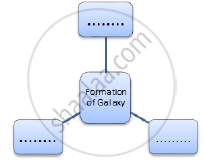
(A3)
(a) Find out similar words from the passage. 01
(i) mass (ii) happenings
(b) Give the verb form of the given words. 01
(i) classified (ii) directions
(A4) Identify and name the clause. 02
Scientists believe that the galaxies were formed from the lumps of matter.
(A5) Can there be life in another galaxy? Give reasons for your answer. 02
(B) Read the passage given in Q. 4 (A) and write the summary of it. Suggest a suitable title to your summary. (05)
Read the extract and do the activities that follow :
‘Your father was my enemy,’ said Frederick. ‘I would have been better pleased by your brave deed if you had told me of another father?’
‘I am proud to be Sir Rowland's son,’ answered Orlando angrily,’ and I would not change my place to be the heir of this dukedom.’
The Duke and his lords went away, leaving Orlando alone with Rosalind and Celia. Celia was angry with her father for speaking so unkindly to Orlando. ‘Would I have done this in my father’s place?’ she said to Rosalind.
‘My father loved Sir Rowland as much as his own soul,’ Rosalind said to Celia, ‘and all the world agreed with him. If I had known that his young man was Sir Rowland’s son I should have begged him with tears not to take so great a risk.’
‘Let us go and speak to Orlando,’ said gentle Celia. ‘I am ashamed of my father’s rude and angry words.’
The two girls went up to Orilando and praised him for his bravery. Rosalind took a gold chain from her neck and gave it to him. ‘I would like to give you more’, she said, ‘but I am not rich.’ Then she and Celia went away.
Orlando, however, could not forget them. He had already fallen in love with the fair Rosalind, but he could not stay at the Duke’s palace. His friends warned him that Frederick was angry and jealous of him. They told Orlando to leave the dukedom, because the Duke meant to do him harm.
A1. Match -
Match the characters and their attributes:
| A | B | ||
| i. | Celia | a. | fair |
| ii. | Orlando | b. | rude and unkind |
| iii. | Frederick | c. | gentle |
| iv. | Rosalind | d. | brave |
A2. Write an imaginary paragraph:
Write an imaginary paragraph in about 50 words in continuation with the given extract.
(A) Read the extract and do the activities that follows :
“Pluck the flowers off”, said the other boy and the daisy trembled for fear, for to be pulled off meant death
to it; and it wished so much to live, as it was to go with the square of turf into the poor captive lark’s cage.
“No, let it stay,” said the other boy, “it looks so pretty.” And so it stayed, and was brought into the lark’s cage. The poor bird was lamenting its lost liberty, and beating its wings against the wires; and the little daisy could not speak or utter a consoling word, much as it would liked to do so. So the forenoon passed. “I have no water,” said the captive lark, “they have all gone out and forgotten to give me anything to drink. My throat is dry and burning. I feel as if I had fire and ice within me and the air is so oppressive. Alas! I must die, and part with the warm sunshine, the fresh green meadows, and all the beauty that God has created.” And it thrust its beak into the piece of grass, to refresh itself a little. Then it noticed the little daisy, and nodded to it, and kissed it with its beak and said : “You must also fade in here, poor little flower. You and the piece of grass are all they have given me in exchange for the whole world, which I enjoyed outside. Each little blade of grass shall be a green tree for me, each of your white petals a fragrant flower. Alas! You only
remind me of what I have lost .
A1. True / False -
State whether the following statements are true or false :
(i) The boys had kept water in the cage for the lark.
(ii) The daisy had a desire to console the poor lark.
(iii) The lark was reminded of its lost liberty.
(iv) The daisy did not want to go into the lark’s cage.
A2. Write an imaginary ending :
Write an imaginary paragraph in about 50 words to give a different ending to the above extract.
(A) Read the following extract and answer the questions given below:
One afternoon in 1977, as his parents and two brothers fished in the Gulf of Mexico, 12-year old Michael Dell sat on the beach. painstakingly putting together a trotline - a maze of ropes to ''which several fish hooks could be attached."You're wasting your time," the rest of the family called to Michael, as they pulled in fish. "Grab a pole and join in the fun."
Michael kept working. It was dinner time when he finished, and everyone else was ready to call it a day. Still, the youngster
cast the trotline far into the water. anchoring it to a stick that he plunged deep in the sand.
Over dinner, his family teased young Michael about coming away empty-handed. But afterward, Michael reeled in his trotline, and on the hooks were more fish than the others had caught all together!
Michael Dell has always been fond of saying, "If you think you have a good idea, try it!" And today, at 29 he has discovered the power of another good idea that has helped him rise in just a few years from teen to a tycoon. He has become the fourth-largest manufacturer of personal computers in America and the youngest man ever to head a Fortune 500 corporation.
(1) What were Michael Dell’s achievements at his age of 29?
(2) What is the secret of Michael Dell’s Success?
(3) How did Michael surprise his family members?
(4) Do you think trying new ideas can make your life successful? How?
(5) Rewrite the following sentences in the ways instructed:
(i) He has discovered the power of another good idea.
(Rewrite the sentence beginning with 'The power of ...' )
(ii) Michael Dell sat on the beach.
(Rewrite it using past perfect continuous tense.)
(iii) The youngster cast the trotline.
(Frame a Wh-question to get the underlined part as
its answer.)
(6) 'Grab a pole and join in the fun'.
Pick out the contextual meaning of the underlined word from
the options are given below:
(i) smash
(ii) hold firmly
(iii) throw away
Read the following extract and answer the questions given
below:
So what is a city? It's a dense amalgamation of buildings and people. A city must provide equity and also be sustainable. As an architect who has been closely connected with Delhi and its planning, my wish list is more about the direction we need to take
so that future generations don't end up living in chaotic dysfunctional cities.
The first requirement for a city is a pragmatic plan. Many of our cities such as Delhi and Bhubaneshwar and even Port Blair in the Andamans have reasonably good master plans. Many also have City Development Plans which have been made an essential
requirement to draw funds from the government's Urban Renewal Programme (JNNURM). But they should be updated frequently based on the changing needs of its people.
And let's not forget its citizens-they need to be more proactively involved when evolving master plans. But often, there's a lack of planning and inadequate implementation systems. This applies to all essential components of city-streets, public transport system, traffic management, affordable housing, cars and parking, drainage, water supply, sewerage, and garbage. Any deficiency in these will lead to poor quality cities which won't be able to handle the pressure of increased population and changing needs.
The second requirement of a good city is good social infrastructure such as parks and places for leisure such as river and sea fronts. It needs to preserve and protect its heritage.
(1) What does a city require to emerge as a good city?
(2) What is the second requirement of a good city?
(3) What are the basic requirements to draw funds from the government's-Urban Renewal programme (JNNURM)?
(4) What suggestions will you give to make your city ideal?
(5) Rewrite the following sentences in the ways instructed:
(i) It's a dense amalgamation of buildings and people.
(Rewrite it using 'as well as'.)
(ii) A city must provide equity and also be sustainable.
(Rewrite it using another modal auxiliary showing "advice".)
(iii) The first requirement for a city is a pragmatic plan.
(Frame a 'Wh' ·question to get the underlined part as an answer.)
(6) Match the words in column 'A' with their meaning in 'B':
| Column A | Column B |
| 1 pragmatic | 1 blend |
| 2 amalgamation | 2 fantastic |
| 3 realistic | |
| 4 ancient |
Read the passage given below :
Success
Everybody wants to succeed in life. For some, success means achieving whatever they desire or dream. For many, it is the name, fame, and social position. Whatever be the meaning of success, it is a success that makes a man popular.
All great men have been successful. They are remembered for their great achievements. But it is certain that success comes to those who are sincere, hardworking, loyal, and committed to their goals.
Success has been man's greatest motivation. It is very important for all. Success has a great effect on life. It brings pleasure and pride. It gives a sense of fulfillment. It means all-around development. Everybody hopes to be successful in life. But success smiles on those who have a proper approach, planning, vision, and stamina. A proper and timely application of all these things is bound to bear fruit. One cannot be successful without cultivating these certain basic things in life. It is very difficult to set out on a journey without knowing one's goals and purposes. The clarity of the objective is a must to succeed in life. A focused approach with proper planning is certain to bring success. Indecision and insincerity are big obstacles on the path to success.
One should have the capability, capacity, and resources to turn one's dreams into reality. Mere desire cannot bring you success. The desire should be weighed against factors like capability and resources. This is the basic requirement of success. The next important thing is the eagerness, seriousness, and the urge to be successful. It is the driving force that decides success. It is the first step on the ladder of success.
One needs to pursue one's goals with all one's sincerity and passion. One should always be in high spirits. Lack of such spirit leads to an inferiority complex which is a big obstruction on the path to success. Time is also a deciding factor. Only the punctual and committed have succeeded in life. The lives of great men are examples of this. They had all these qualities in plenty which helped them rise to the peak of success.
Hard labor is one of the basic requirements of success. There is no substitute for hard labor. It alone can take one to the peak of success. Every success has a ratio of five percent inspiration and ninety-five percent perspiration. It is patience, persistence, and perseverance which play a decisive role in achieving success. Failures are the pillars of success as they are our stepping-stones and we must get up and start again and be motivated.
2.1 On the basis of your reading of the passage, answer any four of the following questions in 30-40 words each:
(a) To whom does success come certainly?
(b) What are the basic things in life we need to achieve success?
(c) What did great men have in plenty to rise to the peak of success? Give any two examples
(d) What is the one basic requirement of success?
(e) Explain: "Failures are pillars of success."
2.2 On the basis of your reading of the passage, fill in any two of the following blanks with appropriate words/phrase :
(a) ________________ plays a decisive role in achieving success.
(b) Goals have to be pursued with ________________ and ________________
(c) Ratio of success is ________________ inspiration.
2.3 Find out the words from the passage that mean the same as the following :
(a) endurance (para 2)
(b) obstruction (para 4)
(c) motivation (para 5)
Read the passage carefully:
|
2.1 On the basis of your understanding of the above passage, answer the following questions in 30-40 words each:
- Write one advantage and one disadvantage of allowing every family member to be part of the decision-making process.
- In today’s world, what are parents asking their kids?
- Which two pieces of advice does the writer give to the parents?
- The passage supports the parents. How far do you agree with the author’s views? Support your view with a reason.
2.2 On the basis of your reading of the above passage, answer the following:
- The synonym of ‘hurt’ as given in paragraph 2 is ______.
- The word, which means the same as a style or method of cooking in paragraph 4, is:
- cuisine
- gourmet
- gastric
- science
- The antonym of ‘agreeable’ as given in paragraph 5 is ______.
- The antonym of ‘simple’ as given in paragraph 6 is:
- difficult
- complicated
- easy
- tricky
A. Read the following passage and do the given activities:-
A1. Answer in one word or two:- (02)
- The Queen of the spices.
- The areas of cultivation of the first type of cardamom.
- Anyone area of cultivation of the second type of cardamom
- The small variety of cardamom is known for-
Cardamom, the Queen of all spices, has a history as old as the human race. It is the dried fruit of a herbaceous perennial plant. Warm humid climate, loamy soil rich in organic matter, distributed rainfall and special cultivation and processing methods all combine to make Indian cardamom truly unique in aroma, flavour, size and it has a parrot green colour.
Two types of cardamom are produced in India. The first type is the large one, which has not much significance as it is not traded in the international market. It is cultivated in the North-eastern area of the country. The second type is produced in the Southern states and these are traded in the international market. These are mainly cultivated in Kerala, Tamil Nadu, and Karnataka. As per the international market rules, only 7 mm quality was previously traded in exchanges. But later, it relaxed its norms, and now 6 mm quality is also traded in the exchanges. Special to Indian taste buds, cardamom is not only unique to our land but also to our senses. The addition of this fragrant spice can add layers of taste to your tea, food, and overall dining experience.
The small variety is known for its exotic quality throughout the world. Traditional auction markets also exist for trading in small cardamom in the country.
A2. Provide information: Indian cardamom is said to be unique in aroma, flavor, size, and colour due to -- (02)
- ______
- ______
- ______
- ______
A3. Write the synonyms for the following from the passage :- (02)
- unusual
- pleasant smell
- importance
- holding moisture
A4. Do as directed:- (02)
- The first type is the large one, which has not much significance.
(Identify the subordinate clause) - Cardamom is not only unique to our land but also to our senses.
(Rewrite the sentence using ‘as well as’)
A5. Indian food is incomplete without spices. State your view. (02)
B. Write a short summary of the passage given in above and suggest a suitable title. (05)
Read the extract and complete the activities given below :
Luxurious houses on the edge of a big city which one promoter sold with the tagline ‘‘Where Nature peeps through every window.’’ All the advantages of a modern lifestyle but with the added bonus of fresh air. But nature isn’t greenery alone; it also includes wild animals.
While the view from the picture windows was easy on the eye, occasionally, it made them gulp with nervousness. At dusk, wild cats leaped out of the adjoining forest on to the top of the peripheral walls and strolled nonchalantly. Sometimes, they lounged on ledges with their long tails swinging freely, oblivious of the many worried human eyes pinned on them. Their cold yellow aggressive eyes turned black as their pupils dilated with failing light.
Some Mumbaikars paid a lot of money to see leopards on safari in Africa. But to watch them from one’s own home was disconcerting. These predators were out of line, stepping off nature into the city. Why did the leopards not stay within the 100-square kilometre Sanjay Gandhi National Park? Perhaps, the leopards thought that if people could venture into nature to jog, walk and picnic, why couldn’t they hang around apartment blocks? If people could enjoy nature, couldn’t nature savour humanity’s offerings?
Capturing leopards is extraordinarily simple. These curious cats seem incapable of resisting a free meal, walking into baited traps without hesitation. The reason the felines are attracted to their residential community is prey : stray dogs that live on rubbish heaps. Taking care of the food source is the best course of action, the volunteers said.
A1. Rewrite the following sentences as per their occurrence in the extract :
- Instead of capturing leopards we can take care of their food.
- Leopards leave their habitat and enter the human habitat.
- Modern lifestyle and nature both attract the dwellers.
- Leopards can enjoy human surroundings by leaving nature.
A2. Complete the following sentences :
- Nature is a combination of ______ and ______
- The best of both the worlds include ______ and ______
- The wild animals are out of line as ______
- The wild cats are attracted towards residential areas because ______
A3. Find out the words for leopards used in the extract :
- ____________
- ____________
- ____________
- ____________
A4. ‘‘If people could venture into nature to jog, walk, and picnic, why couldn’t the wild animals hang around apartment blocks?’’ Express your opinion.
A5. Rewrite the following sentences in the ways instructed :
- Taking care of the food source is the best course of action.
(Use infinitive form of the underlined word and rewrite.) -
Nature isn’t greenery alone; it also includes wild animals.
(Rewrite it by using ‘not only ... but also’.)
A6. Find a word for each of the following expressions from the extract :
- Enjoy the taste of something
- Embarrassing and confusing to watch
- Not conscious or aware of something or someone
- Relaxed and in an unworried manner
Read the passage given below and answer the questions that follow:
| 1. | A fisherman, enfeebled with age, could no longer go out to sea so he began fishing in the river. Every morning he would go down to the river and sit there fishing the whole day long. In the evening he would sell whatever he had caught, buy food for himself and go home. It was a hard life for an old man. One hot afternoon while he was trying to keep awake and bemoaning his fate, a large bird with silvery feathers alighted on a rock near him. It was Kaha, the heavenly bird. “Have you no one to care for you, grandpa?” asked the bird. “Not a soul.” “You should not be doing such work at your age,” said the bird. “From now on I will bring you a big fish every evening. You can sell it and live in comfort.” True to her word, the bird began to drop a large fish at his doorstep every evening. All that the fisherman had to do was take it to the market and sell it. As big fish were in great demand, he was soon rolling in money. He bought a cottage near the sea, with a garden around it and engaged a servant to cook for him. His wife had died some years earlier. He had decided to marry again and began to look for a suitable woman. |
| 2. | One day he heard the royal courtier make an announcement. Our king has news of a great bird called Kaha,” said the courtier. “Whoever can give information about this bird and help catch it, will be rewarded with half the gold in the royal treasury and half the kingdom!” The fisherman was sorely tempted by the reward. Half the kingdom would make him a prince! |
| 3. | “Why does the king want the bird,” he asked. “He has lost his sight,” explained the courtier. “A wise man has advised him to bathe his eyes with the blood of Kaha. Do you know where she can be found?” “No…I mean …no, no…” Torn between greed and his sense of gratitude to the bird, the fisherman could not give a coherent reply. The courtier, sensing that he knew something about the bird, informed the king. The king had him brought to the palace. |
| 4. | “If you have information about the bird, tell me”, urged the king. “I will reward you handsomely and if you help catch her, I will personally crown you king of half my domain.” “I will get the bird for you,” cried the fisherman, suddenly making up his mind. “But Kaha is strong. I will need help. The king sent a dozen soldiers with him. That evening when the bird came with the fish, the fisherman called out to her to wait. “You drop the fish and go and I never get a chance to thank you for all that you‘ve done for me," he said. “Today I have laid out a feast for you inside. Please alight and come in. Kaha was reluctant to accept the invitation but the fisherman pleaded so earnestly that she finally gave in, and alighted. The moment she was on the ground, the fisherman grabbed one of her legs and shouted to the soldiers hiding in his house to come out. They rushed to his aid but their combined effort could not keep Kaha down. |
| 5. | She rose into the air with the fisherman still clinging to her leg. By the time he realised he was being carried away, the fisherman was too high in the air to let go. He hung on grimly, and neither he nor Kaha was ever seen again. |
Based on your understanding of the above passage, answer the questions.
- Why did the fisherman start fishing in the river?
- How did the fisherman spend the day before he met Kaha?
- How did the fisherman betray Kaha?
- Why was the fisherman doubtful about revealing information about Kaha to the courtier?
Read the following excerpt from a case study.
| Impacts of Festivities on Ecology | |||||||||||||||||||||||||||||
| 5 | Festivals are synonymous with celebration, ceremony and joy. However, festivals bring to the fore the flip side of celebrations – pollution – air, water, soil and noise. This led to the need of assessing the awareness level among people about ecological pollution during festivals. So, a study was conducted by scholars of an esteemed university in India. This study was titled Awareness Towards Impact of Festivals on Ecology. | ||||||||||||||||||||||||||||
| 10 | There were two main objectives of the study. The first one was to assess the awareness level among people about ecological protection during festivities. Exploring solutions to bring awareness about celebrating festivals without harming ecology was the second objective. The method used to collect data was a simple questionnaire containing 6 questions, shared with 50 respondents across four selected districts of a state in the southern region of India. | ||||||||||||||||||||||||||||
| 15 |
The research began by understanding the socio-economic conditions of the respondents before sharing the questionnaire. Once the responses were received, the data collected were tabulated (Table 1), for analysis. Table-1: Awareness level among respondents
|
||||||||||||||||||||||||||||
| 20 | The study recommended the imposition of strict rules and regulations as opposed to a total ban on all festive activities which have a drastic impact on our environment. The researchers believed that such measures would help in harnessing some ill-effects that add to the growing pollution and suggested further studies be taken up across the country to assess awareness about ecological degradation. | ||||||||||||||||||||||||||||
| 25 | The observations made in the study pointed to the environmental groups and eco-clubs fighting a losing battle due to city traffic issues, disposal of plastics, garbage dumping and all sorts of ecological degradation. The researchers stressed that the need of the hour is increasing awareness among people to reduce environmental pollution which can be facilitated by celebrating all festivals in an eco-friendly manner. | ||||||||||||||||||||||||||||
On the basis of your understanding of the passage, answer the questions given below.
- Why do the researchers call pollution the ‘flip side’ of festivals?
- Comment on the significance of the second objective of the study with reference to lines 7-12.
- Justify the researchers’ recommendation for limiting the drastic impact of festival pollution on the environment with reference to lines 16-21.
- Why do the researchers feel that environmental groups and eco-clubs are fighting a losing battle in the given scenario?
- Even though a larger number of people say ‘no’ to bursting crackers than those who say ‘yes’, festival pollution persists. How does evidence from table 1 support this statement?
- What purpose does the ‘Can’t Say’ column serve in the questionnaire (table 1)?
Read the following passage and do the activities.
A1. Complete the following sentences.
- Vegetarianism has not spread as desired because ______.
- Vegetarians are of various types ______.
|
Vegetarianism promotes a natural way of life. But despite its implicit message of universal love and nonviolence, it has not spread as it should have. This may be because it usually is an inward looking habit and is best cultivated in the mind. Leading a vegetarian way of life helps the animal kingdom to coexist with man. The animals supply milk, manure and energy. This has been central to Indian culture for thousands of years. A vegetarian lifestyle is natural, multifaceted and helps preservation in a healthy way. Food and health are closely related. Vegetarians are of various types. There are lacto-vegetarians who consume dairy products; Lacto-ovo-vegetarians include eggs in addition to dairy products. Vegans are pure vegetarians who do not consume any food derived from animals. The Western science of food considers food as something to sustain only the human body, whereas Indian science considers food as something which sustains not only the body, but also maintains the purity of heart, mind and soul. Thus, an item of food which is injurious to the mind is not considered to be fit for consumption, even if it is otherwise beneficial to the body or satisfies the taste. Indian food science does not give so much importance to protein or even to a balanced diet but it gives importance to food that increases the strength of the body and its vitality. Vegetarian foods provide an infinite variety of flavours whereas non-vegetarian foods have hardly any taste of their own. In fact, non-vegetarian foods have to be seasoned with ingredients from the vegetable kingdom to make them palatable. |
A2. What is the importance of eating vegetarian food?
A3.
- Pick out two adjectives from the given passage.
- Find words in the passage which mean the following:
- Indirect
- Tasty
A4. Convert the following sentence to negative without changing the meaning.
Leading a vegetarian way of life helps the animal kingdom to coexist with man.
A5. Why do you think vegetarianism is being promoted on a global level? Justify with your response.
Read the passage given below.
| 1 | Ghost nets aren’t supernatural, but they are legitimately scary. A ghost net is a fishing net that’s been lost or abandoned in the ocean. They are one particularly appalling part of the global ghost fishing problem, which includes fishing gear abandoned in the water. Any net or line left in the ocean can pose a threat to marine life. Just because a net is no longer used by fishers doesn’t mean it stops working. These nets continue to trap everything in their path, presenting a major problem for the health of our oceans and marine life. |
| 2 | Ghost nets entangle sea turtles, dolphins and porpoises, birds, sharks, seals and more, apart from catching fish. The nets keep animals from moving freely, cause injuries and keep mammals and birds from rising to the surface for air. Since hundreds of animals can be caught in a single net, this threat is monumental. The ghost nets harm coral reefs too — breaking corals, exposing them to disease and even blocking the reefs from needed sunlight. |
| 3 | Ghost nets are also a major contributor to the ocean plastics crisis. Most modern nets are made of nylon or other plastic compounds that can last for centuries. According to a 2018 study in Scientific Reports, ghost nets make up at least 46 percent of the Great Pacific Garbage Patch. Those abandoned fishing lines and nets that do breakdown never go away; they just become smaller pieces of plastic. Marine animals mistake this microplastic for food and eat it, which can harm internal organs, keep them from eating and expose them to toxic chemicals. |
| 4 | Exorcising ghost nets from our oceans will require commitment, cooperation and innovation. Many groups are working to remove ghost nets from the sea and are collaborating with local fishers and governments around the world to identify target areas and remove as many nets as possible. In 2015, a single World Wildlife Fund for Nature (WWF)-led mission in the Baltic Sea hauled up 268 tons of nets, ropes and other material. |
| 5 | To stop these nets from becoming ghosts in the first place, conservation organisations advocate for fishing gear that can be traced to its owner so anyone dumping nets can be fined and refundable deposits on nets to encourage returning or recycling rather than littering. Tools like sonar reflectors that can make ghost nets easier to find and working with small-scale fisheries to develop more sustainable fishing gear and practices are other suggestions. It is only by attacking this problem from all sides, together with conservation partners, fishers and supporters, can we banish ghost nets and protect our oceans. |
Based on your understanding of the passage, answer the questions given below.
(i) Complete the sentence by choosing an appropriate option. (1)
Ghost nets have been named so because they ______
- cause much harm to the marine life.
- are functional though not in use by fishers.
- are not owned by anyone.
- act as a snare for all animals in oceans.
(ii) Comment on the writer’s reference to the ghost nets in paragraph one, as a health problem for the oceans. (1)
(iii) List the two ways being entangled in a ghost net is likely to impact a walrus. (1)
(Clue: Think about the type of animal a walrus is)
(iv) Select the option that conveys the opposite of ‘negligible’, from words used in paragraph two. (1)
- unimpressive
- monumental
- exposing
- threat
(v) The writer would agree with the given statements based on paragraph three, EXCEPT: (1)
- Most ghost nets take a few years to completely disintegrate.
- Ghost nets contribute to the Great Pacific Garbage Patch.
- Most ghost nets provide nutrition to marine animals, upon disintegration.
- Ghost nets can curtail freedom of marine animals.
(vi) Some records share that fishing nets used to be made of common rope using natural fibres, prior to the 1960s. Based on your understanding of paragraph three, list one major advantage that these had over the fishing nets being used in present times. (1)
(vii) Why is it fair to say that commitment and innovation have to go hand-in-hand to rid the oceans of ghost nets? (1)
(viii) Complete the given sentence with an appropriate inference, with respect to the following: (1)
The writer quotes the example of the WWF-led mission in the Baltic Sea (Paragraph 4), in order to ______.
(ix) How can the solutions, suggested in paragraph five, best be described? (1)
- practical
- presentable
- popular
- prejudiced
(x) Select the most suitable title for the above passage. (1)
- The Scary Side of Ghost Nets
- Ghost Nets – A Result of Human Dominance
- Ghost Nets – A Menace to Marine Life
- Ways to Tackle the Problem of Ghost Nets
Read the passage given below-
| (1) | Milkha Singh, also known as The Flying Sikh, was an Indian track and field sprinter who was introduced to the sport while serving in the Indian Army. He is the only athlete to win gold in 400 metres at the Asian Games as well as the Commonwealth Games. He also won gold medals in the 1958 and 1962 Asian Games. He represented India in the 1956 Summer Olympics in Melbourne, the 1960 Summer Olympics in Rome and the 1964 Summer Olympics in Tokyo. He was awarded the Padma Shri, India's fourth-highest civilian honour, in recognition of his sporting achievements. |
| (2) | The race for which Singh is best remembered is his fourth-place finish in the 400 metres final at the 1960 Olympic Games. He led the race till the 200 m mark before easing off, allowing others to pass him. Singh's fourth-place time of 45.73 seconds was the Indian national record for almost 40 years. |
| (3) | From beginning that saw him orphaned and displaced during the partition of India, Singh became a sporting icon in the country. In 2008, journalist Rohit Brijnath described Singh as "the finest athlete India has ever produced". |
| (4) | He was disappointed with his debut performance at the 1956 Melbourne Olympics. "I returned to India, chastened by my poor performance in Melbourne. I had been so excited by the prospects of being part of the Indian Olympics team, but, hadn't realized how strong and professional the competition would be. My success in India had filled me with a false sense of pride and it was only when I was on the track that I saw how inconsequential my talents were when pitted against superbly fit and seasoned athletes. It was then that I understood what competition actually meant, and that if I wanted to succeed on the international arena, I must be prepared to test my mettle against the best athletes in the world." |
| (5) | Then he decided to make sprinting the sole focus of his life. "Running had thus become my God, my religion and my beloved". "My life during those two years was governed by strict rules and regulations and a self-imposed penance. Every morning I would rise at the crack of dawn, get into my sports kit and dash off to the track, where I would run two or three miles cross-country in the company of my coach." |
| (6) | On how he pushed himself through the tough days of vigorous training. "I practiced so strenuously that often I was drained of all energy, and there were times when I would increase my speed to such an extent that after my rounds, I would vomit blood or drop down unconscious through sheer exercise. My doctors and coaches warned me, asked me to slow down to maintain my health and equilibrium but my determination was too strong to give up. My only focus was to become the best athlete in the world. But then images of a packed stadium filled with cheering spectators, wildly applauding me as I crossed the finishing line, would flash across my mind and I would start again, encouraged by visions of victory." |
Based on your reading answer any five questions from the six given below: (5)
- What is Milkha Singh known as? What realization did Milkha Singh have when he was on the track during the Melbourne Olympics?
- List any two of Milkha Singh's achievements.
- What strict rules and regulations did Milkha Singh follow?
- State two consequences of his hard and strenuous practice.
- What motivated Milkha Singh to become the best athlete in the world?
- Explain the phrase 'I would start again' in the last sentence.
Read the following extract and complete the activities given below:
|
The government of India is encouraging medical tourism in the country by offering tax benefits and export incentives to the participating hospitals. Medical visas are being cleared quickly without any hassles. With a view to facilitating the growth of medical tourism industry, the Ministry of Health and Family Welfare along with the Ministry of Tourism has set up a task force to evaluate the opportunities in the industry. Efforts are being made to standardise procedures and to guide foreign patients to select the hospitals most suited to their needs. Meanwhile, several private hospitals are seeking to take advantage of the booming medical tourism industry and are investing hugely in acquiring equipments and skills. However, medical tourism carries some risks that locally provided medical care does not. Some countries like India, Malaysia and Thailand have very different infectious diseases rarely found in Europe and North America. Exposure to disease without having built-up natural immunity can be a hazard for weak individuals specially with respect to gastrointestinal diseases like Hepatitis A, amoebic dysentery etc., which could slow down the recovery process. Also, medical tourists may be at risk from mosquito-transmitted diseases, influenza and tuberculosis. The quality of post-operative care can also vary dramatically depending on the hospital and the country. Finally, after returning home, a patient has limited contact with their surgeon. This may make it difficult to deal with any complications that may arise later, such as a delayed infection. The concept of medical tourism raises some important questions regarding accessibility, affordability and ethics in medical care. It is unfortunate that a large section of the Indian population has little or no access to private health care. Public health care system is inadequate and lacks proper infrastructure and facilities. One wonders if it is sensible to make provisions for medical tourism in a democratic country like India, which has failed to provide nourishment, sanitation and health care to its masses. |
A1. Complete the web: (2)

A2. Complete the following statements with the help of information provided in the extract: (2)
- Building up natural immunity is must for all because ______.
- The concept of medical tourism can not be much successful in India because _______.
A3. Complete the following table with reference to the statement ‘Medical Tourism is a mixed blessing’: (2)
| Positive aspects of Medical Tourism | Hazard/Nagative aspects of Medical Tourism |
||
| 1. | 1. | ||
| 2. | 2. | ||
A4. ‘We need to promote the concept of Wildlife Tourism in India’. State whether you agree or disagree with the statement. Mention any two arguments. (2)
A5. Language study: (2)
(i) ‘Govt. of India is encouraging medical tourism in the country’. ...(Choose the correct present perfect form of the given statement.)
- Govt. of India is encouraged medical tourism in the country.
- Govt. of India had encouraged medical tourism in the country.
- Govt. of India has been encouraged medical tourism in the country.
- Govt. of India has encouraged medical tourism in the country.
(ii) ‘This may make it difficult to deal with any complication’. ...(Identify the replaced version of the statement using the auxiliary of certainty or definiteness.)
- This can make it difficult to deal with any complication.
- This might make it difficult to deal with any complication.
- This will make it difficult to deal with any complication.
- This have made it difficult to deal with any complication.
A6. Identify the words from the passage with the following meaning: (2)
- growing immensely
- threat
- obtaining
- able to approach/possible to approach
Read the following passage and answer the questions that follow:
|
Based on your understanding of the passage, answer the questions given below:
- When was King Tutankhamen burled? (1)
- 1717
- 1886
- 3300 years ago
- 1848
- Why did Egyptians hold gold in great esteem? (1)
- because it is a good conductor of electricity.
- because of its religious significance.
- for lovely gold ornaments.
- because it is indestructible.
- According to the passage, which of the following statements is NOT true? (1)
- Gold is the best conductor of electricity.
- Apart from gold, copper and silver are good conductors of electricity.
- Gold can be easily beaten, hence it is easy to work with.
- Gold plays an important role in the modern electronics industry.
- Select the option that displays what the writer projects, with reference of the following: (1)
The wandering Israelites worshipped a golden calf ______.- importance of religion
- importance of the metal
- good conductor
- can replace money
- How were the black labourers exploited? (1)
- Complete the following with the phrase from paragraph 1: (1)
Opinion Reason King Tutankhamen was buried in
a solid gold coffin 3300 years ago. - Based on your reading of the text list 2 reasons why the writer says that,
Not only is gold beautiful but it is virtually indestructible. (1) - Who launched South Africa into the gold age? (1)
- Issac Newton
- George Harrison
- George Bernard Shaw
- A farmer
- Select the option that corresponds to the following: (1)
The ancient Egyptians and the modern electronic industry both hold gold in high esteem.- The hardworking student came first because of his diligent practice.
- Honesty is underrated whereas strategy is appreciated.
- The vibrant colours made the interiors look luminous.
- The steaming food was both appetizing and tasty.
- Supply one point to justify the following: (1)
The desire to hoard gold at home has been primarily an occupation of the working and peasant classes.
Read the following passage.
| A | Dirshti was young woman who had always been fascinated by the supernatural. She had read countless books and watched numerous documentaries about ghosts and otherworldly beings. So, when she heard about an abandoned hotel on the outskirts of town that was said to be haunted, she knew she had to investigate. |
| B | One night, Dirshti decided to sneak into the dilapidated hotel with a few of her friends. As they made their way through the dark, eerie corridors, they heard strange noises and felt cold spots. They were convinced that they were not alone. |
| C | Suddenly, they came across a room that was different from the rest. It was filled with old cooking equipment and strange symbols etched into the walls. Drishti felt a chill run down her spine as she entered the room. She knew that this was where the most paranormal activity occurred. As they were examining the room, they heard a loud bang coming from the hallway. They froze in fear, not knowing what was coming their way. They could hear footsteps approaching, and they knew they had to hide. |
| D | They quickly ducked behind some old shelves as the footsteps grew louder. The sound of breathing was getting closer and closer until finally, they saw a figure appear in the doorway. It was a man wearing a chef’s hat, with a face that was twisted in a sinister smile. Drishti and her friends felt their blood run cold as the man approached them. They could feel his cold breath on their faces as he leaned in, whispering in a deep voice, "You shouldn't be here." |
| E | Dirshti and her friends were frozen with fear as they stared into the chef's eyes. But suddenly, the lights flickered on and the figure disappeared. They looked around the room, and everything seemed normal. They had been so scared that they hadn't realized they were in a room with faulty wiring |
| F | Disappointed, they realized that their ghost hunt had been a bust. They left the hotel feeling deflated and let down. They had hoped for an exciting, spine-tingling adventure, but all they got was a scary moment caused by faulty wiring. As they drove home, they couldn't help but feel foolish for getting so worked up over nothing. They had been so convinced that they would find evidence of the paranormal that they had overlooked the simple explanation for the noises they had heard. |
| G | Dirshti learned an important lesson that night. Sometimes, the scariest things are the ones that we create in our own minds. She realized that she didn't need to chase after the supernatural to experience thrills and excitement. The world around her was full of mystery and wonder, and she was content to experience it without the need for ghosts and ghouls. |
Answer the following questions, based on the passage above.
(i) How does the setting contribute to the overall mood and atmosphere of the story? (1)
-
- It creates a sense of nostalgia.
- It provides a sense of false security.
- It adds to the suspense in the story.
- It presents a contrast with the real world.
(ii) List two ways, how the disappointment that Drishti and her friends felt after their ghost hunt is analogous to the feeling of waking up from a dream. Answer in 30 -40 words. (2)
(iii) What is the main flaw in Drishti's approach to investigating the haunted hotel? (1)
- She was too focused on finding evidence of the paranormal.
- She was too skeptical and refused to believe in the possibility of ghosts.
- She relied too heavily on other people's accounts of the supernatural.
- She didn't take enough precautions to ensure her safety.
(iv) After which paragraph of the story, would the following paragraph most likely be placed? (1)
They commenced walking through the hotel, Drishti’s torchlight barely illuminating the darkness around her. Suddenly, they heard a loud creaking noise behind them. Drishti whipped around, pointing her flashlight in the direction of the noise. Nothing. Shaken, they all quickened their pace.
(v) Briefly explain (in 30-40 words) any two elements that classify the story as scary (2)
(vi) Substitute the underlined word in the following sentence with a word/ phrase from paragraphs 4- 6, that means the same. (1)
The sound of the footsteps outside the door left her petrified and the rasping breathing added to her horror.
(vii) What is the most significant lesson that Drishti learns from her experience in the haunted hotel? (1)
- The importance of avoiding risk-taking.
- The need to be more sceptical of the supernatural.
- The value of evaluating your weaknesses
- The power of imagination to create suspense.
(viii) Complete the following appropriately. (1)
Based on the use of the word "dilapidated" to describe the hotel in Paragraph 2, we can infer that its condition was ______.
(ix) Complete the sentence appropriately. (1)
If the title, The Hotel Haunting is given to this passage, it would be an inappropriate title, as compared to The Unsettling Encounter at the Abandoned Hotel because ______.
(x) State whether the given assertion is TRUE or FALSE. (1)
The reason Drishti and her friends visited the abandoned hotel was to prove the existence of ghosts.
Read the following text.
| (1) | Reduction in green areas has caused various environmental problems. People squeezed between concrete structures are looking for various ways to meet their longing for green. One of the ways to do so, is vertical gardens and green walls. Vertical gardening is a unique method of gardening where plants are grown in a vertical position or upward, rather than in the traditional method of planting them on the ground. | ||||||||||||||||||||||||||||||||||||||||||||||||||||||||||||||||||||||||||||||||||||||||||||||||||||||||||||||||||||||||||||||
| (2) | The purpose of vertical gardens and green walls, which arises from the studies of different disciplines (landscape architects, architects, engineers, etc.), is to close the cold image of concrete and increase the visual value. In these systems, nature and structures are integrated, and thus, urban areas and the desired environment have become intertwined. | ||||||||||||||||||||||||||||||||||||||||||||||||||||||||||||||||||||||||||||||||||||||||||||||||||||||||||||||||||||||||||||||
| (3) | Vertical garden case studies often show that, though functionality should be in the foreground when vertical gardens are planned, they are generally made as aesthetic elements in the city's underpasses and city squares and decorative elements in residences without seeking functionality. | ||||||||||||||||||||||||||||||||||||||||||||||||||||||||||||||||||||||||||||||||||||||||||||||||||||||||||||||||||||||||||||||
| (4) | Experts support that the visual quality and evaluation of landscape architecture are determined based on the satisfaction of the users. Hence, a survey questionnaire was prepared for residents of varied age groups from of a metropolitan city. The given Table 1, displays these responses: | ||||||||||||||||||||||||||||||||||||||||||||||||||||||||||||||||||||||||||||||||||||||||||||||||||||||||||||||||||||||||||||||
|
|||||||||||||||||||||||||||||||||||||||||||||||||||||||||||||||||||||||||||||||||||||||||||||||||||||||||||||||||||||||||||||||
| (5) | The study acknowledged that vertical gardening has the potential to transform urban spaces into green, sustainable areas, and further research should explore the impact of vertical gardening on the environment and human well-being. | ||||||||||||||||||||||||||||||||||||||||||||||||||||||||||||||||||||||||||||||||||||||||||||||||||||||||||||||||||||||||||||||
Answer the following questions, based on the passage above.
i. Complete the following analogy appropriately, based on your understanding of paragraphs 1 & 2. (1)
We can say that the situation of people living in concrete structures is comparable with a fish living in a fishbowl, and the need for vertical gardens to the need for decorations in the fishbowl because ______.
ii. Fill the blanks with the appropriate option from those given in brackets, based on your understanding of paragraph 2. (1)
The statement that urban spaces have become more closely connected with the desired natural surroundings through the incorporation of nature and structures in vertical gardens and green walls is a _______ (fact/ opinion) because it is a _______ (subjective judgement/ objective detail).
iii. Justify the following, in about 40 words. (2)
While the survey results suggest that vertical gardens may be effective in improving the quality of life in urban areas, further research and evaluation may be necessary to fully understand their effectiveness and potential drawbacks.
iv. Based on the survey results, which two concerns should a city government, looking to install vertical gardens, address? (1)
v. In Table 1, statement 3, "Vertical gardens increase air quality - indoors and outdoors," received the most neutral responses from participants, with 51 respondents indicating a neutral stance. State any one inference that can be drawn from this. (1)
vi. Select the option that correctly displays what ‘intertwined’ signifies. (Reference-Paragraph 2) (1)
 |
 |
 |
 |
 |
| (i) | (ii) | (iii) | (iv) | (v) |
- (i), (iv) and (v)
- Only (ii)
- Only (iii)
- (ii) and (v)
vii. Infer one benefit and one drawback of vertical gardening in comparison to other solutions, such as community gardens or parks. (Answer in about 40 words) (2)
viii. Which of the following is the main takeaway from the study mentioned in the passage? (1)
- Vertical gardening has minimal impact on the environment or human well-being.
- Vertical gardening is a sustainable practice that can transform urban spaces into green areas.
- The impact of vertical gardening on the environment and human well-being has already been thoroughly explored.
- The study needs to include experts from horticultural firms to offer any recommendations for further research.
Read the passage given below:
|
- Infer one reason for the following based on information in paragraph 1. (1)
The 'blackout' phase is significant ______. - Choose the appropriate option to fill in the blank. (1)
From paragraph 1 & 2, we can infer that there will be ______.
1. no communication with the people.
2. blackout phase.
3. satellite will get no communication.
4. the moon will block the earth.
5. the communication break will be for 15 days.- 1, 2 & 3
- 1, 3 & 4
- 2, 3 & 5
- 3, 4 & 5
- The communication with the satellite will break for approximately ______ days. (1)
- 10
- 15
- 20
- 25
- Complete the following analogy correctly with a word/phrase from paragraph 2: (1)
aroma : cooking : : ______ : space research
(Clue - just like aroma is integral to cooking, similarly __ is/are integral to space research.) - According to ISRO official till 8th July, when Sun will block Mars, ______ signal/signals per day will be sent to the spacecraft. (1)
- no
- considerable
- indefinite
- only for few
- Select the correct option to complete the following sentence: (1)
The ISRO officials are ______ about their control over the spacecraft after the blackout phase.
- doubtful
- apprehensive
- confident
- jittery
- The spacecraft's life was extended by six months because of ______. (1)
- extra fuel
- incomplete work
- lack of communication amongst ISRO officials
- technical problems in its landing
- Read the following sentences: (1)
(A) The blackout was a sudden development.
(B) Because of this, the officials are very nervous about the success of the spacecraft.
- Both (A) & (B) are true.
- Both (A) & (B) are false.
- (A) is true and (B) is false.
- (A) is false and (B) is true.
- Substitute the word 'nonpareil' with one word similar in meaning in the following sentence from paragraph 5. (1)
India managed to get into the nonpareil club of Mars spacecraft in orbit. - The word scarcity in the passage means the opposite of: (1)
- excess
- plenty
- inadequacy
- surplus
Read the passage given below.
|
Most cities, may not be prohibit hawking as a profession, but do place restrictions on the use of urban space. Therefore, a comprehensive study was conducted in 1998-99 on street vending, to provide concrete data for furthering the cause of the hawkers. Eight cities were selected - Mumbai, Ahmedabad, Kolkata, Imphal, Patna, Bhubaneswar and Bangalore. Three points were important while selecting respondents –hawkers were from different parts of a city; sold a variety of goods and adequate numbers of women were covered. The questionnaire was included questions on personal details, details regarding the work and the hazards faced. Table: Results of the survey
It is fair to say that hawkers cannot be removed, because apart from their own livelihood, their services benefit the common urban dweller. |

Based on your understanding of the passage, answer the given questions.
- Fill in the blank by selecting the appropriate option. 1
The study aims to ______ the practice of street vending in urban spaces.
- support
- discourage
- understand
- prove
- Jagan goes door to door with his basket of goods to sell bananas in the city. What action from his end would lead to a prohibition on hawking? 1
- State TRUE or FALSE. 1
The following question could have been a part of the study survey.
What are the challenges presented by the security guards? - Complete the sentence appropriately. 1
The most preferred form of source of capital, according to the survey table, exposes the hawkers to exploitation because ______. - State a point in support for the given opinion: 1
Street vending must be legalised as a profession.
Read the passage given below:
| (1) | Fast-Moving Consumer Goods (FMCG) are products that sell quickly at relatively low cost. FMCG is the fourth-largest sector in the Indian economy. There are three main segments in the sector – food and beverages, which accounts for 19% of the sector; healthcare, which accounts for 31% of the share; and household and personal care, which accounts for the remaining 50% share. The urban segment contributes to about 55% of the revenue share, while the rural segment accounts for 45%. Rise in rural consumption will drive the FMCG market. The Indian processed food market is projected to expand to US\[\$\] 470 billion by 2025, up from US\[\$\] 263 billion in 2019-20. |
| (2) | The Indian FMCG industry grew by 16% in 2021, a 9-year high, despite nationwide lockdowns, supported by consumption-led growth and value expansion from higher product prices, particularly for staples. Real household spending is projected to increase 9.1% after 2021, after a decrease of 9.3% in 2020 due to the economic impact of the pandemic. Price increases across product categories will offset the impact of rising raw material prices, along with volume growth and a resurgence of demand for discretionary items. |
| (3) | The FMCG sector has received good investments and support from the Government in the recent past. The sector witnessed healthy FDI inflows from April 2000-March 2022. Furthermore, as per the Union Budget 2022-23, a substantial amount has been allocated to the Department of Consumer Affairs, and an increased amount has been allocated to the Department of Food and Public Distribution. In 2021-22, the Government approved the Production-Linked Incentive Scheme for the Food Processing Industry (PLISFPI) with an outlay of a larger amount to help Indian brands of food products in the international markets. |
| (4) | The Government's Production-Linked Incentive (PLI) Scheme gives companies a major opportunity to boost exports. The future outlook of the FMCG rural sector looks on track now. Rural consumption has increased, led by a combination of increasing income and higher aspiration levels. There is an increased demand for branded products in rural India. The growth of the organised sector in FMCG is expected to rise with an increased level of brand consciousness, augmented by the growth in modem retail. |
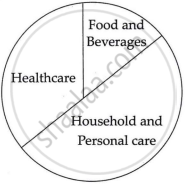 |
|
| Table. FMCG Products | |
| 1. Processed foods: | Cheese products, cereals |
| 2. Prepared meals: | Ready-to-eat meals |
| 3. Beverages: | Bottled water, aerated drinks, and juices |
| 4. Baked goods: | Biscuits, bread |
| 5. Fresh foods, frozen foods, and dry goods: | Fruits, vegetables, milk, butter, frozen food, and nuts |
| 6. Medicines: | Aspirin, pain relievers, and over-the-counter medication that can be purchased without a prescription |
| 7. Cleaning products: | Baking soda, washing powder |
| 8. Cosmetics and toiletries: | Beauty products, soaps, toothpaste |
| 9. Office supplies: | Pens, pencils |
Based on your understanding of the passage, answer the questions given below:
- Does the following statement agree with the information given in para 1? (1)
Food and beverages segment dominates the Global FMCG market and is expected to retain its dominance.
Select from the following:- True - If the statement agrees with the information.
- False - If the statement contradicts the information.
- Not Given - If there is no information on this.
- What do you think gives opportunities to boost exports? (1)
- Select the option that displays the most likely reason for FMCG rural sector being on track. (1)
- FMCG sector has been unable to get investments from the government.
- PLI schemes don't reach the rural sector.
- Gross Merchandise Value (GMV) of the online grocery segment in India is expected to double in the next five years.
- There is a desire to buy branded products in the villages too.
- Complete the sentence based on the following statement: (1)
The Indian FMCG industry grew by 16% in 2021, a 9-year high, despite nationwide lockdowns because ______. - From the given pie chart, which segment of FMCG accounts for the maximum percentage of the sector? (1)
- Complete the given sentence by selecting the most appropriate option: (1)
The combination of increasing income and higher aspiration levels in the rural areas has led to ______.- the Government taking a direct interest
- the demand for branded products
- price increases across product categories
- the fall of supply in urban areas
- How is the Government trying to help Indian brands of food products in the international markets? (1)
- Complete the given sentence by selecting the most appropriate option: (1)
The concluding paragraph of the passage makes a clear case ______.- that the rural people also want branded products
- that the FMCG industry will not focus on brand consciousness
- for the role of data analytics in the FMCG industry
- for the Government's role by providing incentives
- What will be the impact of the increased level of brand consciousness? (1)
- Based on the reading of the passage, correct the following statement: (1)
The urban segment contributes to about 45% of the revenue share, while the rural segment accounts for 55%.
Read the extract and complete the activities given below:
|
This is what Camus meant when he said that "what gives value to travel is fear"-disruption, in other words, (or emancipation) from circumstance, and all the habits behind which we hide. And that is why many of us travel not in search of answers, but of better questions. I, like many people, tend to ask questions of the places I visit, and relish most the ones that ask the most searching questions back of me: "The ideal travel book," Christopher Isherwood once said, "should be perhaps a little like a crime story in which you're in search of something." And it's the best kind of something, I would add, if it's one that you can never quite find. I remember, in fact, after my first trips to Southeast Asia, more than a decade ago, how I would come back to my apartment in New York, and lie in my bed, kept up by something more than jet lag, playing back, in my memory, over and over, all that I had experienced, and paging wistfully through my photographs and reading and re-reading my. diaries, as if to extract some mystery from them. Anyone witnessing this strange scene would have drawn the right conclusion: I was in love. When we go abroad is that we are objects of scrutiny as much as the people we scrutinize, and we are being consumed by the cultures we consume, as much on the road as when we are at home. At the very least, we are objects of speculation (and even desire) who can seem as exotic to the people around us as they do to us. All, in that sense, believed in "being moved" as one of the points of taking trips, and "being transported" by private as well as public means; all saw that "ecstasy" ("ex-stasis") tells us that our highest moments come when we're not stationary, and that epiphany can follow movement as much as it precipitates it. |
A1. Read and rewrite the following sentences and state whether they are True or False: (2)
-
- A traveller may sink in love with his travel-memoirs.
- One gets inspected as he inspects the world around him.
- Quest for something may end in more mystery.
- Staying in comfort at home gives one more happiness than travelling.
A2. Match the persons given in column 'A' with opinions/ characteristics given in column 'B': (2)
| Column 'A' | Column 'B' |
|
(1) Narrator
|
a) ideal travel should be like a crime story. |
|
(2) Camus
|
b) in love with his memoirs. |
|
(3) Isherwood
|
c) more happy when on move. |
| (4) Traveller | d) fear gives value to travel. |
A3. Give reasons: (2)
"We are objects of scrutiny," because
- ______
- ______
A4. "Travelling is an interesting teacher." Write your views in 3-4 sentences. (2)
A5. Do as directed: (2)
- I like to ask questions of the places I visit. (Choose the correct tense form of the above sentence from the following options and rewrite.)
- Simple past tense
- Simple present tense
- Past perfect tense
- Present perfect tense
- I would come back to my apartment in New York. (Choose the correct option using 'used to' for the given sentence and rewrite.
- I use to come back to my apartment in New York.
- I have used to come back to my apartment in New York.
- I used to come back to my apartment in New York.
- I had used to come back to my apartment in New York.
A6. Find out the words from passage which mean: (2)
- reminiscence
- exhilaration
Read the following passage carefully:
|
(1) Plastic pollution has become one of the most pressing environmental issues, as rapidly increasing production of disposable plastic products overwhelms the world’s ability to deal with them. Plastic pollution is most visible in developing Asian and African nations, where garbage collection systems are often inefficient or nonexistent. But the developed world, especially in countries with low recycling rates, also has trouble properly collecting discarded plastics. Plastic trash has become so ubiquitous that it has prompted efforts to write a global treaty negotiated by the United Nations. (2) Plastics made from fossil fuels are just over a century old. Production and development of thousands of new plastic products accelerated after World War II. It transformed the modern age so much that life without plastics is unrecognizable today. Plastics revolutionized medicine with life-saving devices, made space travel possible, lightened cars and jets-saving fuel and pollution- and saved lives with helmets, incubators, and equipment for clean drinking water. (3) The conveniences plastics offer, however, led to a throw-away culture that reveals the material’s dark side: today, single-use plastics account for 40 percent of the plastic produced every year. Many of these products, such as plastic bags and food wrappers, have a lifespan of mere minutes to hours, yet they may persist in the environment for hundreds of years. (4) Most of the plastic trash in the oceans, Earth’s last sink, flows from land. Trash is also carried to sea by major rivers, which act as conveyor belts, picking up more and more trash as they move downstream. Once at sea, much of the plastic trash remains in coastal waters. But once caught up in ocean currents, it can be transported around the world. (5) Millions of animals are killed by plastics every year, from birds to fish to other marine organisms. Nearly 700 species, including endangered ones, are known to have been affected by plastics. Nearly every species of seabirds eats plastics. Most of the deaths of animals are caused by entanglement or starvation. Seals, whales, turtles, and other animals are strangled by abandoned fishing gear or discarded six-pack rings. (6) The solution is to prevent plastic waste from entering rivers and seas in the first place, many scientists and conservationists – including the National Geographic Society – say. This could be accomplished with improved waste management systems and recycling, better product design that takes into account the short life of disposable packaging, and reduction in manufacturing of unnecessary single-use plastics. |
Answer the following questions, based on the above passage:
- Which of the following statements best describes the reason why plastic pollution has become one of the most pressing environmental issues?
- Plastic trash collection systems have become inefficient or nonexistent.
- Rapidly increasing production of disposable plastic products overwhelms the world’s ability to deal with them.
- Some plastics have a lifespan of mere minutes to hours, yet they may persist in the environment for hundreds of years.
- The developed world, especially in countries with low recycling rates, has trouble properly collecting plastics.
- What is the tone of the writer in the given lines from paragraph 2? Rationalise your response in about 40 words.
‘It transformed the modern age so much that life without plastics is unrecognizable today.' - The passage includes some words that are opposites of each other. From the sets (A) – (E) below, identify two sets of synonyms.
- garbage and trash
- starvation and strangled
- disposable and reductio
- persist and downstream
- transformed and revolutionized
- Complete the sentence appropriately:
The writer says that most of the plastic trash is found in the Earth’s last sink and the reason it is transported around the world is _______. - Based on the reading of the passage, examine, in about 40 words, the downside of the convenience that plastic offers.
- Complete the sentence appropriately:
According to conservationists, the two ways in which most of the deaths of animals are caused are _______. - Based on the passage, how can we contribute to the reduction of plastic waste?
- by internationalising the waste management system
- by minimizing the use of single-use plastics
- by not abandoning fishing gear
- by not using helmets made of plastic
- State one reason why plastic pollution is most visible in developing Asian and African nations.
Read the following passage carefully:
|
(1) Rotation of crops is a universal phenomenon which is practised by most of the farmers of the tropical and temperate countries. The main objective of rotation of crops is to obtain higher agricultural returns on the one hand, and to maintain the soil fertility on the other. (2) In other words, the rotation of crops helps in making agriculture more sustainable. The importance of crop rotation is more in the areas where farmers grow two, or more than two crops in the same field in a year. Irrigation facilities have also been appreciably developed in the country during the last three decades. The availability of water to the arable land has helped in the intensification of agriculture. (3) In the areas such as Punjab and Haryana, where the Green Revolution is a big success, one soil exhaustive crop (rice) is followed by another soil exhaustive crop (wheat). Subsequently, the field vacated by wheat is devoted to either rice or maize or cotton. Thus, in one year, the farmers are harvesting three soil exhaustive crops from the same field. Such a rotation of crops may fetch more income to the farmers, but depletes the soil fertility at a faster pace. (4) A number of field studies were conducted to assess the traditional crop rotation pattern. One such field study about the changes in the rotation of crops was conducted in the village Banhera (Tanda), Haridwar district. The main rotation of crops of the village is shown in the table below. |
| Traditional Rotation of Crops (1960-65) in Banhera (Tanda) | ||||
| Year | Kharif (mid-June to mid-October) | Rabi (mid-October mid-April) | Zaid (April to June) | No. of days land left fallow |
| 1960 | Millet/fodder/rice | Gram | Fallow | 90 |
| 1961 | Fallow | Wheat | Fallow | 210 |
| 1962 | Millet/fodder/rice | Gram | Fallow | 90 |
| 1963 | Fallow | Wheat | Fallow | 210 |
| 1964 | Millet mixed with urad/fodder/rice | Gram | Fallow | 90 |
| 1965 | Fallow | Wheat | Fallow | 210 |
Answer the following questions, based on the above passage:
- Fill in the blanks with the appropriate option from those given in brackets, based on your understanding of para 2.
One of the reasons that there has been an intensification of agriculture in the country is the development of irrigation facilities is a/an ______ (fact/opinion) because it is a/an ______ (subjective judgement/objective detail). - Based on your understanding of paras 1 and 2, state whether the following statement is true or false.
If proper irrigation facility is provided, higher agricultural returns can be obtained by making crop rotation more sustainable. - Justify the following in about 40 words.
Crop rotation may fetch more income to the farmers, but depletes the soil fertility at a faster pace. - Based on the table, mention the years when the land was left fallow for maximum number of days.
- The study conducted in village Banhera (Tanda) reflects that during the years 1960 to 1965, from April to June, the land was left fallow or uncultivated throughout. State any one inference that can be drawn from this.
- Select the option that correctly states the significance of crop rotation as given below:
- Crop rotation is done to obtain higher agricultural returns.
- Higher agricultural returns can be obtained by harvesting soil-exhaustive crops.
- Crop rotation demands that land should be left fallow for a few months to increase the fertility of soil.
- Better irrigation facility to the arable land has helped in the intensification of agriculture.
- If crops to be harvested are chosen wisely, crop rotation can help in maintaining fertility of soil.
- (1), (2) and (4)
- (1) only
- (3) and (5)
- (1) and (5)
- Crop rotation is helping in making agriculture more sustainable. Mention one benefit and one drawback of crop rotation. (Answer in about 40 words)
- Which of the following is the main takeaway from the study mentioned in the passage?
- The study needs to include more valid data to support the practice of crop rotation
- Crop rotation is a sustainable practice that can transform the agricultural sector.
- The impact of crop rotation on farmer’s upliftment has been thoroughly explained.
- Crop rotation is independent of the type of crops harvested and availability of water for irrigation.
Read the following passage and do the activities:
A1. Complete the following sentences from the passage: (2)
- Kalam earned a degree in ______ engineering.
- DRDO stands for ______.
- Kalam was ______ of the SLV-III, the first satellite launch vehicle.
- Kalam served as lecturer at ______.
|
A.P.J. Abdul Kalam, in full Avul Pakir Jainulabdeen Abdul Kalam, (born October 15, 1931, Rameshwaram, India - died July 27, 2015, Shillong), Indian scientist who played a leading role in the development of India's missile and nuclear weapons programmes. He was President of India from 2002 to 2007. Kalam earned a degree in aeronautical engineering from the Madras Institute of Technology and in 1958 joined the Defence Research and Development Organisation (DRDO). In 1969, he moved to the Indian Space Research Organisation, where he was project director of the SLV-III, the first satellite launch vehicle that was both designed and produced in India. Rejoining DRDO in 1982, Kalam planned the programme that produced a number of successful missiles, which helped earn him the nickname “Missile Man”. Among those successes was Agni, India's first intermediate-range ballistic missile, which incorporated aspects of the SLVIII and was launched in 1989. Kalam remained committed using science and technology to transform India into a developed country and served as lecturer at several universities. Kalam wrote several books, including an autobiography, Wings of Fire (1999). He received the Padma Bhushan (1981), Padma Vibhushan (1990), Indira Gandhi award for National Integration (1997) and the India's highest civilian award Bharat Ratna (1997). |
A2. Complete the web diagram: (2)

A3. Fill in the blanks by using the suitable phrases/words from the bracket: (2)
[moved to, served as, launched, autobiography]
- Mr. Gunaji has ______ a Principal in this college.
- “The Story of My Experiments with Truth” is the ______ of Mahatma Gandhi.
- My teacher ______ to England for further studies.
- ISRO successfully ______ Chandrayaan-3 mission.
A4. Do as directed: (2)
- Kalam wrote several books. (Frame a Wh-type question to get the underlined part as answer)
- Kalam earned a degree in aeronautical engineering. (Begin the sentence with “A degree in…….)
A5. Who is your role model? Write few lines about him/her. (2)
