Advertisements
Advertisements
प्रश्न
Read the following passage and do the activities.
The Delhi Metro is a metro system serving Delhi and its satellite cities of Bahadurgarh, Ballabhgarh, Faridabad, Ghaziabad, Gurgaon and Noida in the National Capital Region of India. Delhi Metro Rail Corporation Limited
(DMRC), a State-owned company with equal equity participation from the Government of India and the Government of Delhi, built and operates the Delhi
Metro. It is the second oldest metro in India after the Kolkata Metro.
The Delhi Metro is the largest and busiest metro in India, and the world’s 9th longest metro system in length and 16th largest in ridership. A member of CoMET, the network consists of eight colour-coded regular lines, with a total
length of 317 kilometres, serving 231 stations including 6 on Airport Express line and interchange stations. The system has a mix of underground, at-grade, and elevated stations using both broad-gauge and standard-gauge. DMRC operates over 2,700 trips daily. In the financial year 2016–17, the Delhi Metro had an average daily ridership of 2.76 million passengers and served 100 crore (1.0 billion) riders.
The Delhi Metro Rail Corporation was certified by the United Nations in 2011 as the first metro rail and rail-based system in the world to get “carbon credits for reducing greenhouse gas emissions” and helping in reducing pollution levels in the city by 630,000 tonnes every year. Planning for the metro started in 1984 when the Delhi Development Authority and the Urban Arts Commission came up with a proposal for developing a multi-modal transport system for the city. Delhi Metro Rail Corporation (DMRC) was incorporated in May 1995, construction started in 1998, and the first section, on the Red Line, opened in 2002. The development of the network was divided into phases, Phase I containing 3 lines was completed by 2006, and Phase II in 2011. Phase III is scheduled to be mostly complete by 2018.
(A1) Name the following.
(a) The Government authority which built and operates the Delhi Metro -
(b) The first and the oldest Metro in India -
(c) The satellite cities nearby Delhi -
(d) The largest and busiest metro in India -
(A2) The salient features of Delhi Metro are -
(A3) Find out antonyms from the passage for the following.
(i) shortest ´ (ii) increasing ´
(iii) irregular ´ (iv) ended ´
(A4) The Delhi Metro is the largest and busiest metro in India.
(Complete the following sentences with the help of the given sentence.)
(i) No other metro................................
(ii) The Delhi Metro is larger.......................
(A5) “Transportation is the backbone of Indian economy’’ - Elaborate
(B) Read the passage given in Q. 4 (A) and write the summary of it. Suggest a suitable title to your summary.
Advertisements
उत्तर
(A1) 02
(a) Delhi Metro Rail Corporation Limited (DMRC)
(b) The Kolkata Metro
(c) Bahadurgarh, Ballabhgarh, Faridabad, Gaziabad, Gurgaon and Noida.
(d) The Delhi Metro
(A2) The salient features of Delhi Metro are………. 02
(i) It is the largest and busiest metro in India.
(ii) Its total length is 317 kilometers, serving 231 stations.
(iii) The system has a mix of underground, at grade, and elevated stations using both broad-gauge and standard-gauge.
(iv) It operates 2,700 trips daily and carries 2.76 million passengers.
(A3) Find out antonyms from the passage for the following. 02
(i) shortest x longest (ii) increasing x reducing
(iii) irregular x regular (iv) ended x started
(A4)
(i) No other metro in India is as large and busy as the Delhi Metro. 01
(ii) The Delhi Metro is larger than any other metro in India. 01
(A5)
Transportation is the backbone of Indian economy because it facilitates movements of goods or product from one place to another. It removes the hindrance of place. It helps the country for its development by carrying people, goods and services from one place to another. It develops tourism and increases the per capita income of the people. It also helps to get the values to the perishable goods and products. 02
(B) Life-line of Delhi 05
Delhi Metro is considered as the life-line of Delhi – the capital of India which serves cities around like Bahadurgarh, Ballabhgarh, Faridabad, Ghaziabad, Gurgaon and Noida. It is constructed by Delhi Metro Rail Corporation, the Government of India and the Government of Delhi with equal equity participation. Being the largest and busiest metro in India after Kolkata Metro, it operates 2,700 trips
everyday and carries 2.76 million passengers everyday. It is certified by the United Nations in 2011 as the first metro rail and rail-based system in the world to get “carbon credits for reducing greenhouse gas emissions’’ which helps to reduce pollution levels in the city by 630,000 tones every year. Planning of Delhi Metro started in 1984 but Delhi Metro Corporation was incorporated in May 1995 and the actual work started in 1998. Its total length is 317 kilometers serving 231 stations with underground, at grade and elevated stations using both broad-gauge and standard-gauge. It has three phases. The first phase was completed in 2006, second phase in 2011 and the third phase is scheduled to be completed by 2018.
APPEARS IN
संबंधित प्रश्न
 During the devastating July 2005 floods that hit Mumbai, Rajen Dutia received an urgent call from a relative, Lopa Vyas late in the evening. “A friend’s mother is stranded near your home, Rajen. Can you please take her home? Her name is Rashmi,” Vyas told him.
Mumbai had come to a halt and people were trapped everywhere. Despite power failure and raging rain, Dutia stepped out and made his way to the spot, where he found Rashmi as well as a dozen other people. They were stranded in the dark, shivering in the rain. They all lived far away and had no place to go for the night.
Rajen took all of them to his one-bedroom flat, where he served them dinner and invited them to spend the night.
"By doing so," says Rajen, "I was simply fulfilling my karma, paying the universe back for the good it had done for me."
"God is kind. My daughter had just started her new job that day, and had gone for her training. She was stranded too. While she was trying to get to our relatives, she almost drowned, but a young stranger saved her. He and his friends even dropped her to my relative's place and phoned me to say she was safe. One good turn deserves another."
A2. Order
Look at the following sentences from the passage and put them in the correct sequence: (2)
(a) He took them to his one-bedroom flat.
(b) Rajen found Rashmi as well as a dozen other people shivering in the rain.
(c) Mumbai had come to a halt and people were trapped everywhere.
(d) Rajen Dutia received an urgent call.
A3
During the devastating July 2005 floods that hit Mumbai, Rajen Dutia received an urgent call from a relative, Lopa Vyas late in the evening. “A friend’s mother is stranded near your home, Rajen. Can you please take her home? Her name is Rashmi,” Vyas told him.
Mumbai had come to a halt and people were trapped everywhere. Despite power failure and raging rain, Dutia stepped out and made his way to the spot, where he found Rashmi as well as a dozen other people. They were stranded in the dark, shivering in the rain. They all lived far away and had no place to go for the night.
Rajen took all of them to his one-bedroom flat, where he served them dinner and invited them to spend the night.
"By doing so," says Rajen, "I was simply fulfilling my karma, paying the universe back for the good it had done for me."
"God is kind. My daughter had just started her new job that day, and had gone for her training. She was stranded too. While she was trying to get to our relatives, she almost drowned, but a young stranger saved her. He and his friends even dropped her to my relative's place and phoned me to say she was safe. One good turn deserves another."
A2. Order
Look at the following sentences from the passage and put them in the correct sequence: (2)
(a) He took them to his one-bedroom flat.
(b) Rajen found Rashmi as well as a dozen other people shivering in the rain.
(c) Mumbai had come to a halt and people were trapped everywhere.
(d) Rajen Dutia received an urgent call.
A3(i). Fill in the blanks :
Select the words given in the passage (1)
(i) Thousands Of pilgrims were …………….. due to the cloud burst in Uttarakhand.
(ii) The tiger was ……………… by the hunter.
(ii). Antonyms:
Select the correct antonyms for the given words from the alternatives :
(1) Please :
(a) unplease (b) displease (c) misplease
(2) Safe: '
(a) insafe (b) safeless (c) unsafe
A4(i) Tags :
Select the correct tag for the alternatives given below :
One good turn deserves another.
(a) Doesn’t it? (b) don’t it (c) does it?
(ii). Guess:
Choose the correct answer : (1)
Rajen can you please take her home? ‘Can’ indicates :
(a) Obligation (b) ability (c) permission
A5. Personal Response :
‘ one good turn
Deserves another.’
Explain with an
example of your own.
Read the passage given below :
Kausani is situated at a height of 6,075 feet in the Central Himalayas. It is an unusally attractive little town. It covers just about 5.2 sq. kms. It lies to the north of Almora in Uttarakhand's picturesque kumaon region.
Kausani provides the 300-km wide breathtaking view of the Himalayas. It is the most striking aspect of the place. Snow-capped peaks are spread in a stately row. They stare at you in silvery white majesty. The most famous peak on view is Nanda Devi, the second highest mountain in India. It is situated at a height of 25.645 feet and 36 miles away as the crow files. The other famous peaks on view are choukhamba (23,420 feet) and Trishul (23,360 feet). Then there are also Nilkanth, Nandaghunti, Nandaghat and Nandakot. On a clear day, the blue of the sky makes a splendid background to these peaks. At sunrise and at sunset, when the colour changes to a golden orange, the scene gets etched in your memory.
When Gandhiji visited this place in 1929, its scenic beauty held him spellbound. He named it the 'Switzerland of Indian'. He prolonged his two-day stay to fourteen days, making time to write a book, 'Anashakti Yoga'. The place where he was staying was originally a guest-house of the tea estate. It was renamed 'Anashakti Ashram' after the book.
Kausani is the birthplace of Sumitranandan Pant, India's poet laureate. Its natural surroundings inspired many of his poems. Its tea gardens mingle with dense pine forests and fruit orchards. The area is also host to many fairs and religious caremonies. If Uttaranchal is the abode of gods, Kausani is God's own backyard. There is no traffic, no one is in a hurry. If serenity could be put on a canvas, the picture would resemble Kausani.
On the basis of your reading of the above passage, answer the following questions :
(a) Where is Kausani situated ?
(b) What is the most striking aspect of Kausani ?
(c) Which is the most famous peak on view from Kausani ?
(d) How did Kausani influence Sumitranandan Pant ?
(e) When does the view of peaks become so memorable ?
(f) How can we say that Gandhiji was greatly charmed by the natural beauty of Kausani ?
(g) What makes Kausani a calm and quiet place ?
(h) Why, do you think, is Kausani known as 'God' s own backyard' ?
Read the first activity, read the extract and then do all the activities:
The next year Dell enrolled at the University of Texas. Like most first-year students, he needed to earn spending money. Just about everyone on campus was talking about personal computers. At the time, anyone who didn’t have a PC wanted one, but dealers were selling them at a hefty mark-up. People wanted low-cost machines custom-made to their needs, and these were not readily available. Why should dealers get such a big mark-up for so little added value ? Dell wondered. Why not sell from the manufacturer directly to the end user ?
Dell knew that IBM required its dealers to take a monthly quota of PCs, in most cases more than they could sell. He also knew that holding excess inventory was costly. So he bought dealers’ surplus stock at cost. Back in his dormitory room, he added features to improve performance. The improved models found eager buyers. Seeing the hungry market, Dell placed local advertisements offering his customized computers at 15 percent of retail price. Soon he was selling to businesses, doctors’ offices and law firms. The trunk of his car was his store; his room took on the appearance of a small factory.
During a holiday break, Dell’s parents told him they were concerned about his grades. “If you want to start a business, do it after you get your degree,” his father pleaded. Dell agreed, but back in college he felt the opportunity of a lifetime was passing him by. “I couldn’t hear to miss this chance,” he says. After one month he started selling computers again- with a vengeance.
A1. True / False - (2)
Rewrite the following sentences stating against each of them whether they are true or false :
(i) Dell bought computers directly from the IBM company.
(ii) Dealers were selling computers at high prices.
(iii) Dell’s father wanted Dell to get his degree.
(iv) Dealers disagreed to sell the surplus stock of computers to Dell.
A2. Give reasons - (2)
Dell wanted to stait a business of selling computers because :
(i) ____________
(ii) ____________
A3. Guess : (2)
“I couldn’t bear to miss this chance,” Dell says. Guess. which chance Dell did not want to miss”.
A4. Vocabulary - (2)
Find out the words from the extract which mean :
(i) college hall of residence
(ii) large amount added to the cost price
(iii) quantity of good in stock
(iv) with great intensity
A5. Personal response : (2)
Suggest two strategies businessman to become a successful businessman.
A6. Grammar - (2)
Rewrite the following sentences in the ways instructed :
(i) Seeing the hungry market, Dell placed local advertisement. (Make it a compound sentence)
(ii) He added features to improve performance. (Frame ‘Wh’ question to get the underlined part as an answer.)
Read the following passage and do the given activities :
A1. Fill up the blanks with virtues of dogs : (2)
(1) __________
(2) __________
(3) __________
(4) __________
| Human and dogs are inseparable for thousands of years and they are dependent on each other for protection and survival. Relationship between humans and dogs is often characterized by strong emotional bonds which run both way. Dogs are very popular as pets and companions. Dog is the ‘Man’s Best Friend’ and a family member. The dog is one of the most loyal, faithful and devotee animal. In earlier days dogs were kept mainly for hunting and guarding; now they are kept for companionship, protection and showmanship. There are millions of people all over the world who are dog lovers Puppies need more attention at the, early age. As much as possible try many methods of socialization, such as playing with them, taking them for walk, expose them to crowds, make them to obey the orders etc. |
A2. Methods of socialization of puppies are : (2)
(1) …......................
(2) …......................
(3) …......................
(4) …......................
A3. Cross out the odd man : (2)
(i) Inseparable, dependent, protection, popular.
(ii) Hunting. guarding, playing, petting.
(iii) Earlier, human, relationship, family
(iv) Often, mainly, now, emotional
A4.
(1) There are millions of people all over the world. (1)
(Pick out the determiners and write them)
(2) Puppies need more attention. (1)
(Rewrite the sentence without changing its meaning beginning with : Puppies don’t ….....)
A5. Should we ban keeping pets ? Justify. (2)
Read the passage carefully:
|
2.1 On the basis of your understanding of the above passage, answer the following questions in 30-40 words each:
- Write one advantage and one disadvantage of allowing every family member to be part of the decision-making process.
- In today’s world, what are parents asking their kids?
- Which two pieces of advice does the writer give to the parents?
- The passage supports the parents. How far do you agree with the author’s views? Support your view with a reason.
2.2 On the basis of your reading of the above passage, answer the following:
- The synonym of ‘hurt’ as given in paragraph 2 is ______.
- The word, which means the same as a style or method of cooking in paragraph 4, is:
- cuisine
- gourmet
- gastric
- science
- The antonym of ‘agreeable’ as given in paragraph 5 is ______.
- The antonym of ‘simple’ as given in paragraph 6 is:
- difficult
- complicated
- easy
- tricky
Read the following passage and do the activities.
A1. Choose the correct option. (2)
- Thousands of birds were killed due to oil spills because ______.
- It suffocated them
- It was poisonous
- Birds couldn't enter the sea
- There was no fish to feed on
- The primary components of crude oil are ______.
- Methane and ethane
- Carbon and hydrogen
- Sulphur compounds
- Naphthalene
| During the Gulf War, a few years back, tens of thousands of sea birds were killed due to oil spills. Do you know what makes crude oil on ocean water so deadly? Crude oil is not used in the state it is produced at the off-shore wells. It is converted in refineries into a wide range of products such as gasoline, kerosene, diesel, fuel oils, and petrochemical feed-stocks. Before it is refined, the oil also contains potentially fatal components. Crude oil is made up of compounds of carbon and hydrogen called hydrocarbons. These hydrocarbons may be paraffin, the oil that is used as fuel in heaters and lamps or cycloparaffins (naphthenes) or aromatic compounds in varying proportions. While crudes found in the US are mostly paraffinic, these found along the Gulf Coast are naphthenic which contain sulphur compounds in varying amounts, a small amount of nitrogen and very little oxygen. Every variety of crude oil has nickel and vanadium in high concentration. Iron may be found in organic form due to the corrosion of pipes. Paraffins like methane and ethane are asphyxiants, substances that cause suffocation. The effects of cycloparaffins are more or less similar to those of paraffins but unsaturated paraffins are more noxious, than saturated ones. The sulphur present in crude oil may be toxic. The mechanism of toxic action seems to involve its breakdown to hydrogen sulphide. They will act principally on the .nervous system with death resulting mainly from respiratory paralysis. Sulphur in the form of aromatic thiophenes, benzothiophenes can damage the livers and kidneys of sea animals. Sulphur compounds like mercaptens can be very dangerous too. |
A2. Crude oil may be toxic and fatal. Justify. (2)
A3. Rewrite the sentences using one word from the passage for the underlined phrase/word. (2)
- Over consumption of alcohol may lead to death.
- The flowers displayed at the exhibition differ in properties.
A4. Identify and change the voice of the following sentence. (1)
Tens of thousands of sea birds were killed due to oil spills.
A5. With reference from the passage what can you do to control air pollution? (3)
Read the following table displaying the details of five House Captains.
| Name | Motto | Participation in activities | Achievements | Awards | Personal Qualities | Drawbacks | Other notable things |
| Rohit | "Together we can achieve greatness" | Debate club, Quiz club | 1st prize in Science Olympiad | Best Student | Diligent, confident, empathetic | Sometimes tends to be overly competitive | Volunteer at a local NGO |
| Sanya | "Service before self" | Social service club, Drama club | 1st prize in Debate competition | Best Orator | Compassionate, organized, responsible | Can be overly self critical at times | Participated in a Model United Nations conference |
| Rajat | "Never give up, always rise up" | Sports club, Music club | 2nd position in Chess competition | Best Sportsperson | Perseverant, team player, adaptable | Can sometimes be indecisive | Plays in a local band |
| Aryan | "Success through hard work" | Photography club, Science club | 1st prize in a Photography competition | Budding Innovator | Creative, curious, detail oriented | Can sometimes procrastinate | Built a working model of a wind turbine for a science fair |
| Ananya | "Strive for excellence" | "Dance club, Art club | 1st prize in Art competition | Creative Mind | Confident, hardworking, imaginative | Tends to overthink things | Published her own poetry collection |
Answer the following questions, based on the table above.
(i) Identify the person who is likely to ask many "why" questions, and support your choice with one reason. (2)
(ii) Which house captain is most likely to struggle the most with handling stress during the school's annual inter-house sports tournament? (1)
- Rohit
- Sanya
- Rajat
- Ananya
(iii) Give two justifications for Sanya being the best fit to lead a school-wide initiative to promote mental health and well-being among students. (2)
(iv) Select the correct option to fill the blank and complete the analogy. (1)
______ : paint brush :: Rajat : tabla
- Rohit
- Sanya
- Aryan
- Ananya
(v) Based on the personal qualities of the House Captains, why is Rajat the most likely to be a collaborative worker? (1)
(vi) Complete the given sentence with the appropriate reason, with reference to the information in the table. (1)
We can infer that Aryan’s overall performance may be negatively impacted by his weakness in time management because ______.
(vii) Explain briefly why situation (b), from the three situations given below, showcases Ananya's motto, "Lead by example"? (1)
- During a group project, Ananya assigns each team member specific tasks and sets a high standard for the project's quality. She tells them to actively participate in the project and take it to fruition.
- During a house debate competition, Ananya notices that a few of her house members are struggling to articulate their arguments effectively. Ananya takes the time to listen to their concerns and provides constructive feedback and support.
- During a fundraising event, Ananya volunteers to be in charge of organizing and coordinating the event but she frequently delegates tasks to others and attends to her school assignment while her team completes the task successfully.
(viii) Select the option that correctly matches the House Captains (a) -(c), to the trophies (i)-(v). (1)
| House Captains | (a) Rajat | (b) Ananya | (c) Aryan |
 |
 |
 |
 |
 |
| (i) | (ii) | (iii) | (iv) | (v) |
- (a) - (ii) , (b) - (i) , (c) - (iii)
- (a) - (i) , (b) - (v) , (c) - (iv)
- (a) - (v) , (b) - (iii) , (c) - (ii)
- (a) - (iii) , (b) - (iv) , (c) - (i)
Read the passage given below:
|
- Infer one reason for the following based on information in paragraph 1. (1)
The 'blackout' phase is significant ______. - Choose the appropriate option to fill in the blank. (1)
From paragraph 1 & 2, we can infer that there will be ______.
1. no communication with the people.
2. blackout phase.
3. satellite will get no communication.
4. the moon will block the earth.
5. the communication break will be for 15 days.- 1, 2 & 3
- 1, 3 & 4
- 2, 3 & 5
- 3, 4 & 5
- The communication with the satellite will break for approximately ______ days. (1)
- 10
- 15
- 20
- 25
- Complete the following analogy correctly with a word/phrase from paragraph 2: (1)
aroma : cooking : : ______ : space research
(Clue - just like aroma is integral to cooking, similarly __ is/are integral to space research.) - According to ISRO official till 8th July, when Sun will block Mars, ______ signal/signals per day will be sent to the spacecraft. (1)
- no
- considerable
- indefinite
- only for few
- Select the correct option to complete the following sentence: (1)
The ISRO officials are ______ about their control over the spacecraft after the blackout phase.
- doubtful
- apprehensive
- confident
- jittery
- The spacecraft's life was extended by six months because of ______. (1)
- extra fuel
- incomplete work
- lack of communication amongst ISRO officials
- technical problems in its landing
- Read the following sentences: (1)
(A) The blackout was a sudden development.
(B) Because of this, the officials are very nervous about the success of the spacecraft.
- Both (A) & (B) are true.
- Both (A) & (B) are false.
- (A) is true and (B) is false.
- (A) is false and (B) is true.
- Substitute the word 'nonpareil' with one word similar in meaning in the following sentence from paragraph 5. (1)
India managed to get into the nonpareil club of Mars spacecraft in orbit. - The word 'instinct' in the passage means the same as: (1)
- lack
- impulse
- inability
- incapacity
Read the following report and answer the questions by choosing the correct/most appropriate option:
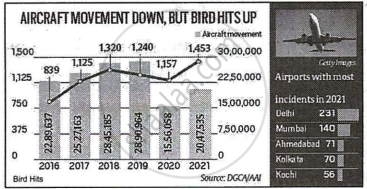 |
|
| (1) |
How bird hits happen, why they are a concern? New Delhi June 20 At least two bird strike incidents happened on Sunday. Both aircrafts returned to their airports of origin and were grounded for maintenance. An ABC aircraft, which took off from Guwahati towards Delhi, suffered damage to its left engine following a bird hit at 1600 feet. The pilots returned to Guwahati. The other strike happened on another flight from Patna to Delhi. The pilots of the aircraft suspected a bird strike during the take-off roll but continued to climb. Following the take-off rotation, they were informed by the cabin crew of sparks emanating from the left engine. Subsequently, the pilots were also informed by air traffic control of smoke coming out of one of the engines. The pilots declared an emergency and returned to Patna. |
| (2) |
Why are bird strikes a concern? Bird strikes are among the most common threats to aircraft safety, and they typically occur during take-off or landing. Dozens of bird-strikes happen each day but some can be more dangerous than others. Typically, when birds collide with an aircraft's airframe, it is unlikely to cause significant problems for the pilots flying. But there are instances when the aircraft engine ingests the birds. This can lead to a loss of thrust for the engine and cause manoeuvrability problems for the crew. In these cases, where a jet engine ingests a bird, procedures would generally call for pilots to land the plane at the closest airport. While most airframe bird strikes are not considered critical to air safety, if a collision cracks a window or a wind screen, pilots will look to land as early as possible. |
| (3) |
How critical are bird strikes to air safety? Smaller planes would generally be more susceptible to the dangers of bird strikes than larger ones. However, given that bird strikes mostly happen during take-off and landing, these incidents could distract the pilots during what are highly critical phases of flights that demand the complete attention of the crew. |
| (4) |
What causes bird-strikes? The presence of birds around an aircraft increases the chances of a bird strike. In the monsoon, as water puddles emerge on open grounds attracting insects to breed, the presence of birds increases. In some cases, bird hits also happen at higher altitudes when a plane is cruising. These are more dangerous than the low-altitude hits, given that they can cause rapid depressurization of cabins. Other reasons for bird activity around the airfield could be presence of landfills or waste disposal sites that can attract a large number of birds. |
- Does the following statement agree with the information given in paragraph 1? (1)
When an airplane is hit by a bird or is suspected to have been hit, the passengers must be asked to get down at once.
Select from the following:
True: If the statement agrees with the information.
False: If the statement contradicts the information.
Not Given: If there is no information on this. - Select the option that displays the most likely reason for bird hits. (1)
- when the aircraft is overloaded
- at the time of landing or taking off
- when the crew become negligent
- when the passengers become panicky
- Complete the sentence appropriately with one word. (1)
Smaller planes are generally more ______ than larger ones. - Complete the sentence by selecting the most appropriate option: (1)
When the window or the windscreen of the airplane is cracked due to a bird hit ______.- the crew must rush to the cockpit
- the pilot must land at the earliest airport
- the pilot must inform the maintenance engineer
- the pilot must get instructions from the aviation wing on what should do in emergency
- Based on the reading of the text, state a point to further the statement. (1)
Dozens of bird hits take place every day ______.
- but only a few are dangerous
- all of them are fatal
- but after every bird hit it is imperative to land the aircraft
- the pilot should ignore them
- Complete the sentence based on the following statement: (1)
Complete attention of the crew is demanded during take-off and landing.
We can say this because ______. - Complete the sentence appropriately with one/two words. (1)
In cases where the aircraft engine infests the bird, it leads to the loss of thrust and causes problems in ______. - Which are the areas more prone to bird hits? (1)
- Based on the reading of the text, state a point to challenge the given statement: (1)
The area around air fields should be clear of any waste disposal sites. - Look at the graph. It shows that between 2016 and 2021, whereas air flights have come down, the bird-hits have gone up. This implies that the incidence of bird hits has: (1)
- decreased
- increased
- remained constant
- been alarming
Read the passage given below:
| (1) | Fast-Moving Consumer Goods (FMCG) are products that sell quickly at relatively low cost. FMCG is the fourth-largest sector in the Indian economy. There are three main segments in the sector – food and beverages, which accounts for 19% of the sector; healthcare, which accounts for 31% of the share; and household and personal care, which accounts for the remaining 50% share. The urban segment contributes to about 55% of the revenue share, while the rural segment accounts for 45%. Rise in rural consumption will drive the FMCG market. The Indian processed food market is projected to expand to US\[\$\] 470 billion by 2025, up from US\[\$\] 263 billion in 2019-20. |
| (2) | The Indian FMCG industry grew by 16% in 2021, a 9-year high, despite nationwide lockdowns, supported by consumption-led growth and value expansion from higher product prices, particularly for staples. Real household spending is projected to increase 9.1% after 2021, after a decrease of 9.3% in 2020 due to the economic impact of the pandemic. Price increases across product categories will offset the impact of rising raw material prices, along with volume growth and a resurgence of demand for discretionary items. |
| (3) | The FMCG sector has received good investments and support from the Government in the recent past. The sector witnessed healthy FDI inflows from April 2000-March 2022. Furthermore, as per the Union Budget 2022-23, a substantial amount has been allocated to the Department of Consumer Affairs, and an increased amount has been allocated to the Department of Food and Public Distribution. In 2021-22, the Government approved the Production-Linked Incentive Scheme for the Food Processing Industry (PLISFPI) with an outlay of a larger amount to help Indian brands of food products in the international markets. |
| (4) | The Government's Production-Linked Incentive (PLI) Scheme gives companies a major opportunity to boost exports. The future outlook of the FMCG rural sector looks on track now. Rural consumption has increased, led by a combination of increasing income and higher aspiration levels. There is an increased demand for branded products in rural India. The growth of the organised sector in FMCG is expected to rise with an increased level of brand consciousness, augmented by the growth in modem retail. |
 |
|
| Table. FMCG Products | |
| 1. Processed foods: | Cheese products, cereals |
| 2. Prepared meals: | Ready-to-eat meals |
| 3. Beverages: | Bottled water, aerated drinks, and juices |
| 4. Baked goods: | Biscuits, bread |
| 5. Fresh foods, frozen foods, and dry goods: | Fruits, vegetables, milk, butter, frozen food, and nuts |
| 6. Medicines: | Aspirin, pain relievers, and over-the-counter medication that can be purchased without a prescription |
| 7. Cleaning products: | Baking soda, washing powder |
| 8. Cosmetics and toiletries: | Beauty products, soaps, toothpaste |
| 9. Office supplies: | Pens, pencils |
Based on your understanding of the passage, answer the questions given below:
- Does the following statement agree with the information given in para 1? (1)
Food and beverages segment dominates the Global FMCG market and is expected to retain its dominance.
Select from the following:- True - If the statement agrees with the information.
- False - If the statement contradicts the information.
- Not Given - If there is no information on this.
- What do you think gives opportunities to boost exports? (1)
- Select the option that displays the most likely reason for FMCG rural sector being on track. (1)
- FMCG sector has been unable to get investments from the government.
- PLI schemes don't reach the rural sector.
- Gross Merchandise Value (GMV) of the online grocery segment in India is expected to double in the next five years.
- There is a desire to buy branded products in the villages too.
- Complete the sentence based on the following statement: (1)
The Indian FMCG industry grew by 16% in 2021, a 9-year high, despite nationwide lockdowns because ______. - From the given pie chart, which segment of FMCG accounts for the maximum percentage of the sector? (1)
- Complete the given sentence by selecting the most appropriate option: (1)
The combination of increasing income and higher aspiration levels in the rural areas has led to ______.- the Government taking a direct interest
- the demand for branded products
- price increases across product categories
- the fall of supply in urban areas
- How is the Government trying to help Indian brands of food products in the international markets? (1)
- Complete the given sentence by selecting the most appropriate option: (1)
The concluding paragraph of the passage makes a clear case ______.- that the rural people also want branded products
- that the FMCG industry will not focus on brand consciousness
- for the role of data analytics in the FMCG industry
- for the Government's role by providing incentives
- What will be the impact of the increased level of brand consciousness? (1)
- Based on the reading of the passage, correct the following statement: (1)
The urban segment contributes to about 45% of the revenue share, while the rural segment accounts for 55%.
