Advertisements
Advertisements
प्रश्न
Read the following passage and do the activities.
In the early days of farming, people did not understand how plants obtained essential nutrients. It so happened that wood ash, fish remains and slaughterhouse waste were thrown on vacant land just to get rid of them. Then, people started to notice that the grass, bushes and shrubs on this vacant land began to grow very well. They reasoned that if their farmland were similarly treated, the growth of their crops would also improve. People gradually began to realize that the nutrients required by plants came from the soil and that the amount of nutrients could be increased by the application of such organic remains to the soil. Thus started the manuring process in farming.
The practice of manuring has been practised as early since the seventeenth century. However, the importance of manuring was not properly understood until scientists began to study the nutritional needs of plants and gave birth to fertilizers. Thus, gradually, the use of fertilizers became accepted by farmers.
There are many types of manure and fertilizer currently being used. Manure is a substance derived from animals and plants. The most important advantage of using manure is the fact that they not only supply a wide range of plant
nutrients, but also improve the structure of the soil. It cements together the soil particles to form soil crumbs. The crumb structure is a desirable condition of cultivated soil. The addition of manure to soil will increase the inorganic and humus content which helps to prevent soil erosion and loss of plant nutrients when it rains. The common manure used in farming consists of farmyard manure, compost, blood meal, bone meal and fish meal.
Unlike manure, fertilizers are inorganic substances which do not improve the structure of the soil. They only supply extra amounts of nutrients to the growing plants when applied to the soil. The commercial fertilizers commonly used today
can be classified into three major categories; namely, nitrogen (N), phosphate and potash fertilizers.
Besides knowing the type of fertilizer to use, a farmer also needs to know when to apply the fertilizer and how to apply it. The fertilizer should be applied at the time when the plants need a particular nutrient most. The time and method
of application will determine how profitably the fertilizers have been used in farming. Fertilizers which have not been properly applied cannot be absorbed in large quantities by plant roots. These fertilizers may be washed away by rain
or they may kill the plants. This would mean a definite financial loss for the farmer.
(A1) Choose the correct option and rewrite the sentences.
(a) What did the people not understand in the early days of farming ? (1/2)
(i) how farming is done
(ii) how plants obtained essential nutrients
(iii) how grass, shrubs and bushes grow.
(b) What is manure ? (1/2)
(i) a substance derived from animals and plants.
(ii) the soil particles to form soil crumbs.
(iii) a combination of nitrogen, phosphate and potash.
(c) When should fertilizers be applied ? (1/2)
(i) When the plants get dried.
(ii) When the plants need a particular nutrient most.
(iii) In the early days of farming.
(d) What determines the profitability of the fertilizers ? (1/2)
(i) grass, bushes and shrubs
(ii) nitrogen, phosphate and potash.
(iii) The time and method of application.
(A2) How did the process of adding manure to the soil begin? (2)
(A3) Find out similar words from the passage. (2)
(i) necessary (ii) comprise
(iii) step by step (iv) ascertain
(A4)
(i) They supply extra amount of nutrients to the growing plants (Begin the sentence with ‘Extra amount of.......... ’.)(1)
(ii) It cements together the soil particles to form soil crumbs.
(Choose the correct option to name the tense.)(1)
(i) Simple present tense
(ii) Simple past tense
(iii) Simple future tense
(A5) ‘Agriculture plays important role in Indian economy’. Explain. (2)
(B) Read the passage given in Q. 4 (A) and write the summary of it. Suggest a suitable title to your summary. (5)
Advertisements
उत्तर
(A1)
(a) how plants obtained essential nutrients . ½
(b) a substance derived from animals and plants. ½
(c) when the plants need a particular nutrient most. ½
(d) The time and method of application. ½
(½ mark for each correct option.)
(A2)
People used to throw wood ash, fish remains and slaughterhouse waste on the vacant land just to get rid of them. When the people noticed that the grass, bushes
and shrubs on that spot began to grow very well, they realised the growth of their crops would also be improved. They also realised that the quality of land would be improved by supplying organic remains to the soil. Thus they began adding manures to the soil in their land. (2)
(½ mark for each correct point.)
(A3)
(i) essential
(ii) consist
(iii) gradually
(iv) determine
(½ mark for each correct word.) (2)
(A4)
(i) Extra amount of nutrients is supplied by them to the growing plants. (1)
(ii) Simple present tense (1)
(A5) Reasonably correct answer written in 4-5 sentences will be accepted. (2)
(B) Summary Writing
Use the following points while writing the summary –
• Read the given passage carefully and underline the important points.
• Write suitable title to your summary.
• Express the theme/gist of the passage in your own words by using the main points you underlined.
• Avoid using the exact lines from the given passage.
• Don’t express your own opinion while writing it.
Marking Scheme
• A suitable title (1)
• Central idea / theme (2)
• Use of appropriate language (2)
APPEARS IN
संबंधित प्रश्न
It is rare to find someone with good technical and communication skills. You can get far ahead of your colleagues if you combine the two early in your career. People will judge, evaluate, promote or block you based on your communication skills. Since habits form by repeating both good and bad forms of communication, learn to observe great communicators and adopt their styles and traits — in written and verbal forms. The art of listening and learning from each and every interaction is another secret recipe. Develop the subconscious habit of listening to yourself as you speak and know when to pause.
Learning what not to say is probably more important than learning what to say. As your career develops, you will realize that the wise speak less. Speak when you have value to add, else refrain. Poorly constructed emails with grammatical errors are acceptable between friends, but they should be seriously avoided while communicating formally with your seniors. Avoid any communication in an emotional state when might say things you will regret later. One unnecessary word uttered at the wrong time or place can ruin a relationship, career or even your life. Such is the power of words. If such a thing happens, you should immediately apologise, else it may haunt you for life.
Another problem to overcome is speaking too fast. Since our minds are working faster than our speech, we are inclined to speak fast. This does not necessarily mean that the person hearing it will get it any faster. On the contrary, it is always the reverse. So slow down and think before you speak. “When I get ready to speak to people,” Abraham Lincoln said, “I spend two-thirds of the time thinking what they want to hear and one-thirds of the time thinking what they want to hear and one-third thinking what I want to say.” Adding humour and wit is also essential. But realize that not all jokes are funny and observe certain boundaries. Never say anything that could offend. Remember you are not a comedian who must offend as many people as you can to be witty.
2.1 Answer the following questions briefly:
(a) Why is it necessary to have good communication skills?
(b) How can communication skills be developed?
(c) What, according to the writer, should be avoided while communicating?
(d) Why should you be careful when you tend to be humorous?
2.2 Choose the most appropriate meanings of the given words from the options provided:
(a) evaluate (para 1)
(i) estimate
(ii) assume
(iii) punish
(iv) evolve
(b) trait (para 1)
(i) treaty
(ii) trail
(iii) quality
(iv) liberty
(c) utter (para 2)
(i) flatter
(ii) speak
(iii) rot
(iv) unique
(d) haunt (para 2)
(i) hunt
(ii) chant
(iii) trouble
(iv) avoid
Q1 Read the following passage and answer the questions that follow:
1. Too many parents these days can't say no, As a result, they find themselves raising 'children' who respond greedily to the advertisements aimed right at them. Even getting what they want doesn't satisfy some kids; they only want more. Now, a growing number of psychologists, educators, and parents think it's time to stop the madness and start teaching kids about what's really important: values like hard work, contentment, honesty, and compassion. The struggle to set limits has never been tougher ‒ and the stakes have never been higher. One recent study of adults who were overindulged as children paints a discouraging picture of their future: when given too much too soon, they grow up to be adults who have difficulty coping with life's disappointments. They also have a distorted sense of entitlement that gets in the way of success in the workplace and in relationships.
2. Psychologists say that parents who overindulge their kids set them up to be more vulnerable to future anxiety and depression. Today's parents themselves raised on values of thrift and self-sacrifice, grew up in a culture where no was a household word. Today's kids want much more, partly because there is so much more to want. The oldest members of this generation were born in the late 1980s, just as PCs and video games were making their assault on the family room. They think of MP3 players and flat-screen TV as essential utilities, and they have developed strategies to get them. One survey of teenagers found that when they crave something new, most expect to ask nine times before their parents give in. By every measure, parents are shelling out record amounts. In the heat of this buying blitz, even parents who desperately need to say no find themselves reaching for their credit cards.
3. Today's parents aren't equipped to deal with the problem. Many of them, raised in the 1960s and '70s, swore they'd act differently from their parents and have closer relationships with their own children. Many even wear the same designer clothes as their kids and listen to the same music. And they work more hours; at the end of a long week, it's tempting to buy peace with 'yes' and not mar precious family time with conflict. Anxiety about the future is another factor. How do well-intentioned parents say no to all the sports gear and arts and language lessons they believe will help their kids thrive in an increasingly competitive world? Experts agree: too much love won't spoil a child. Too few limits will.
4. What parents need to find, is a balance between the advantages of an affluent society and the critical life lessons that come from waiting, saving, and working hard to achieve goals. That search for balance has to start early. Children need limits on their behaviour because they feel better and more secure when they live within a secure structure. Older children learn self-control by watching how others, especially parents act. Learning how to overcome challenges is essential to becoming a successful adult. Few parents ask kids to do chores. They think their kids are already overburdened by social and academic pressures. Every individual can be of service to others, and life has meaning beyond one's own immediate happiness. That means parents eager to teach values have to take a long, hard look at their own.
(a) Answer the following:
- What values do parents and teachers want children to learn?
- What are the results of giving the children too much too soon?
- Why do today's children want more?
- What is the balance which the parents need to have in today's world?
- What is the necessity to set limits for children?
(b) Pick out words from the passage that mean the same as the following:
- a feeling of satisfaction (para 1)
- valuable (para 3)
- important (para 4)
One of the greatest advances in modern technology has been the invention of computers. They are widely used in industries and in universities. Now there is hardly any sphere of human life where computers have not been pressed into service of man. We are heading fast towards the day when a computer will be as much part of man's daily life as a telephone or a calculator.
Computers are capable of doing extremely complicated work in all branches of learning. They can solve the most complex mathematical problems or put thousands of unrelated facts in order. These machines can be put to varied uses. For instance, they can provide information on the best way to prevent traffic jams. This whole process by which machines can be used to work for us has been called 'automation'. In the future 'automation' may enable human beings to enjoy more leisure than they do today. The coming of automation is bound to have important social consequences.
Some years ago an expert on automation, Sir Leon Bagrit, pointed out that it was a mistake to believe that these machines could 'think'. There is no possibility that human beings will be "controlled by machines". Though computers are capable of learning from their mistakes and improving on their performance, they need detailed instructions from human beings to operate. They can never, as it were, lead independent lives or "rule the world" by making decisions of their own.
Sir Leon said that in future, computers would be developed which would be small enough to carry in the pocket. Ordinary people would then be able to use them to obtain valuable information. Computers could be plugged into a national network and be used like radios. For instance, people going on holiday could be informed about weather conditions. Car drivers can be given alternative routes when there are traffic jams. It will also be possible to make tiny translating machines. This will enable people who do not share a common language to talk to each other without any difficulty or to read foreign publications.
a) What is the greatest advancement in modern technology?
b) What complicated works are computers capable of doing?
c) Write one use of computers.
d) Explain automation.
e) Why can't computers lead independent lives or rule the world?
f) How would computers as translating machines help people?
g) What was the prediction of Sir Leon about computers in the future?
h) How can computers help people going on holiday?
Read the passage given below and answer the questions that follow:
If you are addicted to coffee, and doctors warn you to quit the habit, don’t worry and just keep relishing the beverage, because it’s not that bad after all! In fact, according to a new study, the steaming cup of Java can beat fruits and vegetables as the primary source of antioxidants. Some studies state that coffee is the number one source of antioxidants in American diet, and both caffeinated and decaf versions appear to provide similar antioxidant levels.
Antioxidants in general have been linked to a number of potential health benefits, including protection against heart diseases and cancer, but Vinson, a dietitian said that their benefits ultimately depend on how they are absorbed and utilized in the body. The research says that coffee outranks popular antioxidant sources like tea, milk, chocolate and cranberries. Of all the foods and beverages studied, dates actually have the most antioxidants based solely on serving size, but since dates are not consumed anywhere near the level of coffee, the drink comes as the top source of antioxidants, Vinson said.
Besides keeping you alert and awake, coffee has been linked to an increasing number of potential health benefits, including protection against liver and colon cancer, type 2 diabetes, and Parkinson’s disease, according to some recently published studies. The researchers, however, advise that one should consume coffee in moderation, because it can make you jittery and cause stomach pains
(a) What do doctors advise us about the habit of drinking coffee?
(b) What are the two versions of coffee that are drunk in America?
(c) State any two benefits of antioxidants.
(d) What does Vinson say about the consumption of antioxidants?
(e) Name any two popular sources of antioxidants.
(f) How does coffee outrank dates in the level of antioxidants?
(g) Mention any two benefits of coffee.
(h) What do researchers warn us about the excessive use of coffee?
Read the passage given below :
1. When you grow up in a place where it rains five months a year, wise elders help you to get acquainted with the rain early. They teach you that it is ignorant to think that it is the same rain falling every day. Oh no, the rain is always doing different things at different times. There is rain that is gentle, and there is also rain that falls too hard and damages the crops. Hence, the prayer for the sweet rain that helps the crops to grow.
2. The monsoon in the Naga hills goes by the native name, khuthotei (which means the rice-growing season). It lasts from May to early or mid-October. The local residents firmly believe that Durga Puja in October announces the end of rain. After that, one might expect a couple of short winter showers, and the spring showers in March and April. Finally, comes the "big rain" in May; proper rainstorms accompanied by heart-stopping lightning and ear-splitting thunder. I have stood out in storms looking at lightning are across dark skies, a light-and-sound show that can go on for hours.
3. This is the season when people use the word sezuo or süzu to refer to the week-long rains, when clothes don't dry and smell of mould, when fungus forms on the floor and when you can't see the moon or the stars because of the rainclouds. But you learn not to complain. Rain, after all, is the farmer's friend and brings food to the table. Rituals and festivals centre around the agricultural rhythm of life, which is the occupation of about 70 percent of the population.
4. The wise learn to understand its ways. I grew up hearing my grandfather say. "It's very windy this year. We'll get good rain." If the windy season was short and weak, he worried there might not be enough rain for the crops. I learned the interconnectedness of the seasons from childhood, and marvelled at how the wind could bring rain. Another evening, many rainy seasons ago, my paternal aunt observed the new moon and worried, "Its legs are in the air, we're in for some heavy rain." She was right. That week, a storm cut off power lines and brought down trees and bamboos.
5. Eskimos boast of having a hundred names for snow. Norwegians in the north can describe all kinds of snow by an equal amount of names : pudder, powder snow, wet snow, slaps, extra wet snow, tight snowfall, dry snow, and at least 95 more categories of snow. Likewise, in India we have names and names for rain. Some are common, some are passing into history.
6. The rains are also called after flowering plants and people believe that the blossoming of those plants draws out rain. Once the monsoons set in, field work is carried out in earnest and the work of uprooting and transplanting paddy in flooded terrace fields is done. The months of hard labour are June, July and August. In August, as the phrogü plant begins to bloom, a rain will fall. this August rain, also called phrogü, is a sign that the time for cultivation is over. If any new grain seeds are sown, they may not sprout; even if they do sprout, they are not likely to bear grain. The rain acts as a kind of farmer's almanac.
7. The urban population of school-goers and office-goers naturally dislikes the monsoon and its accompanying problems of landslides, muddy streets and periodic infections. For non-farmers, the month of September can be depressing, when the rainfall is incessant and the awareness persists that the monsoons will last out till October. One needs to have the heart of a farmer to remain grateful for the watery days, and be able to observe – from what seems to the inexperienced as a continuous downpour – the many kinds of rain. Some of the commonly known rain-weeks are named after the plants that alternately bloom in August and September. The native belief is that the flowers draw out the rain.
8. Each rain period has a job to fulfil : October rain helps garlic bulbs to form, while kümünyo rain helps the rice bear grain. Without it, the ears of rice cannot form properly. End October is the most beautiful month in the Naga hills, as the fields turn gold and wild sunflowers bloom over the slopes, all heralding the harvest. Prayers go up for protecting the fields from storms, and the rains to retreat because the grain needs to stand in the sun and ripen. The cycle nears completion a few weeks before the harvest, and the rain does retreat so thoroughly from the reaped furrows that the earth quickly turns hard. The months of rain become a distant memory until it starts all over again.
On the basis of your understanding of the above passage, complete the statements given below with the help of options that follow:
a) The rains are called after flowering plants because
(ii) flowers grow in the rainy season.
(iii) it is believed that the plants bring the rain.
(iv) flowers grow all the year round.
b) The rain is like a calendar for farmers because
(ii) it tells them the birthdays of their children.
(iii) each month has a time for plantation.
(iv) different kinds of rain tell different things.
c) People who live in cities don't like rain because
(ii) they are not bothered about the farmers.
(iii) they don't like the plants that grow during the rain.
(iv) going shopping becomes difficult.
d) People pray asking the rain the retreat because
(ii) children don't get a chance to play.
(iii) the crops need the sun and heat to ripen.
(iv) they like to pray.
Answer the following questions briefly:
e) Why do the elders want you to understand the rains in the Naga hills?
f) What does Durga Puja mean to the farmers of the Naga hills?
g) What kind of rain is called sezuo?
h) What is the occupation of more than half the population of the Naga hills?
i) How is the heart of the farmer different from that of the city person?
j) When does rain becomes a memory in the minds of the of the Naga hills?
k) Find words from the passage which mean the same as the following:
(ii) nonstop (para 7)
Read the following passage and do the activities.
Galaxies are vast clusters of thousands of millions of stars, planets, gases and dust, which are held together by gravity. There are over one thousand million galaxies, and each is a very long way from its nearest neighbour.
Galaxies were formed during the Big Bang explosion about 15,000 million years ago. When this phenomenon occurred, everything that was in the universe flew out in different directions. Scientists believe that the galaxies were formed from lumps of matter that resulted. However, the process is nowhere near complete. The universe is still expanding, galaxies are still moving away from each other, new stars are still being created.
Galaxies are classified according to their shapes. There are three main types. The most common type of galaxy is The Spiral. This has several spiral arms radiating out from the center. Spiral galaxies have a large cluster of stars in their nucleus. The second type is the Barred spiral. In this type of galaxy, the spiral arms curve away from the opposite ends of a sort of bar going through the middle of the nucleus. These contain large amounts of gas and dust as well stars. The third type of galaxy is electrical. These consist almost entirely of stars and contain very little gas or dust. Some galaxies have irregular, uneven shapes and cannot be classified.
(A1) State whether the following statements are true or false. 02
(1) The most common type of galaxy is the barred spiral.
(2) Galaxies are clusters, held by gravity.
(3) Scientists do not believe in the Big Bang explosion.
(4) Galaxies are moving from each other.
(A2) Complete the web chart. 02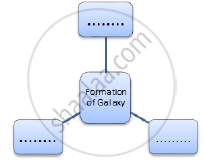
(A3)
(a) Find out similar words from the passage. 01
(i) mass (ii) happenings
(b) Give the verb form of the given words. 01
(i) classified (ii) directions
(A4) Identify and name the clause. 02
Scientists believe that the galaxies were formed from the lumps of matter.
(A5) Can there be life in another galaxy? Give reasons for your answer. 02
(B) Read the passage given in Q. 4 (A) and write the summary of it. Suggest a suitable title to your summary. (05)
Read the first activity, read the extract and then do all the activities:
A1. Complete the following sentence choosing the correct alternatives:
He goes for a morning walk at 1 p.m., because -
(1) ______________________________________________
(2) ______________________________________________
(a) He arrives from work past midnight.
(b) He has to stay in bed for a longer time till late morning.
(c) He has a special plan for early morning.
(d) He does not like to join the early birds' club.
|
Some people can just never wake up early. They munch their breakfast on the way to work. They have excuses ready when they reach the office late. They miss trains on a regular basis. They have never seen a sunrise or met the milkman. Until a loved one turned over a new leaf recently, she was one such late riser. Try as she might, she couldn't help pressing the snooze button a hundred times before she finally got up. She felt terrible about this tendency but there was nothing she could do about it. Come morning, She would just not be able to shrug off the desire to sleep a while more. Only when divine intervention answered her prayers recently was she able to join the early bird's club. Another relative has no plans of joining this league through. She is rather unabashed about waking up past noon on a daily basis. To be fair, her husband is a media personality who typically arrives home from work past midnight. That does indeed give them sufficient justification to stay longer in slumberland each morning. This practice does lead to certain oddities through. He goes for his 'morning' walk at 1 pm, heatwaves, and appalled onlookers notwithstanding. They once returned from a night out only to meet the neighbour's son who was off on an early morning jog! Early risers clearly have the edge in life. By the time most of us wake up, they've been through their morning rituals, enjoyed their walk, had their tea and read the daily news. They're also likely to have made long-distance calls before dawn to those similarly inclined. Thus, by the time the sun warms up they're likely to have discussed all varieties of 'men, matters, and affairs' with a dozen people. |
A2. Web :
Complete the following web :
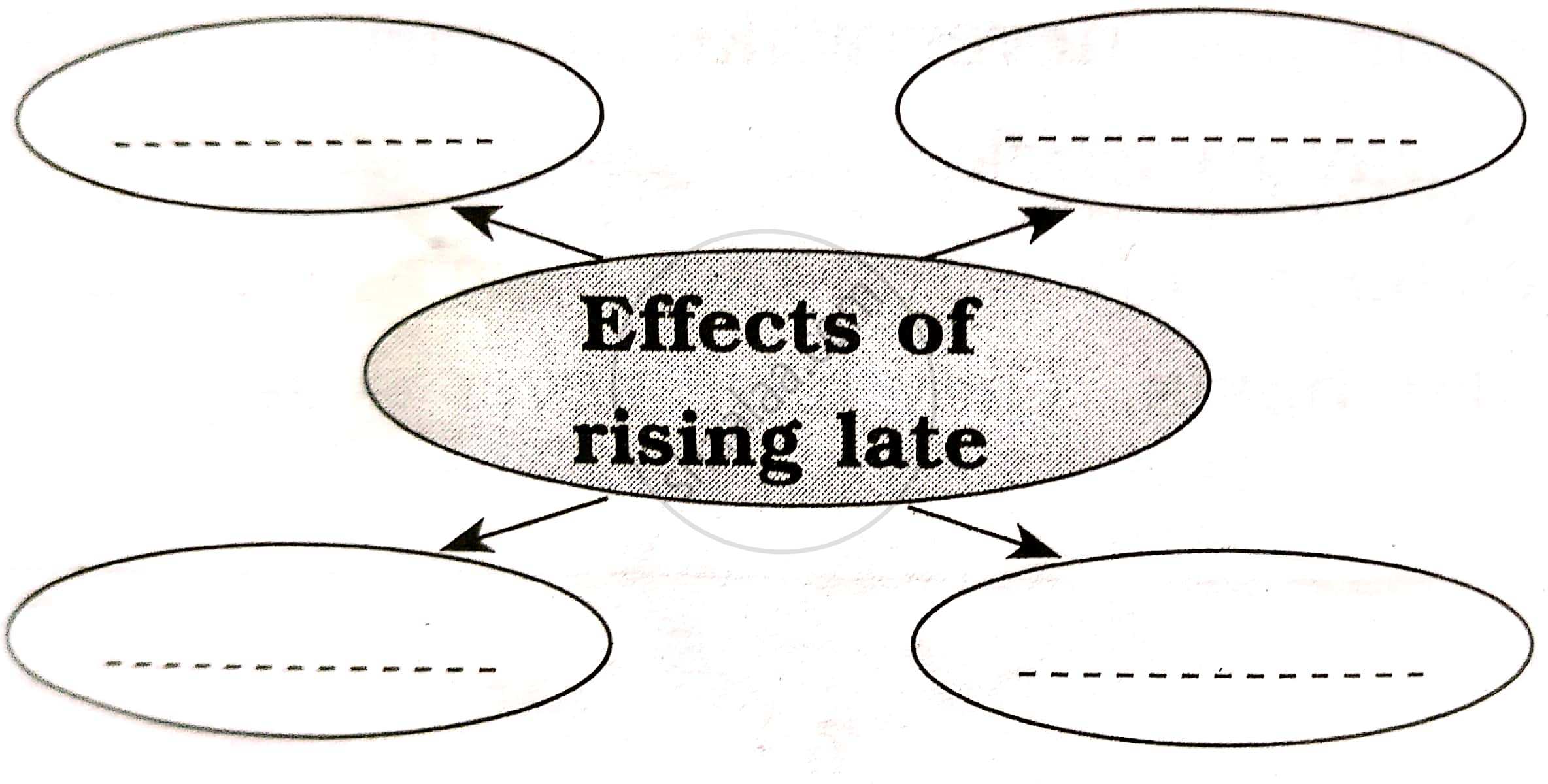
A3. Complete the following statement :
Early risers clearly have the edge in life, because -
(1)
(2)
A4. Vocabulary :
Match the words in column 'A' with their meanings in Column 'B'.
| Column 'A' | Column 'B' |
| (1) justification | (a) dismiss |
| (2) oddities | (b) sleep |
| (3) slumber | (c) strange things |
| (4) shrug off | (d) clarification |
A5. Personal Response:
State two things that you can do to join the early birds' club.
A6. Grammar:
Rewrite the following sentences in the ways instructed :
(1) She felt terrible about this tendency but there was nothing she could do about it. (Rewrite the sentence using 'although'.)
(2) They have never seen a sunrise or met the milkman. (Rewrite using 'neither ... nor'.)
II. Read the passage given below.
| 1 | The North-East of India is a melting pot of variegated cultural mosaic of people and races, an ethnic tapestry of many hues and shades. Yet, these states are lesser explored as compared to the rest of the country. The new generations of travellers who are ‘money rich and time poor’ are increasingly looking for unique experiences --a phenomenon being called the emergence of the ‘experience economy’. For this new and growing breed of tourists, the North-East with its variety and uniqueness holds immense attraction. |
| 2 | A study conducted in 2020 by Dr. Sherap Bhutia, revealed that the foreign tourist arrival in the North-East increased from 37,380 persons in 2005 to 118,552 in 2014. The overall growth rate of tourists (both domestic and foreign) in the North-East was as high as 26.44% during 2005-06. High and positive growth of 12.53% was registered in foreign tourist visits to North-East States of India during 2012 from 2011, which further rose to register a growth of 27.93% during 2013 from 2012. Foreign tourist arrivals in the North-East witnessed a growth of 39.77% during 2014 from 2013, according to data provided from the Ministry of Tourism, Government of India. |
| 3 | The study recommendations for tourism planners included the need to concentrate on some key areas like enhancement of tourist facilities, tourism financing, focus on community involvement and others for the formulation of a sustainable tourism strategy in the North-East States of India. |
i. Infer one reason for the following, based on information in paragraph 1. (1)
The rate of tourism in the North-East of India puzzles tourism officials.
ii. Select the appropriate option to fill in the blanks. (1)
From paragraph 1, we can infer that the ______ and ______ of the North-Eastern states aid attracting the ‘money rich and time poor’ tourists.
1. distinctiveness
2. conventionality
3. diversity
4. uniformity
5. modernity
- 1 & 3
- 2 & 4
- 2 & 5
- 1 & 4
iii. Complete the following analogy correctly with a word/ phrase from paragraph 1: (1)
aroma : cooking : : ______ : painting
(Clue: Just like aroma is integral to cooking, similarly, ______ is/ are integral to painting)
iv. Select the correct option to complete the following sentence: (1)
Travellers advocating the ‘experience economy’ seek a holiday package with ______ (Paragraph 1)
- grand facilities, expensive hotels and excellent services to pamper them.
- a wholesome experience within the budget they have planned for.
- places and cities to buy things from and opportunities to spend money.
- cost-effective services, affordable accommodation and many days of touring.
v. Select the chart that appropriately represents the trend of foreign tourist travels in the North-East, from 2011-2014, as per paragraph 2. (1)
 |
 |
 |
 |
| (1) | (2) | (3) | (4) |
- Option 1
- Option 2
- Option 3
- Option 4
vi. Fill in the blank by selecting the correct option. (1)
The study of tourist travel statistics in the North-East, from 2005 to 2014 showed ______ results.
- expected
- encouraging
- inconsistent
- questionable
vii. Substitute the word ‘witnessed’ with one word similar in meaning, in the following, sentence from paragraph 2: (1)
Foreign tourist arrivals in the North-East witnessed a growth of...
viii. List any 2 examples of ‘tourist facilities’ as referred to, in Paragraph 3. (1)
ix. List one reason why the researchers recommend that the formulation of a tourism strategy in the North-Eastern States of India be sustainable. (1)
x. Select the option that titles paragraphs 1-3 appropriately, with reference to information in the text. (1)
- 1. Full Speed Ahead!
2. Ups and Downs
3. Cause for Concern - 1. Winds of Change
2. Numbers Don't Lie
3. Time for Action - 1. Inspecting Trends
2. Statistically Speaking
3. Let's Investigate - 1. Cause and Effect
2. Dynamic Data
3. Dependable Facts
Read the extract given below:
| (1) | Necessity is indeed the mother of invention. When areas in and around Leh began to experience water shortages, life didn't grind to a halt. Why? Because a retired civil engineer in the Jammu and Kashmir Government came up with the idea of artificial glaciers. |
| (2) | Ladakh, a cold desert at an altitude of 3,000 - 3,500 meters above sea level, has a low average annual rainfall rate of 50 mm. Glaciers have always been the only source of water. Agriculture is completely dependent on glacier melt, unlike the rest of river/monsoon-fed India. But over the years, with increasing effects of climate change, rainfall and snowfall patterns have been changing, resulting in severe shortage and drought situations. Given the extreme winter conditions, the window for farming is usually limited to one harvest season. |
| (3) | It is located between the natural glacier above and the village below. The one closer to the village and lowest in altitude melts first, providing water during April-May, the crucial sowing season. Further, layers of ice above melt with the increasing temperature, thus ensuring continuous supply to the fields.
Therefore, farmers have been able to manage two crops instead of one. It costs about 1,50,000 and above to create a glacier. |
| (4) |
Fondly called the glacier man, he has designed over 15 artificial glaciers in and around Leh since 1987. In recognition of his pioneering effort, he was conferred the Padma Shri by The President of India. |
| (5) |
There are a few basic steps followed while creating an artificial glacier. River or stream water at high altitude is diverted to a shaded area of the hill, facing north, where the winter sun is blocked by a ridge or a mountain range. At the start of winter ie., in November, the diverted water is made to flow on sloping hills facing distribution channels. Stone embankments are built at regular intervals which impede the flow of water, making shallow pools which freeze, forming a cascade of ice along the slope. Ice formation continues for 3-4 months resulting in a large accumulation of ice which is referred to as an ‘artificial glacier’. |

Based on your understanding of the extract, answer the questions below:
- Infer one reason for, the following, based on information in paragraph 1. (1)
Areas in and around Leh began to experience water shortage but life didn't grind to a halt. - Select from the passage the appropriate option to fill in the blanks: (1)
Agriculture is completely dependent on ______ unlike the rest of river/monsoon-fed India.- rainfall pattern
- climate change
- glaciers melt
- extreme winter conditions
- Complete the following analogy correctly with a word/phrase from paragraph 3: (1)
Icing : cake :: layers : ______. - Select the correct option to complete the following sentence: (1)
At the start of winter the diverted water is made to flow ______.- on sloping hills facing distribution channels.
- on high altitude.
- on ice-cold water level.
- on mountain range.
- From the chart select the months of water surplus. (1)
- January, February.
- November, December.
- July, August, September.
- March, April
- Fill in the blank by selecting from the passage the correct option: (1)
The ______ have been the only source of water in areas in and around Ladakh.
- glaciers
- rivers
- streams
- water springs
- The word 'located' in paragraph 3 means: (1)
- found
- locally found
- situated
- adapted
- Write any two steps followed while creating the glaciers. (1)
- List one reason why artificial glaciers seem the best option. (1)
- Select the most suitable title from the following for the passage: (1)
- Water Shortage.
- New Ways Pool Water.
- Artificial Glacier.
- River Beds.
Read the passage given below:
| (1) | When we think of the game of cricket, we come to the conclusion that it is primarily a game that depends on outstanding physical activities, good hand-eye coordination, speed, skill and strength. It provides entertainment and generates strong feelings of excitement. A good match of cricket or of any other game neither adds to the existing stock of human knowledge nor reveals any secret of existence. It does not carry any deep meaning but most people, particularly the lover of sports attach deep emotions and numerous meanings to it. Games are thought of as a metaphor for life. They are supposed to teach many lessons. In fact, more is said and written about a cricket match than about scientific findings or great philosophy. |
| (2) | This is because games, like a morality play, in which settings and rules are made by us, can easily make people test their fair and foul conduct, principles of reward and punishment, and emotions of joy and disappointment. They can make us experience the thrill of war without exposing us to its dangers. A man watching a cricket match on T.V. and munching popcorn is like a surrogate warrior. In fact, games provide us with a safe outlet for our aggressiveness. If games become aggressive, they lose the very purpose of providing entertainment and purging us of our aggressiveness. They can calm our impatience without creating any conflict. |
| (3) | Commentators, journalists, politicians and analysts can do a great favour to the competing teams by keeping the excitement within limits. The teams should play without being dominated by feelings of national honour and shame. Excellent performance of the players of both teams should be enjoyed and appreciated. Winning or losing in a game should not be taken seriously. A game is fun if it is played with true spirit of sportsmanship. |
Based on your understanding of the passage, answer the questions given below:
- Complete the sentence by choosing an appropriate option: (1)
Most people conclude that cricket is primarily a game because ______.- it is played as a match
- it requires two teams
- it includes physical activity
- it depends only on skill and strength.
- Comment on the writer's reference to 'that cricket does not reveal any secret of existence. (1)
- List two responses to which watching a game of cricket gives rise to. (1)
- Select the option that conveys the opposite of 'destroy' from words used in the passage. (1)
- reveals
- experience
- generate
- purging
- The writer would not agree with the given statements based on paragraph 2, EXCEPT (1)
- Rules of any game are made by people.
- Watching a cricket match makes the viewer believe that he is fighting a battle.
- It is necessary for a game to be aggressive in order to build excitement.
- A game can test people's sense of fair judgement.
- With reference to the passage, a spectator is compared to a 'surrogate warrior'. (1)
Choose the option that best describes this phrase:- a spectator who is paid to watch.
- a spectator who is in pain while watching the match.
- a spectator who enjoys the match as an armchair soldier.
- a spectator who makes judgments about reward and punishment.
- Why does the writer compare games to a morality play? (1)
- Complete the given sentence with an appropriate inference with respect to the following: (1)
The writer says that games can calm our impatience without creating any conflict by ______. - The writer advises the players that games should not become aggressive because ______. (1)
- Select the most suitable title for the above passage. (1)
- Excellent Performance by Cricketers
- The Benefits of Playing Cricket
- Cricket - The King of Games
- The True Spirit of Playing Games
