English
Maharashtra State BoardSSC (English Medium) 10th Standard

A.P.J. Abdul Kalam, in full Avul Pakir Jainulabdeen Abdul Kalam, (born October 15, 1931, Rameshwaram, India - died July 27, 2015, Shillong), - English (Second/Third Language)

Advertisements
Advertisements

Question

Read the following passage and do the activities:

A1. Complete the following sentences from the passage: (2)

  1. Kalam earned a degree in ______ engineering.
  2. DRDO stands for ______.
  3. Kalam was ______ of the SLV-III, the first satellite launch vehicle.
  4. Kalam served as lecturer at ______.

A.P.J. Abdul Kalam, in full Avul Pakir Jainulabdeen Abdul Kalam, (born October 15, 1931, Rameshwaram, India - died July 27, 2015, Shillong), Indian scientist who played a leading role in the development of India's missile and nuclear weapons programmes. He was President of India from 2002 to 2007.

Kalam earned a degree in aeronautical engineering from the Madras Institute of Technology and in 1958 joined the Defence Research and Development Organisation (DRDO). In 1969, he moved to the Indian Space Research Organisation, where he was project director of the SLV-III, the first satellite launch vehicle that was both designed and produced in India. Rejoining DRDO in 1982, Kalam planned the programme that produced a number of successful missiles, which helped earn him the nickname “Missile Man”. Among those successes was Agni, India's first intermediate-range ballistic missile, which incorporated aspects of the SLVIII and was launched in 1989.

Kalam remained committed using science and technology to transform India into a developed country and served as lecturer at several universities. Kalam wrote several books, including an autobiography, Wings of Fire (1999). He received the Padma Bhushan (1981), Padma Vibhushan (1990), Indira Gandhi award for National Integration (1997) and the India's highest civilian award Bharat Ratna (1997).

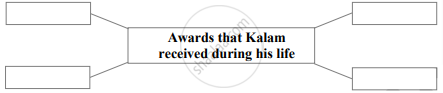
A2. Complete the web diagram: (2)

A3. Fill in the blanks by using the suitable phrases/words from the bracket: (2)
[moved to, served as, launched, autobiography]

  1. Mr. Gunaji has ______ a Principal in this college.
  2. “The Story of My Experiments with Truth” is the ______ of Mahatma Gandhi.
  3. My teacher ______ to England for further studies.
  4. ISRO successfully ______ Chandrayaan-3 mission.

A4. Do as directed: (2)

  1. Kalam wrote several books. (Frame a Wh-type question to get the underlined part as answer)
  2. Kalam earned a degree in aeronautical engineering. (Begin the sentence with “A degree in…….)

A5. Who is your role model? Write few lines about him/her. (2)

Comprehension
Advertisements

Solution

A1. 

  1. Kalam earned a degree in aeronautical engineering.
  2. DRDO stands for Defence Research and Development Organisation.
  3. Kalam was project director of the SLV-III, the first satellite launch vehicle.
  4. Kalam served as lecturer at several universities.

A2. 

A3. 

  1. Mr. Gunaji has served as a Principal in this college.
  2. “The Story of My Experiments with Truth” is the autobiography of Mahatma Gandhi.
  3. My teacher moved to England for further studies.
  4. ISRO successfully launched Chandrayaan-3 mission.

A4. 

  1. What did Kalam write?
  2. A degree in aeronautical engineering was earned by Kalam.

A5. My role model is Malala Yousafzai, a symbol of resilience and advocacy for education and women's rights. Born in Pakistan, Malala stood up against the Taliban to demand education for girls, surviving an assassination attempt at a young age. Her courage has inspired a global movement, leading her to become the youngest Nobel Prize laureate. Malala’s unwavering commitment to education, despite the risks, shows the power of conviction and the impact one individual can have on the world. Her story motivates me to advocate for what I believe in, regardless of the obstacles.

shaalaa.com
Unseen Passage Comprehension
  Is there an error in this question or solution?
2023-2024 (March) Official

RELATED QUESTIONS

During the devastating July 2005 floods that hit Mumbai, Rajen Dutia received an urgent call from a relative, Lopa Vyas late in the evening. “A friend’s mother is stranded near your home, Rajen. Can you please take her home? Her name is Rashmi,” Vyas told him.
Mumbai had come to a halt and people were trapped everywhere. Despite power failure and raging rain, Dutia stepped out and made his way to the spot, where he found Rashmi as well as a dozen other people. They were stranded in the dark, shivering in the rain. They all lived far away and had no place to go for the night.
Rajen took all of them to his one-bedroom flat, where he served them dinner and invited them to spend the night.
"By doing so," says Rajen, "I was simply fulfilling my karma, paying the universe back for the good it had done for me."

"God is kind. My daughter had just started her new job that day, and had gone for her training. She was stranded too. While she was trying to get to our relatives, she almost drowned, but a young stranger saved her. He and his friends even dropped her to my relative's place and phoned me to say she was safe. One good turn deserves another."

A2. Order
Look at the following sentences from the passage and put them in the correct sequence: (2)
(a) He took them to his one-bedroom flat.
(b) Rajen found Rashmi as well as a dozen other people shivering in the rain.
(c) Mumbai had come to a halt and people were trapped everywhere.
(d) Rajen Dutia received an urgent call.

A3

During the devastating July 2005 floods that hit Mumbai, Rajen Dutia received an urgent call from a relative, Lopa Vyas late in the evening. “A friend’s mother is stranded near your home, Rajen. Can you please take her home? Her name is Rashmi,” Vyas told him.
Mumbai had come to a halt and people were trapped everywhere. Despite power failure and raging rain, Dutia stepped out and made his way to the spot, where he found Rashmi as well as a dozen other people. They were stranded in the dark, shivering in the rain. They all lived far away and had no place to go for the night.
Rajen took all of them to his one-bedroom flat, where he served them dinner and invited them to spend the night.
"By doing so," says Rajen, "I was simply fulfilling my karma, paying the universe back for the good it had done for me."

"God is kind. My daughter had just started her new job that day, and had gone for her training. She was stranded too. While she was trying to get to our relatives, she almost drowned, but a young stranger saved her. He and his friends even dropped her to my relative's place and phoned me to say she was safe. One good turn deserves another."

A2. Order
Look at the following sentences from the passage and put them in the correct sequence: (2)
(a) He took them to his one-bedroom flat.
(b) Rajen found Rashmi as well as a dozen other people shivering in the rain.
(c) Mumbai had come to a halt and people were trapped everywhere.
(d) Rajen Dutia received an urgent call.

A3(i). Fill in the blanks :
Select the words given in the passage (1)
(i) Thousands Of pilgrims were …………….. due to the cloud burst in Uttarakhand.
(ii) The tiger was ……………… by the hunter.

(ii). Antonyms:
Select the correct antonyms for the given words from the alternatives :
(1) Please :
(a) unplease (b) displease (c) misplease
(2) Safe: '
(a) insafe (b) safeless (c) unsafe

A4(i) Tags :
Select the correct tag for the alternatives given below :
One good turn deserves another.
(a) Doesn’t it? (b) don’t it (c) does it?

(ii). Guess:
Choose the correct answer : (1)
Rajen can you please take her home? ‘Can’ indicates :
(a) Obligation (b) ability (c) permission

A5. Personal Response :
‘ one good turn
Deserves another.’
Explain with an
example of your own.


The natural life span of a domesticated horse is about 25 – 30 years, 10 years down from what it was in the wild. You can tell a horse’s age from the number of teeth he has. They get all their teeth by the age of 5, after which those teeth just get longer. Horses have close to 360 degree all round vision. The only place they cannot see is directly behind or right in front of themselves, which is why it’s dangerous to stand behind a horse. If they later I it also means that they cannot see a jump once they are about four feet from it, and have to rely on memory as to its height and shape! Each of the horse’s two eyes work independently wherever a horse’s ear points is where the horse is looking. A horse is able to sleep standing up as he is able to lock his leg muscles so that he dosen’t fall asleep. Nor do all horses in the same field ever lie down at once – one animal always stands “on look out” duty.

1) What is the life span of a wild horse?
(2) Why do the horse owners cover their horse’s eyes with blinkers?
(3) What prevents a horse from falling while asleep?
(4)
(a) Falls /shorter/ the mane/ on the/ side/ legged.[Rearrange the words to make a meaningful sentence]
(b) Form antonyms by adding a prefix :
(i) able
(ii) direct 
(5)
(a) They get all their teeth by the age of five. [Pick out the prepositions]
(b) If they feel something behind them they may kick. [Rewrite using ‘unless’]
(6) How have horses helped man through the ages?


The hopping kangaroo is a familiar sight in every snapshot relating to Australia. Members of the kangaroo family can be as small as a rat or as big as a man. Kangaroos are found mainly in Australia, Tasmania and New Guinea. Kangaroos, which are big-footed marsupials that evolved in Australia, use their short front legs like arms. The man-sized kangaroos of Australia are capable of speeding up to 88 km/hr for short distances, their means of locomotion being their powerful hind legs, which carry them over the ground in jumps of 9 m or more at a time.
Weighing around 70 kg, they have an average lifespan of around six to eight years and a maximum lifetime of 20 years. When bothered by predators, kangaroos often head for the water, standing submerged to the chest and attempting to drown the attacker by holding him under water. Another defensive technique is to get their back to a tree and kick at their adversary with their clawed hind feet, sometimes with sufficient force to kill a man. Normally shy animals, they alert other kangaroos to danger by beating on the ground with their hind feet. This loud alarm signal carries over a long distance.
The tail is important for kangaroos. It holds them in balance and supports them when they sit or fight against other kangaroos. The kangaroo uses its short legs as arms. With them it scratches itself, cleans its fur and holds branches when it eats leaves. Kangaroos are marsupials and the females carry newborns in a pouch in front of their abdomens. The babies are born small and climb up into safety of the pouch. There, for the next 225 days or so, they eat, sleep and grow. Once they reach full development, they leave the pouch. A young kangaroo that leaves the pouch is called a ‘joey’. To keep from getting too hot, the kangaroos take naps in the afternoon and do most of their grazing at night. But the best stay-cool secret of these creatures is the spit bath! Kangaroos drool and lick saliva all over their faces and bodies to cool down.

On the basis of your reading of the above passage, complete the following sentences with appropriate words/phrases:
(a) When followed by predators, kangaroos submerge ____________ and _________________.

(b) The powerful hind legs help kangaroos to __________________.

(c) Kangaroos are mainly found in Australia and are ____________________.

(d) They use their front legs to ___________________.

(e) Kangaroos warn others of danger by _______________________.

(f) The secret of kangaroos to stay cool is ______________________.

(g) They use their tails to _________________________.

(h) Before becoming ‘joeys’, the young ones stay in the ______________ and ________________.


He holds him with his skinny hand,

“There was a ship,” quoth he.

i. Who does ‘He’ refer to in the above extract?

ii. What do we know about the speaker’s feelings?

iii. Why is his hand called ‘skinny’?


Q1 Read the following passage and answer the questions that follow:

1. Too many parents these days can't say no, As a result, they find themselves raising 'children' who respond greedily to the advertisements aimed right at them. Even getting what they want doesn't satisfy some kids; they only want more. Now, a growing number of psychologists, educators, and parents think it's time to stop the madness and start teaching kids about what's really important: values like hard work, contentment, honesty, and compassion. The struggle to set limits has never been tougher ‒ and the stakes have never been higher. One recent study of adults who were overindulged as children paints a discouraging picture of their future: when given too much too soon, they grow up to be adults who have difficulty coping with life's disappointments. They also have a distorted sense of entitlement that gets in the way of success in the workplace and in relationships.

2. Psychologists say that parents who overindulge their kids set them up to be more vulnerable to future anxiety and depression. Today's parents themselves raised on values of thrift and self-sacrifice, grew up in a culture where no was a household word. Today's kids want much more, partly because there is so much more to want. The oldest members of this generation were born in the late 1980s, just as PCs and video games were making their assault on the family room. They think of MP3 players and flat-screen TV as essential utilities, and they have developed strategies to get them. One survey of teenagers found that when they crave something new, most expect to ask nine times before their parents give in. By every measure, parents are shelling out record amounts. In the heat of this buying blitz, even parents who desperately need to say no find themselves reaching for their credit cards.

3. Today's parents aren't equipped to deal with the problem. Many of them, raised in the 1960s and '70s, swore they'd act differently from their parents and have closer relationships with their own children. Many even wear the same designer clothes as their kids and listen to the same music. And they work more hours; at the end of a long week, it's tempting to buy peace with 'yes' and not mar precious family time with conflict. Anxiety about the future is another factor. How do well-intentioned parents say no to all the sports gear and arts and language lessons they believe will help their kids thrive in an increasingly competitive world? Experts agree: too much love won't spoil a child. Too few limits will.

4. What parents need to find, is a balance between the advantages of an affluent society and the critical life lessons that come from waiting, saving, and working hard to achieve goals. That search for balance has to start early. Children need limits on their behaviour because they feel better and more secure when they live within a secure structure. Older children learn self-control by watching how others, especially parents act. Learning how to overcome challenges is essential to becoming a successful adult. Few parents ask kids to do chores. They think their kids are already overburdened by social and academic pressures. Every individual can be of service to others, and life has meaning beyond one's own immediate happiness. That means parents eager to teach values have to take a long, hard look at their own.

(a) Answer the following:

  1. What values do parents and teachers want children to learn?
  2. What are the results of giving the children too much too soon?
  3. Why do today's children want more?
  4. What is the balance which the parents need to have in today's world?
  5. What is the necessity to set limits for children?

(b) Pick out words from the passage that mean the same as the following:

  1. a feeling of satisfaction (para 1)
  2. valuable (para 3)
  3. important  (para 4)

Read the following passage:

It's Beginning to Bite
 
In these trying times, when buying ordinary food stuff can burn a hole in your pockets, comes the news that can actually help us save some hard cash when we go out to shop the next time. According to a Stanford University study, the first of its kind in the world, there is no evidence to suggest that there are more nutritional benefits from expensive organic food than those grown by conventional methods. The researchers add that there is no difference in protein and fat content between organic and conventional milk and the vitamin count is similar in both types. The only benefit is that organic foods are not contaminated with pesticides but then before you chew on the plate of organic okra with roti made from organic wheat, they are not 100% pesticide free either. In India, organic food has been growing at 20-22% and the export market is valued at Rs. 1,000 crore. Obviously, the study is not good news for that sector and for people who are big on organic food.


In India, eating organic food is more of a style statement than due to health worries because the stuff is expensive. But people who can, do indulge in not only organic vegetables but even organic eggs laid by 'happy hens', who are allowed to roam around freely whereas 'unhappy hens' are kept in coops. Then there are companies that have installed music channels in their cowsheds and the milk from those sheds are sold at a marked up price since it has more nutritional value because the animals are happy thanks to lilting 24×7 music. We don't know yet any farmer using music to improve his crop quality, but then you never know : plants are known to respond to music.

Why such pickiness about food ? These days, the huge number of TV shows and articles that we see and read on food provide bread and butter for the specialist. But instead of decoding food, its sources and what has gone into growing it, isn't it much better to enjoy what's on the plate ?

(Adapted from The Hindustan Times)


Complete the statements given below by choosing the correct options from those that follow:

(a) According to a Stanford University study, organic food in relation to conventional food is________.
  (i) less nutritious
  (ii) more nutritious
  (iii) very conventional
  (iv) as nutritious

(b) The study will not be welcomed by _________.
  (i) farmers of conventional food
  (ii) makers of pesticides
  (iii) all sectors
  (iv) exporters of organic food

(c) We can save some hard cash by _________.
  (i) buying organic food
  (ii) not buying organic food
  (iii) going to the shop
  (iv) not buying food with pesticides

(d) Music channels are installed in the cowshed because the _________.
  (i) cows then give more milk
  (ii) milk is sold at a higher price
  (iii) milk becomes more pure
  (iv) workers becomes happy

(e) In the second paragraph, the author's attitude to the people who eat food sourced from 'happy' animals is that he _________.
  (i) is happy with them
  (ii) is unhappy with them
  (iii) is laughing at them
  (iv) wants crops to be grown similarly

(f) One benefit of organic food is that __________.
  (i) it is fashionable to eat
  (ii) only rich people can afford it
  (iii) it is less contaminated with pesticides
  (iv) even poor people can afford it

(g) The word 'contaminated' means ________.
  (i) adulterated
  (ii) for adults
  (iii) containing
  (iv) not healthy


Read the passage given below and answer the questions that follow:

If you are addicted to coffee, and doctors warn you to quit the habit, don’t worry and just keep relishing the beverage, because it’s not that bad after all! In fact, according to a new study, the steaming cup of Java can beat fruits and vegetables as the primary source of antioxidants. Some studies state that coffee is the number one source of antioxidants in American diet, and both caffeinated and decaf versions appear to provide similar antioxidant levels.

Antioxidants in general have been linked to a number of potential health benefits, including protection against heart diseases and cancer, but Vinson, a dietitian said that their benefits ultimately depend on how they are absorbed and utilized in the body. The research says that coffee outranks popular antioxidant sources like tea, milk, chocolate and cranberries. Of all the foods and beverages studied, dates actually have the most antioxidants based solely on serving size, but since dates are not consumed anywhere near the level of coffee, the drink comes as the top source of antioxidants, Vinson said.

Besides keeping you alert and awake, coffee has been linked to an increasing number of potential health benefits, including protection against liver and colon cancer, type 2 diabetes, and Parkinson’s disease, according to some recently published studies. The researchers, however, advise that one should consume coffee in moderation, because it can make you jittery and cause stomach pains

(a) What do doctors advise us about the habit of drinking coffee?
 
(b) What are the two versions of coffee that are drunk in America?
 
(c) State any two benefits of antioxidants.
 
(d) What does Vinson say about the consumption of antioxidants?
 
(e) Name any two popular sources of antioxidants.
 
(f) How does coffee outrank dates in the level of antioxidants?
 
(g) Mention any two benefits of coffee.
 
(h) What do researchers warn us about the excessive use of coffee?


Read the following passage carefully:

Gandhiji As a Fund Raiser

Gandhiji was an incurable and irrestible fund raiser. He found special relish in getting jewellery from women. Ranibala of Burdwan was ten years old. One day she was playing with Gandhiji. He explained to her that her bangles were too heavy for her delicate little wrists. She removed the bangles and gave them away to Gandhiji.

He used to talk jokingly to small girls and created distaste for ornaments and created a desire in them to part with the jewellery for the sake of the poor. He motivated them to donate their jewellery for social usage.

Kasturbai didn’t appreciate this habit of Gandhiji. Once she stated calmly, ‘You don’t wear jewels, it is easy for you to get around the boys. But what about our daughters-in-law ? They would surely want them.

“Well!” Gandhiji put in mildly, "our children are young and when they grow up they will not surely choose wives who are found of wearing jewellery.” Kasturbai was very upset with the answer.

Gandhiji was determined to keep the jewels to raise community fund. He was of the opinion that a public worker should accept no costly gifts. He believed that he should not own anything costly, whether given or earned. Kasturbai was a female with a desire to adorn. But Gandhiji moved towards renunciation and donated every penny earned in South Africa to the trustees for the service of South African Indians.

2.1 Answer the questions given below:

(a) How did Gandhiji create a distaste for jewellery in Ranibala?
 
(b) What was Kasturbai’s apprehension about their daughters-in-law?
 
(c) What solution did Gandhiji suggest for the problem posed by Kasturbai?
 
(d) How did Gandhiji serve the community?
 
2.2 Find meanings of the words given below from the options that follow:
 
(e) incurable (para 1)
(i) unreliable
(ii) untreatable
(iii) disagreeable
(iv) unbeatable
 
(f) motivated (para 2)
(i) encouraged
(ii) emboldened
(iii) incited
(iv) softened
 
(g) upset (para 4)
(i) puzzled
(ii) furious
(iii) confused
(iv) distressed
 
(h) renunciation (para 5)
(i) giving up
(ii) disagreement
(iii) opposition
(iv) termination

Read the extract given below and answer the questions that follow:

These meadows aren't worth much to me. They only come to five dessiatins, and are worth perhaps 300 roubles, but I can't stand unfairness. Say what you will, I can't stand unfairness.

(a) Who speaks the above lines and to whom?

(b) How much are the meadows worth?

(c) Find a word in the extract the means 'not based on what is just.'


Read the extract given below and answer the questions that follow:

I even considered fleeing to my hometown, where I could have been a real lawyer right away, without going through this unpleasant training period

(a) Who is 'I'?

(b) How did 'I' suffer during the training period?

(c) What does the word, 'fleeing' mean?


Read the passage given below and answer the questions that follow:            
 1. We sit in the last row, bumped about but free of stares. The bus rolls out of the dull crossroads of the city, and we are soon in open countryside, with fields of sunflowers as far as the eye can see, their heads all facing us. Where there is no water, the land reverts to desert. While still on level ground we see in the distance the tall range of the Mount Bogda, abrupt like a shining prism laid horizontally on the desert surface. It is over 5,000 metres high, and the peaks are under permanent snow, in powerful contrast to the flat desert all around. Heaven Lake lies part of the way up this range, about 2,000 metres above sea-level, at the foot of one of the higher snow-peaks.
 2. As the bus climbs, the sky, brilliant before, grows overcast. I have brought nothing warm to wear: it is all down at the hotel in Urumqi. Rain begins to fall. The man behind me is eating overpoweringly smelly goat's cheese. The bus window leaks inhospitably but reveals a beautiful view. We have passed quickly from desert through arable land to pasture, and the ground is now green with grass, the slopes dark with pine. A few cattle drink at a clear stream flowing past moss-covered stones; it is a Constable landscape . The stream changes into a white torrent, and as we climb higher I wish more and more that I had brought with me something warmer than the pair of shorts that have served me so well in the desert .The stream (which, we are told rises in Heaven Lake) disappears, and we continue our slow ascent. About noon, we arrive at Heaven Lake, and look for a place to stay at the foot, which is the resort area. We get a room in a small cottage, and I am happy to note that there are thick quilts on the beds.

3. Standing outside the cottage we survey our surroundings. Heaven Lake is long, sardine-shaped and fed by snowmelt from a stream at its head. The lake is an intense blue, surrounded on all sides by green mountain walls, dotted with distant sheep. At the head of the lake, beyond the delta of the inflowing stream, is a massive snow-capped peak which dominates the vista; it is part of a series of peaks that culminate, a little out of view, in Mount Bogda itself.

 4. For those who live in the resort there is a small mess-hall by the shore. We eat here sometimes, and sometimes buy food from the vendors outside, who sell kabab and naan until the last buses leave. The kababs, cooked on skewers over charcoal braziers, are particularly good; highly spiced and well-done. Horse's milk is available too from the local Kazakh herdsmen, but I decline this. I am so affected by the cold that Mr. Cao, the relaxed young man who runs the mess, lends me a  spare pair of trousers, several sizes too large but more than comfortable. Once I am warm again, I feel a pre-dinner spurt of energy – dinner will be long in coming – and I ask him whether the lake is good for swimming in.
 5. "Swimming?" Mr. Cao says. "You aren't thinking of swimming, are you?"
 6. "I thought I might," I confess. "What's the water like?"
 7. He doesn't answer me immediately, turning instead to examine some receipts with exaggerated interest. Mr. Cao, with great off-handedness, addresses the air. "People are often drowned here," he says. After a pause, he continues. "When was the last one?" This question is directed at the cook, who is preparing a tray of mantou (squat white steamed bread rolls), and who now appears, wiping his doughy hand across his forehead. "Was it the Beijing athlete?" asks Mr. Cao.

On the basis of your understanding of the above passage, complete the statements given below with the help of options that follow:

(a) One benefit of sitting in the last row of the bus was that:
(i) the narrator enjoyed the bumps.
(ii) no one stared at him.
(iii) he could see the sunflowers.
(iv) he avoided the dullness of the city.

(b) The narrator was travelling to:
(i) Mount Bogda
(ii) Heaven Lake
(iii) a 2000 metre high snow peak
(iv) Urumqi

(c) On reaching the destination the narrator felt relieved because:
(i) he had got away from the desert.
(ii) a difficult journey had come to an end.
(iii) he could watch the snow peak.
(iv) there were thick quilts on the bed.

(d) Mount Bogda is compared to:
(i) a horizontal desert surface
(ii) a shining prism
(iii) a Constable landscape
(iv) the overcast sky

Answer the following questions briefly:
(e) Which two things in the bus made the narrator feel uncomfortable?
(f) What made the scene look like a Constable landscape?
(g) What did he regret as the bus climbed higher?
(h) Why did the narrator like to buy food from outside?
(i) What is ironic about the pair of trousers lent by Mr. Cao?
(j) Why did Mr. Cao not like the narrator to swim in the lake?
(k) Find words from the passage which mean the same as the following:
(i) sellers (para 4)
(ii) increased (para 7)

Read the passage given below and answer the questions that follow:           

The most alarming of man’s assaults upon the environment is the contamination of air, earth, rivers, and sea with lethal materials. This pollution is for the most part irrevocable; the chain of evil it initiates is for the most part irreversible. In this contamination of the environment, chemicals are the sinister partners of radiation in changing the very nature of the world; radiation released through nuclear explosions into the air, comes to the earth in rain, lodges into the soil, enters the grass or corn, or wheat grown there and reaches the bones of a human being, there to remain until his death. Similarly, chemicals sprayed on crops lie long in soil, entering living organisms, passing from one to another in a chain of poisoning and death. Or they pass by underground streams until they emerge and combine into new forms that kill vegetation, sicken cattle, and harm those who drink from once pure wells.

It took hundreds of millions of years to produce the life that now inhabits the earth and reached a stage of adjustment and balance with its surroundings. The environment contained elements that were hostile as well as supporting. Even within the light of the sun, there were short wave radiations with power to injure. Given time, life has adjusted and a balance reached. For time is the essential ingredient, but in the modern world is no time.

The rapidity of change and the speed with which new situations are created follow the heedless pace of man rather than the deliberate pace of nature. Radiation is no longer the bombardment of cosmic rays; it is now the unnatural creation of man’s tampering with the atom. The chemicals to which life is asked to make adjustments are no longer merely calcium and silica and copper and all the rest of the minerals washed out of the rocks and carried in the rivers to the sea; they are the synthetic creations of man’s inventive mind, brewed in his laboratories, and having no counterparts in nature.

(a) On the basis of your understanding of the above passage make notes on it using headings and sub-headings. Use recognizable abbreviations (wherever necessary-minimum four) and a format you consider suitable. Also supply a title to it.

(b) Write a summary of the passage in about 80 words.


1. Read the passage given below :
 1. Maharana Pratap ruled over Mewar only for 25 years. However, he accomplished so much grandeur during his reign that his glory surpassed the boundaries of countries and time turning him into an immortal personality. He along with his kingdom became a synonym for valour, sacrifice and patriotism. Mewar had been a leading Rajput kingdom even before Maharana Pratap occupied the throne. Kings of Mewar, with the cooperation of their nobles and subjects, had established such traditions in the kingdom, as augmented their magnificence despite the hurdles of having a smaller area under their command and less population. There did come a few thorny occasions when the flag of the kingdom seemed sliding down. Their flag once again heaved high in the sky thanks to the gallantry and brilliance of the people of Mewar.
 

2. The destiny of Mewar was good in the sense that barring a few kings, most of the rulers were competent and patriotic. This glorious tradition of the kingdom almost continued for 1500 years since its establishment, right from the reign of Bappa Rawal. In fact only 60 years before Maharana Pratap, Rana Sanga drove the kingdom to the pinnacle of fame. His reputation went beyond Rajasthan and reached Delhi. Two generations before him. Rana Kumbha had given a new stature to the kingdom through victories and developmental work. During his reign, literature and art also progressed extraordinarily. Rana himself was inclined towards writing and his works are read with reverence even today The ambience of his kingdom was conducive to the creation of high quality work of art and literature. These accomplishments were the outcome of a longstanding tradition sustained by several generations.
 
3. The life of the people of Mewar must have been peaceful and prosperous during the long span of time; otherwise such extraordinary accomplishment in these fields would not have been possible. This is reflected in their art and literature as well as their loving nature. They compensate for lack of admirable physique by their firm but pleasant nature. The ambience of Mewar remains lovely thanks to the cheerful and liberal character of its people.
 
4. One may observe astonishing pieces of workmanship not only in the forts and palaces of Mewar but also in public utility buildings. Ruins of many structures which are still standing tall in their grandeur are testimony to the fact that Mewar was not only the land of the brave but also a seat of art and culture. Amidst aggression and bloodshed, literature and art flourished and creative pursuits of literature and artists did not suffer. Imagine, how glorious the period must have been when the Vijaya Stambha which is the sample of our great ancient architecture even today, was constructed. In the same fort, Kirti Stambha is standing high, reflecting how liberal the then administration was which allowed people from other communities and kingdoms to come and carry out construction work. It is useless to indulge in the debate whether the Vijaya Stambha was constructed first or the Kirti Stambha. The fact is that both the capitals are standing side by side and reveal the proximity between the king and the subjects of Mewar.
 
5. The cycle of time does not remain the same Whereas the reign of Rana Sanga was crucial in raising the kingdom to the acme of glory, it also proved to be his nemesis. History took a turn. The fortune of Mewar – the land of the brave, started waning. Rana tried to save the day with his acumen which was running against the stream and the glorious traditions for sometime.
On the basis of your understanding of the above passage answer each of the questions given below with the help of options that follow :
 
(a) Maharana Pratap became immortal because :
(i) he ruled Mewar for 25 years.
(ii) he added a lot of grandeur to Mewar.
(iii) of his valour, sacrifice and patriotism.
(iv) both (ii) and (iii)
 
(b) Difficulties in the way of Mewar were :
(i) lack of cooperation of the nobility.
(ii) ancient traditions of the kingdom.
(iii) its small area and small population.
(iv) the poverty of the subjects.

(c) During thorny occasions :
(i) the flag of Mewar seemed to be lowered.
(ii) the flag of Mewar was hoisted high.
(iii) the people of Mewar showed gallantry.
(iv) most of the rulers heaved a sigh of relief.
 
(d) Mewar was lucky because :
(i) all of its rulers were competent.
(ii) most of its people were competent.
(iii) most of its rulers were competent.
(iv) only a few of its people were incompetent.
 
Answer the following questions briefly:
(e) Who is the earliest king of Mewar mentioned in the passage?
(f) What was Rana Kumbha's contribution to the glory of Mewar?
(g) What does the writer find worth admiration in the people of Mewar?
(h) How could art and literature flourish in Mewar?
(i) How did the rulers show that they cared for their subjects?
(j) What does the erection of Vijaya Stambha and Kirti Stambha in the same fort signify ?
(k) Find words from the passage which mean the same as each of the following:
(i) surprising (para 4)
(ii) evidence (para 4)

Read the passage given below:

People tend to amass possessions, sometimes without being aware of doing so. They can have a delightful surprise when they find something useful which they did not know they owned. Those who never have to change house become indiscriminate collectors of what can only be described as clutter. They leave unwanted objects in drawers, cupboards, and attics for years in the belief that they may one day need them. Old people also accumulate belongings for two other reasons, lack of physical and mental energy, and sentiment. Things owned for a long time are full of associations with the past, perhaps with the relatives who are dead, and so they gradually acquire a sentimental value.

Some things are collected deliberately in an attempt to avoid wastage. Among these are string and brown paper, kept by thrifty people when a parcel has been opened. Collecting small items can be mania. A lady cuts out from newspaper sketches of model clothes that she would like to buy if she had money. As she is not rich, the chances are that she will never be able to afford such purchases. It is a harmless habit, but it litters up her desk.

Collecting as a serious hobby is quite different and has many advantages. It provides relaxation for leisure hours, as just looking at one’s treasure is always a joy. One doesn’t have to go out for amusement as the collection is housed at home. Whatever it consists of - stamps, records, first editions of books, china – there is always something to do in connection with it, from finding the right place for the latest addition to verifying facts in reference books. This hobby educates one not only in the chosen subject but also in general matters which have some bearing on it.

There are other benefits also. One gets to meet like-minded collectors to get advice, compare notes, exchange articles, to show off one’s latest find. So one’s circle of friends grows. Soon the hobby leads to traveling, perhaps a meeting in another town, possibly a trip abroad in search of a rare specimen, for collectors are not confined to one country. Over the years one may well become an authority on one’s hobby and will probably be asked to give informal talks to little gatherings and then, if successful, to larger audiences.

(a) On the basis of your understanding of the above passage make notes on it using headings and sub-headings. Use recognizable abbreviations (wherever necessary-minimum four) and a format you consider suitable. Also, supply an appropriate title to it.

(b) Write a summary of the passage in about 80 words.


Read the passage given below :

1. We often make all things around us the way we want them. Even during our pilgrimages we have begun to look for whatever makes our heart happy, gives comfort to our body and peace to the mind. It is as if external solutions will fulfil or needs, and we do not want to make any special efforts even in our spiritual search. Our minds is resourceful − it works to find shortcuts in simple and easy ways.

2. Even pilgrimages have been converted into tourism opportunities. Instead, we must awaken our conscience and souls and understand the truth. Let us not tamper with either our own nature of that of the Supreme.

3. All our cleverness is rendered ineffective when nature does a dance of destruction. Its fury can and will wash away all imperfection. Indian culture, based on Vedic treatises, assists in human evolution, but we are not using our entire energy in distorting these traditions according to our convenience instead of making efforts to make ourselves worthy of them.

4. The irony is that humans are not even aware of the complacent attitude they have allowed themselves to sink to. Nature is everyone's Amma and her fierce blows will sooner or later corner us and force us to understand this truth. Earlier, pilgrimages to places of spiritual significance were rituals that were undertaken when people became free from their worldly duties. Even now some seekers take up this pious religious journey as a path to peace and knowledge. Anyone travelling with this attitude feels and travels with only a few essential items that his body can carry. Pilgrims traditionally travelled light, on foot, eating light, dried chickpeas and fruits, or whatever was available. Pilgrims of olden days did not feel the need to stay in special AC bedrooms, or travel by luxury cars or indulge themselves with delicious food and savouries.

5. Pilgrims traditionally moved ahead, creating a feeling of belonging towards all, conveying a message of brotherhood among all they came across whether in small caves, ashrams or local settlements. They received the blessings and congregations of yogis and mahatmas in return while conducting the dharma of their pilgrimage. A pilgrimage is like penance or sadhana to stay near nature and to experience a feeling of oneness with it, to keep the body healthy and fulfilled with the amount of food, while seeking freedom from attachments and yet remaining happy while staying away from relatives and associates.

6. This is how a pilgrimage should be rather than making it like a picnic by taking a large group along and living in comfort, packing in entertainment, and tampering with environment. What is worse is giving a boost to the ego of having had a special darshan. Now alms are distributed, charity done while they brag about their spiritual experiences!

7. We must embark on our spiritual journey by first understanding the grace and significance of a pilgrimage and following it up with the prescribed rules and rituals − this is what translates into the ultimate and beautiful medium of spiritual evolution. There is no justification for tampering with nature.

8. A pilgrimage is symbolic of contemplation and meditation and acceptance, and is a metaphor for the constant growth or movement and love for nature that we should hold in our hearts.

9. This is the truth!
One the basis of your understanding of the above passage answer the questions that follow with the help of given options:

(a) How can a pilgrim keep his body healthy?
(i) By travelling light
(ii) By eating small amount of food
(iii) By keeping free from attachments
(iv) Both (i) and (ii)

(b) How do we satisfy our ego?
(i) By having a special darshan
(ii) By distributing alms
(iii) By treating it like a picnic
(iv) Both (i) and (ii)

Answer the following as briefly as possible:
(c) What change has taken place in our attitude towards pilgrimages?
(d) What happens when pilgrimages are turned into picnics?
(e) Why are we complacent in our spiritual efforts?
(f) How does nature respond when we try to be clever with it?
(g) In olden days with what attitude did people go on a pilgrimage?
(h) What message does the passage convey to the pilgrims?
(i) Find words from the passage which mean the same as the following:
(i) made/turned (para 3)
(ii) very satisfied (para 4)


Read the following extract and answer the questions given below:
That day Reuben fold two sacks, which he took to the rambling wooden factory and sold to the man in charge of packing nails. The boy's hand tightly clutched the small five-cent pieces as he ran two kilometres home.
Near his house stood the ancient barn that housed the family's goats and chickens. Reuben found a rusty baking- soda tin and dropped his coins inside. Then he climbed into the loft of the barn and hid the can beneath a pile of sweet-smelling hay.
It was supper time when Reuben got home. His father sat at the big kitchen table, working on a fishing net. Dora was at the black kitchen range, ready to serve dinner as Reuben took his place at the table.
He looked at his mother and smiled. Sunlight from the window gilded her, shoulder-length blond hair. Five foot three, slim and beautiful, she was the centre of the home, the glue that held it together.
Her chores were never-ending. Sewing clothes for her family on the old Singer treadle machine, cooking meals and baking bread, planting a vegetable garden. milking the goats and scrubbing soiled clothes on a washboru·d. But she was happy. Her family and their wellbeing were her highest priority.
Every day after chores and school, Reuben scoured the town, collecting the burlap nail bags. On the day the two-room schoolhouse closed for the summer, no student was more delighted than Reuben. Now he would have more time to devote to his mission.

(1) What is the main theme of the extract? (1)

(2) Where did Reuben keep his savings? Why? (2)

(3) Describe Reuben's mother and her daily chores. (2)

(4) What would you like to present to your mother on Mother's Day? Why? (2)

(5) Rewrite the following sentences in the ways instructed :

(i) He looked at his mother and smiled.
(Rewrite it as a Simple Sentence.) (1)

(ii) Her family and their well-being were her highest priority.
(Rewrite it in the Positive Degree.) (1)

(iii) She was the centre of the home. (1)
(Make it a Rhetorical Question)

(6) Find out the words from the extract which mean -

(i) dried grass (1/2)

(ii) routine tasks (1/2)


Read the following extract and answer the questions given below :

  Early risers clearly have the edge in life. By the time most of us wake up, they've been through their morning rituals, enjoyed their walk, had their tea and read the daily news. They're also likely to have made long-distance calls before dawn to those similarly inclined. Thus, by the time the sun warms up they're likely to have discussed all varieties of 'men, matters, and affairs' with a dozen people.
The upshot of these varying tendencies is that such extreme contrasts often exist in the same household. Weeks pass before the younger lot (typically late risers) and the older lot (normally early birds) come face to face. It's almost as if they live in different time zones and different countries.
All over the country, things are likely to be pretty much the same in this respect, one would think. If the man of the house, any house, decides to take a day off from work, he'd probably find his son emerging from his room at about I0 a.m. and that too in a 'rubbing-eyes' mode. After fooling around for a while the lad would probably dash off to college in a rush whilst simultaneously zipping up his jeans and sending text messages on his phone. His father would undoubtedly be left shaking his head and burying himself deeper into his newspaper.

(1) What is the extract about?

(2) How do the early risers get a headstart in life?

(3) What kind of lifestyle of the young son is reflected in the extract?

(4) According to you, why do the youngsters rise up late?

(5) Rewrite the following sentences in the ways instructed:
(i) He goes for his morning walk at 1 p.m.
(Rewrite it in the Present Perfect Continuous Tense.)
(ii) They live in different time zones.
(Make it a complex sentence.)
(iii) The man decides to take a day off from work.
(Rewrite it using the noun form of the underlined word.)

(6) Find out the words from the extract which mean:
(i) have a slight advantage over
(ii) coming out


Read the following passage and do the activities.

In the early days of farming, people did not understand how plants obtained essential nutrients. It so happened that wood ash, fish remains and slaughterhouse waste were thrown on vacant land just to get rid of them. Then, people started to notice that the grass, bushes and shrubs on this vacant land began to grow very well. They reasoned that if their farmland were similarly treated, the growth of their crops would also improve. People gradually began to realize that the nutrients required by plants came from the soil and that the amount of nutrients could be increased by the application of such organic remains to the soil. Thus started the manuring process in farming.
The practice of manuring has been practised as early since the seventeenth century. However, the importance of manuring was not properly understood until scientists began to study the nutritional needs of plants and gave birth to fertilizers. Thus, gradually, the use of fertilizers became accepted by farmers.
There are many types of manure and fertilizer currently being used. Manure is a substance derived from animals and plants. The most important advantage of using manure is the fact that they not only supply a wide range of plant
nutrients, but also improve the structure of the soil. It cements together the soil particles to form soil crumbs. The crumb structure is a desirable condition of cultivated soil. The addition of manure to soil will increase the inorganic and humus content which helps to prevent soil erosion and loss of plant nutrients when it rains. The common manure used in farming consists of farmyard manure, compost, blood meal, bone meal and fish meal.
Unlike manure, fertilizers are inorganic substances which do not improve the structure of the soil. They only supply extra amounts of nutrients to the growing plants when applied to the soil. The commercial fertilizers commonly used today
can be classified into three major categories; namely, nitrogen (N), phosphate and potash fertilizers.
Besides knowing the type of fertilizer to use, a farmer also needs to know when to apply the fertilizer and how to apply it. The fertilizer should be applied at the time when the plants need a particular nutrient most. The time and method
of application will determine how profitably the fertilizers have been used in farming. Fertilizers which have not been properly applied cannot be absorbed in large quantities by plant roots. These fertilizers may be washed away by rain
or they may kill the plants. This would mean a definite financial loss for the farmer.

(A1) Choose the correct option and rewrite the sentences.
(a) What did the people not understand in the early days of farming ? (1/2)
(i) how farming is done
(ii) how plants obtained essential nutrients
(iii) how grass, shrubs and bushes grow.

(b) What is manure ? (1/2)
(i) a substance derived from animals and plants.
(ii) the soil particles to form soil crumbs.
(iii) a combination of nitrogen, phosphate and potash.

(c) When should fertilizers be applied ? (1/2)
(i) When the plants get dried.
(ii) When the plants need a particular nutrient most.
(iii) In the early days of farming.

(d) What determines the profitability of the fertilizers ? (1/2)
(i) grass, bushes and shrubs
(ii) nitrogen, phosphate and potash.
(iii) The time and method of application.

(A2) How did the process of adding manure to the soil begin? (2)

(A3) Find out similar words from the passage. (2)
(i) necessary (ii) comprise
(iii) step by step (iv) ascertain

(A4)
(i) They supply extra amount of nutrients to the growing plants (Begin the sentence with ‘Extra amount of.......... ’.)(1)

(ii) It cements together the soil particles to form soil crumbs.
(Choose the correct option to name the tense.)(1)
(i) Simple present tense
(ii) Simple past tense
(iii) Simple future tense

(A5) ‘Agriculture plays important role in Indian economy’. Explain. (2)

(B) Read the passage given in Q. 4 (A) and write the summary of it. Suggest a suitable title to your summary. (5)


Read the following extract and complete the note given below :
The small village of Somnathpur contains an extraordinary temple, built around 1268 A.D by the Hoyasalas of Karnataka - one of the most prolific temple builders. Belur and Helebid are among their better-known works. While these suffered during the invasion of the 14th century, the Somnathpur temple stands more or less intact in near-original condition. The small temple captivates with the beauty and vitality of its detailed sculpture, covering almost every inch of the walls, pillars and even ceilings. It has three Shikhars and stands on a star-shaped raised platform with 24 edges. The outer walls have a profusion of detailed carvings: the entire surface run over by carved plaques of stone: There were vertical panels covered by exquisite figures of God and Goddesses, with many incarnations being depicted. There were nymphs too some carrying an ear of maize, a symbol of plenty and prosperity. The elaborate ornamentation, very characteristic of Hoyasala sculptures was a remarkable feature. On closer look and it is worth it-the series of friezes on the outer walls revealed intricately carved caparisored elephants, charging horsemen, stylized flowers and warriors.

                      Somnathpur Temple

(1) Location : ___________
(2) Year : 1268 A.D.
(3) Built by : ___________
(4) Captivates with : ___________
(5) Structural features :
    (i) Three Shikhars
    (ii) Star-shaped platform with 24 edges
   (iii) Outer wall carvings, ___________
    charging horsemen, __________ and warriors.
   (iv) Nymphs-symbol of ___________


Read the extract and do the activities that follow : 

‘Your father was my enemy,’ said Frederick. ‘I would have been better pleased by your brave deed if you had told me of another father?’
‘I am proud to be Sir Rowland's son,’ answered Orlando angrily,’ and I would not change my place to be the heir of this dukedom.’
The Duke and his lords went away, leaving Orlando alone with Rosalind and Celia. Celia was angry with her father for speaking so unkindly to Orlando. ‘Would I have done this in my father’s place?’ she said to Rosalind.
‘My father loved Sir Rowland as much as his own soul,’ Rosalind said to Celia, ‘and all the world agreed with him. If I had known that his young man was Sir Rowland’s son I should have begged him with tears not to take so great a risk.’
‘Let us go and speak to Orlando,’ said gentle Celia. ‘I am ashamed of my father’s rude and angry words.’
The two girls went up to Orilando and praised him for his bravery. Rosalind took a gold chain from her neck and gave it to him. ‘I would like to give you more’, she said, ‘but I am not rich.’ Then she and Celia went away.
Orlando, however, could not forget them. He had already fallen in love with the fair Rosalind, but he could not stay at the Duke’s palace. His friends warned him that Frederick was angry and jealous of him. They told Orlando to leave the dukedom, because the Duke meant to do him harm.

A1. Match - 

Match the characters and their attributes: 

  A   B
i. Celia a. fair
ii. Orlando b. rude and unkind
iii. Frederick c. gentle
iv. Rosalind d. brave

A2. Write an imaginary paragraph: 

Write an imaginary paragraph in about 50 words in continuation with the given extract. 


Read the extract and do the activities that follow:

My mother was still managing Green's, even though its days were numbered. The day after my return I joined her in the small office, where she sat behind her over-large desk, telephone on her right and the latest paperback western  before her, ready to be taken up when noting much was happening – which was fairly often. My mother enjoyed reading westerns-particularly Luke Short, Max Brand, and Clarence E Mulfordmuch in the same way that I enjoyed detective fiction. Both genres were freely available in cheap collins ‘White Circle’, edition published during and just after the War.
We discussed the affair of the skeleton in the cupboard, but as there was no longer any mystery about it, there was nothing for me to investigate. However, armed with the key to the store room, I went down to the basement on my own and made a thorough search of all the old furniture, on the offchance that another skeleton moght tumble out of a cupboard or be found jammed into a drawer or trunk. I did find some old tennis rackets, back numbers of Punch, a cracked china chamber-pot, some old postcards of Darjeeling and Simla, and a framed photograph of King Edward the Seventh. I took the copies of ‘Punch’ to my room and read the reviews of all the plays that had been running in London between 1926 and 1930, thus becoming an authority on the theatre in England of that period.

A1. True/False
State whether the following statements are true or false:
(i) The narrator found one skeleton jammed into a drawer
(ii) The narrator did not like to read detective fiction
(iii) The narrator's mother was managing the Green's hotel
(iv) The narrator wanted to be an authority on the English theatre of that period

A2. Write a gist :
Write a gist of the above given extract in about 50 words.


Read the following extract and answer the questions given below:

In 1945 in Bay Roberts, Canada, a 12- year old boy saw something in a shop window that set his heart racing. But the price - five dollars- was far beyond Reuben Earle's means. Five dollars would buy almost a week's groceries for his family.

Reuben couldn't ask his father for the money. everything Mark Earle made fishing. Reuben's mother. Dora, stretched like elastic to feed and clothe their five children.

Nevertheless, he opened the shop's weathered door and went inside. Standing proud and straight in his flour-sack shirt and washed out trousers, he told the shopkeeper what he wanted, adding, "but I don't have the money now. can you please hold it for me?"

"I will try," the shopkeeper smiled. "Folks around here don't usually have that kind of money to spend on things. It should keep for a while."

Reuben respectfully touched his worn cap and walked out into the May sunlight. The bay rippled in a freshening wind that ruffled his short hair. There was purpose in his loping stride. He would raise the five dollars and not tell anybody.

Hearing the sound of hammering from a side street. Reuben had an idea.

He ran towards the sound and stopped at a construction site. People built their own homes in Bay Roberts, using nails purchased in burlap sacks from a local factory. Sometimes the sacks were discarded is the flurry of building, and Reuben knew he could sell them back to the factory for five cents apiece.

Questions: 

(1) What is the passage about?

(2) What did Reuben ask the shopkeeper? What was the shopkeeper's reply?

(3) Why could not Reuben ask his father for five dollars?

(4) How do you express your love and respect for your parents?

(5) Rewrite the following sentences in the ways instructed:

i. He opened the shop's weathered door and went inside. (Make it simple)

ii. "I will try."
(Rewrite the sentence using another modal Auxiliary showing 'obligation'.)

iii. People built their own homes in Bay Roberts.
(Frame a Wh question to get the underlined part as ita answer)

(6) Give the opposite words of:

(i) respectfully 

(ii) Usually 


Read the following extract and answer the questions given below :

Reuben arrived at the factory. The sack buyer was about to lock up.
"Mister! Please don't close up yet." The man turned and saw Reuben, dirty and sweat-stained.
"Come back tomorrow, boy."
"Please, Mister. I have to sell the sacks now-please." The man heard a tremor in Reuben's voice and could tell he was close to tears.
"Why do you need this money so badly?"
"It's a secret."
The man took the sacks, reached into his pocket and put four nickels into Reuben's hand. Reuben murmured a quiet thank-you and ran home.
Then, clutching the tin can, he headed for the store.
"I have the money" he solemnly told the owner, pouring his coins onto the counter.
The man went to the window and retrieved Reuben's treasure. He wiped the dust off and gently wrapped it in brown paper. Then he placed the parcel in Reuben's hands.
Racing home, Reuben burst through the front door. His mother was scrubbing the kitchen range. "Here Mum!Here!" Reuben exclaimed as he ran to her side. He placed a small box in her work-roughened hand.
She unwrapped it carefully, to save the paper. A blue-velvet jewel box appeared. Dora lifted the did, tears beginning to blur her vision.
In gold tettering on a small, almond-shaped brooch was the word 'Mother'
It was Mother's Day, 1946
Dora had never received such a gift; she had no finery except her wedding ring. Speechless, she smiled radiantly and gathered her son into her arms.

(1) Why did Reuben insist on the sack buyer to buy his sacks that day only?
(2) How did the mother react when Reuben gave her the gift?
(3) In what way was Reuben's gift special to his mother?
(4) What do you plan to do on Mother's Day?
(5) Rewrite the following sentences in the ways instructed :
(i) I have to sell the sacks.
(Rewrite it replacing the underlined part with the modal auxiliary showing 'compulsion'.)
(ii) She smiled radiantly and gathered her son into her arms. (Use 'As soon as'.)
(iii) She unwrapped it carefully.
(Rewrite the sentences using the noun form of the underlined word.)
(6) Find out the words/phrases from the extract which mean:
(i) showing joy (ii) got back


Read the following extract and answer the questions given below:

Researchers recently announced the earth could actually withstand up to 200,000 times the current population. They arrived at this figure by calculating the amount of heat a human body emits, and only at 1.3 million billion would the earth be too hot to be habitable. And though it would feel like being in a can of sardines if that figure were ever reached, the earth is capable of comfortably sustaining a population several times the current 6.5 billion.
In fact, fertility is actually on the decline worldwide. Though the population has grown, the rate of growth has fallen sharply. Twenty years ago, the UN projected that the population would reach 11.16 billion in 2050, today they say it will reach only 9.3 billion. Moreover, the human population will stabilize at about 11.5 billion. While this figure is almost twice the current one, it is hardly claustrophobic.
True, the demands on resources are heavy even now, but this is more due to the manner in which these resources are being used. In fact, figures show that a bigger population does not amount to greater consumption. Over 20% of the world's people in the highest-income countries account for 86% of total private consumption expenditure - the poorest 20% a tiny 1.3%. With just 5% of the world's population, the US consumes about 40% of the world's resources. Would you say the US is overpopulated?
  Concerns on the scarcity of food are equally baseless. In fact, global food production has actually kept up with population growth.

(1) What is the main idea of the first paragraph?
(2) What is the relationship between the population and the available resources?
(3) Why do the researchers claim that the earth is capable of sustaining a bigger population?
(4) What, according to you, are the problems caused by the increasing population?
(5) Rewrite the following sentences in the ways instructed :
(i) The earth would be too hot to be habitable. (Remove 'too'.)
(ii) Though the population has grown, the rate of growth has fallen sharply. (Rewrite it using 'but')
(iii) Moreover, the human population will stabilize at about 11.5 billion. (Make it 'less definite'.)
(6) Find out the words from the extract which mean :
(i) natural capacity to produce  (ii) shortage


Read the first activity, read the extract and then do all the activities:

A1. Complete the following sentence choosing the correct alternatives:

He goes for a morning walk at 1  p.m., because -
(1) ______________________________________________
(2) ______________________________________________
(a) He arrives from work past midnight.
(b) He has to stay in bed for a longer time till late morning.
(c) He has a special plan for early morning.
(d) He does not like to join the early birds' club.

Some people can just never wake up early. They munch their breakfast on the way to work.

They have excuses ready when they reach the office late. They miss trains on a regular basis. They have never seen a sunrise or met the milkman.

Until a loved one turned over a new leaf recently, she was one such late riser. Try as she might, she couldn't help pressing the snooze button a hundred times before she finally got up. She felt terrible about this tendency but there was nothing she could do about it. Come morning, She would just not be able to shrug off the desire to sleep a while more. Only when divine intervention answered her prayers recently was she able to join the early bird's club.

Another relative has no plans of joining this league through. She is rather unabashed about waking up past noon on a daily basis. To be fair, her husband is a media personality who typically arrives home from work past midnight. That does indeed give them sufficient justification to stay longer in slumberland each morning. This practice does lead to certain oddities through. He goes for his 'morning' walk at 1 pm, heatwaves, and appalled onlookers notwithstanding. They once returned from a night out only to meet the neighbour's son who was off on an early morning jog!

Early risers clearly have the edge in life. By the time most of us wake up, they've been through their morning rituals, enjoyed their walk, had their tea and read the daily news. They're also likely to have made long-distance calls before dawn to those similarly inclined. Thus, by the time the sun warms up they're likely to have discussed all varieties of 'men, matters, and affairs' with a dozen people.

A2. Web : 

Complete the following web :

A3. Complete the following statement :

Early risers clearly have the edge in life, because -
(1)
(2)

A4. Vocabulary : 

Match the words in column 'A' with their meanings in Column 'B'.

Column 'A' Column 'B'
(1) justification (a) dismiss
(2) oddities (b) sleep
(3) slumber (c) strange things
(4) shrug off (d) clarification

A5. Personal Response:
State two things that you can do to join the early birds' club.

A6. Grammar:
Rewrite the following sentences in the ways instructed :

(1) She felt terrible about this tendency but there was nothing she could do about it. (Rewrite the sentence using 'although'.)

(2) They have never seen a sunrise or met the milkman. (Rewrite using 'neither ... nor'.)


Read the following passage and do the given activities. 
 A1. State whether the following statements are true or false:
 i. The narrator writes comics.
 ii. Sudhir qualified as a friend.
 iii. The narrator met Sudhir in Dehra.
 iv. Friendship is all about disintegration.

 FRIENDSHIP IS ALL ABOUT DOING THINGS TOGETHER. IT MAY BE Climbing a mountain, fishing in a mountain stream, cycling along a country road, camping in a forest clearing or simply traveling together and sharing the experiences that a new place can bring.
 On at least two of these counts, Sudhir qualified as a friend, albeit a troublesome one, given to involving me in his adolescent escapades.
 I met him in Dehra soon after my return from England. He turned up at my room, saying he’d heard I was a writer and did I have any comics to lend him?
 “I don’t write comics”, I said; but there were some comics lying around, leftover from my own boyhood collection. So I gave these to the lanky youth who stood smiling in the doorway, and he thanked me and said he’d bring them back. From my window, I saw him cycling off in the general direction of Dalanwala.
 He turned up again a few days later and dumped a large pile of new-looking comics on my desk. “Here are all the latest”, he announced. “You can keep them for me. I’m not allowed to read comics at home”.

A2. Complete the web chart with the information from the passage: 

A3. Find out four compound words from the passage. 

A4. Do as directed: 
 i. I am not allowed to read comics at home.
 (Pick out the infinitive)
 ii. From my window, I saw him cycling.
 (Use ‘when’ and rewrite the sentence)

A5. According to you, what are the qualities of a good friend? 


Read the extract and do the activities that follow :

When Rosalind heard about Orlando's wound and saw the handkerchief stained with his blood, she also fainted; and later she told Oliver that she was really Rosalind, and loved Orlando dearly. Oliver had already fallen in love with gentle Celia, and he persuaded the two girls to accompany him to Duke Senior's court. Rosalind, however, wanted to play one more trick as Ganymede, so she made Oliver promise not to tell anyone that the young shepherd boy and his sister Aliena were really Rosalind and Celia.

And so Aliena and Ganymede were introduced to the old Duke, and he did not recognize his daughter, although he remarked on Ganymede's likeness to Rosalind.

Then the "shepherd boy" told Orlando and the Duke that he could find Rosalind and would bring her to them, making the Duke promise that he would allow his daughter to marry Orlando. she and Celia ran quickly to the shepherd's cottage, changed into their own clothes and removed the brown stains from their faces. Then they returned to the Duke, where they were welcomed with great rejoicing.

'To you, I give myself, for I am yours,' Rosalind said to the Duke, her father. Then she turned to Orlando and said: 'To you, I give myself, for I am yours.'

Rosalind and Orlando were married at once in the forest and on the same day Oliver who was no longer selfish and wicked, married Celia. Just as they were going to be married, a messenger came to ask Duke Senior to go back to his dukedom. Celia's father, Duke Frederick, had mended his wicked ways and asked his brother to return.

A1. True/False :

Choose the true statements from those given below and write them down :

(i) Rosalind played the role of a shepherd boy Ganymede.
(ii) Senior Duke recognised his daughter, Celia.
(iii) Oliver married Rosalind.
(iv) Duke Frederick had mended his wicked ways.

A2. Convert into a dialogue :

Convert the above extract into a dialogue form.


(A) Read the following extract and answer the questions given below:
       One afternoon in 1977, as his parents and two brothers fished in the Gulf of Mexico, 12-year old Michael Dell sat on the beach. painstakingly putting together a trotline - a maze of ropes to ''which several fish hooks could be attached."You're wasting your time," the rest of the family called to Michael, as they pulled in fish. "Grab a pole and join in the fun."
        Michael kept working. It was dinner time when he finished, and everyone else was ready to call it a day. Still, the youngster
cast the trotline far into the water. anchoring it to a stick that he plunged deep in the sand.
        Over dinner, his family teased young Michael about coming away empty-handed. But afterward, Michael reeled in his trotline, and on the hooks were more fish than the others had caught all together!
       Michael Dell has always been fond of saying, "If you think you have a good idea, try it!" And today, at 29 he has discovered the power of another good idea that has helped him rise in just a few years from teen to a tycoon. He has become the fourth-largest manufacturer of personal computers in America and the youngest man ever to head a Fortune 500 corporation.
(1) What were Michael Dell’s achievements at his age of 29?
(2) What is the secret of Michael Dell’s Success?
(3) How did Michael surprise his family members?
(4) Do you think trying new ideas can make your life successful? How?
(5) Rewrite the following sentences in the ways instructed:
(i) He has discovered the power of another good idea.
(Rewrite the sentence beginning with 'The power of ...' )
(ii) Michael Dell sat on the beach.
(Rewrite it using past perfect continuous tense.)
(iii) The youngster cast the trotline.
(Frame a Wh-question to get the underlined part as
its answer.)
(6) 'Grab a pole and join in the fun'.
Pick out the contextual meaning of the underlined word from
the options are given below:
(i) smash
(ii) hold firmly
(iii) throw away


Read the following extract and answer the questions given below :

I was 33 at the time, a doctor in the West End of London. I had been lucky)' in advancing through severed arduous Welsh mining assistantships to my own practice- acquired on the installment plan from a dear old family physician who, at our first interview, gazed at my cracked boots and frayed cuffs and trusted me.  
I think I wasn't a bad doctor. My patients seemed to like me not only 1he nice old ladies with nothing wrong with them, who lived near the Park and paid handsomely for my cheerful bedside manner but the cabbies, porters, and deadbeats in the mews and back streets of Bayswater, who paid nothing and often had a great deal wrong with them. Yet there was something- though I treated everything that came my way, read all Ille medical journals, attended scientific meetings, and even found time to take complex postgraduate diplomas - I wasn't quite sure of myself. I didn't stick at anything for long. I had successive ideas of specializing in dermatology, in aural surgery, in pediatrics, but discarded them all. While I worked all day and half of most nights, I really lacked perseverance, stability.  One day I developed indigestion. After resisting my wife's entreaties for several weeks, I went casually to consult a friendly colleague. I expected a bottle of bismuth and an invitation to a bridge. I received instead of the shock of my life: a sentence to six months' complete rest in the country on a milk diet. I had a gastric ulcer. 

(I) What does the doctor tell us about his profession?

(2) What sort of patients did the doctor handle? 

(3) What shock of life did the doctor receive when he visited his doctor colleague? 

(4) What qualities of the doctor appeal you the most? 

(5) Rewrite the following sentences in the ways instructed: 

(i) I read all the medical journals.
(Rewrite it using the past perfect continuous tense.) 

(ii) I treated everything that came n1y way. 
(Rewrite the sentence beginning with "Everything ... ") 

(iii) I received the shock of my life. 
(Make it a Rhetorical question.) 

(6) Find out the words from the extract which mean : 

(i) involving a lot of effort and energy. 

(ii) serious requests   


Read the passage given below :

Globalization

Globalization is the way to open businesses, improve technological growth, economy, etc, at the international level for all countries. It is the way in which manufacturers and producers of the products or goods sell their products globally without any restriction. It provides huge profits to the businessmen as they get 1ow cost labor in poor countries easily. It provides a big opportunity for companies to„ deal with the worldwide market. 

Globalization helps to consider the whole world 'as a single market. Traders are extending their areas of business by treating the world as a global village. Earlier till the 1990s, there was a restriction on importing certain products that were already manufactured in India like agricultural products, engineering goods, food items, and toiletries. However, during the 1990s there was pressure from. the rich countries on the poor and developing countries to allow them to spread their businesses by opening their markets. In India, the globalization and liberalization process was started in 1991. 

After many years, globalization brought about a major revolution in the Indian market when multinational brands came to India and started delivering a wide range of quality products at cheap prices. Prices of good quality products came down because of the cutthroat competition in the market. 

Globalization and liberalization of the businesses in India have flooded the market with quality foreign products but have affected the local Indian industries adversely to a great extent resulting in job loss to poor and uneducated workers. Globalization has been a bonanza for the consumers, however, a loss to the small-scale Indian producers. 

Globalization has had some very positive effects on the Indian consumer in all sectors of society. It has affected the Indian students and education sector to a great extent by making study books and a lot of information available over the internet. The collaboration of foreign universities with Indian universities has brought about a huge change in the field of education.

Globalization of trade in the agricultural sector has brought varieties of quality seeds that have disease resistati8e; property. However, it is not good for the poor Indian farmers because the seeds and agricultural technologies are costly.

It has brought about a huge revolution in the employment sector by the spread of businesses like cottage, handloom, carpet, artisan carving, ceramic, jewelry, and glassware, etc

(a) What is globalization?

(b) Write any two advantages of globalization.

(c) What was the pressure from the rich countries in the 1990s?

(d) What is the effect of multinational brands entering the Indian market?

(e) How are the prices of quality products affected due to globalization?

(f) How have foreign products affected the local industry adversely?

(g) What has been the impact of globalization on Indian students?

(h) Why has globalization had a negative effect on the poor Indian farmer?

(i) How has the cottage industry benefited from globalization?


Read the passage given below.

5

Technology is making advancements at a rapid rate but at the cost of a valued tradition - the crafts industry. The traditional crafts industry is losing a lot of its trained and skilled craftsmen. With that, the art of embellishing brass and copper utensils with fine engravings is also disappearing. The government has identified around 35 crafts as a languishing craft.

10

The speciality of handcrafted items is their design, an association with long traditions belonging to a specific region. The word ‘handcrafted’ does not imply the involvement of dexterous human fingers or an agile mind with a moving spirit anymore. Lessening drudgery, increasing production and promoting efficiency have taken precedence. The labour-saving devices are taking the place of handcrafted tools and this has jeopardized the skills of these artisans.

15

Mechanisation has made its way into everything - cutting, polishing, edging, designing etc. Ideally, the use of machinery should be negligible and the handicrafts should be made purely by hand with a distinguishable artistic appeal. However, with the exception of small-scale industries, the export units are mostly operated by machines. The heavily computerised designs contribute to faster production at lower costs.

20

Although mechanization of crafts poses a challenge to safeguarding traditional crafts, the artisans are lured with incentives in order to impart handicrafts training. Some makers do see machines as a time-saving blessing since they are now able to accomplish difficult and demanding tasks with relative ease. These machines might give a better 25finesse to these products but they don’t stand out as handcrafted. The quantity has overtaken quality in this industry.

30

A need to highlight the importance of the handmade aspect is required by both the government and private sectors, in order to amplify awareness and also support the culture of making handicrafts. A few artisans are still trying their best to rejuvenate and revive their culture and heritage but it’s an uphill task competing with the machine-made goods. A multitude of artisans have changed their professions and are encouraging their progeny to follow suit. There are others who have stayed their ground but are clearly inclined towards buying machines.

35

Nearly two decades ago, there were around 65 lakh artisans in the country. Three years ago, when the government started the process of granting a unique number to the artisans based on the Aadhaar card, 25 lakhs were identified. Loss of traditional crafts is clearly a worrying issue, but it stands to reason that forcing any artisan to follow old ways when concerns of livelihood overrule other considerations, is unfair.

Based on your understanding of the passage, answer the questions given below.

  1. What does the writer mean by calling handicrafts a ‘valued tradition’?
  2. Rewrite the following sentence by replacing the underlined phrase with a word that means the same from lines 5-15.
    If it continues, the workcation (work + vacation) trend will be a powerful boost to domestic tourism operators failing to make progress in the economic slump caused due to the pandemic.
  3. State any two reasons why artisans are choosing to work via machines rather than handcrafted tools.
  4. Why do the artisans need to be ‘lured with incentives’ to impart handicrafts training?
  5. List one likely impact of the support of government and private sectors towards the culture of making handicrafts.
  6. How does the writer justify an artist’s act of abandoning her/his traditional craft for a more lucrative option?

Read the following passage and do the activities.

A1. Fill in the blanks.

  1. ______ is the effect of excessive humour.
  2. ______ and ______ are the qualities of a humorous person.

You are endowed with certain naughtiness as a child. Keep it alive. Humour will lighten all tough situations. One who has humour can sail through any conflict. Humour is buffer that saves you from humiliation. Humour brings everyone together, while humiliation tears them apart. In a society tom with humiliation and inSult, humour is like a breath of fresh air.

Humour should be coupled with care and concern. Humour can keep the spirit high, yet if overdone, it leaves a bad taste. Humour without wisdom is shallow.

Humour without sensitivity is satire-it comes back to you with more problems. The wise use humour to bring wisdom and to lighten situations. The intelligent use humour as a sword to insult others. The irresponsible use humour to escape from responsibility. And fools take humour too seriously!

How does one cultivate a sense of humour? Humour is not just words, it is the lightness of your being. You do not have to read and repeat jokes. Humour can be cultivated by taking life not too seriously (because you will never come out of it alive), having a sense of belonging with everybody, including those who are not friendly, practising Yoga and meditation, having unshakable faith in the Divine and in the laws of Karma, being in the company of those who live in knowledge and have a sense of humour.

A2. How does humour help in building harmony in society?

A3. State the meaning of the following:

  1. Satire
  2. To be shallow

A4. Add a question tag to the following sentences.

  1. You are endowed with certain naughtiness as a child.
  2. Humour can be cultivated by taking life not too seriously.

A5. How do you think can humour help you to develop a better personality?


II. Read the passage given below.

1 The North-East of India is a melting pot of variegated cultural mosaic of people and races, an ethnic tapestry of many hues and shades. Yet, these states are lesser explored as compared to the rest of the country. The new generations of travellers who are ‘money rich and time poor’ are increasingly looking for unique experiences --a phenomenon being called the emergence of the ‘experience economy’. For this new and growing breed of tourists, the North-East with its variety and uniqueness holds immense attraction.
2 A study conducted in 2020 by Dr. Sherap Bhutia, revealed that the foreign tourist arrival in the North-East increased from 37,380 persons in 2005 to 118,552 in 2014. The overall growth rate of tourists (both domestic and foreign) in the North-East was as high as 26.44% during 2005-06. High and positive growth of 12.53% was registered in foreign tourist visits to North-East States of India during 2012 from 2011, which further rose to register a growth of 27.93% during 2013 from 2012. Foreign tourist arrivals in the North-East witnessed a growth of 39.77% during 2014 from 2013, according to data provided from the Ministry of Tourism, Government of India.
3 The study recommendations for tourism planners included the need to concentrate on some key areas like enhancement of tourist facilities, tourism financing, focus on community involvement and others for the formulation of a sustainable tourism strategy in the North-East States of India.

i. Infer one reason for the following, based on information in paragraph 1.  (1)

The rate of tourism in the North-East of India puzzles tourism officials.

ii. Select the appropriate option to fill in the blanks.  (1)

From paragraph 1, we can infer that the ______ and ______ of the North-Eastern states aid attracting the ‘money rich and time poor’ tourists.

1. distinctiveness
2. conventionality
3. diversity
4. uniformity
5. modernity

  1. 1 & 3
  2. 2 & 4
  3. 2 & 5
  4. 1 & 4

iii. Complete the following analogy correctly with a word/ phrase from paragraph 1:  (1)

aroma : cooking : : ______ : painting
(Clue: Just like aroma is integral to cooking, similarly, ______ is/ are integral to painting)

iv. Select the correct option to complete the following sentence:  (1)

Travellers advocating the ‘experience economy’ seek a holiday package with ______ (Paragraph 1)

  1. grand facilities, expensive hotels and excellent services to pamper them.
  2. a wholesome experience within the budget they have planned for.
  3. places and cities to buy things from and opportunities to spend money.
  4. cost-effective services, affordable accommodation and many days of touring.

v. Select the chart that appropriately represents the trend of foreign tourist travels in the North-East, from 2011-2014, as per paragraph 2.  (1)

(1) (2) (3) (4)
  1. Option 1
  2. Option 2
  3. Option 3
  4. Option 4

vi. Fill in the blank by selecting the correct option.  (1)

The study of tourist travel statistics in the North-East, from 2005 to 2014 showed ______ results.

  1. expected
  2. encouraging
  3. inconsistent
  4. questionable

vii. Substitute the word ‘witnessed’ with one word similar in meaning, in the following, sentence from paragraph 2:  (1)

Foreign tourist arrivals in the North-East witnessed a growth of...

viii. List any 2 examples of ‘tourist facilities’ as referred to, in Paragraph 3.  (1)

ix. List one reason why the researchers recommend that the formulation of a tourism strategy in the North-Eastern States of India be sustainable.  (1)

x. Select the option that titles paragraphs 1-3 appropriately, with reference to information in the text.  (1)

  1. 1. Full Speed Ahead!
    2. Ups and Downs
    3. Cause for Concern
  2. 1. Winds of Change
    2. Numbers Don't Lie
    3. Time for Action
  3. 1. Inspecting Trends
    2. Statistically Speaking
    3. Let's Investigate
  4. 1. Cause and Effect
    2. Dynamic Data
    3. Dependable Facts

Read the passage given below.

1 Ghost nets aren’t supernatural, but they are legitimately scary. A ghost net is a fishing net that’s been lost or abandoned in the ocean. They are one particularly appalling part of the global ghost fishing problem, which includes fishing gear abandoned in the water. Any net or line left in the ocean can pose a threat to marine life. Just because a net is no longer used by fishers doesn’t mean it stops working. These nets continue to trap everything in their path, presenting a major problem for the health of our oceans and marine life.
2 Ghost nets entangle sea turtles, dolphins and porpoises, birds, sharks, seals and more, apart from catching fish. The nets keep animals from moving freely, cause injuries and keep mammals and birds from rising to the surface for air. Since hundreds of animals can be caught in a single net, this threat is monumental. The ghost nets harm coral reefs too — breaking corals, exposing them to disease and even blocking the reefs from needed sunlight.
3 Ghost nets are also a major contributor to the ocean plastics crisis. Most modern nets are made of nylon or other plastic compounds that can last for centuries. According to a 2018 study in Scientific Reports, ghost nets make up at least 46 percent of the Great Pacific Garbage Patch. Those abandoned fishing lines and nets that do breakdown never go away; they just become smaller pieces of plastic. Marine animals mistake this microplastic for food and eat it, which can harm internal organs, keep them from eating and expose them to toxic chemicals.
4 Exorcising ghost nets from our oceans will require commitment, cooperation and innovation. Many groups are working to remove ghost nets from the sea and are collaborating with local fishers and governments around the world to identify target areas and remove as many nets as possible. In 2015, a single World Wildlife Fund for Nature (WWF)-led mission in the Baltic Sea hauled up 268 tons of nets, ropes and other material.
5 To stop these nets from becoming ghosts in the first place, conservation organisations advocate for fishing gear that can be traced to its owner so anyone dumping nets can be fined and refundable deposits on nets to encourage returning or recycling rather than littering. Tools like sonar reflectors that can make ghost nets easier to find and working with small-scale fisheries to develop more sustainable fishing gear and practices are other suggestions. It is only by attacking this problem from all sides, together with conservation partners, fishers and supporters, can we banish ghost nets and protect our oceans.

Based on your understanding of the passage, answer the questions given below.

(i) Complete the sentence by choosing an appropriate option. (1)

Ghost nets have been named so because they ______

  1. cause much harm to the marine life.
  2. are functional though not in use by fishers.
  3. are not owned by anyone.
  4. act as a snare for all animals in oceans.

(ii) Comment on the writer’s reference to the ghost nets in paragraph one, as a health problem for the oceans. (1)

(iii) List the two ways being entangled in a ghost net is likely to impact a walrus. (1)
(Clue: Think about the type of animal a walrus is)

(iv) Select the option that conveys the opposite of ‘negligible’, from words used in paragraph two. (1)

  1. unimpressive
  2. monumental
  3. exposing
  4. threat

(v) The writer would agree with the given statements based on paragraph three, EXCEPT: (1)

  1. Most ghost nets take a few years to completely disintegrate.
  2. Ghost nets contribute to the Great Pacific Garbage Patch.
  3. Most ghost nets provide nutrition to marine animals, upon disintegration.
  4. Ghost nets can curtail freedom of marine animals.

(vi) Some records share that fishing nets used to be made of common rope using natural fibres, prior to the 1960s. Based on your understanding of paragraph three, list one major advantage that these had over the fishing nets being used in present times. (1)

(vii) Why is it fair to say that commitment and innovation have to go hand-in-hand to rid the oceans of ghost nets? (1)

(viii) Complete the given sentence with an appropriate inference, with respect to the following: (1)   

The writer quotes the example of the WWF-led mission in the Baltic Sea (Paragraph 4), in order to ______.

(ix) How can the solutions, suggested in paragraph five, best be described? (1)

  1. practical
  2. presentable
  3. popular
  4. prejudiced

(x) Select the most suitable title for the above passage. (1)

  1. The Scary Side of Ghost Nets
  2. Ghost Nets – A Result of Human Dominance
  3. Ghost Nets – A Menace to Marine Life
  4. Ways to Tackle the Problem of Ghost Nets

Read the following passage and answer the questions that follow:

1.

Too many parents these days can't say no, As a result, they find themselves raising 'children' who respond greedily to the advertisements aimed right at them. Even getting what they want doesn't satisfy some kids; they only want more. Now, a growing number of psychologists, educators, and parents think it's time to stop the madness and start teaching kids about what's really important: values like hard work, contentment, honesty, and compassion. The struggle to set limits has never been tougher and the stakes have never been higher. One recent study of adults who were overindulged as children paints a discouraging picture of their future: when given too much too soon, they grow up to be adults who have difficulty coping with life's disappointments. They also have a distorted sense of entitlement that gets in the way of success in the workplace and in relationships.

2.

Psychologists say that parents who overindulge their kids set them up to be more vulnerable to future anxiety and depression. Today's parents themselves raised on values of thrift and self-sacrifice, grew up in a culture where no was a household word. Today's kids want much more, partly because there is so much more to want. The oldest members of this generation were born in the late 1980s, just as PCs and video games were making their assaults on the family room. They think of MP3 players and flat-screen TV as essential utilities, and they have developed strategies to get them. One survey of teenagers found that when they crave something new, most expect to ask nine times before their parents give in. By every measure, parents are shelling out record amounts. In the heat of this buying blitz, even parents who desperately need to say no find themselves reaching for their credit cards.

3.

What parents need to find, is a balance between the advantages of an affluent society and the critical life lessons that come from waiting, saving, and working hard to achieve goals. That search for balance has to start early. Children need limits on their behaviour because they feel better and more secure when they live within a secure structure.

4.

 Older children learn self-control by watching how others, especially parents act. Learning how to overcome challenges is essential to becoming a successful adult. Few parents ask kids to do chores. They think their kids are already overburdened by social and academic pressures. Every individual can be of service to others, and life has meaning beyond one's own immediate happiness. That means parents eager to teach values have to take a long, hard look at their own.

Based on your understanding of the passage, answer any eight questions from the nine given below:

  1. What is challenging for today's parents?
  2. What will be the consequence of over indulging children?
  3. Why do parents get caught in the buying blitz?
  4. How do children learn critical life lessons?
  5. What is the impact of advertisements on children?
  6. Why do children need limits on their behaviour?
  7. How do older children learn self-control?
  8. Find a word in the passage which means 'research'. (Paragraph 2)
  9. Find a word in the passage which means 'wealthy'. (Paragraph 3)

Read the passage given below:

  1. Starting Monday, the country's low-cost Mars mission with the red planet for an extended period will enter the "blackout" phase snapping communication with the satellite. From June 8 to 22 the Sun will block Mars from the Earth snapping communication with the satellite.
  2. A senior Indian Space Research Organisation official said. "This will be for the first time that there will be a communication break for such a long period of about 15 days. During this period, there will be no communication with the satellite", he added.
  3. Expressing confidence about regaining control over the satellite once the blackout phase is over, he said, "the scenario has been tested and the line of communication will be established." The spacecraft's life has been extended for another six months in March due to surplus fuel.
  4. Stating that the spacecraft has been "configured" for the blackout, the ISRO official said, "we are not sending any commands to the spacecraft now, till 8th June few hours of signals will be sent by the spacecraft that will be for about two to three hours per day". In May next year, the mission will have to go through a similar phase once again, if there is another extension of mission life when the Earth will come between the Sun and Mars.
  5. Scripting space history, India on September 24 last successfully placed its low-cost Mars spacecraft in orbit around the red planet in its very first attempt, breaking into an elite club of three countries.
  1. Infer one reason for the following based on information in paragraph 1.  (1)
    The 'blackout' phase is significant ______.
  2. Choose the appropriate option to fill in the blank.    (1)
    From paragraph 1 & 2, we can infer that there will be ______.
    1. no communication with the people.
    2. blackout phase.
    3. satellite will get no communication.
    4. the moon will block the earth.
    5. the communication break will be for 15 days.
    1. 1, 2 & 3
    2. 1, 3 & 4
    3. 2, 3 & 5
    4. 3, 4 & 5
  3. The communication with the satellite will break for approximately ______ days.    (1)
    1. 10
    2. 15
    3. 20
    4. 25
  4. Complete the following analogy correctly with a word/phrase from paragraph 2:     (1)
    aroma : cooking : : ______ : space research
    (Clue - just like aroma is integral to cooking, similarly __ is/are integral to space research.)
  5. According to ISRO official till 8th July, when Sun will block Mars, ______ signal/signals per day will be sent to the spacecraft.     (1)
    1. no
    2. considerable
    3. indefinite
    4. only for few
  6. Select the correct option to complete the following sentence:    (1)
    The ISRO officials are ______ about their control over the spacecraft after the blackout phase.
    1. doubtful
    2. apprehensive
    3. confident
    4. jittery
  7. The spacecraft's life was extended by six months because of ______.       (1)
    1. extra fuel
    2. incomplete work
    3. lack of communication amongst ISRO officials
    4. technical problems in its landing
  8. Read the following sentences:    (1)
    (A) The blackout was a sudden development.
    (B) Because of this, the officials are very nervous about the success of the spacecraft.
    1. Both (A) & (B) are true.
    2. Both (A) & (B) are false.
    3. (A) is true and (B) is false.
    4. (A) is false and (B) is true.
  9. Substitute the word 'nonpareil' with one word similar in meaning in the following sentence from paragraph 5.    (1)
    India managed to get into the nonpareil club of Mars spacecraft in orbit.
  10. The word scarcity in the passage means the opposite of:    (1)
    1. excess
    2. plenty
    3. inadequacy
    4. surplus

Read the passage given below.

Most cities, may not be prohibit hawking as a profession, but do place restrictions on the use of urban space. Therefore, a comprehensive study was conducted in 1998-99 on street vending, to provide concrete data for furthering the cause of the hawkers.

Eight cities were selected - Mumbai, Ahmedabad, Kolkata, Imphal, Patna, Bhubaneswar and Bangalore.

Three points were important while selecting respondents –hawkers were from different parts of a city; sold a variety of goods and adequate numbers of women were covered. The questionnaire was included questions on personal details, details regarding the work and the hazards faced.

Table: Results of the survey

It is fair to say that hawkers cannot be removed, because apart from their own livelihood, their services benefit the common urban dweller.

Based on your understanding of the passage, answer the given questions.

  1. Fill in the blank by selecting the appropriate option.        1
    The study aims to ______ the practice of street vending in urban spaces.
    1. support
    2. discourage
    3. understand
    4. prove
  2. Jagan goes door to door with his basket of goods to sell bananas in the city. What action from his end would lead to a prohibition on hawking?       1
  3. State TRUE or FALSE.      1
    The following question could have been a part of the study survey.
    What are the challenges presented by the security guards?
  4. Complete the sentence appropriately.       1
    The most preferred form of source of capital, according to the survey table, exposes the hawkers to exploitation because ______.
  5. State a point in support for the given opinion:      1   
    Street vending must be legalised as a profession.

Read the passage given below:

(1) Fast-Moving Consumer Goods (FMCG) are products that sell quickly at relatively low cost. FMCG is the fourth-largest sector in the Indian economy. There are three main segments in the sector – food and beverages, which accounts for 19% of the sector; healthcare, which accounts for 31% of the share; and household and personal care, which accounts for the remaining 50% share. The urban segment contributes to about 55% of the revenue share, while the rural segment accounts for 45%. Rise in rural consumption will drive the FMCG market. The Indian processed food market is projected to expand to US\[\$\] 470 billion by 2025, up from US\[\$\] 263 billion in 2019-20.
(2) The Indian FMCG industry grew by 16% in 2021, a 9-year high, despite nationwide lockdowns, supported by consumption-led growth and value expansion from higher product prices, particularly for staples. Real household spending is projected to increase 9.1% after 2021, after a decrease of 9.3% in 2020 due to the economic impact of the pandemic. Price increases across product categories will offset the impact of rising raw material prices, along with volume growth and a resurgence of demand for discretionary items.
(3) The FMCG sector has received good investments and support from the Government in the recent past. The sector witnessed healthy FDI inflows from April 2000-March 2022. Furthermore, as per the Union Budget 2022-23, a substantial amount has been allocated to the Department of Consumer Affairs, and an increased amount has been allocated to the Department of Food and Public Distribution. In 2021-22, the Government approved the Production-Linked Incentive Scheme for the Food Processing Industry (PLISFPI) with an outlay of a larger amount to help Indian brands of food products in the international markets.
(4) The Government's Production-Linked Incentive (PLI) Scheme gives companies a major opportunity to boost exports. The future outlook of the FMCG rural sector looks on track now. Rural consumption has increased, led by a combination of increasing income and higher aspiration levels. There is an increased demand for branded products in rural India. The growth of the organised sector in FMCG is expected to rise with an increased level of brand consciousness, augmented by the growth in modem retail.
Table. FMCG Products
1. Processed foods: Cheese products, cereals
2. Prepared meals: Ready-to-eat meals
3. Beverages: Bottled water, aerated drinks, and juices
4. Baked goods: Biscuits, bread
5. Fresh foods, frozen foods, and dry goods: Fruits, vegetables, milk, butter, frozen food, and nuts
6. Medicines: Aspirin, pain relievers, and over-the-counter medication that can be purchased without a prescription
7. Cleaning products: Baking soda, washing powder
8. Cosmetics and toiletries: Beauty products, soaps, toothpaste
9. Office supplies: Pens, pencils

Based on your understanding of the passage, answer the questions given below:

  1. Does the following statement agree with the information given in para 1? (1)
    Food and beverages segment dominates the Global FMCG market and is expected to retain its dominance.
    Select from the following:
    1. True - If the statement agrees with the information.
    2. False - If the statement contradicts the information.
    3. Not Given - If there is no information on this.
  2. What do you think gives opportunities to boost exports? (1)
  3. Select the option that displays the most likely reason for FMCG rural sector being on track. (1)
    1. FMCG sector has been unable to get investments from the government.
    2. PLI schemes don't reach the rural sector.
    3. Gross Merchandise Value (GMV) of the online grocery segment in India is expected to double in the next five years.
    4. There is a desire to buy branded products in the villages too.
  4. Complete the sentence based on the following statement: (1)
    The Indian FMCG industry grew by 16% in 2021, a 9-year high, despite nationwide lockdowns because ______.
  5. From the given pie chart, which segment of FMCG accounts for the maximum percentage of the sector? (1)
  6. Complete the given sentence by selecting the most appropriate option: (1)
    The combination of increasing income and higher aspiration levels in the rural areas has led to ______.
    1. the Government taking a direct interest
    2. the demand for branded products
    3. price increases across product categories
    4. the fall of supply in urban areas
  7. How is the Government trying to help Indian brands of food products in the international markets? (1)
  8. Complete the given sentence by selecting the most appropriate option: (1)
    The concluding paragraph of the passage makes a clear case ______.
    1. that the rural people also want branded products
    2. that the FMCG industry will not focus on brand consciousness
    3. for the role of data analytics in the FMCG industry
    4. for the Government's role by providing incentives
  9. What will be the impact of the increased level of brand consciousness? (1)
  10. Based on the reading of the passage, correct the following statement: (1)
    The urban segment contributes to about 45% of the revenue share, while the rural segment accounts for 55%.

Read the following extract and Complete the activities given below:

Love is a great force in Private life; it is indeed the greatest of all things, but love in public affairs does not work. It has been tried again and again; by the people of the Middle Ages, and also by the French Revolution, a secular movement which reasserted the Brotherhood of Man, And it has always failed. The idea that nations should love one another, or that business concerns or marketing boards should love one another or that a man in Portugal should love a man in Peru of whom he has never heard — it is absurd, unreal, dangerous. ‘Love is what is needed,” we chant, and then sit back and the world goes on as before.

The fact is we can only love what we know personally. And we cannot know much. In public affairs, in the rebuilding of civilization, something much less dramatic and emotional is needed, namely tolerance. Tolerance is a very dull virtue. It is boring. It is negative. It merely means putting up with people, being able to stand things. No one has ever written an ode to tolerance or raised a statute to her. Yet this is the quality which will be most needed after the war. This is the sound state of mind which we are looking for. This is the only force which will enable different races and classes and interests to settle down together to the work of reconstruction. 

The world is very full of people— appallingly full; it has never been so full before and they are all tumbling over each other.

Most of these people one doesn’t know, and some of them doesn't like. Well, what is one to do? If you don't like people, put up with them as well as you can. Don't try to love them; you can't. But try to tolerate them. On the basis of that tolerance, a civilized future may be built. Certainly, I can see no other foundation for the post-war world.

A1. Choose two correct alternatives which define the theme of the extract:     (2)

  1. Love is a greater force in private as well as in public affairs.
  2. To rebuild civilization we need tolerance more than love.
  3. Patience is the solution in any sort of confrontation.
  4. When you do not like people, nations or civilizations, you need to love them to change them.
  1.  

A2. Complete the following table with the help of the extract:     (2)

Give one merit and one demerit of ‘Love’ and ‘Patience.’

Love (i) ______
(ii) ______
Patience (i) ______
(ii) ______

A3. Write how we can build up a civilized society; with the help of the extract:   (2)

A4. ‘Love and tolerance are the true indicators of a civilized person.’ Justify.      (2)

A5. Do as directed:        (2)

  1. It has been tried again and again.
    (Identify the Active Voice of the above sentence from the given options and rewrite.)
    1. They had tried it again and again.
    2. They has tried it again and again.
    3. They tried it again and again.
    4. They have tried it again and again.
  2. It is the sound state of mind which we are looking for.
    (Identify the correct simple sentence from the given options and rewrite.)
    1. It is the sound state of mind and we are looking for it.
    2. We are looking for the sound state of mind.
    3. We are looking for it but it is the sound state of mind.
    4. The sound state of mind is looked for.

A6. Match the words in column ‘A’ with their meanings in column ‘B’.    (2)

Column ‘A’ Column ‘B’
(i) Secular (a) feeling of great friendship and understanding between people.
(ii) Absurd (b) a society which has its own highly developed culture and ways of life.
(iii) Civilization (c) not connected with any religion.
(iv) Brotherhood (d) not at all logical or sensible.

Share
Notifications

Englishहिंदीमराठी


      Forgot password?
Use app×