Advertisements
Advertisements
Question
Read the following extract and answer the questions given below:
In 1945 in Bay Roberts, Canada, a 12- year old boy saw something in a shop window that set his heart racing. But the price - five dollars- was far beyond Reuben Earle's means. Five dollars would buy almost a week's groceries for his family.
Reuben couldn't ask his father for the money. everything Mark Earle made fishing. Reuben's mother. Dora, stretched like elastic to feed and clothe their five children.
Nevertheless, he opened the shop's weathered door and went inside. Standing proud and straight in his flour-sack shirt and washed out trousers, he told the shopkeeper what he wanted, adding, "but I don't have the money now. can you please hold it for me?"
"I will try," the shopkeeper smiled. "Folks around here don't usually have that kind of money to spend on things. It should keep for a while."
Reuben respectfully touched his worn cap and walked out into the May sunlight. The bay rippled in a freshening wind that ruffled his short hair. There was purpose in his loping stride. He would raise the five dollars and not tell anybody.
Hearing the sound of hammering from a side street. Reuben had an idea.
He ran towards the sound and stopped at a construction site. People built their own homes in Bay Roberts, using nails purchased in burlap sacks from a local factory. Sometimes the sacks were discarded is the flurry of building, and Reuben knew he could sell them back to the factory for five cents apiece.
Questions:
(1) What is the passage about?
(2) What did Reuben ask the shopkeeper? What was the shopkeeper's reply?
(3) Why could not Reuben ask his father for five dollars?
(4) How do you express your love and respect for your parents?
(5) Rewrite the following sentences in the ways instructed:
i. He opened the shop's weathered door and went inside. (Make it simple)
ii. "I will try."
(Rewrite the sentence using another modal Auxiliary showing 'obligation'.)
iii. People built their own homes in Bay Roberts.
(Frame a Wh question to get the underlined part as ita answer)
(6) Give the opposite words of:
(i) respectfully
(ii) Usually
Advertisements
Solution
(1) The passage is about Reuben Earle's determination to collect the five dollars he required to buy a gift.
(2) Reuben requested the shopkeeper to kindly hold the gift for him. The shopkeeper told him that he would try to hold it as the people who lived around there didn't have that kind of money to spend on such things.
(3) Reuben's father was a poor fisherman and everything he earned was used to feed and clothe his five children. therefore, Reuben could not ask his father for five dollars.
(4) I show my love and respect to my parents by obeying them from the bottom of my heart. On their birthdays I will buy valuable gifts for them with utmost love.
(5)
(i) Opening the shops weathered door, he went inside.
(ii) I must try or I ought to try.
(iii) Where did people build their own homes?
(6)
(i) Respectfully x disrespectfully
(ii) Usually x unusually
APPEARS IN
RELATED QUESTIONS
Look at the balloons. Which are the qualities inculcated in the author by her teacher? Write them. (2)

Sister Monica, however, wasn't quite as lenient as that, and spent most of the time telling me about the importance of regularity and hard work. She made me realise that success is, like genius, 99 per cent perspiration and 1 per cent inspiration. It's a lesson that has stood me in good stead.
The teachers I'm most grateful to, though, are not those who have taught me the most, but those who have simply been friends to me, believed me and believed in me. Prominent among them is Sudha Ramasubramanium-Rambo, as we used to call her. I didn't know her too well. She taught me in college, and apart from being incredible in class unless one missed class, she also believed that I actualIy had a Problem when I developed an injury (which several doctors found difficult to diagnose). Despite my missing an exam-the HSC, of all exams- she was the only person who told me to concentrate on my health and assured me that I could take the exam off the top of my head any time I wanted to.
I'm not even certain she remembers it, but at the time, it felt like one of the only rays of hope in an extremely dark tunnel. Perhaps few teachers realize how far their influence extends or how much of a difference their actions and words can make. A number of my teachers have unfortunately taught me kindness and tolerance and patience by being precisely the opposite, and quite obviously, they aren't the people I like to think about. But many of my teachers have been extraordinary people, who have not only taught me in class but also helped mould me and my character in every other way. I only hope that I live up to what their endeavors were undoubtedly mean to create.
B2.Answer
(1) What kind of teachers are disliked by the author? (1)
(2) What was Sudha Ramasubramanium's advice to the author when she was going to miss her HSC exam. ? (1)
B3. Match :
Match the words with their appropriate meanings : (2)
| ‘A’ | ‘B’ |
| (i) Prominent | (a) Treatment |
| (ii) Incredible | (b) Natural |
| (iii) Diagnose | (c) Unbelievable |
| (iv) Endeavours | (d) Noticeable |
| (e) Efforts | |
| (f) Identify a disease |
B.4(i) ‘Wh question’
She made me realize that success is, like genius. (1)
(Frame a ‘Wh’ question to get the underlined part as an answer)
(ii) She taught me in college. (1)
(Begin the sentence with ‘I’ and rewrite).
B5. Personal Response
Do you agree that a teacher should also be your good friend? Justify your answer. (2)
A1. Guess
Select the correct alternatives from the boxes : (2)
(1) The Olympic Games were originally held in honour of:
(a) The Priests (b) The Greeks
(c) The Spartans (d) Zeus
(2) The Olympics were held after every …………..
(a) Year (b) Four years
(c) Three years (d) Two years
(3) All came to know of Olympia from the:
(a) Olympics (b) Spartans
(c) Syracusans (d) Athenians
(4) Altis was the name of a :
(a) God (b) Race
(c) Festival (d) Enclosure
Olympia, the original site of Olympic Games in ancient Greece is situated in a quiet, beautiful valley. The old ruins are shaded by evergreen oaks, pines and poplars, as well as olive trees. Olympia was never a city but a sacred ground occupied by temples and dwellings for the priests. At the centre was the enclosure known as Altis, dedicated to Zeus, the god of gods. It was in honour of Zeus that the quadrennial festival and the games were held.
The fame of Olympia rests largely upon Olympic Games. They were a great national festival of the entire Greek race. During the week of the festival the Athenians, the Spartans, the Syracusans and other groups, all forgot their narrow identities. They regarded an Olympic victory as the highest honour. The simple reward of a twig of wild olive immortalized the victor and his family.
The Olympic Games were held regularly in peace and in war at an interval of four years for over a thousand years from 776 B.C. till 393 A.D. Originally, men who spoke Greek as their mother tongue were allowed to compete in the Olympic Games. No married women were allowed to be present. The athletic programme was varied by the presence of historians, orators and writers. After each event a herald announced the victor's name and handed him a palm. On the last day the successful competitors were each given a garland of wild olive.
A2. Select
Select the word each from the circle which mean the following: (2)
(1) Occurring at the interval of four years
(2) Wreckage
(3) Take part in a game
(4) One who wins.

A3. Complete :
Complete the table and frame your sentence with anyone word : (2)
| Noun | Adjective | Verb |
| beautiful |
A4. (i) The old ruins are, shaded by evergreen oaks, pines and .poplars as well as olive trees.
(Insert not only ……. but also and rewrite). (1)
(ii) No married women were allowed to be present. (Remove 'No' and rewrite the sentence without changing its meaning) (1)
A5. Personal response
How are the winners in Olympics rewarded today? (2)
B1. Choose
Choose the correct alternatives and complete the sentences (2)
(1) The narrator is :
(a) an astronaut
(b) an engineer studying in BITS Pilani
(c) in the team of astronauts.
(2) Armstrong said, 'That's one small step for a man, one giant leap for mankind which means:
(a) one step on the moon means, many steps on the earth.
(b) he felt like a giant on the moon.
(c) one moon mission had opened up many avenues in science and technology for mankind.
It was late evening of July 20. 1969, when we turned up the hostel radio. I was an engineering student at BITS, Pilani. I still remember the feverish excitement that gripped us from July 16 when Apollo 11. the US space rocket, took off from Cape Kennedy, Florida. Neil Armstrong and his team of astronauts, Edwin "Buzz" Aldrin and Michael Collins, were to land on moon, for the first time in human history. We listened 'with rapt attention when Armstrong declared: "That's one small step for a man, one giant leap for mankind."
His death on Saturday, August 25, is a moment to salute the romance of space science that Apollo 11 unleashed. It has changed forever the way we look at our planet Earth and its satellite, the moon.
Standing on powdery moondust, Armstrong put up his thumb, shut one eye and found his thumb blotting out the Earth. "It suddenly struck me that that tiny pea, pretty and blue, was the Earth” he said later. "I felt very, very small." But behind that humbling realisation stood a giant truth:
The effort to explore the universe united mankind in technology and knowledge. Each moon mission, about 110 till date, provided more confidence to take on bolder projects.
B2. Complete (2)
(1) Armstrong describes the earth as ……………
(2) The effort to explore the universe has ………………
(3) Apollo 11 unleashed and changed forever ………………
(4) The author came to know about Apollo 11 mission when he …………..
B3. Solve
Solve the crossword with the clues given below. Refer to the passage for your answers: (2)

Down : (1) The area beyond the earth's atmosphere .
(2) The name of the spacecraft that Armstrong travelled.
Across : (3) A person trained to travel in space.
(4) Y A natural satellite of the earth.
B4. Begin the sentence
(i) With-For the first time .......and rewrite [1]
Neil Armstrong, Edwin Aldrin and Michael Collins were, to land on the moon for the first time.
(ii) Insert 'that' appropriately and rewrite. [1]
Armstrong found his thumb blotting out the Earth.
B5. Personal Response
Would you like to be an astronaut? Give reasons.
AI. Who said to whom
(i) "Is he going to live, sir?"
(ii) "______ the struggle is too hard at the end ______.”
The doctor said to himself, "If my word can save his life, he shall not die.
The will be damned." He called, "Gopal, listen." This was the first time he was going to do a piece of acting before a patient, simulate a feeling and conceal his Judgement. He stooped over the patient and said, with deliberate emphasis, "Don't worry about the will now. You are going to live. Your heart is absolutely sound."
A new glow suffused the patient's face as he heard it. Be asked in a tone of relief,
"Do you say so? If it comes from your lips it must be true............ . "
The doctor said, "Quite right. You are improving ever second. Sleep in peace. You must not exert yourself on any account. You must sleep very soundly.
I will see you in the morning." The patient looked at him gratefully for a moment and then closed his eyes. The doctor picked up his bag and went out, shutting the door softly behind him.
On his way home he stopped for a moment at his hospital, called out his assistant and said, "That Lawley Extension case. You might expect the collapse any second now. Go there with a tube of .....................................'in hand, and give it in case the struggle is too hard at the end. Hurry up.”
Next morning he was back at Lawley Extension at ten. From his car he made a dash for the sick bed. The patient was awake and looked very well. The assistant reported satisfactory pulse. The doctor put his tube to his heart, listened for a while and told the sick man's wife, "Don't look so unhappy, lady. Your husband will live to be a ninety.’’ When they were going back to the hospital, the assistant sitting beside him in the car asked, "Is he going to live, sir?"
"I will bet on it. He will live to be ninety. He has turned at corner. How he has survived this attack will be a puzzle to me all my life," replied the doctor.
A2. Web
Complete the web:

A3. Personal Response
What is your opinion about the doctor and his behaviour?
Nicholas chorier is not your usual photographer. He is a kite aerial photographer. He uses a kite to hoist his camera into the skies and clicks photographs while the camera dangles precariously mid – air.
As a teenager, Nicholas had two passions – photography and kite flying. During’ a trip to India to make a photo report on kite making, he learnt about this unique style of photography. Fascinated, he literally tied his two hobbies together for a living.
Nicholas learnt to make a strong modelled on the Japanese kites, Rokkaku that could endure harsh winds. A novice in his chosen field, he then set out to train himself. Today he is one of the most well – known aerial photographers in the world.
The technique is to tie a cradle containing the photography equipment to the string of the kite and then fly it, thus launching the camera into air. From the ground, Nicholas manipulates the angles of the camera with a remote. An air – to – ground video link enables him to see the view from the kite’s vantage point. Once satisfied with the frame, he clicks a picture.
However, the job does have its pitfalls too. Once, his kite disappeared in the Yamuna river, with his expensive camera in tow.
He is especially fond of India, having made a couple of trips and taken many spectacular photos. “India is too vast and beautiful a country to be captured through the lenses in one life” he says.
He recently released a book, Kite’s Eye View: India between Earth and sky. Though it includes photographs of oft takes sites like the Taj Mahal, it shows them from a totally different perspective.
(1) What were Nicholas’s two passions?
(2) How does Nicholas take aerial photographs?
(3) What is ‘Rokkaku’?
(4)
(a) Pick out words from the passage which mean :
(i) To tolerate
(ii) Costly
(b) Nicholas has two passions. [Start the sentence with ‘Nicholas was …….using the adjective form of passion]
(a) India is too vast a country to be captured through the lenses. [Remove too ………. And rewrite] (b) Nicholas learnt to make strong kites. [Rewrite using past perfect tense]
(6) What risks do aerial photographers face?
He holds him with his skinny hand,
“There was a ship,” quoth he.
i. Who does ‘He’ refer to in the above extract?
ii. What do we know about the speaker’s feelings?
iii. Why is his hand called ‘skinny’?
Read the passage given below and answer the questions that follow:
If you are addicted to coffee, and doctors warn you to quit the habit, don’t worry and just keep relishing the beverage, because it’s not that bad after all! In fact, according to a new study, the steaming cup of Java can beat fruits and vegetables as the primary source of antioxidants. Some studies state that coffee is the number one source of antioxidants in American diet, and both caffeinated and decaf versions appear to provide similar antioxidant levels.
Antioxidants in general have been linked to a number of potential health benefits, including protection against heart diseases and cancer, but Vinson, a dietitian said that their benefits ultimately depend on how they are absorbed and utilized in the body. The research says that coffee outranks popular antioxidant sources like tea, milk, chocolate and cranberries. Of all the foods and beverages studied, dates actually have the most antioxidants based solely on serving size, but since dates are not consumed anywhere near the level of coffee, the drink comes as the top source of antioxidants, Vinson said.
Besides keeping you alert and awake, coffee has been linked to an increasing number of potential health benefits, including protection against liver and colon cancer, type 2 diabetes, and Parkinson’s disease, according to some recently published studies. The researchers, however, advise that one should consume coffee in moderation, because it can make you jittery and cause stomach pains
(a) What do doctors advise us about the habit of drinking coffee?
(b) What are the two versions of coffee that are drunk in America?
(c) State any two benefits of antioxidants.
(d) What does Vinson say about the consumption of antioxidants?
(e) Name any two popular sources of antioxidants.
(f) How does coffee outrank dates in the level of antioxidants?
(g) Mention any two benefits of coffee.
(h) What do researchers warn us about the excessive use of coffee?
Read the following passage carefully:
Gandhiji As a Fund Raiser
Gandhiji was an incurable and irrestible fund raiser. He found special relish in getting jewellery from women. Ranibala of Burdwan was ten years old. One day she was playing with Gandhiji. He explained to her that her bangles were too heavy for her delicate little wrists. She removed the bangles and gave them away to Gandhiji.
He used to talk jokingly to small girls and created distaste for ornaments and created a desire in them to part with the jewellery for the sake of the poor. He motivated them to donate their jewellery for social usage.
Kasturbai didn’t appreciate this habit of Gandhiji. Once she stated calmly, ‘You don’t wear jewels, it is easy for you to get around the boys. But what about our daughters-in-law ? They would surely want them.
“Well!” Gandhiji put in mildly, "our children are young and when they grow up they will not surely choose wives who are found of wearing jewellery.” Kasturbai was very upset with the answer.
Gandhiji was determined to keep the jewels to raise community fund. He was of the opinion that a public worker should accept no costly gifts. He believed that he should not own anything costly, whether given or earned. Kasturbai was a female with a desire to adorn. But Gandhiji moved towards renunciation and donated every penny earned in South Africa to the trustees for the service of South African Indians.
2.1 Answer the questions given below:
(ii) untreatable
(iii) disagreeable
(iv) unbeatable
(ii) emboldened
(iii) incited
(iv) softened
(ii) furious
(iii) confused
(iv) distressed
(ii) disagreement
(iii) opposition
(iv) termination
Read the passage given below :
Kausani is situated at a height of 6,075 feet in the Central Himalayas. It is an unusally attractive little town. It covers just about 5.2 sq. kms. It lies to the north of Almora in Uttarakhand's picturesque kumaon region.
Kausani provides the 300-km wide breathtaking view of the Himalayas. It is the most striking aspect of the place. Snow-capped peaks are spread in a stately row. They stare at you in silvery white majesty. The most famous peak on view is Nanda Devi, the second highest mountain in India. It is situated at a height of 25.645 feet and 36 miles away as the crow files. The other famous peaks on view are choukhamba (23,420 feet) and Trishul (23,360 feet). Then there are also Nilkanth, Nandaghunti, Nandaghat and Nandakot. On a clear day, the blue of the sky makes a splendid background to these peaks. At sunrise and at sunset, when the colour changes to a golden orange, the scene gets etched in your memory.
When Gandhiji visited this place in 1929, its scenic beauty held him spellbound. He named it the 'Switzerland of Indian'. He prolonged his two-day stay to fourteen days, making time to write a book, 'Anashakti Yoga'. The place where he was staying was originally a guest-house of the tea estate. It was renamed 'Anashakti Ashram' after the book.
Kausani is the birthplace of Sumitranandan Pant, India's poet laureate. Its natural surroundings inspired many of his poems. Its tea gardens mingle with dense pine forests and fruit orchards. The area is also host to many fairs and religious caremonies. If Uttaranchal is the abode of gods, Kausani is God's own backyard. There is no traffic, no one is in a hurry. If serenity could be put on a canvas, the picture would resemble Kausani.
On the basis of your reading of the above passage, answer the following questions :
(a) Where is Kausani situated ?
(b) What is the most striking aspect of Kausani ?
(c) Which is the most famous peak on view from Kausani ?
(d) How did Kausani influence Sumitranandan Pant ?
(e) When does the view of peaks become so memorable ?
(f) How can we say that Gandhiji was greatly charmed by the natural beauty of Kausani ?
(g) What makes Kausani a calm and quiet place ?
(h) Why, do you think, is Kausani known as 'God' s own backyard' ?
Read the passage given below and answer the questions that follow:
The most alarming of man’s assaults upon the environment is the contamination of air, earth, rivers, and sea with lethal materials. This pollution is for the most part irrevocable; the chain of evil it initiates is for the most part irreversible. In this contamination of the environment, chemicals are the sinister partners of radiation in changing the very nature of the world; radiation released through nuclear explosions into the air, comes to the earth in rain, lodges into the soil, enters the grass or corn, or wheat grown there and reaches the bones of a human being, there to remain until his death. Similarly, chemicals sprayed on crops lie long in soil, entering living organisms, passing from one to another in a chain of poisoning and death. Or they pass by underground streams until they emerge and combine into new forms that kill vegetation, sicken cattle, and harm those who drink from once pure wells.
It took hundreds of millions of years to produce the life that now inhabits the earth and reached a stage of adjustment and balance with its surroundings. The environment contained elements that were hostile as well as supporting. Even within the light of the sun, there were short wave radiations with power to injure. Given time, life has adjusted and a balance reached. For time is the essential ingredient, but in the modern world is no time.
The rapidity of change and the speed with which new situations are created follow the heedless pace of man rather than the deliberate pace of nature. Radiation is no longer the bombardment of cosmic rays; it is now the unnatural creation of man’s tampering with the atom. The chemicals to which life is asked to make adjustments are no longer merely calcium and silica and copper and all the rest of the minerals washed out of the rocks and carried in the rivers to the sea; they are the synthetic creations of man’s inventive mind, brewed in his laboratories, and having no counterparts in nature.
(a) On the basis of your understanding of the above passage make notes on it using headings and sub-headings. Use recognizable abbreviations (wherever necessary-minimum four) and a format you consider suitable. Also supply a title to it.
(b) Write a summary of the passage in about 80 words.
Read the passage given below and answer the questions that follow:
The most alarming of man’s assaults upon the environment is the contamination of air, earth, rivers, and sea with lethal materials. This pollution is for the most part irrevocable; the chain of evil it initiates is for the most part irreversible. In this contamination of the environment, chemicals are the sinister partners of radiation in changing the very nature of the world; radiation released through nuclear explosions into the air, comes to the earth in rain, lodges into the soil, enters the grass or corn, or wheat grown there and reaches the bones of a human being, there to remain until his death. Similarly, chemicals sprayed on crops lie long in soil, entering living organisms, passing from one to another in a chain of poisoning and death. Or they pass by underground streams until they emerge and combine into new forms that kill vegetation, sicken cattle, and harm those who drink from once pure wells.
It took hundreds of millions of years to produce the life that now inhabits the earth and reached a stage of adjustment and balance with its surroundings. The environment contained elements that were hostile as well as supporting. Even within the light of the sun, there were short wave radiations with power to injure. Given time, life has adjusted and a balance reached. For time is the essential ingredient, but in the modern world is no time.
The rapidity of change and the speed with which new situations are created follow the heedless pace of man rather than the deliberate pace of nature. Radiation is no longer the bombardment of cosmic rays; it is now the unnatural creation of man’s tampering with the atom. The chemicals to which life is asked to make adjustments are no longer merely calcium and silica and copper and all the rest of the minerals washed out of the rocks and carried in the rivers to the sea; they are the synthetic creations of man’s inventive mind, brewed in his laboratories, and having no counterparts in nature.
(a) On the basis of your understanding of the above passage make notes on it using headings and sub-headings. Use recognizable abbreviations (wherever necessary-minimum four) and a format you consider suitable. Also supply a title to it.
(b) Write a summary of the passage in about 80 words.
Read the passage given below:
People tend to amass possessions, sometimes without being aware of doing so. They can have a delightful surprise when they find something useful which they did not know they owned. Those who never have to change house become indiscriminate collectors of what can only be described as clutter. They leave unwanted objects in drawers, cupboards, and attics for years in the belief that they may one day need them. Old people also accumulate belongings for two other reasons, lack of physical and mental energy, and sentiment. Things owned for a long time are full of associations with the past, perhaps with the relatives who are dead, and so they gradually acquire a sentimental value.
Some things are collected deliberately in an attempt to avoid wastage. Among these are string and brown paper, kept by thrifty people when a parcel has been opened. Collecting small items can be mania. A lady cuts out from newspaper sketches of model clothes that she would like to buy if she had money. As she is not rich, the chances are that she will never be able to afford such purchases. It is a harmless habit, but it litters up her desk.
Collecting as a serious hobby is quite different and has many advantages. It provides relaxation for leisure hours, as just looking at one’s treasure is always a joy. One doesn’t have to go out for amusement as the collection is housed at home. Whatever it consists of - stamps, records, first editions of books, china – there is always something to do in connection with it, from finding the right place for the latest addition to verifying facts in reference books. This hobby educates one not only in the chosen subject but also in general matters which have some bearing on it.
There are other benefits also. One gets to meet like-minded collectors to get advice, compare notes, exchange articles, to show off one’s latest find. So one’s circle of friends grows. Soon the hobby leads to traveling, perhaps a meeting in another town, possibly a trip abroad in search of a rare specimen, for collectors are not confined to one country. Over the years one may well become an authority on one’s hobby and will probably be asked to give informal talks to little gatherings and then, if successful, to larger audiences.
(a) On the basis of your understanding of the above passage make notes on it using headings and sub-headings. Use recognizable abbreviations (wherever necessary-minimum four) and a format you consider suitable. Also, supply an appropriate title to it.
(b) Write a summary of the passage in about 80 words.
Read the passage given below carefully :
1. For four days, I walked through the narrow lanes of the old city, enjoying the romance of being in a city where history still lives - in its cobblestone streets and in its people riding asses, carrying vine leaves and palm as they once did during the time of Christ.
2. This is Jerusalem, home to the sacred sites of Christianity, Islam and Judaism. This is the place that houses the church of the Holy Sepulchre, the place where Jesus was finally laid to rest. This is also the site of Christ's crucifixion, burial and resurrection.
3. Built by the Roman Emperor Constantine at the site of an earlier temple to Aphrodite, it is the most venerated Christian shrine in the world. And justifiably so. Here, within the church, are the last five stations of the cross, the 10th station where Jesus was stripped of his clothes, the 11th where he was nailed to the cross, the 12th where he died on the cross, the 13th where the body was removed from the cross, and the 14th, his tomb.
4. For all this weighty tradition the approach and entrance to the church is non-descript. You have to ask for directions. Even to the devout Christian pilgrims walking along the Via Dolorosa - the Way of Sorrows - first nine stations look clueless. Then a courtyard appears, hemmed in by other buildings and a doorway to one side. This leads to a vast area of huge stone architecture.
5. Immediately inside the entrance is your first stop. It's the stone of anointing: this is the place, according to Greek tradition, where Christ was removed from the cross. The Roman Catholics, however, believe it to be the spot where Jesus' body was prepared for burial by Joseph.
6. What happened next ? Jesus was buried. He was taken to a place outside the city of Jerusalem where other graves existed and there, he was buried in a cave. However, all that is along gone, destroyed by continued attacks and rebuilding; what remains is the massive - and impressive - Rotunda (a round building with a dome) that Emperor Constantine built. Under this, and right in the centre of the Rotunda. is the structure that contains the Holy Sepulchre.
7. "How do you know that this is Jesus' tomb ?" I asked one of the pilgrims standing next to me. He was clueless, more interested, like the rest of them, in the novelty of it all and in photographing it, then in its history or tradition.
8. At the start of the first century, the place was a disused quarry outside the city walls. According to the gospels, Jesus' crucifixion occurred 'at a place outside the city walls with graves nearby.....'. Archaeologists have discovered tombs from that era, so the site is compatible with the biblical period.
9. The structure at the site is a marble tomb built over the original burial chamber. It has two rooms, and you enter four at a time into the first of these, the Chapel of the Angel. Here the angel is supposed to have sat on a stone to recount Christ's resurrection. A low door made of white marble, party worn away be pilgrims' hands, leads to a smaller chamber inside. This is the 'room of the tomb', the place where Jesus was buried.
10. We entered in single file. On my right was a large marble slab that covered the original rock bench on which the body of Jesus was laid. A woman knelt and prayed. Her eyes were wet with tears. She pressed her face against the slab to hide them, but it only made it worse.
On the basis of your understanding of this passage answer the following questions with the help of given options:
(a) How does Jerusalem still retain the charm of ancient era?
(i) There are narrow lanes.
(ii) Roads are paved with cobblestones.
(iii) People can be seen riding asses
(iv) All of the above
(b) Holy Sepulchre is sacred to _________.
(i) Christianity
(ii) Islam
(iii) Judaism
(iv) Both (i) and (iii)
(c) Why does one have to constantly ask for directions to the church?
(i) Its lanes are narrow.
(ii) Entrance to the church is non-descript.
(iii) People are not tourist-friendly.
(iv) Everyone is lost in enjoying the romance of the place.
(d) Where was Jesus buried?
(i) In a cave
(ii) At a place outside the city
(iii) In the Holy Sepulchre
(iv) Both (i) and (ii)
Answer the following questions briefly:
(e) What is the Greek belief about the 'stone of anointing'?
(f) Why did Emperor Constantine build the Rotunda?
(g) What is the general attitude of the pilgrims?
(h) How is the site compatible with the biblical period?
(i) Why did the pilgrims enter the room of the tomb in a single file?
(j) Why did 'a woman' try to hide her tears?
(k) Find words from the passage which mean the same as:
(i) A large grave (para 3)
(ii) Having no interesting features/dull (para 4)
Read the passage given below :
1. We often make all things around us the way we want them. Even during our pilgrimages we have begun to look for whatever makes our heart happy, gives comfort to our body and peace to the mind. It is as if external solutions will fulfil or needs, and we do not want to make any special efforts even in our spiritual search. Our minds is resourceful − it works to find shortcuts in simple and easy ways.
2. Even pilgrimages have been converted into tourism opportunities. Instead, we must awaken our conscience and souls and understand the truth. Let us not tamper with either our own nature of that of the Supreme.
3. All our cleverness is rendered ineffective when nature does a dance of destruction. Its fury can and will wash away all imperfection. Indian culture, based on Vedic treatises, assists in human evolution, but we are not using our entire energy in distorting these traditions according to our convenience instead of making efforts to make ourselves worthy of them.
4. The irony is that humans are not even aware of the complacent attitude they have allowed themselves to sink to. Nature is everyone's Amma and her fierce blows will sooner or later corner us and force us to understand this truth. Earlier, pilgrimages to places of spiritual significance were rituals that were undertaken when people became free from their worldly duties. Even now some seekers take up this pious religious journey as a path to peace and knowledge. Anyone travelling with this attitude feels and travels with only a few essential items that his body can carry. Pilgrims traditionally travelled light, on foot, eating light, dried chickpeas and fruits, or whatever was available. Pilgrims of olden days did not feel the need to stay in special AC bedrooms, or travel by luxury cars or indulge themselves with delicious food and savouries.
5. Pilgrims traditionally moved ahead, creating a feeling of belonging towards all, conveying a message of brotherhood among all they came across whether in small caves, ashrams or local settlements. They received the blessings and congregations of yogis and mahatmas in return while conducting the dharma of their pilgrimage. A pilgrimage is like penance or sadhana to stay near nature and to experience a feeling of oneness with it, to keep the body healthy and fulfilled with the amount of food, while seeking freedom from attachments and yet remaining happy while staying away from relatives and associates.
6. This is how a pilgrimage should be rather than making it like a picnic by taking a large group along and living in comfort, packing in entertainment, and tampering with environment. What is worse is giving a boost to the ego of having had a special darshan. Now alms are distributed, charity done while they brag about their spiritual experiences!
7. We must embark on our spiritual journey by first understanding the grace and significance of a pilgrimage and following it up with the prescribed rules and rituals − this is what translates into the ultimate and beautiful medium of spiritual evolution. There is no justification for tampering with nature.
8. A pilgrimage is symbolic of contemplation and meditation and acceptance, and is a metaphor for the constant growth or movement and love for nature that we should hold in our hearts.
9. This is the truth!
One the basis of your understanding of the above passage answer the questions that follow with the help of given options:
(a) How can a pilgrim keep his body healthy?
(i) By travelling light
(ii) By eating small amount of food
(iii) By keeping free from attachments
(iv) Both (i) and (ii)
(b) How do we satisfy our ego?
(i) By having a special darshan
(ii) By distributing alms
(iii) By treating it like a picnic
(iv) Both (i) and (ii)
Answer the following as briefly as possible:
(c) What change has taken place in our attitude towards pilgrimages?
(d) What happens when pilgrimages are turned into picnics?
(e) Why are we complacent in our spiritual efforts?
(f) How does nature respond when we try to be clever with it?
(g) In olden days with what attitude did people go on a pilgrimage?
(h) What message does the passage convey to the pilgrims?
(i) Find words from the passage which mean the same as the following:
(i) made/turned (para 3)
(ii) very satisfied (para 4)
Read the following extract and answer the questions given below:
The Jahangir Art Gallery, the State Bank of lndia building and the canteen close by which offered affordable fare, the amazing street fare, bhelpuri and vadapav. The joy of reading Bombay Times with its page 3 people one would never meet but who seemed like old friends. The Strand bookstore where one could browse for hours. And just when a book was longingly but firmly put down from nowhere, Mr Shanbagh would materialise magically at one's elbow with a special price. Not to forget the joys of trawling the booklined pavements at Fountain, where one could watch the world go by. And wherever I chose to go, there was always my friend, the sea, oh. I loved her, in all her moods, but especially in the monsoon when violent and enraged she splattered Worli seaface with walls of sea spray. My friends are lost, some passed away, some moved away, there were many whose names I never found out, though we took the train together, or met in the lift, every day.
Like every migrant, I promise myself, someday I will return. I may, perhaps, return sometime, but even so, I know, "that one cannot step into the same river twice." You seduced me steadily, o Mumbai, with your glamour and bright lights. City of dreams, tinsel town. I pay tribute to you. Today, I say good-bye with a heavy heart.
(1) What does this extract focus on?
(2) Which mood of the sea did the writer like the most?
(3) How would the writer spend her free time?
( 4) According to you, how can you make your locality clean and beautiful?
(5) Rewrite the following sentences in the ways instructed :
(i) She splattered Worli seaface with walls of sea spray.
(Rewrite it using the Simple Present tense.)
(ii) I never found out their names though we took the train together
(Make it a Compound Sentence.)
(iii) I promise myself, someday I will return.
(Rewrite it using the modal auxiliary 'must'.)
(6) Find out the words from the extract which mean -
(i) courageously
(ii) attracted
Read the following extract and answer the questions given below:
But even in a poverty-free world where every man and woman would earn enough to take care of themselves and their family, there would still be situations of temporary poverty due to a sudden catastrophe or misfortune, a bankruptcy or business downturn leading to failure, or some personal disease or disaster.
A poverty-free world might see a whole group of families, locations, or even regions devastated by some shared disasters, such as floods, tire, cyclones, riots, earthquakes or
other disasters. But such temporary problems could be taken care of by the market mechanism through insurance and other self-paying programmes, assisted of course by social-consciousness-driven enterprises.
There would always remain differences in lifestyle between people at the bottom of society and those at the top income levels. Yet that difference would be the difference between the middle-class and luxury class, just as on trains in Europe today you have only first-class and second-class carriages, whereas in the nineteenth century there were third- class and even fourth-class carriages - sometimes with no windows and just hay strewn on the floor.
Can we really create a poverty-free world? A world without third-class or fourth-class citizens, a world without a hungry, illiterate, barefoot under-class?
(1) What is the extract about?
(2) How will the poverty-free world take care of natural disasters?
(3) According to the writer, what would, 'the world without poverty' be like?
(4) What can we do to help the poor in our society?
(5) Rewrite the following sentences in the ways instructed:
(i) Temporary problems could be taken care of by market mechanisms.
(Rewrite the sentence beginning with 'Market mechanism ........ ')
(ii) In the nineteenth century, there were third-class carriages.
(Form a Wh-question to get the underlined part as an answer.)
(iii) There would still be situations of temporary poverty.
(Rewrite it using 'can'.)
( 6) What do the following words in the extract mean -
(i) devastated
(ii) hay
Read the following extract and answer the questions given
below:
Prominent among the urges that inspire and drive a person in life, is the mge to be a somebody. It is quite human, especially in the early stages of life, to want to do something to win laurels and admiration of all around. There's a pitfall though - the very process of becoming a somebody may subtly reduce yon to a nobody.
American poet Emily Dickinson, who lived in obscurity, has an interesting poem on this theme. "I'm nobody!" she declares, with apparent pride.
"Who are you?
Are you nobody, too?"
Why should anybody be happy about being nobody?
The poem explains :
"How dreaiy to he somebody!
How public, like a frog
To tell your name the livelong day
To an admiring bog!
The word 'bog' is significant. When you become a somebody, you invite adulation :
this then begins to bog you down. The moment you think you have arrived, you begin to stagnate, or, worse, your downslide begins. An endless list of writers, artists, sportsmen, politicians ..... fit this pattern of personal history.
To sustain your development in absolute terms, to become a true somebody, it is important to remain a temporal nobody. Even if destiny makes you a temporal somebody,
you should be able to see yourself as merely an agent of a superior power; no more. This requires an exercise of will. You have to constantly watch out and talk to yourself morning and evening.
(1) What is the main idea of the extract? (1)
(2) Why is it important for one to remain a temporal nobody? How? (1)
(3) What does Emily Dickinson declare with pride? Why? (2)
(4) What would you like to be in your life - Somebody or nobody? Why? (2)
(5) Rewrite the following sentences in the ways instructed
(i) This requires an exercise of will.
(Rewrite it using the Simple Future tense.) (1)
(ii) You have to constantly watch out and talk to yourself.
(Rewrite it using another modal auxiliary showing 'compulsion'.) (1)
(iii) You begin to stagnate.
(Rewrite it using the noun form of the word underlined.) (1)
(6) Find out the words from the extract which mean -
(i) danger (1/2)
(ii) praise (1/2)
Read the following extract and answer the questions given below:
That day Reuben fold two sacks, which he took to the rambling wooden factory and sold to the man in charge of packing nails. The boy's hand tightly clutched the small five-cent pieces as he ran two kilometres home.
Near his house stood the ancient barn that housed the family's goats and chickens. Reuben found a rusty baking- soda tin and dropped his coins inside. Then he climbed into the loft of the barn and hid the can beneath a pile of sweet-smelling hay.
It was supper time when Reuben got home. His father sat at the big kitchen table, working on a fishing net. Dora was at the black kitchen range, ready to serve dinner as Reuben took his place at the table.
He looked at his mother and smiled. Sunlight from the window gilded her, shoulder-length blond hair. Five foot three, slim and beautiful, she was the centre of the home, the glue that held it together.
Her chores were never-ending. Sewing clothes for her family on the old Singer treadle machine, cooking meals and baking bread, planting a vegetable garden. milking the goats and scrubbing soiled clothes on a washboru·d. But she was happy. Her family and their wellbeing were her highest priority.
Every day after chores and school, Reuben scoured the town, collecting the burlap nail bags. On the day the two-room schoolhouse closed for the summer, no student was more delighted than Reuben. Now he would have more time to devote to his mission.
(1) What is the main theme of the extract? (1)
(2) Where did Reuben keep his savings? Why? (2)
(3) Describe Reuben's mother and her daily chores. (2)
(4) What would you like to present to your mother on Mother's Day? Why? (2)
(5) Rewrite the following sentences in the ways instructed :
(i) He looked at his mother and smiled.
(Rewrite it as a Simple Sentence.) (1)
(ii) Her family and their well-being were her highest priority.
(Rewrite it in the Positive Degree.) (1)
(iii) She was the centre of the home. (1)
(Make it a Rhetorical Question)
(6) Find out the words from the extract which mean -
(i) dried grass (1/2)
(ii) routine tasks (1/2)
Read the following extract and answer the questions given below:
One day, King Amrit and Chandan were taking a walk on the terrace of the palace. The terrace offered a beautiful view of the surroundings, and they could see far into the distance. They spotted the weekly market from up there, with people in colourful clothes buying and selling all kinds of things. There was plenty to buy and people had money to buy too. There were no poor people to be seen anywhere. The King watched with a smile on his face. He was delighted to see the prosperity of his kingdom. Like any good ruler, he was happy ·when his people were happy.
He turned to Chandan and said, ''See how contented my people are. But I want to check this first-hand by talking to them. Tomorrow, summon people from all walks of life to the court, and I will ask them myself how they are doing.'' Chandan was used to the king's strange requests and went off to carry out this order.
The next day, the King arrived in the court humming a happy tune to himself. Seeing all the people gathered there waiting for him, he was even more pleased. He cleared his throat and said in a loud voice, ''I have called you here to ask you a very important question. As your king, I need to know if all of you are contented. Do you have enough for your needs? Do you know anyone who is not happy about anything?''.
(1) What do you understand about the King from this extract?
(2) Why did the King want to talk to his people?
(3) How did the King come to know about the prosperity of his kingdom?
(4) According to you, what should the Government do for the bettennent of the poor people?
(5) Rewrite the following sentences in the ways instructed :
(i) He was delighted to see the prosperity of his kingdom.
(Make it a rhetorical question.)
(ii) Summon people from all walls of life to the court
(Rewrite it beginning with 'Let ..... ')
(iii) As soon as the King arrived in the court humming a
happy tune to himself, he cleared his throat.
(Rewrite it using 'No sooner .... than'.)
(6) Find out the words from the extract which mean:
(i) development
(ii) examine
Read the following extract and answer the questions given below:
There are some glimmers of hope. I met up young Navdeep. Ahuja who along with another colleague began the innocuously named Graduates Welfare Association, Fazilka. They are bringing about change with the mandate of citizens' participation in governance and are facilitating the creation of physical and social infrastructure across 22 cities in Punjab. They have put in place a network of cycle rickshaws called Eco-cabs which can be booked through a mobile phone. They are also developing car tree zones, food and culture streets in these cities. All this is being done very efficiently and at a low cost. We need many such organizations. However, my idea of a city in 2020 is not a utopian dream. It is achievable. It has streets where people walk on wide footpaths shaded by leafy trees. Streets are usually one-third of a city's area and its most democratic segment. Public space dedicated to pedestrians reduces inequality and should be accorded priority when developing cities. Adjoining the streets should be cycle lanes where bicycles and, rickshaws can sail past smoothly. It'll have a great public transport system with buses, metro and taxis. Parking will be difficult and expensive so people will use public transport rather than cars. There will be parks and gardens and the air will be clean, as pollution levels will have dropped dramatically. And then cities will become areas of graceful living and a charmed way of life.
(1) What is the extract about?
(2) What will happen when parking becomes difficult and expensive?
(3) How has Graduates Welfare Association brought about changes in some cities?
(4) What efforts will you take to make your city a livable place?
(5) Rewrite the following sentences in the ways instructed :
(i) We need many such organizations.
(Frame a ' Wh-question' to get the underlined part as an answer.)
(ii) It reduces inequality.
(Rewrite it using the Present Perfect Tense.)
(iii) The air will be clean, as pollution levels will. have dropped dramatically.
(Rewrite it using 'unless')
(6) Find out the words from the extract which mean:
(i) co-worker
(ii) small signs
Read the following extract and answer the questions given below:
Questions :
(2) What sort of patients did the doctor have?
(3) What were the reasons for the doctor's indigestion?
(4) “A doctor should have a pleasing personality and good manners.” Do you agree? Explain.
(ii) unsewn
Read the following extract and answer the questions given below:
So what is a city? It's a dense amalgamation of buildings and people. A city must provide equity and also be sustainable. As an architect who has been closely connected with Delhi and its planning, my wish list is more about the direction we need to take so that future generations don 't end up living in chaotic dysfunctional cities.
The first requirement for a city is a pragmatic plan. Many of our cities such.as Delhi and Bhubaneswar and even Port Blair in the Andamans have reasonably good master plans. Many also have City Development Plans which have been made an essential requirement to draw funds. from the government's Urban Renewal Programme (JNNURM). But they should be updated frequently based on the changing needs of its people.
And let's not forget its citizens - they need to be more pro-actively involved when evolving master plans. But often, there's lack of planning and inadequate implementation systems. This applies to all essential components of a city-streets, public transport system, traffic management, affordable housing, cars and parking, drainage. water supply, sewerage, and garbage. Any deficiency in these will lead to poor quality cities that won't be able to handle the pressure of increased population and changing needs.
The second require1nent of a good city is good social infrastructure such as parks and places for leisure such as rivers and seafronts. It needs to preserve and protect its heritage. We are a nation with a rich diversity in culture, arts, and crafts.
Questions:
(1) What issue is raised in the above extract?
(2) What are the requirements for a good city?
(3) Why is it necessary to update our city development plan?
(4) Do you think unplanned cities make the life of its people
miserable? How?
(5) Rewrite the following sentences in the ways instructed :
(i) A city must provide equity and also be sustainable.
(Rewrite the sentence using 'not only ...... but also'.)
(ii) Many of our cities have good master plans.
(Frame a Wh-question to get the underlined part as its answer.)
(iii) It needs to preserve and protect its heritage.
(Identify the tense used in the sentence.)
(6) Find out from the extract the words which mean:
(i) practical
(ii) blend
Read the following extract and answer the questions given below.
|
I grew up in India in which telephones were both rare and virtually useless. When I left India in 1975 to go to the US for graduate studies, we had perhaps, 600 million residents in the country and just two million landline telephones. Having a telephone was a rare privilege: if you weren’t an important government official, or a doctor, or a journalist, you might languish in a long waiting list and never receive a phone.
Telephone were such a rarity (after all, 90% of population had access to a telephone line) that elected members of Parliament had amongst their privileges the right to allocate 15 telephone connections to whomever they deemed worthy.
And if you did have a phone, it wasn’t necessarily a blessing. I spent my high school years in Calcutta, and I remember that if you picked up your phone, you had no guarantee you would reach the number you had dialled. Sometimes you were connected to someone else’s ongoing conversation, and they had no idea you were able to hear them; there was even a technical term for it, the ‘cross - connection’ (appropriately, since these were connections that made us very cross). If you wanted to call another city, say Delhi, you had to book a ‘trunk call’ in the morning and then sit by the telephone all day waiting for it to come through; or you could pay eight times the going rate for a ‘lightning call’ = but even lightning struck slowly in India those days, so it only took half an hour instead of the usual three or four or more to be connected.
|
Questions:
(1). Why were telephones a rarity before 1975? (1)
(2) What special rights did elected members of Parliament use to have? (2)
(3) How did the author differentiate between a ‘trunk call’ and a ‘lightning call’? (2)
(4) Do you think the cellphone has made us global? (2)
(5) Rewrite the following sentences in the ways instructed. . (3)
(i) You could pay eight times the going rate for a ‘lighting call’. (Rewrite it using modal auxiliary showing compulsion)
(ii) I spent my high school years in Calcutta. [Rewrite it using past perfect tense]
(iii) Telephones were a rarity. [Make it a rhetorical question]
(6) Match the words in column ‘A’ with their meanings in column ‘B’. (1)
| Column A | Column B | ||
| (i) | Privilege |
(i)
|
means to reach or get |
| (ii) | Access |
(ii)
|
remedy |
| (iii) | special right |
Read the following extract carefully. (4)
On this historic moment, I stand here to thank Pandit Jawaharlal Nehru. India’s present epoch maker has come over here to bless the state of Maharashtra which is definitely going to last forever. On behalf of thousands of common people, I express my deep sense of gratitude to him for blessing us. We Maharashtrians love him, worship him. And once again, I wish to declare that this state of Maharashtra, recently formed, will work for the betterment of the common people of Maharashtra, but if it comes to sacrifice, whatever best and grand we have, it will be done primarily for India. This is so, because, we believe from the beginning, that Maharashtra depends on India; its greatness depends on the greatness of India. All Maharashtrians believe that both India and Maharashtra can progress only when there is oneness of interest. And, therefore, I have made this clear by bringing to your notice the significance of certain symbols, for example, the Himalayas stand for lndia and the Sahyadri, for Maharashtra. The snowy Himalayas with the highest mountain ranges symbolise India and the Sahyadri with the blackest rock structure and with 200-300 inches rainfall symbolise Maharashtra. I promise you that if the Himalayas are in jeopardy, the Sahyadri of Maharashtra will use its black rock structure like a shield to protect the Himalayas.
‘Hard labour’ is the watch word of our times. And, Panditji, you have given us the message of building Maharashtra and our nation by hard labour. We are going to inscribe this valuable message on our minds and try our best to look at your blessings and your guidance, as the blessings and guidance of an epoch maker.
A1 . Read the following statements. Find out the correct statements and write them down : (2)
(i) Both India and Maharashtra can progress if they have different interests.
(ii) Hard work is the only way to build the future of India and Maharashtra.
(iii) The sacrifice of the best and grand in Maharashtra will be made for the state of Maharashtra.
(iv) In times of great calamity the Sahyadri will protect the Himalayas, like a shield.
A2. Complete the following statements : (2)
(i) The interest of Maharashtra and that of India should be one for the progress of Maharashtra state, because ................
(ii) Maharashtra depends on India, because ................
A3.Complete the table : (2)
| The name of the mountain | Stands for | The reason |
| The Himalayas The Sahyadri |
A4. Vocabulary - (2)
Give antonyms of the following words by adding prefixes :
(i) gratitude
(ii) clear
(iii) believe
(iv) significance
A5. Personal response - (2)
Give your suggestions that will help the people to make Maharashtra prosperous.
A6. Grammar - (2)
Rewrite the following sentences in the ways instructed :
(i) India and Maharashtra can progress only when there is oneness of interest.
(Rewrite it using ‘unless’)
(ii) This state of Maharashtra will work for the betterment of the common people of Maharashtra.
(Rewrite it using modal auxiliary showing ‘obligation’)
Read the extract and do the activities that follow :
‘Your father was my enemy,’ said Frederick. ‘I would have been better pleased by your brave deed if you had told me of another father?’
‘I am proud to be Sir Rowland's son,’ answered Orlando angrily,’ and I would not change my place to be the heir of this dukedom.’
The Duke and his lords went away, leaving Orlando alone with Rosalind and Celia. Celia was angry with her father for speaking so unkindly to Orlando. ‘Would I have done this in my father’s place?’ she said to Rosalind.
‘My father loved Sir Rowland as much as his own soul,’ Rosalind said to Celia, ‘and all the world agreed with him. If I had known that his young man was Sir Rowland’s son I should have begged him with tears not to take so great a risk.’
‘Let us go and speak to Orlando,’ said gentle Celia. ‘I am ashamed of my father’s rude and angry words.’
The two girls went up to Orilando and praised him for his bravery. Rosalind took a gold chain from her neck and gave it to him. ‘I would like to give you more’, she said, ‘but I am not rich.’ Then she and Celia went away.
Orlando, however, could not forget them. He had already fallen in love with the fair Rosalind, but he could not stay at the Duke’s palace. His friends warned him that Frederick was angry and jealous of him. They told Orlando to leave the dukedom, because the Duke meant to do him harm.
A1. Match -
Match the characters and their attributes:
| A | B | ||
| i. | Celia | a. | fair |
| ii. | Orlando | b. | rude and unkind |
| iii. | Frederick | c. | gentle |
| iv. | Rosalind | d. | brave |
A2. Write an imaginary paragraph:
Write an imaginary paragraph in about 50 words in continuation with the given extract.
(A) Read the extract and do the activities that follows :
“Pluck the flowers off”, said the other boy and the daisy trembled for fear, for to be pulled off meant death
to it; and it wished so much to live, as it was to go with the square of turf into the poor captive lark’s cage.
“No, let it stay,” said the other boy, “it looks so pretty.” And so it stayed, and was brought into the lark’s cage. The poor bird was lamenting its lost liberty, and beating its wings against the wires; and the little daisy could not speak or utter a consoling word, much as it would liked to do so. So the forenoon passed. “I have no water,” said the captive lark, “they have all gone out and forgotten to give me anything to drink. My throat is dry and burning. I feel as if I had fire and ice within me and the air is so oppressive. Alas! I must die, and part with the warm sunshine, the fresh green meadows, and all the beauty that God has created.” And it thrust its beak into the piece of grass, to refresh itself a little. Then it noticed the little daisy, and nodded to it, and kissed it with its beak and said : “You must also fade in here, poor little flower. You and the piece of grass are all they have given me in exchange for the whole world, which I enjoyed outside. Each little blade of grass shall be a green tree for me, each of your white petals a fragrant flower. Alas! You only
remind me of what I have lost .
A1. True / False -
State whether the following statements are true or false :
(i) The boys had kept water in the cage for the lark.
(ii) The daisy had a desire to console the poor lark.
(iii) The lark was reminded of its lost liberty.
(iv) The daisy did not want to go into the lark’s cage.
A2. Write an imaginary ending :
Write an imaginary paragraph in about 50 words to give a different ending to the above extract.
(B) Read the extract and do the activities that follows :
“May I come in?” asked the pink lady.
“Please come in,” said my mother. “Do sit down. Do you require a room?”
“Not today, thank you. I’m staying with Padre Dutt. He insisted on putting me up. But I may want a room
for a day or two – just for old times’ sake.”
“You’ve stayed here before.”
“A long time ago. I’m Mrs. Green, you know. The missing Mrs. Green. The one for whom you put up that handsome tombstone in the cementery. I was very touched by it. And I’m glad you didn’t add ‘Beloved wife of Henry Green’, because I didn’t love him any more than he loved me.”
“Then – then – you aren’t the skeleton?” Stammered my mother.
“Do I look like a skaleton?”
“No!”, we said together.
“But we heard you disappeared,” I said, “and when we found that skeleton —”
“You put two and two together.”
“Well, it was Miss Kellner who convinced us,” said my mother. “And you did disappear mysteriously. You
were missing for years. And everyone knew Mr. Green was a philander.”
“Couldn’t wait to get away from him,” said the pink lady. “Couldn’t stand him any more. He was a ladykiller
but not a real killer.”
“But your father came looking for you. Didn’t you get in touch with him?”
“ My father and I were never very close. Mother died when I was very young, and the only relative I had
was a cousin in West Africa. So that’s where I went – Sierra Leone!”
B1. Complete -
Complete the following sentenses :
(i) Mrs. Green couldn’t stand Mr. Green, because ________.
(ii) The relationship between Mrs. Green and her father ________.
(iii) Mrs. Green cousin lived in ________.
(iv) Miss. Kellner convinced the narrator’s mother that the skeleton was of Mrs. Green, because ______.
B2. Convert dialogue into a story :
Convert the above dialogue into a story form in about 50 words.
Read the extract and do the activities that follow:
My mother was still managing Green's, even though its days were numbered. The day after my return I joined her in the small office, where she sat behind her over-large desk, telephone on her right and the latest paperback western before her, ready to be taken up when noting much was happening – which was fairly often. My mother enjoyed reading westerns-particularly Luke Short, Max Brand, and Clarence E Mulfordmuch in the same way that I enjoyed detective fiction. Both genres were freely available in cheap collins ‘White Circle’, edition published during and just after the War.
We discussed the affair of the skeleton in the cupboard, but as there was no longer any mystery about it, there was nothing for me to investigate. However, armed with the key to the store room, I went down to the basement on my own and made a thorough search of all the old furniture, on the offchance that another skeleton moght tumble out of a cupboard or be found jammed into a drawer or trunk. I did find some old tennis rackets, back numbers of Punch, a cracked china chamber-pot, some old postcards of Darjeeling and Simla, and a framed photograph of King Edward the Seventh. I took the copies of ‘Punch’ to my room and read the reviews of all the plays that had been running in London between 1926 and 1930, thus becoming an authority on the theatre in England of that period.
A1. True/False
State whether the following statements are true or false:
(i) The narrator found one skeleton jammed into a drawer
(ii) The narrator did not like to read detective fiction
(iii) The narrator's mother was managing the Green's hotel
(iv) The narrator wanted to be an authority on the English theatre of that period
A2. Write a gist :
Write a gist of the above given extract in about 50 words.
Read the following passage and do the given activities :
A1. Fill up the blanks with virtues of dogs : (2)
(1) __________
(2) __________
(3) __________
(4) __________
| Human and dogs are inseparable for thousands of years and they are dependent on each other for protection and survival. Relationship between humans and dogs is often characterized by strong emotional bonds which run both way. Dogs are very popular as pets and companions. Dog is the ‘Man’s Best Friend’ and a family member. The dog is one of the most loyal, faithful and devotee animal. In earlier days dogs were kept mainly for hunting and guarding; now they are kept for companionship, protection and showmanship. There are millions of people all over the world who are dog lovers Puppies need more attention at the, early age. As much as possible try many methods of socialization, such as playing with them, taking them for walk, expose them to crowds, make them to obey the orders etc. |
A2. Methods of socialization of puppies are : (2)
(1) …......................
(2) …......................
(3) …......................
(4) …......................
A3. Cross out the odd man : (2)
(i) Inseparable, dependent, protection, popular.
(ii) Hunting. guarding, playing, petting.
(iii) Earlier, human, relationship, family
(iv) Often, mainly, now, emotional
A4.
(1) There are millions of people all over the world. (1)
(Pick out the determiners and write them)
(2) Puppies need more attention. (1)
(Rewrite the sentence without changing its meaning beginning with : Puppies don’t ….....)
A5. Should we ban keeping pets ? Justify. (2)
Read the passage given below and answer the questions that follow:
| 1 |
As a novelist and storyteller, I have always drawn upon my memories of places that I have known and lived in over the years. More than most writers, perhaps, I find myself drawing inspiration from the past — my childhood, adolescence, youth, early manhood ... But to talk of my early inspiration I must go back to my very beginnings, to the then small, princely state of Jamnagar, tucked away in the Gulf of Kutch. Here my father started a small palace school for princesses. I was there till the age of six, and I still treasure vivid memories of Jamnagar's beautiful palaces and sandy beaches. |
| 2 | Some of these landmarks are preserved for me in photographs taken by my father, which I have to this day. An old palace with pretty windows of coloured glass remained fixed in my memory and many years later gave me the story, “The Room of Many Colours”, which also inspired an episode in a TV serial called Ek Tha Rusty. I spent a memorable year and a half with him in New Delhi, then still a very new city — just the capital area designed by Edwin Lutyens and Connaught Place, with its gleaming new shops and restaurants and cinemas. I saw Laurel and Hardy films and devoured milkshakes at the Milk Bar, even as the Quit India Movement gathered momentum. |
| 3 | When I was seventeen, I was shipped off to the UK to “better my prospects” as my mother put it. Out of longing for India and the friends I had made in Dehra came my first novel — The Room on the Roof — featuring the life and loves of Rusty, my alter ego. In the 1950s everyone travelled by sea, as air services were still in their infancy. A passenger liner took about three weeks from Southampton to Bombay (now Mumbai). After docking in Bombay, I took a train to Dehra, where I stepped onto the platform of the small railway station and embarked on the hazardous journey of a freelance writer. Railway stations! Trains! Platforms! I knew as long as these were there I would never run out of stories. |
| 4 | I also looked for inspiration in tombs and monuments and the ever-expanding city, but did not find it, and my productivity dropped. Escape from Delhi had become a priority for me. I felt drawn to the hills above Dehra. On the outskirts of Mussoorie I found a small cottage, surrounded by oak and maple trees where the rent, thankfully, was nominal. : |
| 5 |
I'm of the opinion that every writer needs a window. Preferably two Is the house, the room, the situation ... important for a writer? A good wordsmith should be able to work anywhere. But to me, the room you live in day after day is all-important. The stories and the poems float in through my window, float in from the magic mountains, and the words appear on the page without much effort on my part. Planet Earth belongs to me. And at night, the stars are almost within reach. |
1. On the basis of your understanding of the above passage, answer any four of the following questions in 30 - 40 words each:
- What does the writer remember about Jamnagar?
- How did he spend time in Delhi?
- What was the inspiration for the first novel and why?
- What was the importance of trains and railway stations in his life?
- What was the importance of a window in the writer’s life?
2. On the basis of your understanding of the above passage, fill in any two of the following blanks with appropriate words/phrases:
- He was shipped off to UK for ______.
- Everyone travelled by sea because ______.
- The productivity dropped because ______.
3. Find out words/phrases from the passage that mean the same as the following. Attempt any two.
- gulped down/swallowed (para 2)
- early stage (para 3)
- attracted to (para 4)
Read the following extract and complete the table given below:
Children are perpetually asking questions. As adults, we are awkward with questions. We link the act of asking questions to ignorance. It indicates that we do not know; hence, we may look stupid while asking questions.
Children have no shame, whereas adults suffer from layers and layers of shame. Because children have no shame, they are more capable of failing at something and moving on from it. Our sense of shame makes us inhibited. So we do not try new things at work.
Children quickly make friends with strangers. Put two small kids alongside a few toys and they will start playing before they care to know about each other’s antecedents. As adults, we seek the false comfort of known relationships before we agree to play with each other.
Children freely express their emotions; adults learn to suppress their emotional side. We come to the workplace and are frequently counselled, “Do not get emotional.”
Children play. They find play in everything. Adults shun play and consider it the opposite of “serious work”. To a child, every act is an act of play.
Traits Delinking Childhood and Adulthood:
| Traits | Children | Adults | |
| 1 |
Asking Questions |
Perpetually ask questions freely |
(1) Feet awkward with questions (2) ___________ |
| 2 |
Feeling Shame |
(1) Feel no shame (2) ____________ |
(1) Suffer from shame (2) Inhibited to try new things at work |
| 3 |
Making friends |
(1) Quick in making friendship without knowing each other |
(1) ____________ |
| 4 |
Expressing emotions |
(1) ____________ |
(1) Suppress emotions. |
Read the first activity, read the extract and then do all the activities:
A1. Correct the following statements with the help of the facts from the extract :
(1) Everybody in every part of the globe would have access to administration and social care services because he or she would not be able to afford them.
(2) We would avoid boom and bust cycles and be able to surmount natural disaster with great ease.
|
To me, a world without poverty means that every person would have the ability to take care of his or her own basic life needs. In such a world, nobody would die of hunger or suffer from malnutrition. This is a goal world leaders have been calling for decades, but have never set out any way of achieving it. Today 40,000 children die each day around the world from hunger-related diseases. In a poverty-free world, no children would die of such causes. Everybody in every part of the globe would have access to education and health-care services because he or she would be able to afford them. Unlike today, the state would not be required to provide free or subsidized health-care or schooling. All state organizations created to provide free or subsidized services for the poor would no longer be required and welfare agencies, or the national welfare department. No free schools, no free hospital care, no begging in the streets. State-run safety-net programmers would have no rationale for existence because no one would live on charity anymore. State-run social security programmers, income-support programmes would be unnecessary. Social structures in a poverty-free world would, of course, be quite different from those that exist in a poverty-ridden world. But nobody would be at the mercy of anyone else, and that is what would make all the difference between a world without poverty and one riddled with it. Finally, a poverty-free world would be economically much Stronger and far more stable than the world today. one-fifth of the world's inhabitants who today live a life of extreme poverty would become income earners and income spenders. They would generate extra demand in the market to make the world economy grow. They would bring their creativity and innovations into the market-place to increase the world's productive capacity. Since nobody would ever become poor, except on a temporary and limited basis, the economy would probably not go through extreme swings. We would avoid boom-and-bust cycles and be able to surmount man-made disasters with greater ease. |
A2.
Complete the following statement :
The situation in the world without poverty would be different, because -
(1) the state need not ___________
(2) nobody __________
A3. Find out :
Find and write in the blank boxes :
One-fifth of the world's inhabitants today live a life of extreme poverty. How would they economically Stand in a poverty-free world?
| They would be income earners and income spenders |
A4. Vocabulary :
Find out the words from the extract that mean the following :
(1) calamity (2) overcome
(3) bringing new ideas (4) financially
A5. Personal Response :
Suggest at least four solutions to overcome the problems of increasing poverty.
A6. Grammar :
Rewrite the following sentences in the ways instructed :
(1) Nobody would die of hunger or suffer from malnutrition.
(Remove the negative and rewrite.)
(2) Everybody in every part of the globe would have accessed education and health-care services.
(Rewrite the above sentences beginning with 'Education'.)
A Read the first activity, read the extract and then do all the activities :
A1. Complete :
Complete the following sentences :
(1) The two organizations that conducted the research to develop a smartphone-based optical bio-sensor are _______ and __________ .
(2) The _________ and _________ methods were used in the research instead of the differential method.
|
Urea is a major product of nitrogen metabolism in humans. It is eliminated from the body mainly by the kidneys through urine. Urea levels in body fluids, such as blood and saliva, rise drastically under certain kidney dysfunctions. Heart failure, hypovolemic shock, gastrointestinal bleeding, and severe infections can also lead to a rise. Thus urea in blood and saliva provides key information on renal function and helps diagnose various disorders. Most methods for estimating urea in body fluids are based on colorimetry. These methods are time-consuming and involve painful blood extraction. Collecting saliva is non-evasive and research has correlated salivary and blood urea levels. Recently scientists from the IIT-D and the AIIMS, New Delhi successfully developed a smartphone-based optical biosensor to detect urea in saliva. To fabricate the sensor, they directly immobilised the urease enzyme with a pH indicator on a filter paper-based strip. As a response to the urea on saliva, the paper strip changes colour. The red, green and blue levels help measure urea concentration. The scientists used the slope method, sensor response change per unit time, instead of the differential method, the difference in sensor response between two-time intervals, to increase sensitivity and eliminate interference by variations in ambient light. The team clinically validated spiked saliva samples and samples from healthy volunteers. The smartphone application with paper strip can even be operated by non-professional with limited training. This saves time and cost spent on bulky spectroscopic procedures. The report can revolutionise the medical screening of large populations. And such mass screening of diseases would boost national health. |
A2. Complete the following sentence using the correct alternatives from those given below :
Two objectives to conduct the research are ___________ .
(i) The colorimetry method used to estimate urea in body fluids consumes more time.
(ii) Information obtained from the presence of urea in blood and saliva is not helpful to diagnose various diseases.
(iii) Collecting samples of saliva is a non-invasive procedure.
(iv) Blood extraction is the easiest and less painful exercise.
A3. Write two benefits of the smartphone-based optical biosensor.
A4. Find out similar-meaning words from the extract for the following words :
(1) specimen (2) extremely (3) focus (4) remove
A5. Personal Response :
'Research revolutionises the lifestyle of people in all spheres of life'-
Do you agree? Explain with an example in about 25 words.
A6. Grammar :
Rewrite the following sentences in the ways instructed :
(1) These methods are time consuming and painful.
(Rewrite the sentence using 'as well as'.)
(2) The smartphone application with paper-strip can be operated.
(Begin the sentence with 'They ___ .)
(B) Summerise the above extract with the help of the points given and suggest a suitable title::
Research by the organisations - methods adopted - reasons for the research - advantages.
Read the extract and do the activities that follow :
Two weeks later, I wrote: "Dear Mum, thanks for the socks. But I wish you had sent me a food parcel instead. How about some guava cheese? And some mango pickle. They don't give us pickle in school. Headmaster's wife says it heats the blood."
"About that skeleton. If a dead body was hidden in that cupboard after 1930- must have been, if the newspapers of that year were under the skeleton - it must have been someone who disappeared around that time or a little later. Must have been before Tirloki joined the hotel, or he'd remember. What about the registers- would they give us a clue?"
Received a parcel containing guava cheese, strawberry jam, and mango pickle. HEadmaster confiscated the pickle. Maybe he needed it to heat his blood.
A note enclosed with parcel read: "Old hotel registers missing. Must have been thrown out. Or perhaps Mr. Green took them away when he left. Tirloki says a German spy stayed in the hotel just before the War broke out. The spy used to visit the Gurkha Lines and the armaments factory. He was passing information on to a dentist who visited Germany every year. When war broke out, the dentist was kept in a prisoner-of-war camp. The spy disappeared-some say to Tibet. Could the spy have been silenced and put away in the cupboard? But I keep forgetting it was a woman's skeleton. Tirloki says the spy was a man. But a clever spy may have been a woman dressed as a man. But a clever spy may have been a woman dressed as a man. what do you think? "
It was the football season, and I wasn't doing much thinking. Chasing a football in the monsoon mist and slush called for single-minded endurance, especially when we were being beaten 5-0 by Simla Youngs, a team of junior clerks from the government offices. Not the ideal training for a boy-detective. The winter holidays were still four months distant, and the case of the unidentified skeleton appeared to be resolving itself with a little help from my mother and her friends.
B1. Complete :
Complete the following sentences :
(1) The narrator's football team was beaten 5-0 by ___________ .
(2) Headmaster's wife says that ___________ .
(3) Things that the narrator received in the parcel are __________ .
(4) The German spy was passing information ___________ .
B2. Write a gist :
Write a gist of the extract in about 50 words.
Read the following extract and answer the questions given below :
I was 33 at the time, a doctor in the West End of London. I had been lucky)' in advancing through severed arduous Welsh mining assistantships to my own practice- acquired on the installment plan from a dear old family physician who, at our first interview, gazed at my cracked boots and frayed cuffs and trusted me.
I think I wasn't a bad doctor. My patients seemed to like me not only 1he nice old ladies with nothing wrong with them, who lived near the Park and paid handsomely for my cheerful bedside manner but the cabbies, porters, and deadbeats in the mews and back streets of Bayswater, who paid nothing and often had a great deal wrong with them. Yet there was something- though I treated everything that came my way, read all Ille medical journals, attended scientific meetings, and even found time to take complex postgraduate diplomas - I wasn't quite sure of myself. I didn't stick at anything for long. I had successive ideas of specializing in dermatology, in aural surgery, in pediatrics, but discarded them all. While I worked all day and half of most nights, I really lacked perseverance, stability. One day I developed indigestion. After resisting my wife's entreaties for several weeks, I went casually to consult a friendly colleague. I expected a bottle of bismuth and an invitation to a bridge. I received instead of the shock of my life: a sentence to six months' complete rest in the country on a milk diet. I had a gastric ulcer.
(I) What does the doctor tell us about his profession?
(2) What sort of patients did the doctor handle?
(3) What shock of life did the doctor receive when he visited his doctor colleague?
(4) What qualities of the doctor appeal you the most?
(5) Rewrite the following sentences in the ways instructed:
(i) I read all the medical journals.
(Rewrite it using the past perfect continuous tense.)
(ii) I treated everything that came n1y way.
(Rewrite the sentence beginning with "Everything ... ")
(iii) I received the shock of my life.
(Make it a Rhetorical question.)
(6) Find out the words from the extract which mean :
(i) involving a lot of effort and energy.
(ii) serious requests
Read the following passage carefully:
|
On the basis of your reading of the above passage, answer the following question:
- The Dancing Girl belongs to:
- Mohenjo-Daro
- Greek culture
- Homo sapiens
- Tibet
- In the museum she’s kept among:
- dancing figures
- bronze statues
- terracotta animals
- books
- Which information is not given in the passage?
- The girl is caged behind glass.
- She is a rare artefact.
- School books communicate the wealth of our heritage.
- She cannot be rediscovered as she’s bronze.
- ‘Great Art’ has power because:
- It appeals to us despite the passage of time.
- It is small and can be understood.
- It’s seen in pictures and sketches.
- It’s magnified a million times.
- The jewellery she wears:
- consists of only bangles of shell or ivory or thin metal.
- is a necklace with two pendants.
- both (i) and (ii) are correct.
- neither (i) nor (ii) is correct.
- She reminds us:
- of the never-say-die attitude of humans.
- why museums in our country are exciting.
- why she will make us come into money.
- of dancing figures.
- The synonym of the word “among” in para 1 is ______.
- The size of the dancing girl is equal to the length of the human palm. (True/False)
Read the passage given below carefully and answer the questions that follow.
1. Overpowering prey is a challenge for creatures that do not have limbs. Some species like Russell's viper inject poison. Some others opt for an alternative non-chemical method – rat snakes, for instance, catch and push their prey against the ground, while pythons use their muscle power to crush their prey to death. But snakes can't be neatly divided into poisonous and non-poisonous categories.
2. Even species listed as non-poisonous aren't completely free of poison. The common Sand Boa, for instance, produces secretions particularly poisonous to birds. So the species doesn't take any chance – it crushes its prey) and injects poison as an extra step.
3. Do vipers need poison powerful enough to kill hundreds of rats with just one drop? After all, they eat only one or two at a time.
4. While hunting animals try their worst to kill most efficiently, their prey uses any trick to avoid becoming a meal, such as developing immunity to poison.) For instance, Californian ground squirrels are resistant to Northern Pacific rattlesnake poison.
5. Competition with prey is not the only thing driving snakes to evolve more and more deadly poison. Snakes also struggle to avoid becoming prey themselves.
6. Some snake killers have partial immunity to poison. Famously, mongooses are highly resistant to cobra poison, and with their speed and agility, kill snakes fearlessly. It would be the death of cobras as a species if they didn't evolve a more deadly poison to stop mongooses.
7. Poison has another important role. It's an extreme meat softener, specific enzymes break up the insides of the prey. Normally, a reptile depends on the sun's warm rays to aid digestion.
8. But I wonder if we cannot use venom in our favour. In remote parts of India, local hospitality often involves leather tough meat. I chew and chew until my jaws ache. If I spit it out or refuse, our hosts would be offended, I swallow like a python stuffing a deer down its throat and hope I don't choke. If only I had poison.
(b) How does Sand Boa kill its prey?
(c) There is a constant tussle between the hunting animal and its prey? Why?
(e) What difficulty does the writer face when he is entertained in the remote parts of India?
2.2 On the basis of your reading of the above passage fill in any two of the following blanks.
b. humans
c. a python
d. prey
b. hardens
c. softens
d. breaks down
iii. Californian squirrels are ______________ rattlesnake poison.
a. afraid of
b. helpless against
c. resistant to
d. indifferent to
a. Liquid substances released from glands (para 2)
c. Particular (para 7)
Read of the following passage and answer the questions:
When I casually mentioned this to a friend, he casually replied that I had better get one in the Tigris marshes, for there they were as common as mosquitoes, and were often tamed by the Arabs. We were going to Basra to the Consulate-General to collect and answer our mail from Europe. At the Consulate-General we found that my friend's mail had arrived but that mine had not.
Questions :
(a) What was 'they'?
(b) Where could the author get 'one'?
(c) Find the exact word from the extract which means 'domesticated.'
(d) What did the author find at the Consulate-General?
Read the passage given below:
During our growing up years we as children were taught both at home and school-to worship the photos and idols of the gods of our respective religions. When we grow a little older, we were to read holy books like The Bhagwad Gita, Bible, and Quran; we were told that there are a lot of life lessons to be learned from these holy books. We were then introduced to stories from our mythologies which taught us about ethics and morality-what is good and what is bad I also learned to be respectful towards my parents who made my life comfortable with their hard work and love and care, and my teachers who guided me to become a good student and a responsible citizen.
Much later in life, I realised that though we learn much from our respective holy books, there is a lot to learn from our surroundings. This realization dawned upon me when I learned to enquire and explore. Everything around us- the sun, the moon, the stars, rain, rivers, stones, rocks, birds, plants, and animals-teach us many valuable life lessons.
No wonder that besides the scriptures in many cultures nature is also worshipped. The message that we get is to save our environment and maintain ecological balance. People are taught to live in harmony with nature and recognize that there is God in all aspects of nature.
Nature is a great teacher. A river never stops flowing. If it finds an obstacle in its way in the form of heavy rock, the river water fights to remove it from its path or finds an alternative path to move ahead. This teaches us to be progressive in life, and keep the fighting spirit alive.
Snakes are worshipped as they eat insects in the field that can hurt our crops, thus protecting the grains for us. In fact, whatever we worship is our helper and makes our lives easy for us. There are many such examples in nature, but we are not ready to learn a lesson, Overcome with greed, we are destroying nature. As a result, we face natural disasters like drought, floods, and landslides. We don't know that nature is angry with us.
However, it is never too late to learn. If we learn to respect nature the quality of our life will improve.
2.1 Answer briefly the following questions:
(a) What are we taught in our childhood and growing up years?
(b) Why should we respect our parents and teachers?
(c) What message do we get when we worship nature?
(d) How does a river face an obstacle that comes in its way?
2.2 Choose meanings of the words given below with the help of options that follow:
(e) guided
(i) answered
(ii) advised
(iii) fought
(iv) polished
(f) explore
(i) search
(ii) frequent
(iii) describe
(iv) request
(g) valuable
(i) proper
(ii) desirable
(iii) available
(iv) useful
(ii) friendship
(iii) discomfort
(iv) honesty
Read the passage given below.
|
5 |
Technology is making advancements at a rapid rate but at the cost of a valued tradition - the crafts industry. The traditional crafts industry is losing a lot of its trained and skilled craftsmen. With that, the art of embellishing brass and copper utensils with fine engravings is also disappearing. The government has identified around 35 crafts as a languishing craft. |
|
10 |
The speciality of handcrafted items is their design, an association with long traditions belonging to a specific region. The word ‘handcrafted’ does not imply the involvement of dexterous human fingers or an agile mind with a moving spirit anymore. Lessening drudgery, increasing production and promoting efficiency have taken precedence. The labour-saving devices are taking the place of handcrafted tools and this has jeopardized the skills of these artisans. |
|
15 |
Mechanisation has made its way into everything - cutting, polishing, edging, designing etc. Ideally, the use of machinery should be negligible and the handicrafts should be made purely by hand with a distinguishable artistic appeal. However, with the exception of small-scale industries, the export units are mostly operated by machines. The heavily computerised designs contribute to faster production at lower costs. |
|
20 |
Although mechanization of crafts poses a challenge to safeguarding traditional crafts, the artisans are lured with incentives in order to impart handicrafts training. Some makers do see machines as a time-saving blessing since they are now able to accomplish difficult and demanding tasks with relative ease. These machines might give a better 25finesse to these products but they don’t stand out as handcrafted. The quantity has overtaken quality in this industry. |
|
30 |
A need to highlight the importance of the handmade aspect is required by both the government and private sectors, in order to amplify awareness and also support the culture of making handicrafts. A few artisans are still trying their best to rejuvenate and revive their culture and heritage but it’s an uphill task competing with the machine-made goods. A multitude of artisans have changed their professions and are encouraging their progeny to follow suit. There are others who have stayed their ground but are clearly inclined towards buying machines. |
|
35 |
Nearly two decades ago, there were around 65 lakh artisans in the country. Three years ago, when the government started the process of granting a unique number to the artisans based on the Aadhaar card, 25 lakhs were identified. Loss of traditional crafts is clearly a worrying issue, but it stands to reason that forcing any artisan to follow old ways when concerns of livelihood overrule other considerations, is unfair. |
Based on your understanding of the passage, answer the questions given below.
- What does the writer mean by calling handicrafts a ‘valued tradition’?
- Rewrite the following sentence by replacing the underlined phrase with a word that means the same from lines 5-15.
If it continues, the workcation (work + vacation) trend will be a powerful boost to domestic tourism operators failing to make progress in the economic slump caused due to the pandemic. - State any two reasons why artisans are choosing to work via machines rather than handcrafted tools.
- Why do the artisans need to be ‘lured with incentives’ to impart handicrafts training?
- List one likely impact of the support of government and private sectors towards the culture of making handicrafts.
- How does the writer justify an artist’s act of abandoning her/his traditional craft for a more lucrative option?
Read the passage given below.
|
5 |
I saw ‘Jaws’, the popular shark movie, the summer it came out, in 1975 and became paranoid about sharks. Though I kept swimming after Jaws, it was always with the vague fear that a shark’s teeth could tug on my leg at any moment. Never mind that there’d been only two shark bites since 1900 on the Connecticut coast, where I lived. |
| 10 | So, when I got this assignment for the National Geographic magazine, I decided to accept and do what I’d never wanted to do: swim with the sharks. I had to go to a place in the Bahamas known as Tiger Beach and dive with tiger sharks, the species responsible for more recorded attacks on humans than any shark except the great white. It was to be my first dive after getting certified-which meant it would be my first dive anywhere other than a swimming pool or a quarry-and without a diver’s cage. Most people who got wind of this plan thought I was either very brave or very stupid. |
|
15
|
But I just wanted to puncture an illusion. The people who know sharks intimately tend to be the least afraid of them, and no one gets closer to sharks than divers. The divers who run operations at Tiger Beach speak lovingly of the tiger sharks and the way people talk about their children or their pets. In their eyes, these sharks aren’t man-eaters any more than dogs are. |
|
20
25 |
The business of puncturing illusions is never just black and white. My fellow divers had hundreds of dives under their belt and on the two-hour boat ride to the site on the morning of our first dive, they kept saying things like, “Seriously, I really can’t believe this is your first dive.” All this was okay with me until I reached the bottom and immediately had to fend off the first tiger shark, I had ever laid eyes on. However, when I watched the other divers feeding them fish and steering them gently, it became easy to see the sharks in a very benign light. |
| 30 | I think it would be unfair not to mention that tiger sharks are apex predators. They act as a crucial balancing force in ocean ecosystems, constraining the numbers of animals like sea turtles and limiting their behaviour by preventing them from overgrazing the seagrass beds. Furthermore, tiger sharks love warm water, they eat almost anything, have a huge litter and are the hardiest shark species. If the planet and its oceans continue to warm, some species will be winners and others will be losers, and tiger sharks are likely to be winners. |
Based on your understanding of the passage, answer the questions given below.
- Cite a point in evidence, from the text, to suggest that the writer's post-Jaws fear was not justified.
- State any one trait of the writer that is evident from lines 5-10 and provide a reason for your choice.
- People thought the writer was ‘either brave or very stupid’. Why did some people think that he was ‘very stupid’?
- Why does the writer say that people who know sharks intimately tend to be least afraid of them?
- Rewrite the given sentence by replacing the underlined phrase with another one, from lines 10-20.
Some academicians think that reward, as a form of discipline, is a simple right or wrong issue. - What does the use of the phrase ‘benign light’ suggest in the context of the writer’s viewpoint about tiger sharks?
- Select a suitable phrase from lines 15-25 to complete the following sentence appropriately.
I agree the team will find this experience tough, but competing will be easier next time after they get this tournament ______ - Apex predators serve to keep prey numbers in check. How can we say that tiger sharks are apex predators?
- Analyse why having a large litter is one of the features that empower tiger sharks to emerge, winners, if global warming persists.
Read the following passage and complete the activities:
A1. Complete the chart on the life stages of fireflies: (2)

|
Fireflies are beetles and go through several life stages, starting out as an egg, then hatching into larvae. At the juvenile stage, they turn into pupae and then, finally adults. Fireflies spend most of their lives in a larval stage, hidden away. There are 2000 different species of fireflies. But they all go through a long juvenile stage and a short adult life, which is mainly about courtship, mating and reproduction. The juveniles living underground or underwater, are very different though-they're hunters, they eat snails and soft-bodied insects and they have very different habitats. Conserving them is essential for human life as fireflies are a key part of the food web. They are predators of agricultural pests. In turn, they are prey for spiders and other insects. They are completely enmeshed in the web of life. In addition, about 70 years ago, scientists unravelled the mystery of fireflies' light-producing talents. Since then, the bio-chemical reactions that fireflies experience have been used in detecting bacterial contamination in foods, testing drugs against cancer, developing drought-resistant crops. They have been used in space exploration. So fireflies give us beauty and inventions. Fireflies carry oxygen, calcium, magnesium and a natural chemical called luciferin. These react together to produce the photons. This is how the fireflies glow. Firefly tourism is growing across the world. In Maharashtra, for example, a particular species monsoon fireflies, emerge before the rains. They're beautiful and a festival is held in Purushwadi, encouraging firefly tourism. Its wonderful that people around the world go to see fireflies in their natural habitat. We need to be cautious. Too many people can disturb adult and larval habitats. Fireflies need darkness to communicate with each other and we need fireflies because they are harbingers of hope. |
A2. Write two reasons for the conservation of fireflies. (2)
A3. Make antonyms of the following words using prefix: (2)
- different × ______
- experience × ______
- bacterial × ______
- natural × ______
A4. Do as directed: (2)
(i) Too many people can disturb adult and larval habitat.
(Rewrite using 'as well as')
(ii) These react together to produce photons.
(Pick out the infinitive from the given sentence)
A5. Can you think of any other insect that teaches us some values of life? Explain with examples. (2)
Read the passage and write a summary of it in a paragraph. Suggest a suitable title.
|
Vegetarianism promotes a natural way of life. But despite its implicit message of universal love and nonviolence, it has not spread as it should have. This may be because it usually is an inward looking habit and is best cultivated in the mind. Leading a vegetarian way of life helps the animal kingdom to coexist with man. The animals supply milk, manure and energy. This has been central to Indian culture for thousands of years. A vegetarian lifestyle is natural, multifaceted and helps preservation in a healthy way. Food and health are closely related. Vegetarians are of various types. There are lacto-vegetarians who consume dairy products; Lacto-ovo-vegetarians include eggs in addition to dairy products. Vegans are pure vegetarians who do not consume any food derived from animals. The Western science of food considers food as something to sustain only the human body, whereas Indian science considers food as something which sustains not only the body but also maintains the purity of heart, mind and the soul. Thus, an item of food that is injurious to the mind is not considered to be fit for consumption, even if it is otherwise beneficial to the body or satisfies the taste. Indian food science does not give so much importance to protein or even to a balanced diet but it gives importance to food that increases the strength of the body and its vitality. Vegetarian foods provide an infinite variety of flavours whereas non-vegetarian foods have hardly any taste of their own. In fact, non-vegetarian foods have to be seasoned with ingredients from the vegetable kingdom to make them palatable. |
Read the following passage and do the given activities:
A1. Match the columns A with B correctly: (2)
| A | B |
| (i) Rocket programming | (a) IIT (Bombay) |
| (ii) Graduation | (b) ISRO |
| (iii) Masters in Engineering | (c) S. T. Hindu College |
| (iv) Ph.D | (d) IISC |
|
The humble son of a farmer from Sarakkalvilai village in Tamil Nadu's Kanyakumari district, Dr. K. Sivan as Indian Space Research Organization (ISRO) chairman was leading the Chandrayaan-2 mission to the moon. Sivan studied in a Tamil medium government school. After graduating from S.T. Hindu College in Nagercoil, Sivan completed a Master's in Engineering from IISC in 1982. In 2006, he received Ph.D in Aerospace Engineering from IIT Bombay. Sivan is the first graduate in his family. His brother and two sisters were unable to complete higher education due to their poverty. "When I was in college, I used to help my father in the field. That was the reason he got me admitted to a college near our house." Sivan told TOI, "Only when I had completed my B.Sc. (Mathematics) with 100% marks his mind changed." Sivan said he had spent his childhood days without a shoe or sandal. I continued wearing a vesti (dhoti) till college. I wore pants for the first time when I entered MIT." He joined ISRO in 1982 and worked on almost all rocket programmes. Before taking charge as an ISRO chairman in January 2018, he was the director, of Vikram Sarabhai Space Centre (VSSC) which develops rockets. He is known as ISRO's 'Rocket Man'. |
A2. Answer the following questions in a few words. (One or two words) (2)
- What is Dr. Sivan known as?
- In which subject Dr. Sivan scored 100% marks in B.Sc.?
- When did Dr. Sivan join ISRO?
- In which space centre Dr. Sivan was the director?
A3. Match the word connectors from the passage and use one of the connectors in your own sentence: (2)
| A | B |
| (i) Tamil | (a) School |
| (ii) Government | (b) Medium |
| (c) Centre |
A4. Do as directed: (2)
- Sivan is the first graduate in his family. (Rewrite as a negative sentence)
- His brother and two sister were unable to complete higher education due to their poverty.
(Rewrite the above sentence using 'neither ____nor')
A5. Personal Response: (2)
What inspiration can we draw from Dr. Sivan's success?
Read the following passage and do the activities:
|
Sachin Ramesh Tendulkar who was born on 24th April 1973 in Mumbai is a former Indian International Cricketer and a former captain of the Indian National Team. He is regarded as one of the greatest batsmen of all time and is often referred as the ‘God of cricket’ by Indian Cricket followers. He made his debut on 15th November 1989 against Pakistan in ‘Karachi’ at the age of sixteen. He is the only player to have scored one hundred international centuries and only player to complete more than 30,000 runs in international cricket. He was trained under the able guidance of Ramakant Achrekar Sir. He received the Arjuna Award in 1994, Rajiv Gandhi Khel Ratna Award in 1997, Padma Shri and Padma Vibhushan Awards in 1999 and 2008 respectively, fourth and second highest civilian awards of India. He was also awarded the Bharat Ratna, highest civilian award of India in 2013. He is a devotee of the deity Ganesha. |
A1. Complete the following sentences from the passage: (2)
- Sachin was born on _____.
- Sachin is a devotee of the deity ______.
- He was trained under the able guidance of ______.
- He made debut on ______.
A2. Complete the web diagram: (2)
A3. Match the ‘Synonyms’: (2)
| ‘A’ | ‘B’ | ||
| i. | debut | a. | previous |
| ii. | received | b. | God |
| iii. | former | c. | got |
| iv. | deity | d. | first performance |
A4. Do as directed: (2)
- He made his debut. (Make ‘Simple Future Tense’.)
- He received the Arjuna Award. (Choose the correct Q-tag.)
- did he?
- didn’t he?
- doesn’t he?
A5. Do you like to play games? Why? (2)
Read the following passage and answer the questions that follow:
|
Based on your understanding of the passage, answer the questions given below:
- When was King Tutankhamen burled? (1)
- 1717
- 1886
- 3300 years ago
- 1848
- Why did Egyptians hold gold in great esteem? (1)
- because it is a good conductor of electricity.
- because of its religious significance.
- for lovely gold ornaments.
- because it is indestructible.
- According to the passage, which of the following statements is NOT true? (1)
- Gold is the best conductor of electricity.
- Apart from gold, copper and silver are good conductors of electricity.
- Gold can be easily beaten, hence it is easy to work with.
- Gold plays an important role in the modern electronics industry.
- Select the option that displays what the writer projects, with reference of the following: (1)
The wandering Israelites worshipped a golden calf ______.- importance of religion
- importance of the metal
- good conductor
- can replace money
- How were the black labourers exploited? (1)
- Complete the following with the phrase from paragraph 1: (1)
Opinion Reason King Tutankhamen was buried in
a solid gold coffin 3300 years ago. - Based on your reading of the text list 2 reasons why the writer says that,
Not only is gold beautiful but it is virtually indestructible. (1) - Who launched South Africa into the gold age? (1)
- Issac Newton
- George Harrison
- George Bernard Shaw
- A farmer
- Select the option that corresponds to the following: (1)
The ancient Egyptians and the modern electronic industry both hold gold in high esteem.- The hardworking student came first because of his diligent practice.
- Honesty is underrated whereas strategy is appreciated.
- The vibrant colours made the interiors look luminous.
- The steaming food was both appetizing and tasty.
- Supply one point to justify the following: (1)
The desire to hoard gold at home has been primarily an occupation of the working and peasant classes.
Read the following table displaying the details of five House Captains.
| Name | Motto | Participation in activities | Achievements | Awards | Personal Qualities | Drawbacks | Other notable things |
| Rohit | "Together we can achieve greatness" | Debate club, Quiz club | 1st prize in Science Olympiad | Best Student | Diligent, confident, empathetic | Sometimes tends to be overly competitive | Volunteer at a local NGO |
| Sanya | "Service before self" | Social service club, Drama club | 1st prize in Debate competition | Best Orator | Compassionate, organized, responsible | Can be overly self critical at times | Participated in a Model United Nations conference |
| Rajat | "Never give up, always rise up" | Sports club, Music club | 2nd position in Chess competition | Best Sportsperson | Perseverant, team player, adaptable | Can sometimes be indecisive | Plays in a local band |
| Aryan | "Success through hard work" | Photography club, Science club | 1st prize in a Photography competition | Budding Innovator | Creative, curious, detail oriented | Can sometimes procrastinate | Built a working model of a wind turbine for a science fair |
| Ananya | "Strive for excellence" | "Dance club, Art club | 1st prize in Art competition | Creative Mind | Confident, hardworking, imaginative | Tends to overthink things | Published her own poetry collection |
Answer the following questions, based on the table above.
(i) Identify the person who is likely to ask many "why" questions, and support your choice with one reason. (2)
(ii) Which house captain is most likely to struggle the most with handling stress during the school's annual inter-house sports tournament? (1)
- Rohit
- Sanya
- Rajat
- Ananya
(iii) Give two justifications for Sanya being the best fit to lead a school-wide initiative to promote mental health and well-being among students. (2)
(iv) Select the correct option to fill the blank and complete the analogy. (1)
______ : paint brush :: Rajat : tabla
- Rohit
- Sanya
- Aryan
- Ananya
(v) Based on the personal qualities of the House Captains, why is Rajat the most likely to be a collaborative worker? (1)
(vi) Complete the given sentence with the appropriate reason, with reference to the information in the table. (1)
We can infer that Aryan’s overall performance may be negatively impacted by his weakness in time management because ______.
(vii) Explain briefly why situation (b), from the three situations given below, showcases Ananya's motto, "Lead by example"? (1)
- During a group project, Ananya assigns each team member specific tasks and sets a high standard for the project's quality. She tells them to actively participate in the project and take it to fruition.
- During a house debate competition, Ananya notices that a few of her house members are struggling to articulate their arguments effectively. Ananya takes the time to listen to their concerns and provides constructive feedback and support.
- During a fundraising event, Ananya volunteers to be in charge of organizing and coordinating the event but she frequently delegates tasks to others and attends to her school assignment while her team completes the task successfully.
(viii) Select the option that correctly matches the House Captains (a) -(c), to the trophies (i)-(v). (1)
| House Captains | (a) Rajat | (b) Ananya | (c) Aryan |
 |
 |
 |
 |
 |
| (i) | (ii) | (iii) | (iv) | (v) |
- (a) - (ii) , (b) - (i) , (c) - (iii)
- (a) - (i) , (b) - (v) , (c) - (iv)
- (a) - (v) , (b) - (iii) , (c) - (ii)
- (a) - (iii) , (b) - (iv) , (c) - (i)
Read the passage given below.
|
Most cities, may not be prohibit hawking as a profession, but do place restrictions on the use of urban space. Therefore, a comprehensive study was conducted in 1998-99 on street vending, to provide concrete data for furthering the cause of the hawkers. Eight cities were selected - Mumbai, Ahmedabad, Kolkata, Imphal, Patna, Bhubaneswar and Bangalore. Three points were important while selecting respondents –hawkers were from different parts of a city; sold a variety of goods and adequate numbers of women were covered. The questionnaire was included questions on personal details, details regarding the work and the hazards faced. Table: Results of the survey
It is fair to say that hawkers cannot be removed, because apart from their own livelihood, their services benefit the common urban dweller. |

Based on your understanding of the passage, answer the given questions.
- Fill in the blank by selecting the appropriate option. 1
The study aims to ______ the practice of street vending in urban spaces.
- support
- discourage
- understand
- prove
- Jagan goes door to door with his basket of goods to sell bananas in the city. What action from his end would lead to a prohibition on hawking? 1
- State TRUE or FALSE. 1
The following question could have been a part of the study survey.
What are the challenges presented by the security guards? - Complete the sentence appropriately. 1
The most preferred form of source of capital, according to the survey table, exposes the hawkers to exploitation because ______. - State a point in support for the given opinion: 1
Street vending must be legalised as a profession.
Read the following report and answer the questions by choosing the correct/most appropriate option:
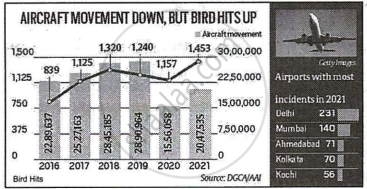 |
|
| (1) |
How bird hits happen, why they are a concern? New Delhi June 20 At least two bird strike incidents happened on Sunday. Both aircrafts returned to their airports of origin and were grounded for maintenance. An ABC aircraft, which took off from Guwahati towards Delhi, suffered damage to its left engine following a bird hit at 1600 feet. The pilots returned to Guwahati. The other strike happened on another flight from Patna to Delhi. The pilots of the aircraft suspected a bird strike during the take-off roll but continued to climb. Following the take-off rotation, they were informed by the cabin crew of sparks emanating from the left engine. Subsequently, the pilots were also informed by air traffic control of smoke coming out of one of the engines. The pilots declared an emergency and returned to Patna. |
| (2) |
Why are bird strikes a concern? Bird strikes are among the most common threats to aircraft safety, and they typically occur during take-off or landing. Dozens of bird-strikes happen each day but some can be more dangerous than others. Typically, when birds collide with an aircraft's airframe, it is unlikely to cause significant problems for the pilots flying. But there are instances when the aircraft engine ingests the birds. This can lead to a loss of thrust for the engine and cause manoeuvrability problems for the crew. In these cases, where a jet engine ingests a bird, procedures would generally call for pilots to land the plane at the closest airport. While most airframe bird strikes are not considered critical to air safety, if a collision cracks a window or a wind screen, pilots will look to land as early as possible. |
| (3) |
How critical are bird strikes to air safety? Smaller planes would generally be more susceptible to the dangers of bird strikes than larger ones. However, given that bird strikes mostly happen during take-off and landing, these incidents could distract the pilots during what are highly critical phases of flights that demand the complete attention of the crew. |
| (4) |
What causes bird-strikes? The presence of birds around an aircraft increases the chances of a bird strike. In the monsoon, as water puddles emerge on open grounds attracting insects to breed, the presence of birds increases. In some cases, bird hits also happen at higher altitudes when a plane is cruising. These are more dangerous than the low-altitude hits, given that they can cause rapid depressurization of cabins. Other reasons for bird activity around the airfield could be presence of landfills or waste disposal sites that can attract a large number of birds. |
- Does the following statement agree with the information given in paragraph 1? (1)
When an airplane is hit by a bird or is suspected to have been hit, the passengers must be asked to get down at once.
Select from the following:
True: If the statement agrees with the information.
False: If the statement contradicts the information.
Not Given: If there is no information on this. - Select the option that displays the most likely reason for bird hits. (1)
- when the aircraft is overloaded
- at the time of landing or taking off
- when the crew become negligent
- when the passengers become panicky
- Complete the sentence appropriately with one word. (1)
Smaller planes are generally more ______ than larger ones. - Complete the sentence by selecting the most appropriate option: (1)
When the window or the windscreen of the airplane is cracked due to a bird hit ______.- the crew must rush to the cockpit
- the pilot must land at the earliest airport
- the pilot must inform the maintenance engineer
- the pilot must get instructions from the aviation wing on what should do in emergency
- Based on the reading of the text, state a point to further the statement. (1)
Dozens of bird hits take place every day ______.
- but only a few are dangerous
- all of them are fatal
- but after every bird hit it is imperative to land the aircraft
- the pilot should ignore them
- Complete the sentence based on the following statement: (1)
Complete attention of the crew is demanded during take-off and landing.
We can say this because ______. - Complete the sentence appropriately with one/two words. (1)
In cases where the aircraft engine infests the bird, it leads to the loss of thrust and causes problems in ______. - Which are the areas more prone to bird hits? (1)
- Based on the reading of the text, state a point to challenge the given statement: (1)
The area around air fields should be clear of any waste disposal sites. - Look at the graph. It shows that between 2016 and 2021, whereas air flights have come down, the bird-hits have gone up. This implies that the incidence of bird hits has: (1)
- decreased
- increased
- remained constant
- been alarming
