Advertisements
Advertisements
Question
The natural life span of a domesticated horse is about 25 – 30 years, 10 years down from what it was in the wild. You can tell a horse’s age from the number of teeth he has. They get all their teeth by the age of 5, after which those teeth just get longer. Horses have close to 360 degree all round vision. The only place they cannot see is directly behind or right in front of themselves, which is why it’s dangerous to stand behind a horse. If they later I it also means that they cannot see a jump once they are about four feet from it, and have to rely on memory as to its height and shape! Each of the horse’s two eyes work independently wherever a horse’s ear points is where the horse is looking. A horse is able to sleep standing up as he is able to lock his leg muscles so that he dosen’t fall asleep. Nor do all horses in the same field ever lie down at once – one animal always stands “on look out” duty.
1) What is the life span of a wild horse?
(2) Why do the horse owners cover their horse’s eyes with blinkers?
(3) What prevents a horse from falling while asleep?
(4)
(a) Falls /shorter/ the mane/ on the/ side/ legged.[Rearrange the words to make a meaningful sentence]
(b) Form antonyms by adding a prefix :
(i) able
(ii) direct
(5)
(a) They get all their teeth by the age of five. [Pick out the prepositions]
(b) If they feel something behind them they may kick. [Rewrite using ‘unless’]
(6) How have horses helped man through the ages?
Advertisements
Solution
(1) The life span of the wild horse is 35–40 years.
(2) Horse owners cover their horses’ eyes with blinkers to prevent them from getting distracted or startled by what they see around them.
(3) The horse can lock his leg muscles which help him from falling while asleep.
(4) (a) The mane falls on the shorter legged side.
(b) (i) able × disable
(ii) direct × indirect
(5) (a) The prepositions in the sentence are ‘by’ and ‘of’.
(b) They may not kick unless they feel something behind them.
(6) Horses have historically been useful for humans. They have helped us by hauling our heavy loads, helping us traverse great distances and ploughing our fields before the advent of technology. They have also been great pets and loyal warhorses in cavalries.
APPEARS IN
RELATED QUESTIONS
The hopping kangaroo is a familiar sight in every snapshot relating to Australia. Members of the kangaroo family can be as small as a rat or as big as a man. Kangaroos are found mainly in Australia, Tasmania and New Guinea. Kangaroos, which are big-footed marsupials that evolved in Australia, use their short front legs like arms. The man-sized kangaroos of Australia are capable of speeding up to 88 km/hr for short distances, their means of locomotion being their powerful hind legs, which carry them over the ground in jumps of 9 m or more at a time.
Weighing around 70 kg, they have an average lifespan of around six to eight years and a maximum lifetime of 20 years. When bothered by predators, kangaroos often head for the water, standing submerged to the chest and attempting to drown the attacker by holding him under water. Another defensive technique is to get their back to a tree and kick at their adversary with their clawed hind feet, sometimes with sufficient force to kill a man. Normally shy animals, they alert other kangaroos to danger by beating on the ground with their hind feet. This loud alarm signal carries over a long distance.
The tail is important for kangaroos. It holds them in balance and supports them when they sit or fight against other kangaroos. The kangaroo uses its short legs as arms. With them it scratches itself, cleans its fur and holds branches when it eats leaves. Kangaroos are marsupials and the females carry newborns in a pouch in front of their abdomens. The babies are born small and climb up into safety of the pouch. There, for the next 225 days or so, they eat, sleep and grow. Once they reach full development, they leave the pouch. A young kangaroo that leaves the pouch is called a ‘joey’. To keep from getting too hot, the kangaroos take naps in the afternoon and do most of their grazing at night. But the best stay-cool secret of these creatures is the spit bath! Kangaroos drool and lick saliva all over their faces and bodies to cool down.
On the basis of your reading of the above passage, complete the following sentences with appropriate words/phrases:
(a) When followed by predators, kangaroos submerge ____________ and _________________.
(b) The powerful hind legs help kangaroos to __________________.
(c) Kangaroos are mainly found in Australia and are ____________________.
(d) They use their front legs to ___________________.
(e) Kangaroos warn others of danger by _______________________.
(f) The secret of kangaroos to stay cool is ______________________.
(g) They use their tails to _________________________.
(h) Before becoming ‘joeys’, the young ones stay in the ______________ and ________________.
Read the following extract and answer the questions given below:
Now, as I stood on the shore of that desolate Highland loch
I raised my voice in a surge of self-justification : ''By Heavens!
This is my opportunity. Gastric ulcer or no gastric ulcer, I will
write a novel.'' Before I could change 1ny mind I walked straight to the village and bot1ght myself two dozen penny exercise books.
Upstairs in my cold, clean bedroom was a scrubbed deal table and a very hard chair. Next morning, I found myself in this chair, facing a new exercise book open upon the table, slowly' becoming aware that, short of dog-Lati11 prescriptions, I had never composed a significant phrase in all my life. It was a discot1raging thought as I picked 11p my pen and gazed out of the window. Never mind, I would begin. Three hours later Mrs. Angus, the farmer's wife, called me to dinner. The page was still blank.
As I went dow-n to m:y milk and junket-they call this "curds'' in Tarbert - I felt a dreadful fool. I felt like the wretched poet in Daudet's Jack whose im1nortal masterpiece never progressed beyond its stillborn opening phrase : ''In a remote valley of Pyrenees ..... ". I recollected, rather gri111ly, the sharp advice with which my old schoolmaster had goaded me to action. ''Get it down!'' he had said. ''If it ~tops in your head it will always be nothing.
Get it down.'' And so, after lunch, I went upstairs and began to get it down.
(1) What is the main idea of the extract? (1)
(2) Why did the narrator buy two dozen penny exercise books? (2)
(3) How was the narrator unprepared for writing his novel? (2)
(4) Write in brief about what you will do in your forthcoming vacation. (2)
(5) Rewrite the following sentences in the ways instructed:
(i) I stood on the shore of that desolate Highland loch.
(Rewrite it using 'used to'.) (1)
(ii) I went down to my milk and junket.
(Rewrite it in the Past Perfect Tense.) (1)
(iii) I walked straight to the village and bought myself
two dozen penny exercise books. (Make it simple). (1)
(6) Find out the words from the extract which mean:
(i) chance (1/2)
(ii) lake (1/2)
Read the following extract carefully. (4)
Read the following passage and do the given activities :
A1. Fill up the blanks with virtues of dogs : (2)
(1) __________
(2) __________
(3) __________
(4) __________
| Human and dogs are inseparable for thousands of years and they are dependent on each other for protection and survival. Relationship between humans and dogs is often characterized by strong emotional bonds which run both way. Dogs are very popular as pets and companions. Dog is the ‘Man’s Best Friend’ and a family member. The dog is one of the most loyal, faithful and devotee animal. In earlier days dogs were kept mainly for hunting and guarding; now they are kept for companionship, protection and showmanship. There are millions of people all over the world who are dog lovers Puppies need more attention at the, early age. As much as possible try many methods of socialization, such as playing with them, taking them for walk, expose them to crowds, make them to obey the orders etc. |
A2. Methods of socialization of puppies are : (2)
(1) …......................
(2) …......................
(3) …......................
(4) …......................
A3. Cross out the odd man : (2)
(i) Inseparable, dependent, protection, popular.
(ii) Hunting. guarding, playing, petting.
(iii) Earlier, human, relationship, family
(iv) Often, mainly, now, emotional
A4.
(1) There are millions of people all over the world. (1)
(Pick out the determiners and write them)
(2) Puppies need more attention. (1)
(Rewrite the sentence without changing its meaning beginning with : Puppies don’t ….....)
A5. Should we ban keeping pets ? Justify. (2)
(A) Read the following extract and answer the questions given below:
One afternoon in 1977, as his parents and two brothers fished in the Gulf of Mexico, 12-year old Michael Dell sat on the beach. painstakingly putting together a trotline - a maze of ropes to ''which several fish hooks could be attached."You're wasting your time," the rest of the family called to Michael, as they pulled in fish. "Grab a pole and join in the fun."
Michael kept working. It was dinner time when he finished, and everyone else was ready to call it a day. Still, the youngster
cast the trotline far into the water. anchoring it to a stick that he plunged deep in the sand.
Over dinner, his family teased young Michael about coming away empty-handed. But afterward, Michael reeled in his trotline, and on the hooks were more fish than the others had caught all together!
Michael Dell has always been fond of saying, "If you think you have a good idea, try it!" And today, at 29 he has discovered the power of another good idea that has helped him rise in just a few years from teen to a tycoon. He has become the fourth-largest manufacturer of personal computers in America and the youngest man ever to head a Fortune 500 corporation.
(1) What were Michael Dell’s achievements at his age of 29?
(2) What is the secret of Michael Dell’s Success?
(3) How did Michael surprise his family members?
(4) Do you think trying new ideas can make your life successful? How?
(5) Rewrite the following sentences in the ways instructed:
(i) He has discovered the power of another good idea.
(Rewrite the sentence beginning with 'The power of ...' )
(ii) Michael Dell sat on the beach.
(Rewrite it using past perfect continuous tense.)
(iii) The youngster cast the trotline.
(Frame a Wh-question to get the underlined part as
its answer.)
(6) 'Grab a pole and join in the fun'.
Pick out the contextual meaning of the underlined word from
the options are given below:
(i) smash
(ii) hold firmly
(iii) throw away
Read the passage given below.
|
5 |
Technology is making advancements at a rapid rate but at the cost of a valued tradition - the crafts industry. The traditional crafts industry is losing a lot of its trained and skilled craftsmen. With that, the art of embellishing brass and copper utensils with fine engravings is also disappearing. The government has identified around 35 crafts as a languishing craft. |
|
10 |
The speciality of handcrafted items is their design, an association with long traditions belonging to a specific region. The word ‘handcrafted’ does not imply the involvement of dexterous human fingers or an agile mind with a moving spirit anymore. Lessening drudgery, increasing production and promoting efficiency have taken precedence. The labour-saving devices are taking the place of handcrafted tools and this has jeopardized the skills of these artisans. |
|
15 |
Mechanisation has made its way into everything - cutting, polishing, edging, designing etc. Ideally, the use of machinery should be negligible and the handicrafts should be made purely by hand with a distinguishable artistic appeal. However, with the exception of small-scale industries, the export units are mostly operated by machines. The heavily computerised designs contribute to faster production at lower costs. |
|
20 |
Although mechanization of crafts poses a challenge to safeguarding traditional crafts, the artisans are lured with incentives in order to impart handicrafts training. Some makers do see machines as a time-saving blessing since they are now able to accomplish difficult and demanding tasks with relative ease. These machines might give a better 25finesse to these products but they don’t stand out as handcrafted. The quantity has overtaken quality in this industry. |
|
30 |
A need to highlight the importance of the handmade aspect is required by both the government and private sectors, in order to amplify awareness and also support the culture of making handicrafts. A few artisans are still trying their best to rejuvenate and revive their culture and heritage but it’s an uphill task competing with the machine-made goods. A multitude of artisans have changed their professions and are encouraging their progeny to follow suit. There are others who have stayed their ground but are clearly inclined towards buying machines. |
|
35 |
Nearly two decades ago, there were around 65 lakh artisans in the country. Three years ago, when the government started the process of granting a unique number to the artisans based on the Aadhaar card, 25 lakhs were identified. Loss of traditional crafts is clearly a worrying issue, but it stands to reason that forcing any artisan to follow old ways when concerns of livelihood overrule other considerations, is unfair. |
Based on your understanding of the passage, answer the questions given below.
- What does the writer mean by calling handicrafts a ‘valued tradition’?
- Rewrite the following sentence by replacing the underlined phrase with a word that means the same from lines 5-15.
If it continues, the workcation (work + vacation) trend will be a powerful boost to domestic tourism operators failing to make progress in the economic slump caused due to the pandemic. - State any two reasons why artisans are choosing to work via machines rather than handcrafted tools.
- Why do the artisans need to be ‘lured with incentives’ to impart handicrafts training?
- List one likely impact of the support of government and private sectors towards the culture of making handicrafts.
- How does the writer justify an artist’s act of abandoning her/his traditional craft for a more lucrative option?
Read the passage given below and answer the questions that follow:
|
1. The Higgs boson has been called, or miscalled, the God particle, enabling it to pass into the realm of popular scientific lore, like the discovery of the smallpox vaccine, the structure of DNA, or the theory of relativity. It would be difficult for most people to understand its significance, just as it would be to comprehend the notion of relativity, but such problems are overcome by locating science in personalities as well as cultural and national traditions. The first thing that you and I know about the Higgs boson is that it’s named after Peter Higgs, a physicist at Edinburgh University who made the discovery - although the original insight, in one of those recurrent back stories of science, was Philip Anderson’s. 2. Still, we have Higgs, and Edinburgh, and western civilisation to fall back on. The rest - “the Higgs boson is a hypothetical elementary particle predicted by the Standard Model of particle physics. It belongs to a class of particles known as bosons ...” - we needn’t worry too much about. But maybe we should worry just enough to ask, “What is a boson?” since the word tends to come up as soon as Higgs does. Is it, an ignoramus such myself would ask, akin to an atom or a molecule? It is, in fact, along with the fermion (named after Enrico Fermi), one of the two fundamental classes of subatomic particles. 3. From Bose The word must surely have some European genealogy. In fact, “boson” is derived from Satyendra Nath Bose, an Indian physicist from Kolkata who, in 1924, realised that the statistical method used to analyse most 19th-century work on the thermal behaviour of gases was inadequate. He first sent off a paper on quantum statistics to a British journal, which turned it down. He then sent it to Albert Einstein, who immediately grasped its immense importance, and published it in a German journal. Bose’s innovation came to be known as the Bose-Einstein statistics and became a basis of quantum mechanics. Einstein saw that it had profound implications for physics; that it had opened the way for this subatomic particle, which he named, after his Indian collaborator, “boson.” Still, science and the West are largely synonymous and coeval: they are words that have the same far-reaching meaning. Just as Van Gogh and Toulouse-Lautrec’s paintings digest the Japanese prints they were responding to so we don’t need to be aware of Japanese prints when viewing the post-impressionists, western science is pristine, and bears no mark of what’s outside itself. 4. Other Indian contributions The last Indian scientific discovery that is universally acknowledged is zero. Indians are very strong at maths, and the only modern Indian who’s remotely part of the western mythology of science is Srinivasa Ramanujan, equally well known for his Hindu idiosyncrasies and his agonised stay in Cambridge as he is for his mathematical genius. 5. Indians can be excellent geeks, as demonstrated by the tongue-tied astrophysicist Raj Koothrappalli in the U.S. sitcom Big Bang Theory; but the Nobel prize can only be aspired to by Sheldon Cooper, the super-geek and genius in the series, for whom Raj’s country of origin is a diverting enigma, and miles away from the popular myth of science on which Big Bang Theory is dependent. Bose didn’t get the Nobel Prize; nor did his contemporary and namesake, J.C. Bose, whose contribution to the fashioning of wireless predates Marconi’s. The only Indian scientist to get a Nobel Prize is the physicist C.V. Raman, for his work on a light at Kolkata University. Other Indians have had to become Americans to get the award. 6. Conditions have always been inimical to science in India, from colonial times to the present day; and despite that, its contributions have occasionally been huge. Yet non-western science (an ugly label engendered by the exclusive nature of western popular imagination) is yet to find its Rosalind Franklin, its symbol of paradoxical success. Unlike Franklin, however, scientists were never in a race that they lost; they simply came from another planet. |
Based on your reading of the passage, answer twelve out of fifteen questions that follow:
(a) What is the first thing which the narrator knows about Higgs Boson?
(b) What is Bose-Einstein statistics?
(c) How does Sheldon view Raj’s country of origin?
(d) What do Van Gogh’s paintings do to Japanese prints?
(e) Has India always got credit for its merit?
(f) What do Higgs Boson have in common with Smallpox vaccine?
- Both are used in medical radiography.
- Both are part of scientific myth and legends now.
- Both were met with scepticism on their discovery.
- Both fetched their teams a Nobel prize.
(g) Which statement is not true about Boson?
- They were not discovered by Enrico Fermi.
- They constitute one class of subatomic particle.
- It is named after an Indian Physicist.
- It was discovered by Satyendra Nath Bose.
(h) Choose the word which is an apt synonym of the word Ignoramus. (used in para 2)
- Idiot
- Intelligent
- Idealist
- Ingenious
(i) How are esoteric scientific concepts made understandable for people?
- By printing short introductory courses.
- By comparing it with other scientific discoveries.
- By locating science in personalities, social and cultural traditions. iv. By revising the country’s educational structure.
(j) Based on the reading of the passage, which statements are correct about Higgs Boson.
- They are called God’s particle.
- Philip Anderson’s study provided the original insight.
- This concept is easily understood by common people.
- A physicist from Edinburgh University made the discovery.
- It was discovered by Albert Einstein.
- 1, 2 & 3
- 2, 3 & 5
- 1, 4 & 5
- 1, 2 & 4
(k) Which field of Physics was SN Bose working on?
- Quantum Mechanics
- Electromagnetism
- Geophysics
- Acoustic
(l) Which scientist/mathematician out of the following won the Nobel prize?
- J C Bose
- C V Raman
- Srinivasa Ramanujan
- S N Bose
(m) What is Srinivasa Ramanujan known for in popular culture?
- Mathematical genius.
- For formulation of game theory.
- Hindu Idiosyncrasies.
- Troubled stay in Cambridge.
- For devising another explanation for chaos theory.
- 1, 2 & 3
- 1, 3 & 5
- 1, 3 & 4
- 1, 4 & 5
(n) The conclusion of third paragraph highlights that ______.
- Western art grants recognition to all its inspirations.
- Van Gogh painted Japanese prints.
- Western art subsumes all the influences under it.
- Van Gogh and Toulouse-Lautrec are post-impressionist painters.
(o) Why did JC Bose deserve a Nobel?
- He was an Indian physicist.
- He was the only one researching on wireless.
- His research & findings on wireless started before Marconi.
- He acquired American citizenship.
Read the following table displaying the details of five House Captains.
| Name | Motto | Participation in activities | Achievements | Awards | Personal Qualities | Drawbacks | Other notable things |
| Rohit | "Together we can achieve greatness" | Debate club, Quiz club | 1st prize in Science Olympiad | Best Student | Diligent, confident, empathetic | Sometimes tends to be overly competitive | Volunteer at a local NGO |
| Sanya | "Service before self" | Social service club, Drama club | 1st prize in Debate competition | Best Orator | Compassionate, organized, responsible | Can be overly self critical at times | Participated in a Model United Nations conference |
| Rajat | "Never give up, always rise up" | Sports club, Music club | 2nd position in Chess competition | Best Sportsperson | Perseverant, team player, adaptable | Can sometimes be indecisive | Plays in a local band |
| Aryan | "Success through hard work" | Photography club, Science club | 1st prize in a Photography competition | Budding Innovator | Creative, curious, detail oriented | Can sometimes procrastinate | Built a working model of a wind turbine for a science fair |
| Ananya | "Strive for excellence" | "Dance club, Art club | 1st prize in Art competition | Creative Mind | Confident, hardworking, imaginative | Tends to overthink things | Published her own poetry collection |
Answer the following questions, based on the table above.
(i) Identify the person who is likely to ask many "why" questions, and support your choice with one reason. (2)
(ii) Which house captain is most likely to struggle the most with handling stress during the school's annual inter-house sports tournament? (1)
- Rohit
- Sanya
- Rajat
- Ananya
(iii) Give two justifications for Sanya being the best fit to lead a school-wide initiative to promote mental health and well-being among students. (2)
(iv) Select the correct option to fill the blank and complete the analogy. (1)
______ : paint brush :: Rajat : tabla
- Rohit
- Sanya
- Aryan
- Ananya
(v) Based on the personal qualities of the House Captains, why is Rajat the most likely to be a collaborative worker? (1)
(vi) Complete the given sentence with the appropriate reason, with reference to the information in the table. (1)
We can infer that Aryan’s overall performance may be negatively impacted by his weakness in time management because ______.
(vii) Explain briefly why situation (b), from the three situations given below, showcases Ananya's motto, "Lead by example"? (1)
- During a group project, Ananya assigns each team member specific tasks and sets a high standard for the project's quality. She tells them to actively participate in the project and take it to fruition.
- During a house debate competition, Ananya notices that a few of her house members are struggling to articulate their arguments effectively. Ananya takes the time to listen to their concerns and provides constructive feedback and support.
- During a fundraising event, Ananya volunteers to be in charge of organizing and coordinating the event but she frequently delegates tasks to others and attends to her school assignment while her team completes the task successfully.
(viii) Select the option that correctly matches the House Captains (a) -(c), to the trophies (i)-(v). (1)
| House Captains | (a) Rajat | (b) Ananya | (c) Aryan |
 |
 |
 |
 |
 |
| (i) | (ii) | (iii) | (iv) | (v) |
- (a) - (ii) , (b) - (i) , (c) - (iii)
- (a) - (i) , (b) - (v) , (c) - (iv)
- (a) - (v) , (b) - (iii) , (c) - (ii)
- (a) - (iii) , (b) - (iv) , (c) - (i)
Read the following text.
| (1) | In recent years, there has been a surge in both group and solo travel among young adults in India. A survey conducted among young adults aged 18-25 aimed to explore the reasons behind their travel preferences and recorded the percentage variation for 10 common points that influence travel choices. |
| (2) | Among those who prefer solo travel, the most common reason cited was the desire for independence and freedom (58%), followed closely by the opportunity for introspection and self-discovery (52%). Additionally, solo travellers appreciated the ability to customize their itinerary to their preferences (44%) and the chance to meet new people on their own terms (36%). |
| (3) | On the other hand, those who prefer group travel often cited the desire for socializing and making new friends (61%) as their primary reason. Group travel also provided a sense of security and safety in unfamiliar places (52%) and allowed for shared experiences and memories with others (48%). Additionally, group travellers enjoyed the convenience of having pre-planned itineraries and organized transportation (38%). |
| (4) | Interestingly, both groups had similar levels of interest in exploring new cultures and trying new experiences (40% for solo travellers, 36% for group travellers). Similarly, both groups valued the opportunity to relax and escape from the stresses of everyday life (36% for solo travellers, 32% for group travellers). |
| (5) | However, there were also some notable differences between the two groups. For example, solo travellers placed a higher priority on budget-friendly travel options (38%) compared to group travellers (24%). Conversely, group travellers were more likely to prioritize luxury and comfort during their travels (28%) compared to solo travellers (12%). |
| (6) | Overall, the survey results suggest that both group and solo travel have their own unique advantages and appeal to different individuals, based on their preferences and priorities. |
Answer the following questions, based on given passage.
- Infer two possible ways that the survey, mentioned in paragraph (1) could be beneficial. Answer in about 40 words. (2)
- Which travel choice point of the survey would influence tour operators to incorporate group dinners, social events, and shared accommodations in their itinerary? (1)
- Freedom to customise itinerary
- Luxury and comfort
- Security and safety
- Desire for making new friends
- What do the top choices in the survey, for travelling solo and in a group suggest about young adults? (1)
- Identify the solo traveller from the following three travellers: (1)
- Reshma- I don’t want to keep hunting for rickshaws or taxis. A pre-booked vehicle is perfect.
- Nawaz-I’m happy sharing a room in a hostel. I don’t need hotel accommodation.
- Deepak-I’m not worried about my well-being, even while exploring remote areas.
- Which of the following is an example of an opportunity for self-discovery, as mentioned in paragraph 2? (1)
- Trying new cuisine
- Hiring a tour guide
- Purchasing local artifacts
- Advance booking travel tickets
- How might the differences in budget priorities between solo and group travellers impact the types of accommodations and activities offered by the travel industry in India? (2)
- Complete the sentence appropriately. The similarities in the percentage of both solo and group travellers who are interested in exploring new cultures and trying new experiences may be due to ______. (1)
- State TRUE or FALSE. (1)
The title, "Wanderlust: The Solo Travel Trend Among Young Adults in India", is appropriate for this passage.
Read the following report and answer the questions by choosing the correct/most appropriate option:
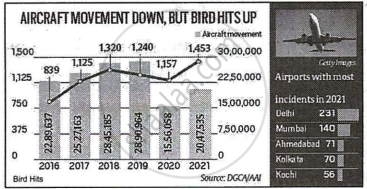 |
|
| (1) |
How bird hits happen, why they are a concern? New Delhi June 20 At least two bird strike incidents happened on Sunday. Both aircrafts returned to their airports of origin and were grounded for maintenance. An ABC aircraft, which took off from Guwahati towards Delhi, suffered damage to its left engine following a bird hit at 1600 feet. The pilots returned to Guwahati. The other strike happened on another flight from Patna to Delhi. The pilots of the aircraft suspected a bird strike during the take-off roll but continued to climb. Following the take-off rotation, they were informed by the cabin crew of sparks emanating from the left engine. Subsequently, the pilots were also informed by air traffic control of smoke coming out of one of the engines. The pilots declared an emergency and returned to Patna. |
| (2) |
Why are bird strikes a concern? Bird strikes are among the most common threats to aircraft safety, and they typically occur during take-off or landing. Dozens of bird-strikes happen each day but some can be more dangerous than others. Typically, when birds collide with an aircraft's airframe, it is unlikely to cause significant problems for the pilots flying. But there are instances when the aircraft engine ingests the birds. This can lead to a loss of thrust for the engine and cause manoeuvrability problems for the crew. In these cases, where a jet engine ingests a bird, procedures would generally call for pilots to land the plane at the closest airport. While most airframe bird strikes are not considered critical to air safety, if a collision cracks a window or a wind screen, pilots will look to land as early as possible. |
| (3) |
How critical are bird strikes to air safety? Smaller planes would generally be more susceptible to the dangers of bird strikes than larger ones. However, given that bird strikes mostly happen during take-off and landing, these incidents could distract the pilots during what are highly critical phases of flights that demand the complete attention of the crew. |
| (4) |
What causes bird-strikes? The presence of birds around an aircraft increases the chances of a bird strike. In the monsoon, as water puddles emerge on open grounds attracting insects to breed, the presence of birds increases. In some cases, bird hits also happen at higher altitudes when a plane is cruising. These are more dangerous than the low-altitude hits, given that they can cause rapid depressurization of cabins. Other reasons for bird activity around the airfield could be presence of landfills or waste disposal sites that can attract a large number of birds. |
- Does the following statement agree with the information given in paragraph 1? (1)
When an airplane is hit by a bird or is suspected to have been hit, the passengers must be asked to get down at once.
Select from the following:
True: If the statement agrees with the information.
False: If the statement contradicts the information.
Not Given: If there is no information on this. - Select the option that displays the most likely reason for bird hits. (1)
- when the aircraft is overloaded
- at the time of landing or taking off
- when the crew become negligent
- when the passengers become panicky
- Complete the sentence appropriately with one word. (1)
Smaller planes are generally more ______ than larger ones. - Complete the sentence by selecting the most appropriate option: (1)
When the window or the windscreen of the airplane is cracked due to a bird hit ______.- the crew must rush to the cockpit
- the pilot must land at the earliest airport
- the pilot must inform the maintenance engineer
- the pilot must get instructions from the aviation wing on what should do in emergency
- Based on the reading of the text, state a point to further the statement. (1)
Dozens of bird hits take place every day ______.
- but only a few are dangerous
- all of them are fatal
- but after every bird hit it is imperative to land the aircraft
- the pilot should ignore them
- Complete the sentence based on the following statement: (1)
Complete attention of the crew is demanded during take-off and landing.
We can say this because ______. - Complete the sentence appropriately with one/two words. (1)
In cases where the aircraft engine infests the bird, it leads to the loss of thrust and causes problems in ______. - Which are the areas more prone to bird hits? (1)
- Based on the reading of the text, state a point to challenge the given statement: (1)
The area around air fields should be clear of any waste disposal sites. - Look at the graph. It shows that between 2016 and 2021, whereas air flights have come down, the bird-hits have gone up. This implies that the incidence of bird hits has: (1)
- decreased
- increased
- remained constant
- been alarming
