Advertisements
Advertisements
Question
Read the following passage and do the activities.
Galaxies are vast clusters of thousands of millions of stars, planets, gases and dust, which are held together by gravity. There are over one thousand million galaxies, and each is a very long way from its nearest neighbour.
Galaxies were formed during the Big Bang explosion about 15,000 million years ago. When this phenomenon occurred, everything that was in the universe flew out in different directions. Scientists believe that the galaxies were formed from lumps of matter that resulted. However, the process is nowhere near complete. The universe is still expanding, galaxies are still moving away from each other, new stars are still being created.
Galaxies are classified according to their shapes. There are three main types. The most common type of galaxy is The Spiral. This has several spiral arms radiating out from the center. Spiral galaxies have a large cluster of stars in their nucleus. The second type is the Barred spiral. In this type of galaxy, the spiral arms curve away from the opposite ends of a sort of bar going through the middle of the nucleus. These contain large amounts of gas and dust as well stars. The third type of galaxy is electrical. These consist almost entirely of stars and contain very little gas or dust. Some galaxies have irregular, uneven shapes and cannot be classified.
(A1) State whether the following statements are true or false. 02
(1) The most common type of galaxy is the barred spiral.
(2) Galaxies are clusters, held by gravity.
(3) Scientists do not believe in the Big Bang explosion.
(4) Galaxies are moving from each other.
(A2) Complete the web chart. 02
(A3)
(a) Find out similar words from the passage. 01
(i) mass (ii) happenings
(b) Give the verb form of the given words. 01
(i) classified (ii) directions
(A4) Identify and name the clause. 02
Scientists believe that the galaxies were formed from the lumps of matter.
(A5) Can there be life in another galaxy? Give reasons for your answer. 02
(B) Read the passage given in Q. 4 (A) and write the summary of it. Suggest a suitable title to your summary. (05)
Advertisements
Solution
(A1)
(a) False
(b) True
(c) False
(d) True
(A2)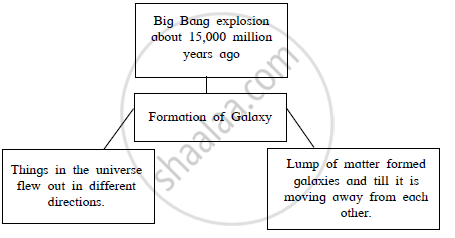
(A3)
(a) (i) lump (ii) phenomenon
(b) (i) classify (ii) direct
(A4) Main clause – Scientist believe.
Subordinate clause – that the galaxies were formed from the lumps of matter.
(A5) Any reasonably correct answer written in 4-5 sentences.
(B) Galaxies
Galaxies are stars, planets, gases and dust held together by gravity. There are over 1000 million galaxies in the universe, and there is a vast distance between them. Galaxies were formed when the Big Bang explosion took place 15,000 million years ago. Things in the universe flew out in different directions, forming lumps of matter or galaxies. The process is still on and the universe continues to expand. Galaxies can be classified into spiral, barred spiral and elliptical. Spiral galaxies have spiral arms from the nucleus. The nucleus has a large cluster of stars. Barred spiral galaxies have arms from the opposite ends of a bar across the nucleus and contain a large amount of gas, dust and stars. Elliptical galaxies are made up of mostly stars, and have very little gas or dust.
APPEARS IN
RELATED QUESTIONS
He holds him with his skinny hand,
“There was a ship,” quoth he.
i. Who does ‘He’ refer to in the above extract?
ii. What do we know about the speaker’s feelings?
iii. Why is his hand called ‘skinny’?
Read the passage given below :
1. To ensure its perpetuity, the ground is well held by the panther both in space and in time. It enjoys a much wider distribution over the globe than its bigger cousins and procreates sufficiently profusely to ensure its continuity for all time to come.
(ii) in the branches of the trees
(iii) behind the tree trunks
(iv) at its heels
(ii) trains its cubs
(iii) watches the progress of the mother
(iv) is impulsive and impatient
Answer the following questions briefly :
(ii) came down / fell (para 7)
Read the following extract and answer the questions given below.
|
I grew up in India in which telephones were both rare and virtually useless. When I left India in 1975 to go to the US for graduate studies, we had perhaps, 600 million residents in the country and just two million landline telephones. Having a telephone was a rare privilege: if you weren’t an important government official, or a doctor, or a journalist, you might languish in a long waiting list and never receive a phone.
Telephone were such a rarity (after all, 90% of population had access to a telephone line) that elected members of Parliament had amongst their privileges the right to allocate 15 telephone connections to whomever they deemed worthy.
And if you did have a phone, it wasn’t necessarily a blessing. I spent my high school years in Calcutta, and I remember that if you picked up your phone, you had no guarantee you would reach the number you had dialled. Sometimes you were connected to someone else’s ongoing conversation, and they had no idea you were able to hear them; there was even a technical term for it, the ‘cross - connection’ (appropriately, since these were connections that made us very cross). If you wanted to call another city, say Delhi, you had to book a ‘trunk call’ in the morning and then sit by the telephone all day waiting for it to come through; or you could pay eight times the going rate for a ‘lightning call’ = but even lightning struck slowly in India those days, so it only took half an hour instead of the usual three or four or more to be connected.
|
Questions:
(1). Why were telephones a rarity before 1975? (1)
(2) What special rights did elected members of Parliament use to have? (2)
(3) How did the author differentiate between a ‘trunk call’ and a ‘lightning call’? (2)
(4) Do you think the cellphone has made us global? (2)
(5) Rewrite the following sentences in the ways instructed. . (3)
(i) You could pay eight times the going rate for a ‘lighting call’. (Rewrite it using modal auxiliary showing compulsion)
(ii) I spent my high school years in Calcutta. [Rewrite it using past perfect tense]
(iii) Telephones were a rarity. [Make it a rhetorical question]
(6) Match the words in column ‘A’ with their meanings in column ‘B’. (1)
| Column A | Column B | ||
| (i) | Privilege |
(i)
|
means to reach or get |
| (ii) | Access |
(ii)
|
remedy |
| (iii) | special right |
Read the following extract and answer the questions given below:
But being named an 'AdarshGaon' is far from easy. Villages had to give a proposal after which a committee headed by Mr. Pawar inspected the villages. "The Villages had to show dedication in the struggle to fight mediocrity. They had to follow all the conditions of becoming an 'AdarshGaon'. We chose villages with a revolutionary spark, "Mr. Pawar says.
Villages need to follow strict rules. The process begins with effective water management through the watershed technique and water auditing. taking responsibility for the village's natural resources-planting trees and stopping grazing. contributing labour for the village work, and then expanding to bring about behavioral changes in the people for harboring social change. Hiware Bazaar is free of any kind of addiction and there are no liquor or tobacco shops in the village. Vasectomy has been made compulsory, as is the pre-marital HIV test.
The 'AdarshGaon' model prides itself on being based on the joint decisions made by the Gram Sabha, where all the villagers are present. Even while selecting the new villages under the scheme, Mr. Pawar made sure that the decision to become an ideal village was taken by the entire village together.
The greatest victory for Hiware Bazaar so far has been the reverse migration that the village has witnessed since 1989. As many as 93 families have come back to the village," from the slums in Mumbai and Pune," Mr. Pawar says.
Questions:
(1) What features of 'Adarsh Gaon' are given in this extract?
(2) What is the procedure for selecting 'Adarsh Gaon'?
(3) What is the greatest victory for Hiware Bazaar?
(4) Do you think all villages in Maharashtra should follow the ideals of Hiware Bazaar? why?
(5) Rewrite the following sentences in the ways instructed :
i. Mr. Pawar inspected the villages.
(Rewrite it using the noun form of the word underlined.)
ii. Vasectomy has been made compulsory by the villagers.
(Rewrite it beginning with-"The villagers........".)
iii. There are no liquor or tobacco shops in the village.
(Rewrite it using 'neither......nor'.)
(6) Find out the words from the extract which mean:
(i) causing a great change
(ii) the quality of being average
(A) Read the following extract and answer the questions given below:
One afternoon in 1977, as his parents and two brothers fished in the Gulf of Mexico, 12-year old Michael Dell sat on the beach. painstakingly putting together a trotline - a maze of ropes to ''which several fish hooks could be attached."You're wasting your time," the rest of the family called to Michael, as they pulled in fish. "Grab a pole and join in the fun."
Michael kept working. It was dinner time when he finished, and everyone else was ready to call it a day. Still, the youngster
cast the trotline far into the water. anchoring it to a stick that he plunged deep in the sand.
Over dinner, his family teased young Michael about coming away empty-handed. But afterward, Michael reeled in his trotline, and on the hooks were more fish than the others had caught all together!
Michael Dell has always been fond of saying, "If you think you have a good idea, try it!" And today, at 29 he has discovered the power of another good idea that has helped him rise in just a few years from teen to a tycoon. He has become the fourth-largest manufacturer of personal computers in America and the youngest man ever to head a Fortune 500 corporation.
(1) What were Michael Dell’s achievements at his age of 29?
(2) What is the secret of Michael Dell’s Success?
(3) How did Michael surprise his family members?
(4) Do you think trying new ideas can make your life successful? How?
(5) Rewrite the following sentences in the ways instructed:
(i) He has discovered the power of another good idea.
(Rewrite the sentence beginning with 'The power of ...' )
(ii) Michael Dell sat on the beach.
(Rewrite it using past perfect continuous tense.)
(iii) The youngster cast the trotline.
(Frame a Wh-question to get the underlined part as
its answer.)
(6) 'Grab a pole and join in the fun'.
Pick out the contextual meaning of the underlined word from
the options are given below:
(i) smash
(ii) hold firmly
(iii) throw away
Read the passage carefully:
|
2.1 On the basis of your understanding of the above passage, answer the following questions in 30-40 words each:
- Write one advantage and one disadvantage of allowing every family member to be part of the decision-making process.
- In today’s world, what are parents asking their kids?
- Which two pieces of advice does the writer give to the parents?
- The passage supports the parents. How far do you agree with the author’s views? Support your view with a reason.
2.2 On the basis of your reading of the above passage, answer the following:
- The synonym of ‘hurt’ as given in paragraph 2 is ______.
- The word, which means the same as a style or method of cooking in paragraph 4, is:
- cuisine
- gourmet
- gastric
- science
- The antonym of ‘agreeable’ as given in paragraph 5 is ______.
- The antonym of ‘simple’ as given in paragraph 6 is:
- difficult
- complicated
- easy
- tricky
Read of the following passage and answer the questions:
When I casually mentioned this to a friend, he casually replied that I had better get one in the Tigris marshes, for there they were as common as mosquitoes, and were often tamed by the Arabs. We were going to Basra to the Consulate-General to collect and answer our mail from Europe. At the Consulate-General we found that my friend's mail had arrived but that mine had not.
Questions :
(a) What was 'they'?
(b) Where could the author get 'one'?
(c) Find the exact word from the extract which means 'domesticated.'
(d) What did the author find at the Consulate-General?
A. Read the following passage and do the given activities:-
A1. Answer in one word or two:- (02)
- The Queen of the spices.
- The areas of cultivation of the first type of cardamom.
- Anyone area of cultivation of the second type of cardamom
- The small variety of cardamom is known for-
Cardamom, the Queen of all spices, has a history as old as the human race. It is the dried fruit of a herbaceous perennial plant. Warm humid climate, loamy soil rich in organic matter, distributed rainfall and special cultivation and processing methods all combine to make Indian cardamom truly unique in aroma, flavour, size and it has a parrot green colour.
Two types of cardamom are produced in India. The first type is the large one, which has not much significance as it is not traded in the international market. It is cultivated in the North-eastern area of the country. The second type is produced in the Southern states and these are traded in the international market. These are mainly cultivated in Kerala, Tamil Nadu, and Karnataka. As per the international market rules, only 7 mm quality was previously traded in exchanges. But later, it relaxed its norms, and now 6 mm quality is also traded in the exchanges. Special to Indian taste buds, cardamom is not only unique to our land but also to our senses. The addition of this fragrant spice can add layers of taste to your tea, food, and overall dining experience.
The small variety is known for its exotic quality throughout the world. Traditional auction markets also exist for trading in small cardamom in the country.
A2. Provide information: Indian cardamom is said to be unique in aroma, flavor, size, and colour due to -- (02)
- ______
- ______
- ______
- ______
A3. Write the synonyms for the following from the passage :- (02)
- unusual
- pleasant smell
- importance
- holding moisture
A4. Do as directed:- (02)
- The first type is the large one, which has not much significance.
(Identify the subordinate clause) - Cardamom is not only unique to our land but also to our senses.
(Rewrite the sentence using ‘as well as’)
A5. Indian food is incomplete without spices. State your view. (02)
B. Write a short summary of the passage given in above and suggest a suitable title. (05)
Read the passage given below.
|
5 |
I saw ‘Jaws’, the popular shark movie, the summer it came out, in 1975 and became paranoid about sharks. Though I kept swimming after Jaws, it was always with the vague fear that a shark’s teeth could tug on my leg at any moment. Never mind that there’d been only two shark bites since 1900 on the Connecticut coast, where I lived. |
| 10 | So, when I got this assignment for the National Geographic magazine, I decided to accept and do what I’d never wanted to do: swim with the sharks. I had to go to a place in the Bahamas known as Tiger Beach and dive with tiger sharks, the species responsible for more recorded attacks on humans than any shark except the great white. It was to be my first dive after getting certified-which meant it would be my first dive anywhere other than a swimming pool or a quarry-and without a diver’s cage. Most people who got wind of this plan thought I was either very brave or very stupid. |
|
15
|
But I just wanted to puncture an illusion. The people who know sharks intimately tend to be the least afraid of them, and no one gets closer to sharks than divers. The divers who run operations at Tiger Beach speak lovingly of the tiger sharks and the way people talk about their children or their pets. In their eyes, these sharks aren’t man-eaters any more than dogs are. |
|
20
25 |
The business of puncturing illusions is never just black and white. My fellow divers had hundreds of dives under their belt and on the two-hour boat ride to the site on the morning of our first dive, they kept saying things like, “Seriously, I really can’t believe this is your first dive.” All this was okay with me until I reached the bottom and immediately had to fend off the first tiger shark, I had ever laid eyes on. However, when I watched the other divers feeding them fish and steering them gently, it became easy to see the sharks in a very benign light. |
| 30 | I think it would be unfair not to mention that tiger sharks are apex predators. They act as a crucial balancing force in ocean ecosystems, constraining the numbers of animals like sea turtles and limiting their behaviour by preventing them from overgrazing the seagrass beds. Furthermore, tiger sharks love warm water, they eat almost anything, have a huge litter and are the hardiest shark species. If the planet and its oceans continue to warm, some species will be winners and others will be losers, and tiger sharks are likely to be winners. |
Based on your understanding of the passage, answer the questions given below.
- Cite a point in evidence, from the text, to suggest that the writer's post-Jaws fear was not justified.
- State any one trait of the writer that is evident from lines 5-10 and provide a reason for your choice.
- People thought the writer was ‘either brave or very stupid’. Why did some people think that he was ‘very stupid’?
- Why does the writer say that people who know sharks intimately tend to be least afraid of them?
- Rewrite the given sentence by replacing the underlined phrase with another one, from lines 10-20.
Some academicians think that reward, as a form of discipline, is a simple right or wrong issue. - What does the use of the phrase ‘benign light’ suggest in the context of the writer’s viewpoint about tiger sharks?
- Select a suitable phrase from lines 15-25 to complete the following sentence appropriately.
I agree the team will find this experience tough, but competing will be easier next time after they get this tournament ______ - Apex predators serve to keep prey numbers in check. How can we say that tiger sharks are apex predators?
- Analyse why having a large litter is one of the features that empower tiger sharks to emerge, winners, if global warming persists.
Read the passage given below:
| (1) | When we think of the game of cricket, we come to the conclusion that it is primarily a game that depends on outstanding physical activities, good hand-eye coordination, speed, skill and strength. It provides entertainment and generates strong feelings of excitement. A good match of cricket or of any other game neither adds to the existing stock of human knowledge nor reveals any secret of existence. It does not carry any deep meaning but most people, particularly the lover of sports attach deep emotions and numerous meanings to it. Games are thought of as a metaphor for life. They are supposed to teach many lessons. In fact, more is said and written about a cricket match than about scientific findings or great philosophy. |
| (2) | This is because games, like a morality play, in which settings and rules are made by us, can easily make people test their fair and foul conduct, principles of reward and punishment, and emotions of joy and disappointment. They can make us experience the thrill of war without exposing us to its dangers. A man watching a cricket match on T.V. and munching popcorn is like a surrogate warrior. In fact, games provide us with a safe outlet for our aggressiveness. If games become aggressive, they lose the very purpose of providing entertainment and purging us of our aggressiveness. They can calm our impatience without creating any conflict. |
| (3) | Commentators, journalists, politicians and analysts can do a great favour to the competing teams by keeping the excitement within limits. The teams should play without being dominated by feelings of national honour and shame. Excellent performance of the players of both teams should be enjoyed and appreciated. Winning or losing in a game should not be taken seriously. A game is fun if it is played with true spirit of sportsmanship. |
Based on your understanding of the passage, answer the questions given below:
- Complete the sentence by choosing an appropriate option: (1)
Most people conclude that cricket is primarily a game because ______.- it is played as a match
- it requires two teams
- it includes physical activity
- it depends only on skill and strength.
- Comment on the writer's reference to 'that cricket does not reveal any secret of existence. (1)
- List two responses to which watching a game of cricket gives rise to. (1)
- Select the option that conveys the opposite of 'destroy' from words used in the passage. (1)
- reveals
- experience
- generate
- purging
- The writer would not agree with the given statements based on paragraph 2, EXCEPT (1)
- Rules of any game are made by people.
- Watching a cricket match makes the viewer believe that he is fighting a battle.
- It is necessary for a game to be aggressive in order to build excitement.
- A game can test people's sense of fair judgement.
- With reference to the passage, a spectator is compared to a 'surrogate warrior'. (1)
Choose the option that best describes this phrase:- a spectator who is paid to watch.
- a spectator who is in pain while watching the match.
- a spectator who enjoys the match as an armchair soldier.
- a spectator who makes judgments about reward and punishment.
- Why does the writer compare games to a morality play? (1)
- Complete the given sentence with an appropriate inference with respect to the following: (1)
The writer says that games can calm our impatience without creating any conflict by ______. - The writer advises the players that games should not become aggressive because ______. (1)
- Select the most suitable title for the above passage. (1)
- Excellent Performance by Cricketers
- The Benefits of Playing Cricket
- Cricket - The King of Games
- The True Spirit of Playing Games
