Advertisements
Advertisements
Question
Look at the balloons. Which are the qualities inculcated in the author by her teacher? Write them. (2)

Sister Monica, however, wasn't quite as lenient as that, and spent most of the time telling me about the importance of regularity and hard work. She made me realise that success is, like genius, 99 per cent perspiration and 1 per cent inspiration. It's a lesson that has stood me in good stead.
The teachers I'm most grateful to, though, are not those who have taught me the most, but those who have simply been friends to me, believed me and believed in me. Prominent among them is Sudha Ramasubramanium-Rambo, as we used to call her. I didn't know her too well. She taught me in college, and apart from being incredible in class unless one missed class, she also believed that I actualIy had a Problem when I developed an injury (which several doctors found difficult to diagnose). Despite my missing an exam-the HSC, of all exams- she was the only person who told me to concentrate on my health and assured me that I could take the exam off the top of my head any time I wanted to.
I'm not even certain she remembers it, but at the time, it felt like one of the only rays of hope in an extremely dark tunnel. Perhaps few teachers realize how far their influence extends or how much of a difference their actions and words can make. A number of my teachers have unfortunately taught me kindness and tolerance and patience by being precisely the opposite, and quite obviously, they aren't the people I like to think about. But many of my teachers have been extraordinary people, who have not only taught me in class but also helped mould me and my character in every other way. I only hope that I live up to what their endeavors were undoubtedly mean to create.
B2.Answer
(1) What kind of teachers are disliked by the author? (1)
(2) What was Sudha Ramasubramanium's advice to the author when she was going to miss her HSC exam. ? (1)
B3. Match :
Match the words with their appropriate meanings : (2)
| ‘A’ | ‘B’ |
| (i) Prominent | (a) Treatment |
| (ii) Incredible | (b) Natural |
| (iii) Diagnose | (c) Unbelievable |
| (iv) Endeavours | (d) Noticeable |
| (e) Efforts | |
| (f) Identify a disease |
B.4(i) ‘Wh question’
She made me realize that success is, like genius. (1)
(Frame a ‘Wh’ question to get the underlined part as an answer)
(ii) She taught me in college. (1)
(Begin the sentence with ‘I’ and rewrite).
B5. Personal Response
Do you agree that a teacher should also be your good friend? Justify your answer. (2)
Advertisements
Solution
B1. Select
The qualities inculcated in the author by her teachers were kindness, hard work, regularity and tolerance.
B2. Answer:
(1) The author disliked those teachers who were unkind and intolerant to the children.
(2) Sudha Ramasubramanium advised the author to concentrate on her health and assured her that she could take the exam off the top of her health.
B3. Match:
| ‘A’ | ‘B’ |
| (i) Prominent | (d) Noticeable |
| (ii) Incredible | (c) Unbelievable |
| (iii) Diagnose | (f) Identify a disease |
| (iv) Endeavours | (e) Efforts |
B4. i. ‘Wh question’
What did she make me realise?
B4. ii. I was taught by her in college.
B5. Personal Response:
A teacher should be able to come down to the level of a friend. Looking at a child’s perspective through and adult’s mindset creates a wide gap between the teacher and the student. Therefore, a teacher should become a friend of the students in order to understand the student better and be a positive influence. Children are able to express themselves freely only when they know that they are not being judged or suppressed.
APPEARS IN
RELATED QUESTIONS
A1. Guess
Select the correct alternatives from the boxes : (2)
(1) The Olympic Games were originally held in honour of:
(a) The Priests (b) The Greeks
(c) The Spartans (d) Zeus
(2) The Olympics were held after every …………..
(a) Year (b) Four years
(c) Three years (d) Two years
(3) All came to know of Olympia from the:
(a) Olympics (b) Spartans
(c) Syracusans (d) Athenians
(4) Altis was the name of a :
(a) God (b) Race
(c) Festival (d) Enclosure
Olympia, the original site of Olympic Games in ancient Greece is situated in a quiet, beautiful valley. The old ruins are shaded by evergreen oaks, pines and poplars, as well as olive trees. Olympia was never a city but a sacred ground occupied by temples and dwellings for the priests. At the centre was the enclosure known as Altis, dedicated to Zeus, the god of gods. It was in honour of Zeus that the quadrennial festival and the games were held.
The fame of Olympia rests largely upon Olympic Games. They were a great national festival of the entire Greek race. During the week of the festival the Athenians, the Spartans, the Syracusans and other groups, all forgot their narrow identities. They regarded an Olympic victory as the highest honour. The simple reward of a twig of wild olive immortalized the victor and his family.
The Olympic Games were held regularly in peace and in war at an interval of four years for over a thousand years from 776 B.C. till 393 A.D. Originally, men who spoke Greek as their mother tongue were allowed to compete in the Olympic Games. No married women were allowed to be present. The athletic programme was varied by the presence of historians, orators and writers. After each event a herald announced the victor's name and handed him a palm. On the last day the successful competitors were each given a garland of wild olive.
A2. Select
Select the word each from the circle which mean the following: (2)
(1) Occurring at the interval of four years
(2) Wreckage
(3) Take part in a game
(4) One who wins.

A3. Complete :
Complete the table and frame your sentence with anyone word : (2)
| Noun | Adjective | Verb |
| beautiful |
A4. (i) The old ruins are, shaded by evergreen oaks, pines and .poplars as well as olive trees.
(Insert not only ……. but also and rewrite). (1)
(ii) No married women were allowed to be present. (Remove 'No' and rewrite the sentence without changing its meaning) (1)
A5. Personal response
How are the winners in Olympics rewarded today? (2)
Read the passage given below and answer the questions that follow:
The most alarming of man’s assaults upon the environment is the contamination of air, earth, rivers, and sea with lethal materials. This pollution is for the most part irrevocable; the chain of evil it initiates is for the most part irreversible. In this contamination of the environment, chemicals are the sinister partners of radiation in changing the very nature of the world; radiation released through nuclear explosions into the air, comes to the earth in rain, lodges into the soil, enters the grass or corn, or wheat grown there and reaches the bones of a human being, there to remain until his death. Similarly, chemicals sprayed on crops lie long in soil, entering living organisms, passing from one to another in a chain of poisoning and death. Or they pass by underground streams until they emerge and combine into new forms that kill vegetation, sicken cattle, and harm those who drink from once pure wells.
It took hundreds of millions of years to produce the life that now inhabits the earth and reached a stage of adjustment and balance with its surroundings. The environment contained elements that were hostile as well as supporting. Even within the light of the sun, there were short wave radiations with power to injure. Given time, life has adjusted and a balance reached. For time is the essential ingredient, but in the modern world is no time.
The rapidity of change and the speed with which new situations are created follow the heedless pace of man rather than the deliberate pace of nature. Radiation is no longer the bombardment of cosmic rays; it is now the unnatural creation of man’s tampering with the atom. The chemicals to which life is asked to make adjustments are no longer merely calcium and silica and copper and all the rest of the minerals washed out of the rocks and carried in the rivers to the sea; they are the synthetic creations of man’s inventive mind, brewed in his laboratories, and having no counterparts in nature.
(a) On the basis of your understanding of the above passage make notes on it using headings and sub-headings. Use recognizable abbreviations (wherever necessary-minimum four) and a format you consider suitable. Also supply a title to it.
(b) Write a summary of the passage in about 80 words.
1. Read the passage given below :
1. Maharana Pratap ruled over Mewar only for 25 years. However, he accomplished so much grandeur during his reign that his glory surpassed the boundaries of countries and time turning him into an immortal personality. He along with his kingdom became a synonym for valour, sacrifice and patriotism. Mewar had been a leading Rajput kingdom even before Maharana Pratap occupied the throne. Kings of Mewar, with the cooperation of their nobles and subjects, had established such traditions in the kingdom, as augmented their magnificence despite the hurdles of having a smaller area under their command and less population. There did come a few thorny occasions when the flag of the kingdom seemed sliding down. Their flag once again heaved high in the sky thanks to the gallantry and brilliance of the people of Mewar.
On the basis of your understanding of the above passage answer each of the questions given below with the help of options that follow :
(ii) he added a lot of grandeur to Mewar.
(iii) of his valour, sacrifice and patriotism.
(iv) both (ii) and (iii)
(b) Difficulties in the way of Mewar were :
(ii) ancient traditions of the kingdom.
(iii) its small area and small population.
(iv) the poverty of the subjects.
(c) During thorny occasions :
(ii) the flag of Mewar was hoisted high.
(iii) the people of Mewar showed gallantry.
(iv) most of the rulers heaved a sigh of relief.
(d) Mewar was lucky because :
(ii) most of its people were competent.
(iii) most of its rulers were competent.
(iv) only a few of its people were incompetent.
Answer the following questions briefly:
(e) Who is the earliest king of Mewar mentioned in the passage?
(f) What was Rana Kumbha's contribution to the glory of Mewar?
(g) What does the writer find worth admiration in the people of Mewar?
(h) How could art and literature flourish in Mewar?
(i) How did the rulers show that they cared for their subjects?
(j) What does the erection of Vijaya Stambha and Kirti Stambha in the same fort signify ?
(k) Find words from the passage which mean the same as each of the following:
(ii) evidence (para 4)
(A) Read the fo llowing extract and answer the questions given below :
Kalpana Chawla was extremely proud other birth-place and made every effort to bring it into the lime-light. During space flights she vit, (mid prondk point it out to her Fellow-astronauts. Once, during the second Hight she remembered her closest friend, Dais Chawla, who died in a road accident. In fact, despite her celebrity status, she took pains to track down her former teachers, classmates and friends in India and showed a keen desire to stay in touch with them.
Her affectionate and humble nature won the hearts of all who came in contact with her. Although Kalpana had a strong desire to go to Mars, fly over its canyons she was equally concerned about the well-being of the earth. She always urged young people to listen to the sounds of nature and take care of our fragile planet. During, her space trips, she took many breatlitakilig photographs of the earth for various terrestrial studies later on the ground. When she was in space, she always felt a sense of connection with everyone on the earth.
It was Kalpana's cherished desire to visit India again. But that was not to be. A few months after her tragic death, Harrison visited India. He went to her school and college, met her family, teachers and friends and scattered her ashes over the Himalayas.
(1) What is the extract about? (1)
(2) How was Kalpana connected with India and Indians? (2)
(3) How was Kalpana concerned about the well-being of the earth? (2)
(4) What would you like to do For India? (2)
(5) Rewrite the following sentences in the ways instructed:
(i) She took many breathtaking photographs of the earth.
(Rewrite it using the Present Perfect Continuous tense.) (1)
(ii) He scattered her ashes over the Himalayas.
(Rewrite it beginning with 'Her ashes ...... ')(1)
(iii) Kalpana was extremely proud of her birth-place and made every effort to bring it into limelight.
(Rewrite it using 'not only ...... but also'.)(1)
( 6) Give the antonyms from the extract for -
(i) collected (1/2)
(ii) forgot (1/2)
(B) Summary :
Write a summary of the above extract with the help of the following
points and suggest a suitable title :
Points : Kalpana's affection towards India and Indians her humble - nature her love for the earth Harrison's visit to India. (4)
Read the following extract and answer the questions given below.
|
I grew up in India in which telephones were both rare and virtually useless. When I left India in 1975 to go to the US for graduate studies, we had perhaps, 600 million residents in the country and just two million landline telephones. Having a telephone was a rare privilege: if you weren’t an important government official, or a doctor, or a journalist, you might languish in a long waiting list and never receive a phone.
Telephone were such a rarity (after all, 90% of population had access to a telephone line) that elected members of Parliament had amongst their privileges the right to allocate 15 telephone connections to whomever they deemed worthy.
And if you did have a phone, it wasn’t necessarily a blessing. I spent my high school years in Calcutta, and I remember that if you picked up your phone, you had no guarantee you would reach the number you had dialled. Sometimes you were connected to someone else’s ongoing conversation, and they had no idea you were able to hear them; there was even a technical term for it, the ‘cross - connection’ (appropriately, since these were connections that made us very cross). If you wanted to call another city, say Delhi, you had to book a ‘trunk call’ in the morning and then sit by the telephone all day waiting for it to come through; or you could pay eight times the going rate for a ‘lightning call’ = but even lightning struck slowly in India those days, so it only took half an hour instead of the usual three or four or more to be connected.
|
Questions:
(1). Why were telephones a rarity before 1975? (1)
(2) What special rights did elected members of Parliament use to have? (2)
(3) How did the author differentiate between a ‘trunk call’ and a ‘lightning call’? (2)
(4) Do you think the cellphone has made us global? (2)
(5) Rewrite the following sentences in the ways instructed. . (3)
(i) You could pay eight times the going rate for a ‘lighting call’. (Rewrite it using modal auxiliary showing compulsion)
(ii) I spent my high school years in Calcutta. [Rewrite it using past perfect tense]
(iii) Telephones were a rarity. [Make it a rhetorical question]
(6) Match the words in column ‘A’ with their meanings in column ‘B’. (1)
| Column A | Column B | ||
| (i) | Privilege |
(i)
|
means to reach or get |
| (ii) | Access |
(ii)
|
remedy |
| (iii) | special right |
Read the passage given below.
| 5 | Changing food preferences have brought about rapid changes in the structure of the Indian diet. The rapid proliferation of multinational fast food companies and the influence of Western culture have replaced traditional home-cooked meals with ready-to-eat, processed foods thus increasing the risk of chronic diseases in urban Indians. Therefore, nurturing healthy eating habits among Indians from an early age would help to reduce health risks. |
| 10 | To date, little is known about the quality and quantity of foods and beverages consumed by urban Indian adolescents. This lack of evidence is a significant barrier to the development of effective nutrition promotion and disease prevention measures. |
|
15
20
|
Therefore, a self-administered, semi-quantitative, 59-item meal-based food frequency questionnaire (FFQ) was developed to assess the dietary intake of adolescents. A total of 1026 students (aged 14-16 years) attending private, English-speaking schools in Kolkata completed the survey. A sample percentage of the food consumption pattern is displayed.
The survey results report poor food consumption patterns and highlight the need to design healthy eating initiatives. Interestingly, while there were no gender differences in the consumption of legumes and fried snacks, the survey found more females consumed cereals, vegetables and fruits than their male counterparts. |
| 25 | In conclusion, the report suggested that schools ought to incorporate food literacy concepts into their curriculum as they have the potential of increasing the fruit and vegetable intake of teenagers. Additionally, healthy school canteen policies with improved availability, accessibility, variety and affordability of healthy food choices would support the consumption of nutritious food in students. |

Based on your understanding of the passage, answer the questions given below.
- What does the researcher mean by ‘changing food preferences'?
- Why was this survey on the food consumption of adolescents undertaken?
- With reference to the above figure, write one conclusion about students' consumption of energy-dense drinks.
- What can be concluded from the ‘no intake’ data of fruit consumption versus energy-dense snacks, with reference to the above figure?
- There were gender differences observed in the consumption of healthy foods, according to the survey. Substantiate.
- Why is ‘affordability’ recommended as a significant feature of a school canteen policy?
- Identify a word from lines 9-18 indicating that the questionnaire was specifically designed to be completed by a respondent without the intervention of the researcher collecting the data.
Read the following excerpt from a Case Study. J.K. Rowling - A Journey.
|
The story of Joanne Kathleen Rowling's near magical rise to fame is almost as well known as the characters she creates. Rowling was constantly writing and telling stories to her younger sister Dianne. "The first story I ever wrote down was about a rabbit called Rabbit." Rowling said in an interview. "He got measles and was visited by his friends including a giant bee called Miss Bee. And ever since Rabbit and Miss Bee, I have always wanted to be a writer, though I rarely told anyone so. However, my parents, both of whom come from impoverished backgrounds and neither of whom had been to college, took the view that my overactive imagination was an amusing personal quirk that would never pay a mortgage or secure a pension. A writer from the age of six, with two unpublished novels in the drawer, she was stuck on a train when Harry walked into her mind fully formed. She spent the next five years constructing the plots of seven books, one for every year of his secondary school life. Rowling says she started writing the first book, Harry Potter and the Sorcerer's Stone, in Portugal, where she was teaching English. At first nobody wanted to publish Harry Potter. She was told that plot was too complex. Refusing to compromise, she found a publisher. In 1997 Rowling received her first royalty cheque. By book three, she had sky rocketed to the top of the publishing world. A row of zeroes appeared on the author's bank balance and her life was turned upside down. Day and night she had journalists knocking on the unanswered door of her flat. Rowling's quality control has become legendary, as her obsession with accuracy. She's thrilled with Stephen Fry's taped version of the books and outraged that an Italian dust jacket showed Harry minus his glasses. "Don't they understand that the glasses are the clue to his vulnerability." Annual earnings of J.K. Rowlin from 2010 to 2019
|

On the basis of your understanding of the passage answer any five of the six questions given below. (5)
- Explain J. K. Rowling's 'near magical rise to fame'.
- What reason did the publishers give for rejecting Rowling's book?
- What was the drawback of achieving fame?
- Why was Rowling outraged with the Italian dust jacket?
- Find a word in the last para that means the same as 'insecure/helpless'.
- According to the graph, how many years did it take Rowling to become very successful?
Read the extract given below:
| (1) | Necessity is indeed the mother of invention. When areas in and around Leh began to experience water shortages, life didn't grind to a halt. Why? Because a retired civil engineer in the Jammu and Kashmir Government came up with the idea of artificial glaciers. |
| (2) | Ladakh, a cold desert at an altitude of 3,000 - 3,500 meters above sea level, has a low average annual rainfall rate of 50 mm. Glaciers have always been the only source of water. Agriculture is completely dependent on glacier melt, unlike the rest of river/monsoon-fed India. But over the years, with increasing effects of climate change, rainfall and snowfall patterns have been changing, resulting in severe shortage and drought situations. Given the extreme winter conditions, the window for farming is usually limited to one harvest season. |
| (3) | It is located between the natural glacier above and the village below. The one closer to the village and lowest in altitude melts first, providing water during April-May, the crucial sowing season. Further, layers of ice above melt with the increasing temperature, thus ensuring continuous supply to the fields.
Therefore, farmers have been able to manage two crops instead of one. It costs about 1,50,000 and above to create a glacier. |
| (4) |
Fondly called the glacier man, he has designed over 15 artificial glaciers in and around Leh since 1987. In recognition of his pioneering effort, he was conferred the Padma Shri by The President of India. |
| (5) |
There are a few basic steps followed while creating an artificial glacier. River or stream water at high altitude is diverted to a shaded area of the hill, facing north, where the winter sun is blocked by a ridge or a mountain range. At the start of winter ie., in November, the diverted water is made to flow on sloping hills facing distribution channels. Stone embankments are built at regular intervals which impede the flow of water, making shallow pools which freeze, forming a cascade of ice along the slope. Ice formation continues for 3-4 months resulting in a large accumulation of ice which is referred to as an ‘artificial glacier’. |

Based on your understanding of the extract, answer the questions below:
- Infer one reason for, the following, based on information in paragraph 1. (1)
Areas in and around Leh began to experience water shortage but life didn't grind to a halt. - Select from the passage the appropriate option to fill in the blanks: (1)
Agriculture is completely dependent on ______ unlike the rest of river/monsoon-fed India.- rainfall pattern
- climate change
- glaciers melt
- extreme winter conditions
- Complete the following analogy correctly with a word/phrase from paragraph 3: (1)
Icing : cake :: layers : ______. - Select the correct option to complete the following sentence: (1)
At the start of winter the diverted water is made to flow ______.- on sloping hills facing distribution channels.
- on high altitude.
- on ice-cold water level.
- on mountain range.
- From the chart select the months of water surplus. (1)
- January, February.
- November, December.
- July, August, September.
- March, April
- Fill in the blank by selecting from the passage the correct option: (1)
The ______ have been the only source of water in areas in and around Ladakh.
- glaciers
- rivers
- streams
- water springs
- The word 'located' in paragraph 3 means: (1)
- found
- locally found
- situated
- adapted
- Write any two steps followed while creating the glaciers. (1)
- List one reason why artificial glaciers seem the best option. (1)
- Select the most suitable title from the following for the passage: (1)
- Water Shortage.
- New Ways Pool Water.
- Artificial Glacier.
- River Beds.
Read the passage given below and answer the questions that follow:
| 1. | The man with the white face entered the carriage at Rugby. He moved slowly in spite of the urgency of his porter, and even while he was still on the platform I noted how ill he seemed. He dropped into the corner over against me with a sigh, made an incomplete attempt to arrange his travelling shawl and became motionless, with his eyes staring vacantly. Presently he was moved by a sense of my observation, looked up at me, and put out a spiritless hand for his newspaper. Then he glanced again in my direction. I feigned to read. I feared I had unwittingly embarrassed him, and in a moment I was surprised to find him speaking. |
| 2. | "I beg your pardon?" said I. "That book," he repeated, pointing a lean finger, "is about dreams." "Obviously," I answered, for it was Fortnum Roscoe's Dream States, and the title was on the cover. He hung silent for a space as if he sought words. "Yes," he said at last, "but they tell you nothing." I did not catch his meaning for a second. "They don't know," he added. I looked a little more attentively at his face. "There are dreams," he said, "and dreams." That sort of proposition I never dispute. "I suppose--" he hesitated. "Do you ever dream? I mean vividly." "I dream very little," I answered. "I doubt if I have three vivid dreams in a year." "Ah!" he said and seemed for a moment to collect his thoughts. "Your dreams don't mix with your memories?" he asked abruptly. "You don't find yourself in doubt; did this happen or did it not?" "Hardly ever. Except just for a momentary hesitation now and then. I suppose few people do." "Does he say--?" He indicated the book. "Says it happens at times and gives the usual explanation about intensity of impression and the like to account for its not happening as a rule. I suppose you know something of these theories--" "Very little--except that they are wrong." |
| 3. | His emaciated hand played with the strap of the window for a time. I prepared to resume reading, and that seemed to precipitate his next remark. He leant forward almost as though he would touch me. "Isn't there something called consecutive dreaming--that goes on night after night?" "I believe there is. There are cases given in most books on mental trouble." "Mental trouble! Yes. I daresay there are. It's the right place for them. But what I mean--" He looked at his bony knuckles. "Is that sort of thing always dreaming? Is it dreaming? Or is it something else? Mightn't it be something else?" |
| 4. | I should have snubbed his persistent conversation but for the drawn anxiety of his face. I remember now the look of his faded eyes and the lids red stained--perhaps you know that look. "I'm not just arguing about a matter of opinion," he said. "The thing's killing me." "Dreams?" "If you call them dreams. Night after night. Vivid!—so vivid . . . this--" (he indicated the landscape that went streaming by the window) "seems unreal in comparison! I can scarcely remember who I am, what business I am on . . . ."He paused. "Even now--" "The dream is always the same--do you mean?" I asked. "It's over." "You mean?" "I died." "Died?" |
| 5. | "Smashed and killed, and now, so much of me as that dream was, is dead. Dead forever. I dreamt I was another man, you know, living in a different part of the world and in a different time. I dreamt that night after night. Night after night I woke into that other life. Fresh scenes and fresh happenings--until I came upon the last--" "When you died?" "When I died." "And since then--" "No," he said. "Thank God! That was the end of the dream.. . " |
| 6. | It was clear I was in for this dream. And after all, I had an hour before me, the light was fading fast, and Fortnum Roscoe has a dreary way with him. "Living in a different time," I said: "do you mean in some different age?" "Yes." "Past?" "No, to come--to come." "The year three thousand, for example?" "I don't know what year it was. I did when I was asleep, when I was dreaming, that is, but not now--not now that I am awake. There's a lot of things I have forgotten since I woke out of these dreams, though I knew them at the time when I was--I suppose it was dreaming. They called the year differently from our way of calling the year . . . What did they call it?" He put his hand to his forehead. "No," said he, "I forget." He sat smiling weakly. For a moment I feared he did not mean to tell me his dream. As a rule, I hate people who tell their dreams, but this struck me differently. I proffered assistance even. "It began--" I suggested. |
| 7. | "It was vivid from the first. I seemed to wake up in it suddenly. And it's curious that in these dreams I am speaking of I never remembered this life I am living now. It seemed as if the dream life was enough while it lasted. Perhaps--But I will tell you how I find myself when I do my best to recall it all. I don't remember anything clearly until I found myself sitting in a sort of loggia looking out over the sea. I had been dozing, and suddenly I woke up--fresh and vivid--not a bit dreamlike—because the girl had stopped fanning me." |
On the basis of your reading of the above excerpt, choose the correct option to answer the following questions:
- How did the man with the white face behave as he entered the carriage? (1)
- Excited and enthusiastic
- Scared
- Excited and nervous
- showed no enthusiasm
- What was the name of the book which the narrator was reading? (1)
- Fortnum Roscoe's Dream States
- Dream States
- Dreams of the States
- State of the Dream
- What was the man’s opinion about the theory of dreams given in the narrator’s book? (1)
- He felt that it was all correct.
- He felt the book painted a wrong picture.
- He felt that the book explained nothing.
- He felt that the book was confusing.
- Statement 1: The narrator couldn’t snub the man’s conversation.
Statement 2: The man with the white face looked anxious. (1)
- Both 1 & 2 are correct and 2 is the reason for 1.
- Both 1 & 2 are correct and 2 is not the reason for 1.
- 1 is correct and 2 is incorrect.
- Both 1 & 2 are incorrect.
- What is NOT the reason for narrator being interested in listening to the man’s description of his last dream? (1)
- The man’s dream was about an alien.
- It was getting dark.
- The narrator had still an hour’s journey left.
- His book was getting boring.
- What did the man NOT say about the last dream which he had? (1)
- It was a dream which wasn’t clear.
- He was sitting in the loggia.
- His last dream was very clear.
- He would wake up in these dreams suddenly.
- Which of the following is NOT true for the Man with the white face? (1)
- He moved around slowly.
- He looked sickly.
- He didn’t want to talk about his dream.
- He didn’t believe in theories of Fortnum Roscoe's Dream States.
- "I dream very little," I answered. "I doubt if I have three vivid dreams in a year. This line highlights that the narrator did not – (1)
- Have normal dreams.
- Good sleep pattern.
- Give much importance to the science behind dreams.
- like talking to the man with the white face.
- How does the use of vivid and descriptive language in the passage enhance the reader's understanding of the man's experience? (1)
- Complete the sentence appropriately. (1)
It is fair to say that the man's experience of consecutive dreaming is similar with being lost in a maze because ______. - Choose the right answer which explains the phrase: (1)
He hung silent for a space as if he sought words.
- he was at a loss of words.
- he was indecisive.
- he was left hanging because of his indecisiveness.
- he stayed silent for some time as if he searched for words.
- State whether the following opinion is TRUE or FALSE. (1)
The author implies that memory and consciousness are not objective, but rather are shaped by our subjective experiences and perceptions. - What does the man with the white face, most likely mean by "there are dreams, and dreams"? (Reference - paragraph 2) (1)
- What do the man's "vacant" stare and "spiritless" hand suggest about his condition? (1)
- In paragraph 2, the narrator says, “I did not catch his meaning for a second.”
Which of the following expressions correctly display the usage of “catch”? (1)- catch a glimpse
- catch a hunger
- catch an anger
- catch a skill
Read the following report and answer the questions by choosing the correct/most appropriate option:
 |
|
| (1) |
How bird hits happen, why they are a concern? New Delhi June 20 At least two bird strike incidents happened on Sunday. Both aircrafts returned to their airports of origin and were grounded for maintenance. An ABC aircraft, which took off from Guwahati towards Delhi, suffered damage to its left engine following a bird hit at 1600 feet. The pilots returned to Guwahati. The other strike happened on another flight from Patna to Delhi. The pilots of the aircraft suspected a bird strike during the take-off roll but continued to climb. Following the take-off rotation, they were informed by the cabin crew of sparks emanating from the left engine. Subsequently, the pilots were also informed by air traffic control of smoke coming out of one of the engines. The pilots declared an emergency and returned to Patna. |
| (2) |
Why are bird strikes a concern? Bird strikes are among the most common threats to aircraft safety, and they typically occur during take-off or landing. Dozens of bird-strikes happen each day but some can be more dangerous than others. Typically, when birds collide with an aircraft's airframe, it is unlikely to cause significant problems for the pilots flying. But there are instances when the aircraft engine ingests the birds. This can lead to a loss of thrust for the engine and cause manoeuvrability problems for the crew. In these cases, where a jet engine ingests a bird, procedures would generally call for pilots to land the plane at the closest airport. While most airframe bird strikes are not considered critical to air safety, if a collision cracks a window or a wind screen, pilots will look to land as early as possible. |
| (3) |
How critical are bird strikes to air safety? Smaller planes would generally be more susceptible to the dangers of bird strikes than larger ones. However, given that bird strikes mostly happen during take-off and landing, these incidents could distract the pilots during what are highly critical phases of flights that demand the complete attention of the crew. |
| (4) |
What causes bird-strikes? The presence of birds around an aircraft increases the chances of a bird strike. In the monsoon, as water puddles emerge on open grounds attracting insects to breed, the presence of birds increases. In some cases, bird hits also happen at higher altitudes when a plane is cruising. These are more dangerous than the low-altitude hits, given that they can cause rapid depressurization of cabins. Other reasons for bird activity around the airfield could be presence of landfills or waste disposal sites that can attract a large number of birds. |
- Does the following statement agree with the information given in paragraph 1? (1)
When an airplane is hit by a bird or is suspected to have been hit, the passengers must be asked to get down at once.
Select from the following:
True: If the statement agrees with the information.
False: If the statement contradicts the information.
Not Given: If there is no information on this. - Select the option that displays the most likely reason for bird hits. (1)
- when the aircraft is overloaded
- at the time of landing or taking off
- when the crew become negligent
- when the passengers become panicky
- Complete the sentence appropriately with one word. (1)
Smaller planes are generally more ______ than larger ones. - Complete the sentence by selecting the most appropriate option: (1)
When the window or the windscreen of the airplane is cracked due to a bird hit ______.- the crew must rush to the cockpit
- the pilot must land at the earliest airport
- the pilot must inform the maintenance engineer
- the pilot must get instructions from the aviation wing on what should do in emergency
- Based on the reading of the text, state a point to further the statement. (1)
Dozens of bird hits take place every day ______.
- but only a few are dangerous
- all of them are fatal
- but after every bird hit it is imperative to land the aircraft
- the pilot should ignore them
- Complete the sentence based on the following statement: (1)
Complete attention of the crew is demanded during take-off and landing.
We can say this because ______. - Complete the sentence appropriately with one/two words. (1)
In cases where the aircraft engine infests the bird, it leads to the loss of thrust and causes problems in ______. - Which are the areas more prone to bird hits? (1)
- Based on the reading of the text, state a point to challenge the given statement: (1)
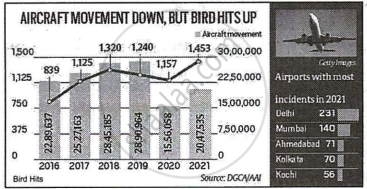
The area around air fields should be clear of any waste disposal sites. - Look at the graph. It shows that between 2016 and 2021, whereas air flights have come down, the bird-hits have gone up. This implies that the incidence of bird hits has: (1)
- decreased
- increased
- remained constant
- been alarming
