Advertisements
Advertisements
Question
 During the devastating July 2005 floods that hit Mumbai, Rajen Dutia received an urgent call from a relative, Lopa Vyas late in the evening. “A friend’s mother is stranded near your home, Rajen. Can you please take her home? Her name is Rashmi,” Vyas told him.
Mumbai had come to a halt and people were trapped everywhere. Despite power failure and raging rain, Dutia stepped out and made his way to the spot, where he found Rashmi as well as a dozen other people. They were stranded in the dark, shivering in the rain. They all lived far away and had no place to go for the night.
Rajen took all of them to his one-bedroom flat, where he served them dinner and invited them to spend the night.
"By doing so," says Rajen, "I was simply fulfilling my karma, paying the universe back for the good it had done for me."
"God is kind. My daughter had just started her new job that day, and had gone for her training. She was stranded too. While she was trying to get to our relatives, she almost drowned, but a young stranger saved her. He and his friends even dropped her to my relative's place and phoned me to say she was safe. One good turn deserves another."
A2. Order
Look at the following sentences from the passage and put them in the correct sequence: (2)
(a) He took them to his one-bedroom flat.
(b) Rajen found Rashmi as well as a dozen other people shivering in the rain.
(c) Mumbai had come to a halt and people were trapped everywhere.
(d) Rajen Dutia received an urgent call.
A3
During the devastating July 2005 floods that hit Mumbai, Rajen Dutia received an urgent call from a relative, Lopa Vyas late in the evening. “A friend’s mother is stranded near your home, Rajen. Can you please take her home? Her name is Rashmi,” Vyas told him.
Mumbai had come to a halt and people were trapped everywhere. Despite power failure and raging rain, Dutia stepped out and made his way to the spot, where he found Rashmi as well as a dozen other people. They were stranded in the dark, shivering in the rain. They all lived far away and had no place to go for the night.
Rajen took all of them to his one-bedroom flat, where he served them dinner and invited them to spend the night.
"By doing so," says Rajen, "I was simply fulfilling my karma, paying the universe back for the good it had done for me."
"God is kind. My daughter had just started her new job that day, and had gone for her training. She was stranded too. While she was trying to get to our relatives, she almost drowned, but a young stranger saved her. He and his friends even dropped her to my relative's place and phoned me to say she was safe. One good turn deserves another."
A2. Order
Look at the following sentences from the passage and put them in the correct sequence: (2)
(a) He took them to his one-bedroom flat.
(b) Rajen found Rashmi as well as a dozen other people shivering in the rain.
(c) Mumbai had come to a halt and people were trapped everywhere.
(d) Rajen Dutia received an urgent call.
A3(i). Fill in the blanks :
Select the words given in the passage (1)
(i) Thousands Of pilgrims were …………….. due to the cloud burst in Uttarakhand.
(ii) The tiger was ……………… by the hunter.
(ii). Antonyms:
Select the correct antonyms for the given words from the alternatives :
(1) Please :
(a) unplease (b) displease (c) misplease
(2) Safe: '
(a) insafe (b) safeless (c) unsafe
A4(i) Tags :
Select the correct tag for the alternatives given below :
One good turn deserves another.
(a) Doesn’t it? (b) don’t it (c) does it?
(ii). Guess:
Choose the correct answer : (1)
Rajen can you please take her home? ‘Can’ indicates :
(a) Obligation (b) ability (c) permission
A5. Personal Response :
‘ one good turn
Deserves another.’
Explain with an
example of your own.
Advertisements
Solution
A1. Complete:
Effects of Floods:
1. Life comes to a halt.
2. There are power failures.
3. People get trapped and property is damaged.
4. There is a shortage of basic supplies like food and clothing.
A2. Order:
1. (d) Rajen Dutia received an urgent call.
2. (c) Mumbai had come to a halt and people were trapped everywhere.
3. (b) Rajen found Rashmi as well as a dozen other people shivering in the rain.
4. (a) He took them to his one-bedroom flat.
A3. i. Fill in the blanks:
i. Thousands of pilgrims were stranded due to the cloud burst in Uttarakhand.
ii. The tiger was trapped by the hunter.
A3. ii. Antonyms:
(1) (b) displease
(2) (c) unsafe
A4. i. Tags:
One good turn deserves another, (a)doesn’t it?
A4. ii. Guess:
Rajen can you please take her home? ‘Can’ indicates: (a) ‘can’ indicates obligation.
A5. Personal Response:
The expression ‘one good turn deserves another’ means if someone does a good deed to me it is
my duty to return the favour if possible or at least do some good deed to help anyone in need. For
example, if my classmate shares his lunch or stationery with me in school, I should be ready to do
the same for him or for any one else in need.
APPEARS IN
RELATED QUESTIONS
B1. Choose
Choose the correct alternatives and complete the sentences (2)
(1) The narrator is :
(a) an astronaut
(b) an engineer studying in BITS Pilani
(c) in the team of astronauts.
(2) Armstrong said, 'That's one small step for a man, one giant leap for mankind which means:
(a) one step on the moon means, many steps on the earth.
(b) he felt like a giant on the moon.
(c) one moon mission had opened up many avenues in science and technology for mankind.
It was late evening of July 20. 1969, when we turned up the hostel radio. I was an engineering student at BITS, Pilani. I still remember the feverish excitement that gripped us from July 16 when Apollo 11. the US space rocket, took off from Cape Kennedy, Florida. Neil Armstrong and his team of astronauts, Edwin "Buzz" Aldrin and Michael Collins, were to land on moon, for the first time in human history. We listened 'with rapt attention when Armstrong declared: "That's one small step for a man, one giant leap for mankind."
His death on Saturday, August 25, is a moment to salute the romance of space science that Apollo 11 unleashed. It has changed forever the way we look at our planet Earth and its satellite, the moon.
Standing on powdery moondust, Armstrong put up his thumb, shut one eye and found his thumb blotting out the Earth. "It suddenly struck me that that tiny pea, pretty and blue, was the Earth” he said later. "I felt very, very small." But behind that humbling realisation stood a giant truth:
The effort to explore the universe united mankind in technology and knowledge. Each moon mission, about 110 till date, provided more confidence to take on bolder projects.
B2. Complete (2)
(1) Armstrong describes the earth as ……………
(2) The effort to explore the universe has ………………
(3) Apollo 11 unleashed and changed forever ………………
(4) The author came to know about Apollo 11 mission when he …………..
B3. Solve
Solve the crossword with the clues given below. Refer to the passage for your answers: (2)

Down : (1) The area beyond the earth's atmosphere .
(2) The name of the spacecraft that Armstrong travelled.
Across : (3) A person trained to travel in space.
(4) Y A natural satellite of the earth.
B4. Begin the sentence
(i) With-For the first time .......and rewrite [1]
Neil Armstrong, Edwin Aldrin and Michael Collins were, to land on the moon for the first time.
(ii) Insert 'that' appropriately and rewrite. [1]
Armstrong found his thumb blotting out the Earth.
B5. Personal Response
Would you like to be an astronaut? Give reasons.
Read the passage given below:
1. Every morning Ravi gives his brain an extra boost. We're not talking about drinking strong cups of coffee or playing one of those mind-training video games advertised all over Facebook. "I jump onto my stationary bike and cycle for 45 minutes to work," says Ravi. "When I get to my desk, my brain is at peak activity for a few hours." After his mental focus comes to a halt later in the day, he starts it with another short spell of cycling to be able to run errands.
2. Ride, work, ride, repeat. It's scientifically proven system that describes some unexpected benefits of cycling. In a recent study in the Journal of Clinical and Diagnostic Research, scientists found that people scored higher on tests of memory, reasoning, and planning after 30 minutes of spinning on a stationary bike than they did before they rode the bike. They also completed the tests faster after pedalling.
3. Exercise is like fertilizer for your brain. All those hours spent on exercising your muscles, create rich capillary beds not only in leg and hip muscles, but also in your brain. More blood vessels in your brain and muscles mean more oxygen and nutrients to help them work. When you pedal, you also force more nerve cells to fire. The result: you double or triple the production of these cells – literally building your brain. You also release neurotransmitters (the messengers between your brain cells) so all those cells, new and old, can communicate with each other for better, faster functioning. 'That's a pretty profound benefit to cyclists.
4. This kind of growth is especially important with each passing birthday, because as we age, our brains shrink and those connections weaken. Exercise restores and protects the brain cells. Neuroscientists say, "Adults who exercise display sharper memory skills, higher concentration levels, more fluid thinking, and greater problem-solving ability than those who are sedentary."
5. Cycling also elevates your mood, relieves anxiety, increases stress resistance, and even banishes the blues. "Exercise works in the same way as psychotherapy and antidepressants in the treatment of depression, maybe better," says Dr. Manjari. A recent study analyzing 26 years of research finds that even some exercise – as little as 20 to 30 minutes a day – can prevent depression over the long term.
6. Remember: although it's healthy, exercise itself is a stress, especially when you're just getting started or getting back into riding. When you first begin to exert yourself, your body releases a particular hormone to raise your heart rate, blood pressure, and blood glucose levels, says Meher Ahluwalia, PhD, a professor of integrative physiology. As you get fitter, it takes a longer, harder ride to trigger that same response.
On the basis of your understanding of the passage, complete the statements given below with the help of the options that follow:
(a) Ravi gets his brain to work at peak level by
(ii) playing games that need brain activity.
(iii) cycling on a stationary bike.
(iv) taking tablets to pump up his brain.
(b) When nerve cells work during exercise then
(ii) the brain is strengthened by multiplying them.
(iii) you start to lose your temper.
(iv) your stationary cycle starts to beep.
Answer the following questions briefly:
(c) How does exercise help the brain?
(d) Why does Ravi do a circuit of 'ride, work, ride'?
(e) What is the work of neurotransmitters?
(f) What benefits other than greater brain activity does one get from cycling?
(g) Why is exercise so important for adults?
(h) How is exercise itself a stress?
(ii) inactive (para 4)
Read the passage given below and answer the questions that follow:
The most alarming of man’s assaults upon the environment is the contamination of air, earth, rivers, and sea with lethal materials. This pollution is for the most part irrevocable; the chain of evil it initiates is for the most part irreversible. In this contamination of the environment, chemicals are the sinister partners of radiation in changing the very nature of the world; radiation released through nuclear explosions into the air, comes to the earth in rain, lodges into the soil, enters the grass or corn, or wheat grown there and reaches the bones of a human being, there to remain until his death. Similarly, chemicals sprayed on crops lie long in soil, entering living organisms, passing from one to another in a chain of poisoning and death. Or they pass by underground streams until they emerge and combine into new forms that kill vegetation, sicken cattle, and harm those who drink from once pure wells.
It took hundreds of millions of years to produce the life that now inhabits the earth and reached a stage of adjustment and balance with its surroundings. The environment contained elements that were hostile as well as supporting. Even within the light of the sun, there were short wave radiations with power to injure. Given time, life has adjusted and a balance reached. For time is the essential ingredient, but in the modern world is no time.
The rapidity of change and the speed with which new situations are created follow the heedless pace of man rather than the deliberate pace of nature. Radiation is no longer the bombardment of cosmic rays; it is now the unnatural creation of man’s tampering with the atom. The chemicals to which life is asked to make adjustments are no longer merely calcium and silica and copper and all the rest of the minerals washed out of the rocks and carried in the rivers to the sea; they are the synthetic creations of man’s inventive mind, brewed in his laboratories, and having no counterparts in nature.
(a) On the basis of your understanding of the above passage make notes on it using headings and sub-headings. Use recognizable abbreviations (wherever necessary-minimum four) and a format you consider suitable. Also supply a title to it.
(b) Write a summary of the passage in about 80 words.
Read the following extract and answer the questions given below:
There are some glimmers of hope. I met up young Navdeep. Ahuja who along with another colleague began the innocuously named Graduates Welfare Association, Fazilka. They are bringing about change with the mandate of citizens' participation in governance and are facilitating the creation of physical and social infrastructure across 22 cities in Punjab. They have put in place a network of cycle rickshaws called Eco-cabs which can be booked through a mobile phone. They are also developing car tree zones, food and culture streets in these cities. All this is being done very efficiently and at a low cost. We need many such organizations. However, my idea of a city in 2020 is not a utopian dream. It is achievable. It has streets where people walk on wide footpaths shaded by leafy trees. Streets are usually one-third of a city's area and its most democratic segment. Public space dedicated to pedestrians reduces inequality and should be accorded priority when developing cities. Adjoining the streets should be cycle lanes where bicycles and, rickshaws can sail past smoothly. It'll have a great public transport system with buses, metro and taxis. Parking will be difficult and expensive so people will use public transport rather than cars. There will be parks and gardens and the air will be clean, as pollution levels will have dropped dramatically. And then cities will become areas of graceful living and a charmed way of life.
(1) What is the extract about?
(2) What will happen when parking becomes difficult and expensive?
(3) How has Graduates Welfare Association brought about changes in some cities?
(4) What efforts will you take to make your city a livable place?
(5) Rewrite the following sentences in the ways instructed :
(i) We need many such organizations.
(Frame a ' Wh-question' to get the underlined part as an answer.)
(ii) It reduces inequality.
(Rewrite it using the Present Perfect Tense.)
(iii) The air will be clean, as pollution levels will. have dropped dramatically.
(Rewrite it using 'unless')
(6) Find out the words from the extract which mean:
(i) co-worker
(ii) small signs
Read the following extract and answer the questions given below.
|
I grew up in India in which telephones were both rare and virtually useless. When I left India in 1975 to go to the US for graduate studies, we had perhaps, 600 million residents in the country and just two million landline telephones. Having a telephone was a rare privilege: if you weren’t an important government official, or a doctor, or a journalist, you might languish in a long waiting list and never receive a phone.
Telephone were such a rarity (after all, 90% of population had access to a telephone line) that elected members of Parliament had amongst their privileges the right to allocate 15 telephone connections to whomever they deemed worthy.
And if you did have a phone, it wasn’t necessarily a blessing. I spent my high school years in Calcutta, and I remember that if you picked up your phone, you had no guarantee you would reach the number you had dialled. Sometimes you were connected to someone else’s ongoing conversation, and they had no idea you were able to hear them; there was even a technical term for it, the ‘cross - connection’ (appropriately, since these were connections that made us very cross). If you wanted to call another city, say Delhi, you had to book a ‘trunk call’ in the morning and then sit by the telephone all day waiting for it to come through; or you could pay eight times the going rate for a ‘lightning call’ = but even lightning struck slowly in India those days, so it only took half an hour instead of the usual three or four or more to be connected.
|
Questions:
(1). Why were telephones a rarity before 1975? (1)
(2) What special rights did elected members of Parliament use to have? (2)
(3) How did the author differentiate between a ‘trunk call’ and a ‘lightning call’? (2)
(4) Do you think the cellphone has made us global? (2)
(5) Rewrite the following sentences in the ways instructed. . (3)
(i) You could pay eight times the going rate for a ‘lighting call’. (Rewrite it using modal auxiliary showing compulsion)
(ii) I spent my high school years in Calcutta. [Rewrite it using past perfect tense]
(iii) Telephones were a rarity. [Make it a rhetorical question]
(6) Match the words in column ‘A’ with their meanings in column ‘B’. (1)
| Column A | Column B | ||
| (i) | Privilege |
(i)
|
means to reach or get |
| (ii) | Access |
(ii)
|
remedy |
| (iii) | special right |
Read the following passage and do the activities.
Galaxies are vast clusters of thousands of millions of stars, planets, gases and dust, which are held together by gravity. There are over one thousand million galaxies, and each is a very long way from its nearest neighbour.
Galaxies were formed during the Big Bang explosion about 15,000 million years ago. When this phenomenon occurred, everything that was in the universe flew out in different directions. Scientists believe that the galaxies were formed from lumps of matter that resulted. However, the process is nowhere near complete. The universe is still expanding, galaxies are still moving away from each other, new stars are still being created.
Galaxies are classified according to their shapes. There are three main types. The most common type of galaxy is The Spiral. This has several spiral arms radiating out from the center. Spiral galaxies have a large cluster of stars in their nucleus. The second type is the Barred spiral. In this type of galaxy, the spiral arms curve away from the opposite ends of a sort of bar going through the middle of the nucleus. These contain large amounts of gas and dust as well stars. The third type of galaxy is electrical. These consist almost entirely of stars and contain very little gas or dust. Some galaxies have irregular, uneven shapes and cannot be classified.
(A1) State whether the following statements are true or false. 02
(1) The most common type of galaxy is the barred spiral.
(2) Galaxies are clusters, held by gravity.
(3) Scientists do not believe in the Big Bang explosion.
(4) Galaxies are moving from each other.
(A2) Complete the web chart. 02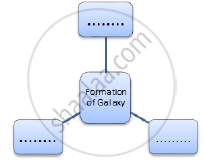
(A3)
(a) Find out similar words from the passage. 01
(i) mass (ii) happenings
(b) Give the verb form of the given words. 01
(i) classified (ii) directions
(A4) Identify and name the clause. 02
Scientists believe that the galaxies were formed from the lumps of matter.
(A5) Can there be life in another galaxy? Give reasons for your answer. 02
(B) Read the passage given in Q. 4 (A) and write the summary of it. Suggest a suitable title to your summary. (05)
Read the passage given below:
During our growing up years we as children were taught both at home and school-to worship the photos and idols of the gods of our respective religions. When we grow a little older, we were to read holy books like The Bhagwad Gita, Bible, and Quran; we were told that there are a lot of life lessons to be learned from these holy books. We were then introduced to stories from our mythologies which taught us about ethics and morality-what is good and what is bad I also learned to be respectful towards my parents who made my life comfortable with their hard work and love and care, and my teachers who guided me to become a good student and a responsible citizen.
Much later in life, I realised that though we learn much from our respective holy books, there is a lot to learn from our surroundings. This realization dawned upon me when I learned to enquire and explore. Everything around us- the sun, the moon, the stars, rain, rivers, stones, rocks, birds, plants, and animals-teach us many valuable life lessons.
No wonder that besides the scriptures in many cultures nature is also worshipped. The message that we get is to save our environment and maintain ecological balance. People are taught to live in harmony with nature and recognize that there is God in all aspects of nature.
Nature is a great teacher. A river never stops flowing. If it finds an obstacle in its way in the form of heavy rock, the river water fights to remove it from its path or finds an alternative path to move ahead. This teaches us to be progressive in life, and keep the fighting spirit alive.
Snakes are worshipped as they eat insects in the field that can hurt our crops, thus protecting the grains for us. In fact, whatever we worship is our helper and makes our lives easy for us. There are many such examples in nature, but we are not ready to learn a lesson, Overcome with greed, we are destroying nature. As a result, we face natural disasters like drought, floods, and landslides. We don't know that nature is angry with us.
However, it is never too late to learn. If we learn to respect nature the quality of our life will improve.
2.1 Answer briefly the following questions:
(a) What are we taught in our childhood and growing up years?
(b) Why should we respect our parents and teachers?
(c) What message do we get when we worship nature?
(d) How does a river face an obstacle that comes in its way?
2.2 Choose meanings of the words given below with the help of options that follow:
(e) guided
(i) answered
(ii) advised
(iii) fought
(iv) polished
(f) explore
(i) search
(ii) frequent
(iii) describe
(iv) request
(g) valuable
(i) proper
(ii) desirable
(iii) available
(iv) useful
(ii) friendship
(iii) discomfort
(iv) honesty
A. Read the following passage and do the given activities:
A1. List the benefits of Yoga (02)
- ______
- ______
- ______
- ______
We give undue importance to our health and the treatment of diseases. A large number of medicines treat only the symptoms of the disease, and not the root cause. In fact, the cause of many chronic ailments is still being researched. It is here that Yoga therapy comes to our assistance. Yoga emphasizes the treatment of the root cause of an ailment. It works in a slow, subtle and miraculous manner. Modern medicine can claim to save a life at a critical stage, but, for complete recovery and regaining of normal health, one must believe in the efficiency of Yoga therapy.
The Yogic way of life includes a code of ethics, regulations, discipline, combined with prayer and meditation. Even a discussion of these subjects helps one relieve mental tensions and change attitudes. Simple Asana has helped to stretch and relax the whole body and release tensions. The sincere practice of Yoga postures is beneficial, for the mind and body.
The continued practice of Yoga has a profound effect on the inner dimensions of life. Yoga aims at developing mental, physical, spiritual, and emotional facilities. Other forms of physical exercises, like aerobics, assure only physical well-being. They have little to do with the development of the soul and mind.
A2. Complete the following statement according to the passage: (02)
- One must believe in the ________
- Aerobics assure only __________
A3. Fill up the word-formation chart: (02)
| Noun | Verb | Adjective |
| development | ______ | ______ |
| ______ | believe | ______ |
A4.
- Yoga emphasizes the treatment of the root cause of an ailment.
(Frame ‘Wh-‘ Question to get the underlined part as an answer) (02) - We give undue importance to our health.
(Begin with Undue importance......) (02)
A5. Do you believe Yoga Asanas are better than physical exercises? Justify your answer.
B. Summary Writing (5)
Write a short summary of the passage given in above and suggest a suitable title.
Read the extract and complete the activities given below :
Luxurious houses on the edge of a big city which one promoter sold with the tagline ‘‘Where Nature peeps through every window.’’ All the advantages of a modern lifestyle but with the added bonus of fresh air. But nature isn’t greenery alone; it also includes wild animals.
While the view from the picture windows was easy on the eye, occasionally, it made them gulp with nervousness. At dusk, wild cats leaped out of the adjoining forest on to the top of the peripheral walls and strolled nonchalantly. Sometimes, they lounged on ledges with their long tails swinging freely, oblivious of the many worried human eyes pinned on them. Their cold yellow aggressive eyes turned black as their pupils dilated with failing light.
Some Mumbaikars paid a lot of money to see leopards on safari in Africa. But to watch them from one’s own home was disconcerting. These predators were out of line, stepping off nature into the city. Why did the leopards not stay within the 100-square kilometre Sanjay Gandhi National Park? Perhaps, the leopards thought that if people could venture into nature to jog, walk and picnic, why couldn’t they hang around apartment blocks? If people could enjoy nature, couldn’t nature savour humanity’s offerings?
Capturing leopards is extraordinarily simple. These curious cats seem incapable of resisting a free meal, walking into baited traps without hesitation. The reason the felines are attracted to their residential community is prey : stray dogs that live on rubbish heaps. Taking care of the food source is the best course of action, the volunteers said.
A1. Rewrite the following sentences as per their occurrence in the extract :
- Instead of capturing leopards we can take care of their food.
- Leopards leave their habitat and enter the human habitat.
- Modern lifestyle and nature both attract the dwellers.
- Leopards can enjoy human surroundings by leaving nature.
A2. Complete the following sentences :
- Nature is a combination of ______ and ______
- The best of both the worlds include ______ and ______
- The wild animals are out of line as ______
- The wild cats are attracted towards residential areas because ______
A3. Find out the words for leopards used in the extract :
- ____________
- ____________
- ____________
- ____________
A4. ‘‘If people could venture into nature to jog, walk, and picnic, why couldn’t the wild animals hang around apartment blocks?’’ Express your opinion.
A5. Rewrite the following sentences in the ways instructed :
- Taking care of the food source is the best course of action.
(Use infinitive form of the underlined word and rewrite.) -
Nature isn’t greenery alone; it also includes wild animals.
(Rewrite it by using ‘not only ... but also’.)
A6. Find a word for each of the following expressions from the extract :
- Enjoy the taste of something
- Embarrassing and confusing to watch
- Not conscious or aware of something or someone
- Relaxed and in an unworried manner
II. Read the passage given below.
| 1 | The North-East of India is a melting pot of variegated cultural mosaic of people and races, an ethnic tapestry of many hues and shades. Yet, these states are lesser explored as compared to the rest of the country. The new generations of travellers who are ‘money rich and time poor’ are increasingly looking for unique experiences --a phenomenon being called the emergence of the ‘experience economy’. For this new and growing breed of tourists, the North-East with its variety and uniqueness holds immense attraction. |
| 2 | A study conducted in 2020 by Dr. Sherap Bhutia, revealed that the foreign tourist arrival in the North-East increased from 37,380 persons in 2005 to 118,552 in 2014. The overall growth rate of tourists (both domestic and foreign) in the North-East was as high as 26.44% during 2005-06. High and positive growth of 12.53% was registered in foreign tourist visits to North-East States of India during 2012 from 2011, which further rose to register a growth of 27.93% during 2013 from 2012. Foreign tourist arrivals in the North-East witnessed a growth of 39.77% during 2014 from 2013, according to data provided from the Ministry of Tourism, Government of India. |
| 3 | The study recommendations for tourism planners included the need to concentrate on some key areas like enhancement of tourist facilities, tourism financing, focus on community involvement and others for the formulation of a sustainable tourism strategy in the North-East States of India. |
i. Infer one reason for the following, based on information in paragraph 1. (1)
The rate of tourism in the North-East of India puzzles tourism officials.
ii. Select the appropriate option to fill in the blanks. (1)
From paragraph 1, we can infer that the ______ and ______ of the North-Eastern states aid attracting the ‘money rich and time poor’ tourists.
1. distinctiveness
2. conventionality
3. diversity
4. uniformity
5. modernity
- 1 & 3
- 2 & 4
- 2 & 5
- 1 & 4
iii. Complete the following analogy correctly with a word/ phrase from paragraph 1: (1)
aroma : cooking : : ______ : painting
(Clue: Just like aroma is integral to cooking, similarly, ______ is/ are integral to painting)
iv. Select the correct option to complete the following sentence: (1)
Travellers advocating the ‘experience economy’ seek a holiday package with ______ (Paragraph 1)
- grand facilities, expensive hotels and excellent services to pamper them.
- a wholesome experience within the budget they have planned for.
- places and cities to buy things from and opportunities to spend money.
- cost-effective services, affordable accommodation and many days of touring.
v. Select the chart that appropriately represents the trend of foreign tourist travels in the North-East, from 2011-2014, as per paragraph 2. (1)
 |
 |
 |
 |
| (1) | (2) | (3) | (4) |
- Option 1
- Option 2
- Option 3
- Option 4
vi. Fill in the blank by selecting the correct option. (1)
The study of tourist travel statistics in the North-East, from 2005 to 2014 showed ______ results.
- expected
- encouraging
- inconsistent
- questionable
vii. Substitute the word ‘witnessed’ with one word similar in meaning, in the following, sentence from paragraph 2: (1)
Foreign tourist arrivals in the North-East witnessed a growth of...
viii. List any 2 examples of ‘tourist facilities’ as referred to, in Paragraph 3. (1)
ix. List one reason why the researchers recommend that the formulation of a tourism strategy in the North-Eastern States of India be sustainable. (1)
x. Select the option that titles paragraphs 1-3 appropriately, with reference to information in the text. (1)
- 1. Full Speed Ahead!
2. Ups and Downs
3. Cause for Concern - 1. Winds of Change
2. Numbers Don't Lie
3. Time for Action - 1. Inspecting Trends
2. Statistically Speaking
3. Let's Investigate - 1. Cause and Effect
2. Dynamic Data
3. Dependable Facts
