Advertisements
Advertisements
Question
Prove that the coefficient of xn in the expansion of (1 + x)2n is twice the coefficient of xn in the expansion of (1 + x)2n–1 .
Advertisements
Solution

Comparing the indices of x in xn and in Tr + 1, we obtain
r = n
Therefore, the coefficient of xn in the expansion of (1 + x)2n is
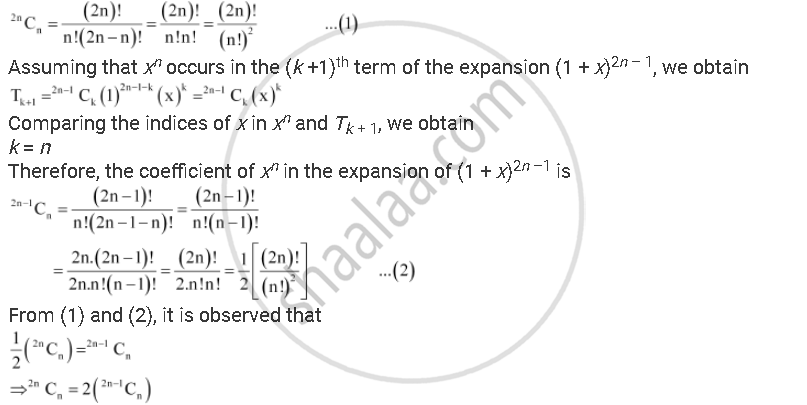
Therefore, the coefficient of xn in the expansion of (1 + x)2n is twice the coefficient of xn in the expansion of (1 + x)2n–1.
Hence, proved.
RELATED QUESTIONS
Find the coefficient of a5b7 in (a – 2b)12
Find the 4th term in the expansion of (x – 2y)12 .
Find the 13th term in the expansion of `(9x - 1/(3sqrtx))^18 , x != 0`
Find the middle terms in the expansions of `(3 - x^3/6)^7`
The coefficients of the (r – 1)th, rth and (r + 1)th terms in the expansion of (x + 1)n are in the ratio 1:3:5. Find n and r.
Find a positive value of m for which the coefficient of x2 in the expansion
(1 + x)m is 6
Find the middle terms in the expansion of:
(i) \[\left( 3x - \frac{x^3}{6} \right)^9\]
Find the middle terms in the expansion of:
(iii) \[\left( 3x - \frac{2}{x^2} \right)^{15}\]
Find the middle terms(s) in the expansion of:
(i) \[\left( x - \frac{1}{x} \right)^{10}\]
Find the term independent of x in the expansion of the expression:
(i) \[\left( \frac{3}{2} x^2 - \frac{1}{3x} \right)^9\]
Find the term independent of x in the expansion of the expression:
(iii) \[\left( 2 x^2 - \frac{3}{x^3} \right)^{25}\]
Find the term independent of x in the expansion of the expression:
(iv) \[\left( 3x - \frac{2}{x^2} \right)^{15}\]
Find the term independent of x in the expansion of the expression:
(v) \[\left( \frac{\sqrt{x}}{3} + \frac{3}{2 x^2} \right)^{10}\]
Find a, if the coefficients of x2 and x3 in the expansion of (3 + ax)9 are equal.
If in the expansion of (1 + x)n, the coefficients of three consecutive terms are 56, 70 and 56, then find n and the position of the terms of these coefficients.
If the coefficients of three consecutive terms in the expansion of (1 + x)n be 76, 95 and 76, find n.
If the 2nd, 3rd and 4th terms in the expansion of (x + a)n are 240, 720 and 1080 respectively, find x, a, n.
If p is a real number and if the middle term in the expansion of \[\left( \frac{p}{2} + 2 \right)^8\] is 1120, find p.
Write the total number of terms in the expansion of \[\left( x + a \right)^{100} + \left( x - a \right)^{100}\] .
If A and B are the sums of odd and even terms respectively in the expansion of (x + a)n, then (x + a)2n − (x − a)2n is equal to
In the expansion of \[\left( x - \frac{1}{3 x^2} \right)^9\] , the term independent of x is
If rth term is the middle term in the expansion of \[\left( x^2 - \frac{1}{2x} \right)^{20}\] then \[\left( r + 3 \right)^{th}\] term is
Find the middle term (terms) in the expansion of `(p/x + x/p)^9`.
Find the coefficient of `1/x^17` in the expansion of `(x^4 - 1/x^3)^15`
Find n in the binomial `(root(3)(2) + 1/(root(3)(3)))^n` if the ratio of 7th term from the beginning to the 7th term from the end is `1/6`
If xp occurs in the expansion of `(x^2 + 1/x)^(2n)`, prove that its coefficient is `(2n!)/(((4n - p)/3)!((2n + p)/3)!)`
Middle term in the expansion of (a3 + ba)28 is ______.
The number of terms in the expansion of [(2x + y3)4]7 is 8.
If n is the number of irrational terms in the expansion of `(3^(1/4) + 5^(1/8))^60`, then (n – 1) is divisible by ______.
The number of rational terms in the binomial expansion of `(4^(1/4) + 5^(1/6))^120` is ______.
If the 4th term in the expansion of `(ax + 1/x)^n` is `5/2` then the values of a and n respectively are ______.
The coefficient of y49 in (y – 1)(y – 3)(y – 5) ...... (y – 99) is ______.
