Advertisements
Advertisements
Question
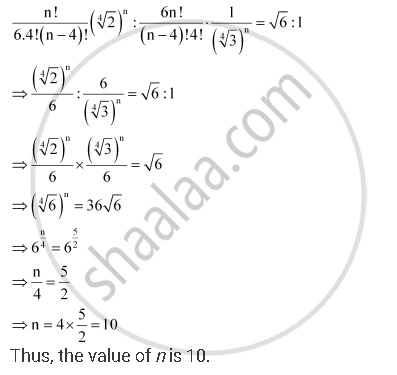
Find n, if the ratio of the fifth term from the beginning to the fifth term from the end in the expansion of `(root4 2 + 1/ root4 3)^n " is " sqrt6 : 1`
Advertisements
Solution
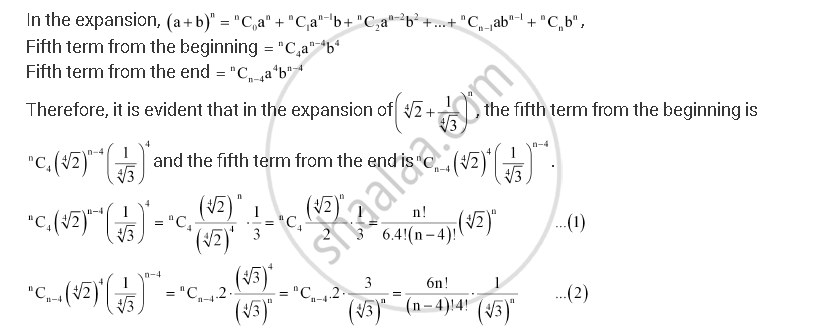
It is given that the ratio of the fifth term from the beginning to the fifth term from the end is `sqrt6 : 1`. Therefore, from (1) and (2), we obtain
RELATED QUESTIONS
Write the general term in the expansion of (x2 – y)6
Write the general term in the expansion of (x2 – yx)12, x ≠ 0
Find the 13th term in the expansion of `(9x - 1/(3sqrtx))^18 , x != 0`
The coefficients of the (r – 1)th, rth and (r + 1)th terms in the expansion of (x + 1)n are in the ratio 1:3:5. Find n and r.
Find the middle term in the expansion of:
(ii) \[\left( \frac{a}{x} + bx \right)^{12}\]
Find the middle terms in the expansion of:
(ii) \[\left( 2 x^2 - \frac{1}{x} \right)^7\]
Find the middle terms in the expansion of:
(iii) \[\left( 3x - \frac{2}{x^2} \right)^{15}\]
Find the middle terms(s) in the expansion of:
(iii) \[\left( 1 + 3x + 3 x^2 + x^3 \right)^{2n}\]
Find the middle terms(s) in the expansion of:
(v) \[\left( x - \frac{1}{x} \right)^{2n + 1}\]
Find the middle terms(s) in the expansion of:
(vi) \[\left( \frac{x}{3} + 9y \right)^{10}\]
Find the term independent of x in the expansion of the expression:
(ii) \[\left( 2x + \frac{1}{3 x^2} \right)^9\]
Find the term independent of x in the expansion of the expression:
(vi) \[\left( x - \frac{1}{x^2} \right)^{3n}\]
Find the term independent of x in the expansion of the expression:
(vii) \[\left( \frac{1}{2} x^{1/3} + x^{- 1/5} \right)^8\]
If the coefficients of \[\left( 2r + 4 \right)\text{ th and } \left( r - 2 \right)\] th terms in the expansion of \[\left( 1 + x \right)^{18}\] are equal, find r.
If the coefficients of 2nd, 3rd and 4th terms in the expansion of (1 + x)2n are in A.P., show that \[2 n^2 - 9n + 7 = 0\]
If the coefficients of 2nd, 3rd and 4th terms in the expansion of (1 + x)n are in A.P., then find the value of n.
Find the coefficient of a4 in the product (1 + 2a)4 (2 − a)5 using binomial theorem.
If in the expansion of (1 + x)n, the coefficients of three consecutive terms are 56, 70 and 56, then find n and the position of the terms of these coefficients.
If a, b, c and d in any binomial expansion be the 6th, 7th, 8th and 9th terms respectively, then prove that \[\frac{b^2 - ac}{c^2 - bd} = \frac{4a}{3c}\].
If the 2nd, 3rd and 4th terms in the expansion of (x + a)n are 240, 720 and 1080 respectively, find x, a, n.
If p is a real number and if the middle term in the expansion of \[\left( \frac{p}{2} + 2 \right)^8\] is 1120, find p.
Write the middle term in the expansion of \[\left( x + \frac{1}{x} \right)^{10}\]
Find the sum of the coefficients of two middle terms in the binomial expansion of \[\left( 1 + x \right)^{2n - 1}\]
The number of irrational terms in the expansion of \[\left( 4^{1/5} + 7^{1/10} \right)^{45}\] is
In the expansion of \[\left( x - \frac{1}{3 x^2} \right)^9\] , the term independent of x is
In the expansion of \[\left( \frac{1}{2} x^{1/3} + x^{- 1/5} \right)^8\] , the term independent of x is
The middle term in the expansion of \[\left( \frac{2x}{3} - \frac{3}{2 x^2} \right)^{2n}\] is
Find the middle term in the expansion of `(2ax - b/x^2)^12`.
Find the term independent of x, x ≠ 0, in the expansion of `((3x^2)/2 - 1/(3x))^15`
If the term free from x in the expansion of `(sqrt(x) - k/x^2)^10` is 405, find the value of k.
Find the middle term (terms) in the expansion of `(x/a - a/x)^10`
If p is a real number and if the middle term in the expansion of `(p/2 + 2)^8` is 1120, find p.
If the middle term of `(1/x + x sin x)^10` is equal to `7 7/8`, then value of x is ______.
In the expansion of `(x^2 - 1/x^2)^16`, the value of constant term is ______.
Middle term in the expansion of (a3 + ba)28 is ______.
The sum of coefficients of the two middle terms in the expansion of (1 + x)2n–1 is equal to 2n–1Cn.
Let the coefficients of the middle terms in the expansion of `(1/sqrt(6) + βx)^4, (1 - 3βx)^2` and `(1 - β/2x)^6, β > 0`, common difference of this A.P., then `50 - (2d)/β^2` is equal to ______.
