Advertisements
Advertisements
प्रश्न
Find n, if the ratio of the fifth term from the beginning to the fifth term from the end in the expansion of `(root4 2 + 1/ root4 3)^n " is " sqrt6 : 1`
Advertisements
उत्तर
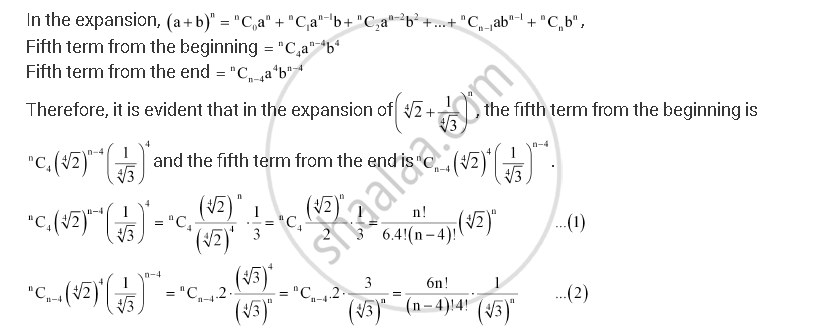
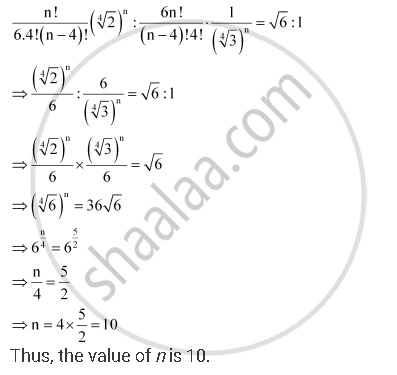
It is given that the ratio of the fifth term from the beginning to the fifth term from the end is `sqrt6 : 1`. Therefore, from (1) and (2), we obtain
संबंधित प्रश्न
Write the general term in the expansion of (x2 – yx)12, x ≠ 0
Find the 4th term in the expansion of (x – 2y)12 .
Find the middle terms in the expansions of `(x/3 + 9y)^10`
The coefficients of the (r – 1)th, rth and (r + 1)th terms in the expansion of (x + 1)n are in the ratio 1:3:5. Find n and r.
Prove that the coefficient of xn in the expansion of (1 + x)2n is twice the coefficient of xn in the expansion of (1 + x)2n–1 .
Find the middle term in the expansion of:
(ii) \[\left( \frac{a}{x} + bx \right)^{12}\]
Find the middle terms(s) in the expansion of:
(i) \[\left( x - \frac{1}{x} \right)^{10}\]
Find the middle terms(s) in the expansion of:
(ii) \[\left( 1 - 2x + x^2 \right)^n\]
Find the middle terms(s) in the expansion of:
(vii) \[\left( 3 - \frac{x^3}{6} \right)^7\]
Find a, if the coefficients of x2 and x3 in the expansion of (3 + ax)9 are equal.
If 3rd, 4th 5th and 6th terms in the expansion of (x + a)n be respectively a, b, c and d, prove that `(b^2 - ac)/(c^2 - bd) = (5a)/(3c)`.
If the coefficients of three consecutive terms in the expansion of (1 + x)n be 76, 95 and 76, find n.
If the 2nd, 3rd and 4th terms in the expansion of (x + a)n are 240, 720 and 1080 respectively, find x, a, n.
Write the middle term in the expansion of \[\left( x + \frac{1}{x} \right)^{10}\]
If A and B are the sums of odd and even terms respectively in the expansion of (x + a)n, then (x + a)2n − (x − a)2n is equal to
In the expansion of \[\left( \frac{1}{2} x^{1/3} + x^{- 1/5} \right)^8\] , the term independent of x is
The number of terms with integral coefficients in the expansion of \[\left( {17}^{1/3} + {35}^{1/2} x \right)^{600}\] is
Find the term independent of x, x ≠ 0, in the expansion of `((3x^2)/2 - 1/(3x))^15`
Find the term independent of x in the expansion of `(3x - 2/x^2)^15`
Find the middle term (terms) in the expansion of `(3x - x^3/6)^9`
Find the value of r, if the coefficients of (2r + 4)th and (r – 2)th terms in the expansion of (1 + x)18 are equal.
If p is a real number and if the middle term in the expansion of `(p/2 + 2)^8` is 1120, find p.
Show that the middle term in the expansion of `(x - 1/x)^(2x)` is `(1 xx 3 xx 5 xx ... (2n - 1))/(n!) xx (-2)^n`
Find n in the binomial `(root(3)(2) + 1/(root(3)(3)))^n` if the ratio of 7th term from the beginning to the 7th term from the end is `1/6`
If xp occurs in the expansion of `(x^2 + 1/x)^(2n)`, prove that its coefficient is `(2n!)/(((4n - p)/3)!((2n + p)/3)!)`
If the middle term of `(1/x + x sin x)^10` is equal to `7 7/8`, then value of x is ______.
Middle term in the expansion of (a3 + ba)28 is ______.
The sum of coefficients of the two middle terms in the expansion of (1 + x)2n–1 is equal to 2n–1Cn.
The coefficient of x256 in the expansion of (1 – x)101(x2 + x + 1)100 is ______.
Let the coefficients of the middle terms in the expansion of `(1/sqrt(6) + βx)^4, (1 - 3βx)^2` and `(1 - β/2x)^6, β > 0`, common difference of this A.P., then `50 - (2d)/β^2` is equal to ______.
The term independent of x in the expansion of `[(x + 1)/(x^(2/3) - x^(1/3) + 1) - (x - 1)/(x - x^(1/2))]^10`, x ≠ 1 is equal to ______.
The sum of the real values of x for which the middle term in the binomial expansion of `(x^3/3 + 3/x)^8` equals 5670 is ______.
