Advertisements
Advertisements
Question
Narrate in your own words a similar based on text to the class.
Advertisements
Solution
26th November 2008 is considered one of the black days in the History of Mumbai. 10 armed men wreaked havoc in the city, fired mercilessly at helpless Mumbaikars, and pushed the entire country into a state of fear for the next 3 days. The terrorist attack started when 10 heavily armed men arrived at two locations in Colaba in inflatable speedboats, at around 9:30 p.m. They then split into groups of two and opened fire at different locations of Mumbai. The locations targeted were Leopold Café, Chhatrapati Shivaji Maharaj Terminus, The Taj Mahal Palace Hotel, Oberoi Trident, and Cama Hospital. They also blew up two taxis with explosives. Though the Mumbai Police were caught unawares by the terrorist attack, they showed exemplary courage and deftness and managed to neutralize three terrorists. In the course of their efforts to take stock of the situation, Police officers Hemant Karkare, Vijay Salaskar, and Ashok Kamte, were killed by the terrorists. The Mumbai Police managed to arrest the terrorist Ajmal Kasab alive near Girgaon Chowpatty. Police officer Tukaram Omble was martyred while achieving this feat. Later that night, two terrorists managed to sneak into the Nariman House building, a Jewish centre in Colaba while three of them entered the Taj Mahal Hotel building and held the residents' hostage. They threatened and even killed a few hostages in these locations. The center deployed the Rapid Action Force, Marine Commandos, and the NSG commandos for the rescue operation. The hostage situation at the Taj was resolved on the morning of 27th November. Major Sandeep Unnikrishnan of the NSG was killed during the rescue of Commando Sunil Yadav, who was hit in the leg by a bullet at Taj. The rescue operation at the Nariman House continued for the next two days. Finally, on 29th November 2008 at around 8 a.m., the nightmare ended as the last terrorist of the group was killed.
APPEARS IN
RELATED QUESTIONS
If your friends get here before 7 o’clock we can take them out for dinner.
(Rewrite: Using ‘unless’)
Fill in the blank with the suitable word.
I ran _____________ my old friend in the market place.
Fill in the blanks in the passage givben below with the appropriate form of the verb given in brackets. Do not write the passage, but write the verbs in the correct order.
One day I ____________ (1)(be) in the lunch line, and there I saw a pile of apples. The teacher-incharge _____________ (2)(state) at me and said, “Just __________ (3)(take) one. God ________ (4)(watch)”. So, I ____________ (5)(take) an apple, and the line __________ (6)(move) along. At the next table there ____________ (7)(be) a pile of chocolate chip cookies. I ____________ (8)(not know) what to do. “Put,” the kid behind me ____________ (9)(whisper), “_____________ (10)(take) all you want. God’s watching the apples. ”
What does the tree symbolise in the poem?
What tells the reader the serene atmosphere about old Caspar’s home.
Name Kaspar’s grandchildren? Why did the boy come home?
How was the country affected by the war?
Research the Battle of Blenheim. Then write an essay defending Wilhelmine’s position that the battle was a “wicked thing” or Kaspar’s position that it was a | “great victory.”
Can it be argued that this is an anti- war poem?
Mention the two moods of the poet?
What is the symbolic significance of the sun, sky and wind in the first stanza?
We are not allowed to play in the sun. We are not allowed to play in the rain.
Ichabod Crane, the central character of the short story 'The Legend of Sleepy Hollow', is a person who arouses both our amusement and pity. Discuss.
Give an account of how Napoleon and his companions were unjust and cruel in their behavior towards the other animals.
Not many people read for pleasure these days.
(Begin: Few ................................. )
What do you like the most about the poem?
Below is a topic for essay writing. Follow the steps listed above to write on this topic.
Think before you shop
Given below is the dictionary meaning of
Smirk: to smile in a silly or unpleasant way that shows that you are pleased with yourself.
Look up the dictionary for the following words which are also related to facial expressions and write down the meaning of each
|
smile |
grin |
grimace |
sneer |
Use the phrase in a sentence of your own, after finding out its meaning.
on board
We add ‘un-’ to make opposites. For example, true — untrue. Add ‘un’– to the word below to make its opposite. Then look up the meaning of the word you have formed in the dictionary.
controlled: ____________
We add ‘un-’ to make opposites. For example, true — untrue. Add ‘un’– to the word below to make its opposite. Then look up the meaning of the word you have formed in the dictionary.
educated: ____________
What happened to the crow in the end?
Discuss with your partner and describe the atmosphere in the woods when Peter Crouch was heading towards Mrs. Adis’s House. It was -
- a dark moonless night.
- _________________________
- _________________________
Refer to a standard dictionary and find out the meaning of the following word:
Reported speech
‘Earth has not anything to show more fair.’
This line expresses the poet’s feelings. The sight he saw from the bridge is beautiful. There are a few more lines similar to the above. With the help of your partner find them and discuss what they express.
The setting of the act is the office of the newspaper 'The Herald'. Explain how it is the proper background for the theme of the play.
Think and write in your own words.
How can the tender maiden Autumn become a full-grown woman? What change in nature does this imply?
Write a short autobiography of a brook. (20 to 30 lines)
Answer the following question :
Why should one be wary of opinions that flatter one’s self- esteem?
Write in your own words:-
What problems do customers face when they have to make a cash deposit at a bank?
Prepare and present a short speech on the following.
How I accomplished a difficult task.
Find more topics from your Environmental Studies or Mathematics textbooks for drawing tree diagrams. Draw and label the diagrams.
| Life on earth began with unicellular I organisms known as protozoa. The following are the stages of evolution of animals. Invertebrates are animals without a backbone, for e.g., a snail. The vertebrates are animals which have a backbone. E.g., Aquatic animals like fish. Animals which: live in water and also on land are called amphibians. E.g. A frog. A few invertebrates are worms and mosquitoes and a few I vertebrates are reptiles. |
Create a poster for the following.
You are Sita/ Sudhan. Design a poster in not more than 50 words to focus on not wasting water. Be creative.
Draft Letter for the following.
You are Sadasivam. You recently visited your native town in Vellore. You happened to accompany your grandmother to your family temple. You were shocked to notice the poor condition and maintenance of the temple. Write a letter to the Editor of the local newspaper highlighting the poor condition of the temple. Also, give some suggestions and request the HRC to take steps to improve the situation.
Local Historians
- Ask students to collect stories about their town from older people.
- Ask them to find out how the streets were named.
- Are there any interesting people or legends to which the street names refer?
- Are there any local places in town about which people tell stories?
- Any haunted houses?
- Let students find out when the town was founded and by whom.
- Visit a local historical society to see old photographs or artifacts.
Let students create an original historical fiction:
Describe the town from the point of view of a fictitious citizen who might have lived in the town long ago. Include local issues of the time in the story. Write the story of the town from the fictionalized point of view of a resident who actually lived.
Your friend has presented a beautiful art piece on your birthday. Write a letter to her appreciating her art work.
You are waiting to board a train in a railway station. The train is delayed by an hour. Write a paragraph about the crowded scene in the railway station based on your observation.
| vendors | tea vendors | shops | families | piles of luggage |
| porters | trolley | scroll board | announcement | ticket counter queue |

Read the acrostic poem on ‘Friend’. Write an acrostic poem like this on ‘Tree’.
| Friend | Tree |
|
Friends always love each other |
T |
|
Respect each Other |
R |
|
Interact with each other |
E |
|
Enjoy playing with each Other |
E |
|
Never hurt your friends |
|
|
Do everything together |
The word in the sentence is jumbled. Write them in order.
was island the inhabited.
Here is a word, clock. Write down words relating to clock.

This is a park where children talk to different animals and birds. Write four sentences about the picture. Use capital letters where required, complete sentences and punctuation.

Now colour the picture.
Who do you think is the naughtiest child in your class? Describe her/him in five lines.
Give another word from the story that means
| completed | |
| surprised | |
| strange | |
| make up your mind |
List as many summer activities as you can.

Which country would you like to visit when you grow up?
Make a project by drawing or pasting.
- a map of that country, its national flag
- stamps of the country, its currency
- some famous monuments or landmarks
Why did the grandmother accompany the author to school?
What difficulty did she experience while eating Chinese food?
Why did his travel companion curse and mutter?
Write a composition (300 - 350 words) on the following:
It is very important for young people to spend time quietly or alone for a short while every day. If you were given an hour to spend on your own, how will you spend it? What will you learn from the process?
"That which we obtain too easily, we esteem too lightly. It is dearness only which gives everything its value."- Thomas Paine
Do we value only what we struggle for? Plan your response, and then write an essay to explain your views on this issue. Be sure to support your position with specific points and examples. (You may use examples from your reading, observations, and inputs from subjects such as History, Science and literature)
You have had to shift to a new house recently. Write a letter to your grandmother telling her what you miss about your old house. Tell her also what you like about your new house and what you plan to do to make it comfortable for yourself.
The line 'The house-roofs seemed to heave and sway' in Browning's poem 'The Patriot' means ______.
Find some examples of antithesis from your mother tongue and translate them into English.
In your opinion what things will help to make the world a better place? Discuss with your friends and write down at least three of the things.
Observe the tourist leaflets given and answer the following.
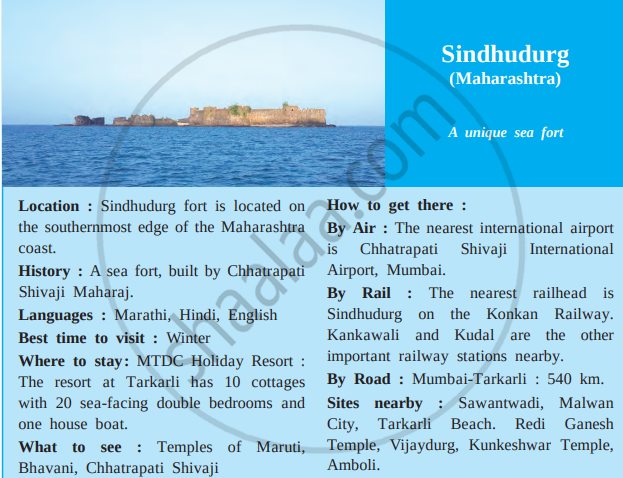

- Which places do these leaflets describe?
- What are the main points given in each leaflet?
- How can one reach Tadoba?
- Which is the best season to visit Tadoba? Why?
- List tourism-related words, e.g., tourist, booking etc.
What strategies do you use when you study on your own?
Divide the students into groups of five. They sit in a circle. They choose one object of daily use such as a bag, wallet, box, etc. The group leader writes four sentences about it.
- I have found a ______
- It’s (colour)
- It’s (shape)
- It has a ______
- I found it (place where it was found)
Others, too, write four sentences each.
- • I’ve lost a ______
- It’s (colour)
- It’s (shape)
- It has a ______
- • I lost it (place where it was lost)
They all open read their lines, beginning with the group leader. The player whose description matches the group leader’s the most gets the object.
Informal Letter -
Write a letter to your friend describing the details of the vacation.
Write an original short story that begins with the following words:
She was still on the phone giving out instructions when...
Read the passage given below and answer the questions (i), (ii) and (iii) that follow.
| (1) | “Can I see the Manager?” I said, and added solemnly, “Alone.” I don't know why I said “Alone.” “Certainly,” said the accountant and fetched him. | |
| (2) | The Manager was a grave, calm man. I held my fifty-six dollars clutched in a crumpled ball in my pocket. “Are you the Manager?” I asked. God knows I did not doubt it. “Yes,” he said. “Can I see you …. alone?” I asked. |
5 |
| (3) | The Manager looked at me in some alarm. He felt that I had an awful secret to reveal. “Come in here,” he said, and led the way to a private room. He turned the key in the lock. “We are safe from interruption here,” he said; “Sit down.” We both sat down and looked at each other. I found no voice to speak. “You are one of Pinkerton’s men, I presume,” he said. |
10 |
| (4) |
He had gathered from my mysterious manner that I was a detective. I knew what he was thinking, and it made me worse. |
15
20
|
| (5) | The Manager got up and opened the door. He called to the accountant. “Mr. Montgomery,” he said unkindly loud, “this gentleman is opening an account, he will deposit fifty-six dollars. Good morning.” I rose. A big iron door stood open at the side of the room. “Good morning,” I said, and stepped into the safe. “Come out,” said the Manager coldly and showed me the other way. |
30 |
| (6) | I went up to the accountant’s wicket and poked the ball of money at him with a quick convulsive movement as if I were doing a conjuring trick. My face was ghastly pale. “Here,” I said, “deposit it.” The tone of the words seemed to mean, “Let us do this painful thing while the fit is on us.” He took the money and gave it to another clerk. |
35 |
| (7) | He made me write the sum on a slip and sign my name in a book. I no longer knew what I was doing. The bank swam before my eyes. “Is it deposited?” I asked in a hollow, vibrating voice. “It is,” said the accountant. “Then I want to draw a cheque.” My idea was to draw out six dollars of it for present use. Someone gave me a chequebook through a wicket and someone else began telling me how to write it out. The people in the bank had the impression that I was an invalid millionaire. I wrote something on the cheque and thrust it in at the clerk. He looked at it. |
40
45 |
| (8) | “What! Are you drawing it all out again?” he asked in surprise. Then I realised that I had written fifty-six instead of six. I was too far gone to reason now. I had a feeling that it was impossible to explain the thing. I had burned my boats. All the clerks had stopped writing to look at me. Reckless with misery, I made a plunge. “Yes, the whole thing.” “You withdraw all your money from the bank?” “Every cent of it.” “Are you not going to deposit anymore?” said the clerk, astonished. “Never.” |
50
55 |
| (9) | An idiot hope struck me that they might think something had insulted me while I was writing the cheque and that I had changed my mind. I made a wretched attempt to look like a man with a fearfully quick temper. | |
| (10) | The clerk prepared to pay the money. “How will you have it?” he said. This question came as a bolt from the blue. “What?” “How will you have it?” “Oh!”— I caught his meaning and answered without even trying to think— “in fifties.” He gave me a fifty-dollar bill. “And the six?” he asked dryly. “In sixes,” I said. He gave it to me and I rushed out. As the big door swung behind me. I caught the echo of a roar of laughter that went up to the ceiling of the bank. Since then, I bank no more. I keep my money in cash in my trousers pocket and my savings in silver dollars in a sock. |
60
65
70 |
| Adapted from: My Financial Career By Stephen Leacock |
||
-
- Find a single word from the passage that will exactly replace the underlined word or words in the following sentences. [3]
- The kind stranger went and got back the ball from where it had rolled into the bush.
- I took offence at the expression on his face that was clearly meant to insinuate I was a liar.
- The firm experienced a financial loss when the contract went to a contender who had just entered the business.
- For each of the words given below, choose the correct sentence that uses the same word unchanged in spelling, but with a different meaning from that which it carries in the passage. [3]
- alarm (line 8)
- The silence from the other end set off alarm bells in her head.
- The pallor of his skin alarmed those standing around.
- I set my alarm for six o’clock but slept through it.
- The sound of the approaching jets caused some alarm in the war room.
- wicket (line 44)
- The wicketkeeper was the true saviour of the day for that one match.
- The team wanted to bat while the wicket was still dry.
- The man at the window handed us our tickets through the wicket.
- The quick loss of wickets demoralised the team.
- reason (line 48)
- After the tragedy, his ability to reason is severely diminished.
- They reasoned they could get better seats if they arrived early.
- Recipients of funds were selected without rhyme or reason.
- We have every reason to celebrate.
- alarm (line 8)
- Find a single word from the passage that will exactly replace the underlined word or words in the following sentences. [3]
- Answer the following questions as briefly as possible in your own words.
- With reference to the passage, explain the meaning of the expression of the ‘I had burned my boats?’ [2]
- Cite any two instances of the behaviour of the bank employees that indicate the insignificance of a deposit of fifty-six dollars. [2]
- Why do you think the people in the bank thought of the narrator as an “invalid millionaire?” [2]
- Summarise why the narrator decided ‘to bank no more’ (paragraphs 6 to 10). You are required to write the summary in the form of a connected passage in about 100 words. Failure to keep within the word limit will be penalised. [8]
