Advertisements
Advertisements
Question
Why did his travel companion curse and mutter?
Advertisements
Solution
Mr. Sletherby’s travel companion was a young man of about twenty-two. He cursed and muttered because he had lost his valet along with the family crest. He claimed that he did so foolishly to seal a letter. He had forgotten to collect the valet.
APPEARS IN
RELATED QUESTIONS
Which figure of speech is used in the lines:
(Last week in someone’s place we saw
A dozen eyeballs on the floor.)
Why is the poet so much against watching television? Give two reasons.
Thus I entered, and thus I go!
In triumphs, people have dropped down dead,
"Paid by the world, what dost thou owe
Me? "....God might question; now instead,
'Tis God shall repay: I am safer so.
Read the above lines and amswer the question that follow.
How did the leader come and go?
Discuss the theme of the story ‘ Hearts and Hands.’
You are to be awarded a Special Prize at the Annual Prize Day ceremony of your school. Write a letter to a lady relative, giving her the news. Be sure to include details of the prize that you are to receive, and tell her why you have been chosen for this honour.
Re-write the following sentences according to the instructions given after each. Make other changes that may be necessary, but do not change the meaning of each sentence.
- As soon as we lit the candle, the power supply was restored.
(Begin: No sooner………. ) - The bee is more industrious than all other creatures.
(Use: ‘most industrious’) - The old woman was too slow to catch the bus.
(Begin : The old woman was so……… ) - “I’ll do it tomorrow,” he promised.
(Rewrite in indirect speech) - Though Reema got an expensive gift she was not happy.
(Begin: In spite of……… ) - I prefer reading a book to watching a movie.
(Begin: I would rather…….. ) - I have never seen Mr. Roy lose his temper.
(Begin: Never…….. ) - She found your keys in the garage.
(Begin: The keys……… )
Write an original short story that begins with the words: "It was raining hard that night. In my hurry to get into the house, I didn't notice the black car parked across the road. I realized something was, wrong when .........
Answer the following questions with reference to Ray Douglas Bradbury’s short story, ‘All Summer in a Day’:
Why was there so much excitement in the schoolroom that morning? What sets Margot apart from the other children?
We have come across words like 'gale' and 'storm' in the account. Here are two more words for 'storm': typhoon, cyclone. How many words does your language have for 'storm'?
Give reasons for the following.
Tut’s body was buried along with gilded treasures.
Write a letter to your friend narrating your experiences in a rescue operation.
Read the poem ‘The Road Not Taken’ by Robert Frost.
Write a character sketch of your family member.
‘Kalpana Chawla was a heroine’. How did a journalist support his statement?
The story of Kalpana Chawla has become an inspiration for millions of young Indians. How? What message did she send from the space shuttle to students of her college?
Discuss with your partner on the following topic. Express your views and opinions in favour of and against the topic.
Are sports essential in Jr. Colleges?
Study the following format of an informal letter carefully. Using the format,

Write an informal letter to your friend who has gone to another town for a month.
Write a short essay on the following.
My favourite sports event.
You have an Environment Protection Week to be celebrated in your school. You have invited an environmentalist. You have to interview him/her about how to save environment. Frame about 10-12 questions for the interview.
Write a paragraph of 100 – 120 words about a memorable anecdote/incident of your life.
Read the jumbled lines from the poem and rearrange them in correct order.
| 1. cinnamon, betel leaves |
| 2. and ginger and garlic” |
| 3. Go to Muthu’s |
| 4. My mother would say: |
| 5. and get some |
| 6. “Little boy Raj… |
| 7. And so I go to the shops |
| 8. singing all the way |
| 9. tomatoes and pickles” |
| 10. “Sesame seeds, onions |
| 11. I rattle off a list: |
| 12. what I’d want |
| 13. and when Muthu asks me |
| 14. my mother twists my ear |
| 15. and back home |
| 16. ouch! |
Now complete the following sentence, choosing the right word.
Ramu’s ______ loved to play in the ______. (sun, son)
Now, find and write the antonyms for the words in Box A from the set of words in Box B
| A | B | ||
| amateur | professional | leader | eccentric |
| compulsory | respective | elusive | cheap |
| traditional | unnecessary | supportive | ancillary |
| expensive | hateful | desperate | trivial |
| hopeful | modern | fanciful | repulsive |
| accepted | fulfilled | refused | showered |
| invaluable | novice | optional | |
| complex | antique | determined | |
Why had Miss Meadows chosen 'A Lament' as the lesson that particular day?
How did Jack manage to pay seven pounds eighty and eighty pence out of six pounds?
Reading a map
Nowadays though locations are traced easily using GPS, (Global Positioning System) one should know what to look for in the map to reach the destination. Here are a few general instructions to be followed while reading a map.
- Identify and understand the elements of the map correctly.
- Look out for the title to know what the map shows.
- Study the symbols/colors that are used on the map and find what they stand for.
- Look at the scale of the map. (whether to be scaled or not to be scaled)
- Look for the pointer to know the direction.
Let us together scale the summit. Here is a drawing of the Everest showing the way to the summit, and the position of the camps with their heights. Trace the trekking trail to reach the summit with the given details and write an interesting paragraph in about 100 words.
The Summit of Mount Everest

Parents can never be friends with their children. Express your views either for or against this statement.
Translate the following sentence into your mother tongue.
The second question to ask is - is it pleasant?
Observe the tourist leaflets given and answer the following.
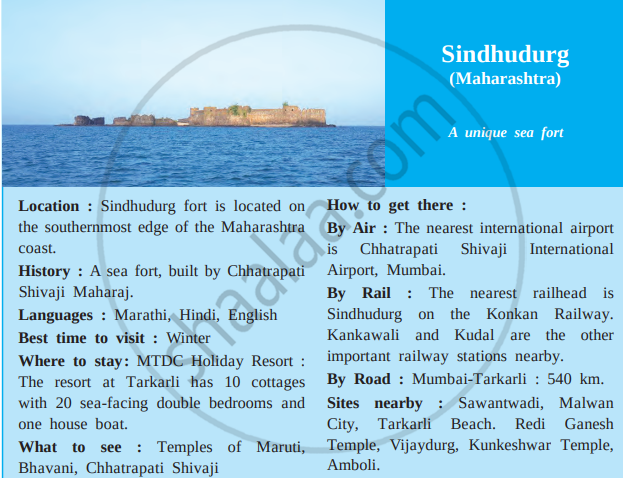

- Which places do these leaflets describe?
- What are the main points given in each leaflet?
- How can one reach Tadoba?
- Which is the best season to visit Tadoba? Why?
- List tourism-related words, e.g., tourist, booking etc.
