Advertisements
Advertisements
Question
It is found that on heating a gas its volume increases by 50% and its pressure decreases to 60% of its original value. If the original temperature was −15°C, find the temperature to which it was heated.
Advertisements
Solution
Let the original volume (V) = 1 and
the original pressure (P) = 1 and
the temperature given (T) = −15°C.
= −15 + 273
= 258 K
V1 or new volume after heating = original volume + 50% of original volume
= `1 + 1 xx 50/100`
= `1 + 1/2`
= `3/2`
P1 or decreased pressure = 60%
`1 xx 60/100 = 0.6`
T1 = to be calculated
`(PV)/T = (P_1 V_1)/T_1`
`(1 xx 1)/258 = 3/2 xx 0.6/T_1`
T1 = 232.2
T1 = 232.2 − 273
= −40.8°C
APPEARS IN
RELATED QUESTIONS
Give the assumptions of the kinetic molecular theory.
State the law which is represented by the following graph:
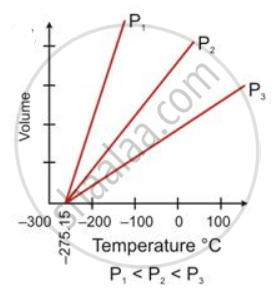
Choose the correct answer:
The volume-temperature relationship is given by
What will be the minimum pressure required to compress 500 dm3 of air at 1 bar to 200 dm3 temperature remaining constant?
Give its
(i) graphical representation,
(ii) mathematical expression
(iii) significance
Correct the following statement:
The volume of a fixed mass of a gas is directly proportional to its temperature, pressure remaining constant.
At a given temperature the pressure of a gas reduces to 75% of its initial value and the volume increases by 40% of its initial value. Find this temperature if the initial temperature was -10°C.
Fill in the blank with the correct word, from the words in option:
If the temperature of a fixed mass of a gas is kept constant and the pressure is increased, the volume correspondingly _______.
Fill in the blank with the correct word, from the words in option:
At -273°C the volume of a gas is theoretically ______.
A fixed volume of a gas occupies 760cm3 at 27°C and 70 cm of Hg. What will be its vol. at s.t.p.
