Advertisements
Advertisements
Question
An LPG cylinder can withstand a pressure of 14.9 atmospheres. The pressure gauge of the cylinder indicates 12 atmospheres at 27°C. Because of a sudden fire in the building, the temperature rises. At what temperature will the cylinder explode?
Advertisements
Solution
P = 14.9 atm
V = 28 cm3
T = ?
P1 = 12 atm
V = V1
T1 = 300 K
Using gas equation,
`("P" "V")/"T" = ("P"_1 "V"_1)/"T"_1`
`(14.9xx"V")/"T" = (12xx"V")/300`
T = 372.5 K
T = 372.5 - 273 = 99.5 °C
APPEARS IN
RELATED QUESTIONS
State the law which is represented by the following graph:
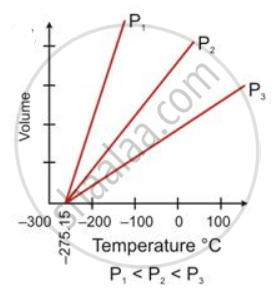
Give reasons for the following:
Mountaineers carry oxygen cylinders with them.
State the following:
Ice point in absolute temperature
Choose the correct answer:
The absolute temperature value that corresponds to 27°C is
Choose the correct answer:
The volume-temperature relationship is given by
2 liters of gas is enclosed in a vessel at a pressure of 760 mmHg. If the temperature remains constant, calculate pressure when volume changes to 4 dm3.
Calculate the final volume of a gas 'X' if the original pressure of the gas at STP is doubled and its temperature is increased three times.
2500 cm3 of hydrogen is taken at STP. The pressure of this gas is further increased by two and a half times (temperature remaining constant). What volume will hydrogen occupy now?
At a given temperature the pressure of a gas reduces to 75% of its initial value and the volume increases by 40% of its initial value. Find this temperature if the initial temperature was -10°C.
A fixed volume of a gas occupies 760cm3 at 27°C and 70 cm of Hg. What will be its vol. at s.t.p.
