Advertisements
Advertisements
प्रश्न
An LPG cylinder can withstand a pressure of 14.9 atmospheres. The pressure gauge of the cylinder indicates 12 atmospheres at 27°C. Because of a sudden fire in the building, the temperature rises. At what temperature will the cylinder explode?
Advertisements
उत्तर
P = 14.9 atm
V = 28 cm3
T = ?
P1 = 12 atm
V = V1
T1 = 300 K
Using gas equation,
`("P" "V")/"T" = ("P"_1 "V"_1)/"T"_1`
`(14.9xx"V")/"T" = (12xx"V")/300`
T = 372.5 K
T = 372.5 - 273 = 99.5 °C
APPEARS IN
संबंधित प्रश्न
State the law which is represented by the following graph:
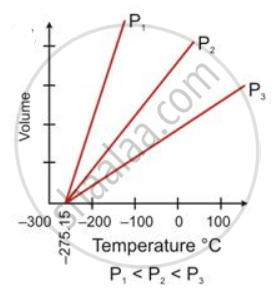
Choose the correct answer:
The volume-temperature relationship is given by
88 cm3 of nitrogen is at a pressure of 770 mm mercury. If the pressure is raised to 880 mmHg, find by how much the volume will diminish, the temperature remaining constant.
Taking the volume of hydrogen as calculated in Q.19, what change must be made in Kelvin (absolute) temperature to return the volume to 2500 cm3 (pressure remaining constant)?
Give its
(i) graphical representation,
(ii) mathematical expression
(iii) significance
A certain mass of gas occupied 850 ml at a pressure of 760 mm of Hg. On increasing the pressure it was found that the volume of the gas was 75% of its initial value. Assuming constant temperature, find the final pressure of the gas?
At a given temperature the pressure of a gas reduces to 75% of its initial value and the volume increases by 40% of its initial value. Find this temperature if the initial temperature was -10°C.
Fill in the blank with the correct word, from the words in option:
At -273°C the volume of a gas is theoretically ______.
The pressure on one mole of gas at s.t.p. is doubled and the temperature is raised to 546 K. What is the final volume of the gas ? [one mole of a gas occupies a volume of 22.4 litres at stp.]
The following question refers to one mole of chlorine gas.
What volume will it occupy at 273°C?
