Advertisements
Advertisements
प्रश्न
2 liters of gas is enclosed in a vessel at a pressure of 760 mmHg. If the temperature remains constant, calculate pressure when volume changes to 4 dm3.
Advertisements
उत्तर
V = 2 litres
P = 760 mm
V1 = 4000 m3 [1 dm3 = 4 litres]
P1= ?
`"PV"/"T" = ("P"_1 "V"_1)/"T"_1`
`(760 xx 2)/"T" = ("P"_1 xx 4)/"T"_1`
`"P"_1 = 760/2 = 380` mm
APPEARS IN
संबंधित प्रश्न
Give the assumptions of the kinetic molecular theory.
Explain Charles's law on the basis of the kinetic theory of matter.
State the law which is represented by the following graph:
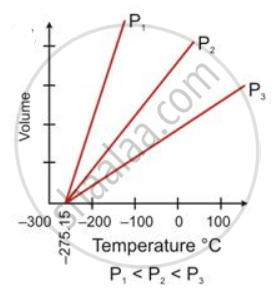
It is found that on heating a gas its volume increases by 50% and its pressure decreases to 60% of its original value. If the original temperature was −15°C, find the temperature to which it was heated.
Correct the following statement:
The volume of a fixed mass of a gas is directly proportional to its temperature, pressure remaining constant.
A certain mass of gas occupied 850 ml at a pressure of 760 mm of Hg. On increasing the pressure it was found that the volume of the gas was 75% of its initial value. Assuming constant temperature, find the final pressure of the gas?
Fill in the blank with the correct word, from the words in option:
At -273°C the volume of a gas is theoretically ______.
A fixed volume of a gas occupies 760cm3 at 27°C and 70 cm of Hg. What will be its vol. at s.t.p.
According to Charles’s law, at constant pressure, the temperature is inversely proportional to volume.
The following question refers to one mole of chlorine gas.
What volume will it occupy at 273°C?
