Advertisements
Advertisements
प्रश्न
At constant temperature, the effect of change of pressure on the volume of a gas was as given below:
|
Pressure in atmosphere |
Volume in liters |
|
0.20 |
112 |
|
0.25 |
89.2 |
|
0.40 |
56.25 |
|
0.60 |
37.40 |
|
0.80 |
28.10 |
|
1.00 |
22.4 |
(a) Plot the following graphs
- P vs V
- P vs 1/V
- PV vs P
Interpret each graph in terms of the law.
(b) Assuming that the pressure values given above are correct, find the correct measurement of the volume.
Advertisements
उत्तर
|
P/atm |
V/dm3 |
1/V |
PV |
|
0.2 |
112 |
0.009 |
22.4 |
|
0.25 |
89.2 |
0.011 |
22.4 |
|
0.4 |
56.25 |
0.018 |
22.4 |
|
0.6 |
37.4 |
0.027 |
22.4 |
|
0.8 |
28.1 |
0.036 |
22.4 |
|
1 |
22.4 |
0.045 |
22.4 |
(a) Plot the following graphs:
1. P vs. V:
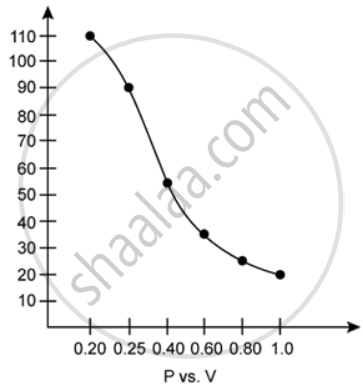
At constant temperature, P is inversely proportional to V. Thus, the plot of V versus P will be a rectangular hyperbola.
2. P vs. 1/V:
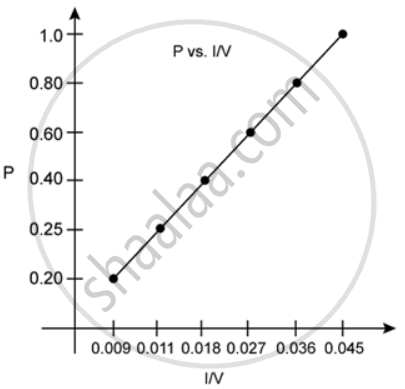
According to Boyle's law, at a constant temperature, the pressure of a fixed amount of gas varies inversely to its volume. The graph of pressure versus 1/V shows a positive slope.
3. PV vs. P:

According to Boyle's law, the product of pressure and volume is constant at a constant temperature. The graph of PV versus P is constant which indicates that the given gas obeys Boyle's law.
(b) The correct measurements of the volume are given below:
|
P/atm |
V/dm3 |
|
0.2 |
112 |
|
0.25 |
89.6 |
|
0.4 |
56 |
|
0.6 |
37.33 |
|
0.8 |
28 |
|
1 |
22.4 |
APPEARS IN
संबंधित प्रश्न
Explain Boyle's Law on the basis of the kinetic theory of matter.
Give reasons for the following:
Inflating a balloon seems to violate Boyle's law.
Choose the correct answer:
If the pressure is doubled for a fixed mass of a gas, its volume will become
A certain mass of a gas occupies 2 litres at 27°C and 100 Pa. Find the temperature when volume and pressure become half of their initial values.
Correct the following statement:
The volume of a gas is inversely proportional to its pressure at a constant temperature.
50 cm3 of hydrogen is collected over water at 17°C and 750 mmHg pressure. Calculate the volume of a dry gas at STP. The water vapour pressure at 17°C is 14 mmHg.
A gas cylinder having a capacity of 20 litres contains a gas at 100 atmos. How many flasks of 200 cm3 capacity can be filled from it at 1 atmos. pressure if the temperature remains constant?
Name or state the following:
The law which studies the relationship between pressure of a gas and the volume occupied by it at constant temperature.
According to Boyle’s law, the shape of the graph between pressure and reciprocal of volume is _______.
State Boyle’s law
