Advertisements
Advertisements
प्रश्न
State Charles's law.
Advertisements
उत्तर
Charles's Law
At constant pressure, the volume of a given mass of a dry gas increases or decreases by 1/273rd of its original volume at 0°C for each degree centigrade rise or fall in temperature.
V ∝ T (at constant pressure)
At temperature T1 (K) and volume V1 (cm3):
`"V"_1 ∝ "T"_1 "or" "V"_1/"T"_1 = "K"` = constant...(i)
At temperature T2 (K) and volume V2 (cm3):
`"V"_2 ∝ "T"_2 "or" "V"_2/"T"_2 = "K"` = constant….(ii)
From (i) and (ii),
`"V"_1/"T"_1 = "V"_2/"T"_2` = constant
For Temperature = Conversion from Celsius to Kelvin
1 K = °C + 273
Example:
20°C = 20 + 273 = 293 K
APPEARS IN
संबंधित प्रश्न
Give the assumptions of the kinetic molecular theory.
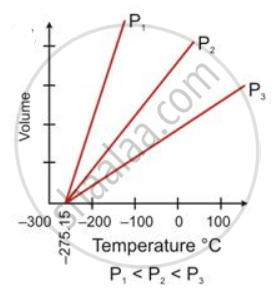
State the law which is represented by the following graph:
Give reasons for the following:
Mountaineers carry oxygen cylinders with them.
How did Charles's law lead to the concept of an absolute scale of temperature?
Choose the correct answer:
The absolute temperature value that corresponds to 27°C is
What will be the minimum pressure required to compress 500 dm3 of air at 1 bar to 200 dm3 temperature remaining constant?
Calculate the final volume of a gas 'X' if the original pressure of the gas at STP is doubled and its temperature is increased three times.
Fill in the blank with the correct word, from the words in option:
If the temperature of a fixed mass of a gas is kept constant and the pressure is increased, the volume correspondingly _______.
The pressure on one mole of gas at s.t.p. is doubled and the temperature is raised to 546 K. What is the final volume of the gas ? [one mole of a gas occupies a volume of 22.4 litres at stp.]
According to Charles’s law, at constant pressure, the temperature is inversely proportional to volume.
