Advertisements
Advertisements
Question
A certain mass of gas occupied 850 ml at a pressure of 760 mm of Hg. On increasing the pressure it was found that the volume of the gas was 75% of its initial value. Assuming constant temperature, find the final pressure of the gas?
Advertisements
Solution
V1 = 850 ml
V2 = `850 xx 75/100 = (850 xx 3)/4` ml
P1 = 760 mm of Hg
P2 = ?
At constant temperature P1V1 = P2V2
∴ P2 = `("P"_1"V"_1)/"V"_2`
`= (760 xx 850 xx 4)/(850 xx 3)`
P2 = `3040/3 = 1013.33` mm of Hg
APPEARS IN
RELATED QUESTIONS
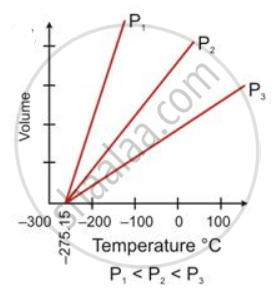
State the law which is represented by the following graph:
Choose the correct answer:
The absolute temperature value that corresponds to 27°C is
2 liters of gas is enclosed in a vessel at a pressure of 760 mmHg. If the temperature remains constant, calculate pressure when volume changes to 4 dm3.
Calculate the final volume of a gas 'X' if the original pressure of the gas at STP is doubled and its temperature is increased three times.
An LPG cylinder can withstand a pressure of 14.9 atmospheres. The pressure gauge of the cylinder indicates 12 atmospheres at 27°C. Because of a sudden fire in the building, the temperature rises. At what temperature will the cylinder explode?
Give its
(i) graphical representation,
(ii) mathematical expression
(iii) significance
Correct the following statement:
The volume of a fixed mass of a gas is directly proportional to its temperature, pressure remaining constant.
At a given temperature the pressure of a gas reduces to 75% of its initial value and the volume increases by 40% of its initial value. Find this temperature if the initial temperature was -10°C.
Fill in the blank with the correct word, from the words in option:
At -273°C the volume of a gas is theoretically ______.
The pressure on one mole of gas at s.t.p. is doubled and the temperature is raised to 546 K. What is the final volume of the gas ? [one mole of a gas occupies a volume of 22.4 litres at stp.]
