Advertisements
Advertisements
Question
Is the given relation a function? Give reasons for your answer.
g = `"n", 1/"n" |"n"` is a positive integer
Advertisements
Solution
g = `"n", 1/"n" |"n"` is a positive integer
Therefore, the element n is a positive integer and the corresponding `1/"n"` will be a unique and distinct number.
Therefore, every element in the domain has unique image.
A relation is said to be function if every element of one set has one and only one image in other set.
Hence, g is a function.
APPEARS IN
RELATED QUESTIONS
A = {1, 2, 3, 5} and B = {4, 6, 9}. Define a relation R from A to B by R = {(x, y): the difference between x and y is odd; x ∈ A, y ∈ B}. Write R in roster form.
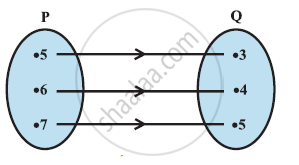
The given figure shows a relationship between the sets P and Q. Write this relation
- in set-builder form.
- in roster form.
What is its domain and range?
Let A = {x, y, z} and B = {1, 2}. Find the number of relations from A to B.
Let R be the relation on Z defined by R = {(a, b): a, b ∈ Z, a – b is an integer}. Find the domain and range of R.
The relation f is defined by f(x) = `{(x^2,0<=x<=3),(3x,3<=x<=10):}`
The relation g is defined by g(x) = `{(x^2, 0 <= x <= 2),(3x,2<= x <= 10):}`
Show that f is a function and g is not a function.
Let A = {1, 2, 3, 4}, B = {1, 5, 9, 11, 15, 16} and f = {(1, 5), (2, 9), (3, 1), (4, 5), (2, 11)}. Is the following true?
f is a relation from A to B
Justify your answer in case.
Find the inverse relation R−1 in each of the cases:
(ii) R = {(x, y), : x, y ∈ N, x + 2y = 8}
Determine the domain and range of the relation R defined by
(ii) R = {(x, x3) : x is a prime number less than 10}
Determine the domain and range of the relations:
(i) R = {(a, b) : a ∈ N, a < 5, b = 4}
Let A = [1, 2, 3, ......., 14]. Define a relation on a set A by
R = {(x, y) : 3x − y = 0, where x, y ∈ A}.
Depict this relationship using an arrow diagram. Write down its domain, co-domain and range.
The adjacent figure shows a relationship between the sets P and Q. Write this relation in (i) set builder form (ii) roster form. What is its domain and range?
If R is a relation from set A = (11, 12, 13) to set B = (8, 10, 12) defined by y = x − 3, then write R−1.
Let R = [(x, y) : x, y ∈ Z, y = 2x − 4]. If (a, -2) and (4, b2) ∈ R, then write the values of a and b.
If R is a relation from a finite set A having m elements of a finite set B having n elements, then the number of relations from A to B is
If `(x + 1/3, y/3 - 1) = (1/2, 3/2)`, find x and y
Let A = {1, 2, 3, 4), B = {4, 5, 6}, C = {5, 6}. Verify, A × (B ∪ C) = (A × B) ∪ (A × C)
Write the relation in the Roster Form. State its domain and range
R3 = {(x, y)/y = 3x, y∈ {3, 6, 9, 12}, x∈ {1, 2, 3}
Select the correct answer from given alternative
If A = {a, b, c} The total no. of distinct relations in A × A is
Answer the following:
If A = {1, 2, 3}, B = {4, 5, 6} check if the following are relations from A to B. Also write its domain and range
R4 = {(4, 2), (2, 6), (5, 1), (2, 4)}
Answer the following:
Find R : A → A when A = {1, 2, 3, 4} such that R = {(a, b)/|a − b| ≥ 0}
Answer the following:
Show that the following is an equivalence relation
R in A = {x ∈ N/x ≤ 10} given by R = {(a, b)/a = b}
Let A = {1, 2, 3, 7} and B = {3, 0, –1, 7}, the following is relation from A to B?
R3 = {(2, –1), (7, 7), (1, 3)}
Represent the given relation by
(a) an arrow diagram
(b) a graph and
(c) a set in roster form, wherever possible
{(x, y) | x = 2y, x ∈ {2, 3, 4, 5}, y ∈ {1, 2, 3, 4}
Multiple Choice Question :
If there are 1024 relation from a set A = {1, 2, 3, 4, 5} to a set B, then the number of elements in B is
Discuss the following relation for reflexivity, symmetricity and transitivity:
The relation R defined on the set of all positive integers by “mRn if m divides n”
Let A = {a, b, c} and R = {(a, a), (b, b), (a, c)}. Write down the minimum number of ordered pairs to be included to R to make it symmetric
Let P be the set of all triangles in a plane and R be the relation defined on P as aRb if a is similar to b. Prove that R is an equivalence relation
On the set of natural numbers let R be the relation defined by aRb if 2a + 3b = 30. Write down the relation by listing all the pairs. Check whether it is symmetric
On the set of natural numbers let R be the relation defined by aRb if a + b ≤ 6. Write down the relation by listing all the pairs. Check whether it is transitive
On the set of natural numbers let R be the relation defined by aRb if a + b ≤ 6. Write down the relation by listing all the pairs. Check whether it is equivalence
Let A = {a, b, c}. What is the equivalence relation of smallest cardinality on A? What is the equivalence relation of largest cardinality on A?
Choose the correct alternative:
Let R be the universal relation on a set X with more than one element. Then R is
If R3 = {(x, x) | x is a real number} is a relation. Then find domain and range of R3.
If R = {(x, y): x, y ∈ Z, x2 + 3y2 ≤ 8} is a relation on the set of integers Z, then the domain of R–1 is ______.
Let S = {x ∈ R : x ≥ 0 and `2|sqrt(x) - 3| + sqrt(x)(sqrt(x) - 6) + 6 = 0}`. Then S ______.
Let \(A=\{1,2,3,4,5\}\), \(B=\{1,4,5\}\), and \((x,y)\in R\) imply \(x
Let \(A=\{1,2,3\}\), \(B=\{3,4\}\), and \(C=\{4,5,6\}\). What is \((A\times B)\cap(A\times C)\)?
Given \(A=\{1,2,3,4,5\}\), which relation consists of ordered pairs satisfying \(x+y=5\), where \(x,y\in A\)?
