Advertisements
Advertisements
Question
Represent the given relation by
(a) an arrow diagram
(b) a graph and
(c) a set in roster form, wherever possible
{(x, y) | y = x + 3, x, y are natural numbers < 10}
Advertisements
Solution
x = {1, 2, 3, 4, 5, 6, 7, 8, 9}
y = {1, 2, 3, 4, 5, 6, 7, 8, 9}
y = x + 3
when x = 1 ⇒ y = 1 + 3 = 4
when x = 2 ⇒ y = 2 + 3 = 5
when x = 3 ⇒ y = 3 + 3 = 6
when x = 4 ⇒ y = 4 + 3 = 7
when x = 5 ⇒ y = 5 + 3 = 8
when x = 6 ⇒ y = 6 + 3 = 9
when x = 7 ⇒ y = 7 + 3 = 10
when x = 8 ⇒ y = 8 + 3 = 11
when x = 9 ⇒ y = 9 + 3 = 12
R = {(1, 4) (2, 5) (3, 6) (4, 7) (5, 8) (6, 9)}
(a) Arrow diagram
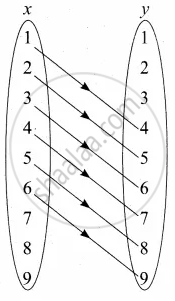
(b) Graph

(c) Roster form: R = {(1, 4) (2, 5) (3, 6) (4, 7) (5, 8) (6, 9)}
APPEARS IN
RELATED QUESTIONS
Let A = [1, 2, 3, 4, 5, 6]. Let R be a relation on A defined by {(a, b) : a, b ∈ A, b is exactly divisible by a}
(i) Writer R in roster form
(ii) Find the domain of R
(ii) Find the range of R.
Express {(x, y) / x2 + y2 = 100, where x, y ∈ W} as a set of ordered pairs
Answer the following:
Show that the relation R in the set A = {1, 2, 3, 4, 5} Given by R = {(a, b)/|a − b| is even} is an equivalence relation.
Let A = {1, 2, 3, 7} and B = {3, 0, –1, 7}, the following is relation from A to B?
R2 = {(–1, 1)}
A company has four categories of employees given by Assistants (A), Clerks (C), Managers (M), and an Executive Officer (E). The company provides ₹ 10,000, ₹ 25,000, ₹ 50,000, and ₹ 1,00,000 as salaries to the people who work in the categories A, C, M, and E respectively. If A1, A2, A3, A4, and A5 were Assistants; C1, C2, C3, C4 were Clerks; M1, M2, M3 were managers and E1, E2 was Executive officers and if the relation R is defined by xRy, where x is the salary given to person y, express the relation R through an ordered pair and an arrow diagram
In the set Z of integers, define mRn if m − n is divisible by 7. Prove that R is an equivalence relation
Is the given relation a function? Give reasons for your answer.
f = {(x, x) | x is a real number}
Let f: R `rightarrow` R be defined by f(x) = `x/(1 + x^2), x ∈ R`. Then the range of f is ______.
Which statement is true in general for ordered pairs?
For a relation \(R\), the range is the set of all:
