Advertisements
Advertisements
Question
In a series LCR circuit, the phase difference between the voltage and the current is 45°. Then the power factor will be ______.
Options
0.607
0.707
0.808
1
Advertisements
Solution
In a series LCR circuit, the phase difference between the voltage and the current is 45°. Then the power factor will be 0.707.
Explanation:
Let, Inductance = L
Conductance = C
Resistance = R
Frequency = f
Phase Difference between current and voltage = `phi`
As, in LCR circuit,
Power Factor = `cos phi`
Substitute the given values from,
`phi = 45^circ`
`cos 45^circ = 1/sqrt(2)`
Therefore, Power factor = 0.707
APPEARS IN
RELATED QUESTIONS
Obtain an expression for average power dissipated in a purely resistive A.C. circult.
A resistor of 500 Ω and an inductance of 0.5 H are in series with an AC source which is given by V = `100 sqrt2` sin (1000 t). The power factor of the combination is ______.
What is wattles current?
Prove that an ideal capacitor in an AC circuit does not dissipate power
An AC source generating a voltage e = e0sinωt is connected to a capacitor of capacitance C. Find the expression for the current i flowing through it. Plot a graph of e and i versus ωt.
A light bulb is rated 100W for 220 V AC supply of 50 Hz. Calculate
- resistance of the bulb.
- the rms current through the bulb
An AC circuit consists of only an inductor of inductance 2 H. If the current is represented by a sine wave of amplitude 0.25 A and frequency 60 Hz, calculate the effective potential difference across the inductor. (π = 3.142)
A 100 μF capacitor is charged with a 50 V source supply. Then source supply is removed and the capacitor is connected across an inductance, as a result of which 5A current flows through the inductance. Calculate the value of the inductance.
What is meant by wattles current?
An alternating e.m.f. of 0.2 V is applied across an LCR series circuit having R = 4 `Omega`, C = 80 µF and L = 200 mH. At resonance the voltage drop across the inductor is ____________.
In series 'LR' circuit and in series 'RC' circuit, same current is flowing. If the frequency of e.m.f. of a.c. is increased for both the circuits, the impedance will ____________.
An e.m.f. E = E0 sin `omega`t is applied to a circuit containing 'L' and 'R' in series. If XL = R, then the power dissipated in the circuit is ____________.
The voltage gain of a CE amplifier is 50. A sinusoidal ac of amplitude 10 mV is applied as a signal. The output of the amplifier will be ______.
In a series LR circuit XL = R and power factor of the circuit is P1. When capacitor with capacitance C such that XL= XC is put in series, the power factor becomes P2. The ratio `"P"_1/"P"_2` is ______.
In series LCR circuit R = 18 Ω and impedance is 33 Ω An rms voltage 220V is applied across the circuit. The ture power consumed in AC circuit is ______.
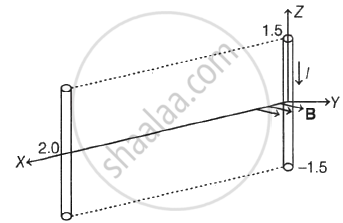
A conductor lies along the Z-axis at −1.5 ≤ Z ≤ 1.5 m and carries a fixed current of 10.0 A in −az direction as (see figure). For a field B = 3.0 × 10⁻⁴`"e"^(−0.2"x")`ay T, find the power required to move the conductor at constant speed to x = 2.0 m, y = 0 in 5 × 10⁻³ s. Assume parallel motion along the x-axis.
What is the average value of alternating current over a complete cycle?
The power factor of LCR circuit is ______.
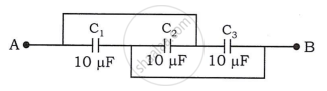
The effective capacitor between A and B in the following circuit is ______.
Where is the power dissipated in an alternating current circuit?
In an a.c. circuit, voltage and current are given by:
V = 100 sin (100 t) V and I = `100 sin (100 t + pi/3)` mA respectively.
The average power dissipated in one cycle is:
What is the power in a DC circuit?
What is the average power when \[\cos\phi=0\]?
In the instantaneous-power expression, what does \[V_m\] represent?
In the instantaneous-power expression, what does \[I_m\] represent?
What does \[\omega\] represent in the instantaneous-power expression?
What does \[\phi\] represent in the voltage and current expressions for a series LCR circuit?
In a circuit where current lags voltage, which ratio gives the power factor?
Which component of current is perpendicular to the applied voltage \[V\]?
Why is \[I_p\] known as the power component?
After the lagging and leading wattless currents cancel, what is the effective power?
For a series LCR circuit with \[R=3\,\Omega\], \[L=25.48\,\mathrm{mH}\], \[C=796\,\mu\mathrm{F}\], and frequency \[50\,\mathrm{Hz}\], what is the inductive reactance?
For a series LCR circuit with \[C=796\,\mu\mathrm{F}\] and frequency \[50\,\mathrm{Hz}\], what is the capacitive reactance?
What phase difference is obtained from \[\phi=\tan^{-1}((X_C-X_L)/R)\] when \[X_C=4\,\Omega\], \[X_L=8\,\Omega\], and \[R=3\,\Omega\]?
What is the resonance frequency corresponding to \[\omega_0=222.1\,\mathrm{rad/s}\]?
On what principle does a metal detector doorway work?
What circuit arrangement does a person walk through in a metal detector doorway?
