Advertisements
Advertisements
Question
What is meant by wattles current?
Advertisements
Solution
The component of current (IRMS sin φ), which has a phase angle of \[\frac{\pi}{2}\] with the voltage is called reactive component. The power consumed is zero. So that it is also known as ‘Wattless’ current.
APPEARS IN
RELATED QUESTIONS
Prove that an ideal capacitor in an AC circuit does not dissipate power
A 25 μF capacitor, a 0.10 H inductor, and a 25Ω resistor are connected in series with an AC source whose emf is given by e = 310 sin 314 t (volt). What is the frequency, reactance, impedance, current, and phase angle of the circuit?
An e.m.f. E = E0 sin `omega`t is applied to a circuit containing 'L' and 'R' in series. If XL = R, then the power dissipated in the circuit is ____________.
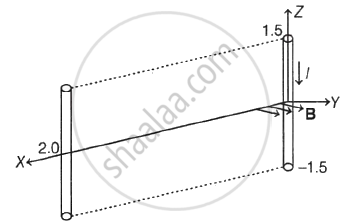
A conductor lies along the Z-axis at −1.5 ≤ Z ≤ 1.5 m and carries a fixed current of 10.0 A in −az direction as (see figure). For a field B = 3.0 × 10⁻⁴`"e"^(−0.2"x")`ay T, find the power required to move the conductor at constant speed to x = 2.0 m, y = 0 in 5 × 10⁻³ s. Assume parallel motion along the x-axis.
What does \[\omega\] represent in the instantaneous-power expression?
What does \[t\] represent in the instantaneous-power expression?
Which component of current is perpendicular to the applied voltage \[V\]?
After the lagging and leading wattless currents cancel, what is the effective power?
What phase difference is obtained from \[\phi=\tan^{-1}((X_C-X_L)/R)\] when \[X_C=4\,\Omega\], \[X_L=8\,\Omega\], and \[R=3\,\Omega\]?
What circuit arrangement does a person walk through in a metal detector doorway?
