Advertisements
Advertisements
Question
In a reaction between A and B, the initial rate of reaction (r0) was measured for different initial concentrations of A and B as given below:
| A/mol L−1 | 0.20 | 0.20 | 0.40 |
| B/mol L−1 | 0.30 | 0.10 | 0.05 |
| r0/mol L−1 s−1 | 5.07 × 10⁻⁵ | 5.07 × 10⁻⁵ | 1.43 × 10⁻⁴ |
What is the order of the reaction with respect to A and B?
Advertisements
Solution
Suppose the order of the reaction with respect to A is m and with respect to B is n.
∴ Rate (r0) = k[A]m [B]n
For the given data, we have,
Rate (r1) = 5.07 × 10−5
= k (0.20)m × (0.30)n ...(i)
Rate (r2) = 5.07 × 10−5
= k (0.20)m × (0.10)n ...(ii)
Rate (r3) = 1.43 × 10−4
= k (0.40)m × (0.05)n ...(iii)
Dividing eq. (i) by eq. (ii), we have,
`(5.07 xx 10^-5)/(5.07 xx 10^-5) = (k (0.20)^m xx (0.30)^n)/(k (0.20)^m xx (0.10)^n)`
⇒ 1 = (3)n
⇒ n = 0
Dividing eq. (iii) by eq. (ii) and putting the value of n, we get,
`(1.43 xx 10^-4)/(5.07 xx 10^-5) = (k (0.40)^m xx (0.05)^0)/(k (0.20)^m xx (0.10)^0)`
⇒ `(1.43 xx 10^-4)/(5.07 xx 10^-5)` = 2m
⇒ (2)m = 2.82
⇒ m log10 2 = log10 2.82 = 0.45
⇒ m = `0.45/(log_10 2)`
= `0.45/0.3010`
= 1.49
= 1.50
Hence, the order with respect to A is 1.5, and the order with respect to B is 0.
APPEARS IN
RELATED QUESTIONS
For a reaction A + B ⟶ P, the rate is given by
Rate = k [A] [B]2
How is the rate of reaction affected if the concentration of B is doubled?
For a reaction A + B ⟶ P, the rate is given by
Rate = k [A] [B]2
What is the overall order of reaction if A is present in large excess?
For a chemical reaction R → P, the variation in the concentration (R) vs. time (t) plot is given as:
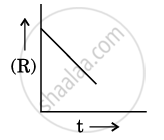
(i) Predict the order of the reaction.
(ii) What is the slope of the curve?
(iii) Write the unit of rate constant for this reaction.
The following data were obtained during the first order thermal decomposition of SO2Cl2 at a constant volume :
SO2Cl2 (g) → SO2 (g) + Cl2 (g)
| Experiment | Time/s–1 | Total pressure/atm |
| 1 | 0 | 0.4 |
| 2 | 100 | 0.7 |
Calculate the rate constant.
(Given : log 4 = 0.6021, log 2 = 0.3010)
For a reaction R ---> P, half-life (t1/2) is observed to be independent of the initial concentration of reactants. What is the order of reaction?
The decomposition of N2O5(g) at 320K according to the following equation follows first order reaction:
`N_2O_(5(g))->2NO_(2(g))+1/2O_(2(g))`
The initial concentration of N2O5(g) is 1.24 x 10⁻² mol. L-1 and after 60 minutes 0.20x10⁻² molL-1. Calculate the rate constant of the reaction at 320K.
Rate of reaction for the combustion of propane is equal to:
\[\ce{C3H8_{(g)} + 5O2_{(g)} -> 3CO2_{(g)} + 4H2O_{(g)}}\]
What is the order of a reaction which has a rate expression; Rate = `"k"["A"]^(3/2)["B"]^1`?
Which of the following statement is true for order of a reaction?
The value of rate constant of a pseudo first order reaction ______.
In any unimolecular reaction:
(i) only one reacting species is involved in the rate determining step.
(ii) the order and the molecularity of slowest step are equal to one.
(iii) the molecularity of the reaction is one and order is zero.
(iv) both molecularity and order of the reaction are one.
In a reaction if the concentration of reactant A is tripled, the rate of reaction becomes twenty seven times. What is the order of the reaction?
Assertion: Order and molecularity are same.
Reason: Order is determined experimentally and molecularity is the sum of the stoichiometric coefficient of rate determining elementary step.
A catalyst in a reaction changes which of the following?
If the 0.05 molar solution of m+ is replaced by a 0.0025 molar m+ solution, then the magnitude of the cell potential would be
The number of molecules of the reactants taking part in a single step of the reaction is indicative of ______.
For the reaction, \[\ce{A +2B → AB2}\], the order w.r.t. reactant A is 2 and w.r.t. reactant B. What will be change in rate of reaction if the concentration of A is doubled and B is halved?
For a chemical reaction starting with some initial concentration of reactant At as a function of time (t) is given by the equation,
`1/("A"_"t"^4) = 2 + 1.5 xx 10^-3` t
The rate of disappearance of [A] is ____ × 10-2 M/sec when [A] = 2 M.
[Given: [At] in M and t in sec.]
[Express your answer in terms of 10-2 M /s]
[Round off your answer if required]
Assertion (A): Order of reaction is applicable to elementary as well as complex reactions.
Reason (R): For a complex reaction, molecularity has no meaning.
