Advertisements
Advertisements
Question
If tan θ = 3 and θ lies in third quadrant, then the value of sin θ ______.
Options
`1/sqrt(10)`
`- 1/sqrt(10)`
`(-3)/sqrt(10)`
`3/sqrt(10)`
Advertisements
Solution
If tanθ = 3 and θ lies in the third quadrant, then the value of sin θ `underline((-3)/sqrt(10))`.
Explanation:
tanθ = 3, θ lies in the third quadrant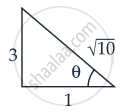
∴ sinθ = `(-3)/sqrt(10)` where θ lies in third quadrant.
APPEARS IN
RELATED QUESTIONS
Prove that `2 sin^2 pi/6 + cosec^2 (7pi)/6 cos^2 pi/3 = 3/2`
Find the value of: sin 75°
Find the value of: tan 15°
Prove the following:
cot 4x (sin 5x + sin 3x) = cot x (sin 5x – sin 3x)
Prove the following:
`(sin x - sin 3x)/(sin^2 x - cos^2 x) = 2sin x`
Prove the following:
cot x cot 2x – cot 2x cot 3x – cot 3x cot x = 1
Prove that: `(cos x - cosy)^2 + (sin x - sin y)^2 = 4 sin^2 (x - y)/2`
If \[\sin A = \frac{4}{5}\] and \[\cos B = \frac{5}{13}\], where 0 < A, \[B < \frac{\pi}{2}\], find the value of the following:
If \[\sin A = \frac{4}{5}\] and \[\cos B = \frac{5}{13}\], where 0 < A, \[B < \frac{\pi}{2}\], find the value of the following:
cos (A + B)
If \[\sin A = \frac{4}{5}\] and \[\cos B = \frac{5}{13}\], where 0 < A, \[B < \frac{\pi}{2}\], find the value of the following:
sin (A − B)
If \[\sin A = \frac{12}{13}\text{ and } \sin B = \frac{4}{5}\], where \[\frac{\pi}{2}\] < A < π and 0 < B < \[\frac{\pi}{2}\], find the following:
cos (A + B)
If \[\sin A = \frac{3}{5}, \cos B = - \frac{12}{13}\], where A and B both lie in second quadrant, find the value of sin (A + B).
If \[\cos A = - \frac{12}{13}\text{ and }\cot B = \frac{24}{7}\], where A lies in the second quadrant and B in the third quadrant, find the values of the following:
tan (A + B)
Prove that:
\[\frac{7\pi}{12} + \cos\frac{\pi}{12} = \sin\frac{5\pi}{12} - \sin\frac{\pi}{12}\]
Prove that
\[\frac{\tan A + \tan B}{\tan A - \tan B} = \frac{\sin \left( A + B \right)}{\sin \left( A - B \right)}\]
Prove that:
Prove that:
Prove that:
sin2 (n + 1) A − sin2 nA = sin (2n + 1) A sin A.
Prove that:
cos2 A + cos2 B − 2 cos A cos B cos (A + B) = sin2 (A + B)
Prove that:
tan 13x − tan 9x − tan 4x = tan 13x tan 9x tan 4x
Prove that:
\[\frac{\tan^2 2x - \tan^2 x}{1 - \tan^2 2x \tan^2 x} = \tan 3x \tan x\]
If tan A = x tan B, prove that
\[\frac{\sin \left( A - B \right)}{\sin \left( A + B \right)} = \frac{x - 1}{x + 1}\]
If sin (α + β) = 1 and sin (α − β) \[= \frac{1}{2}\], where 0 ≤ α, \[\beta \leq \frac{\pi}{2}\], then find the values of tan (α + 2β) and tan (2α + β).
If sin α + sin β = a and cos α + cos β = b, show that
If tan α = x +1, tan β = x − 1, show that 2 cot (α − β) = x2.
Write the maximum and minimum values of 3 cos x + 4 sin x + 5.
If tan (A + B) = p and tan (A − B) = q, then write the value of tan 2B.
If \[\frac{\cos \left( x - y \right)}{\cos \left( x + y \right)} = \frac{m}{n}\] then write the value of tan x tan y.
If 3 sin x + 4 cos x = 5, then 4 sin x − 3 cos x =
If \[\cos P = \frac{1}{7}\text{ and }\cos Q = \frac{13}{14}\], where P and Q both are acute angles. Then, the value of P − Q is
The value of cos (36° − A) cos (36° + A) + cos (54° + A) cos (54° − A) is
If cos (A − B) \[= \frac{3}{5}\] and tan A tan B = 2, then
If `(sin(x + y))/(sin(x - y)) = (a + b)/(a - b)`, then show that `tanx/tany = a/b` [Hint: Use Componendo and Dividendo].
If sinθ + cosθ = 1, then find the general value of θ.
The value of tan 75° - cot 75° is equal to ______.
If tanα = `m/(m + 1)`, tanβ = `1/(2m + 1)`, then α + β is equal to ______.
The value of sin(45° + θ) - cos(45° - θ) is ______.
If sinx + cosx = a, then sin6x + cos6x = ______.
