Advertisements
Advertisements
प्रश्न
If tan θ = 3 and θ lies in third quadrant, then the value of sin θ ______.
विकल्प
`1/sqrt(10)`
`- 1/sqrt(10)`
`(-3)/sqrt(10)`
`3/sqrt(10)`
Advertisements
उत्तर
If tanθ = 3 and θ lies in the third quadrant, then the value of sin θ `underline((-3)/sqrt(10))`.
Explanation:
tanθ = 3, θ lies in the third quadrant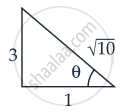
∴ sinθ = `(-3)/sqrt(10)` where θ lies in third quadrant.
APPEARS IN
संबंधित प्रश्न
Prove that `2 sin^2 pi/6 + cosec^2 (7pi)/6 cos^2 pi/3 = 3/2`
Prove the following:
`(cos (pi + x) cos (-x))/(sin(pi - x) cos (pi/2 + x)) = cot^2 x`
Prove the following:
`(cos9x - cos5x)/(sin17x - sin 3x) = - (sin2x)/(cos 10x)`
Prove the following:
`(sin 5x + sin 3x)/(cos 5x + cos 3x) = tan 4x`
If \[\sin A = \frac{4}{5}\] and \[\cos B = \frac{5}{13}\], where 0 < A, \[B < \frac{\pi}{2}\], find the value of the following:
cos (A + B)
If \[\sin A = \frac{4}{5}\] and \[\cos B = \frac{5}{13}\], where 0 < A, \[B < \frac{\pi}{2}\], find the value of the following:
cos (A − B)
If \[\sin A = \frac{1}{2}, \cos B = \frac{\sqrt{3}}{2}\], where \[\frac{\pi}{2}\] < A < π and 0 < B < \[\frac{\pi}{2}\], find the following:
tan (A - B)
Evaluate the following:
sin 78° cos 18° − cos 78° sin 18°
Prove that:
\[\tan\frac{\pi}{12} + \tan\frac{\pi}{6} + \tan\frac{\pi}{12}\tan\frac{\pi}{6} = 1\]
If tan A + tan B = a and cot A + cot B = b, prove that cot (A + B) \[\frac{1}{a} - \frac{1}{b}\].
If tan x + \[\tan \left( x + \frac{\pi}{3} \right) + \tan \left( x + \frac{2\pi}{3} \right) = 3\], then prove that \[\frac{3 \tan x - \tan^3 x}{1 - 3 \tan^2 x} = 1\].
If sin (α + β) = 1 and sin (α − β) \[= \frac{1}{2}\], where 0 ≤ α, \[\beta \leq \frac{\pi}{2}\], then find the values of tan (α + 2β) and tan (2α + β).
If sin α sin β − cos α cos β + 1 = 0, prove that 1 + cot α tan β = 0.
If angle \[\theta\] is divided into two parts such that the tangents of one part is \[\lambda\] times the tangent of other, and \[\phi\] is their difference, then show that\[\sin\theta = \frac{\lambda + 1}{\lambda - 1}\sin\phi\]
If \[\tan\theta = \frac{\sin\alpha - \cos\alpha}{\sin\alpha + \cos\alpha}\] , then show that \[\sin\alpha + \cos\alpha = \sqrt{2}\cos\theta\].
Find the maximum and minimum values of each of the following trigonometrical expression:
12 cos x + 5 sin x + 4
Reduce each of the following expressions to the sine and cosine of a single expression:
\[\sqrt{3} \sin x - \cos x\]
If x cos θ = y cos \[\left( \theta + \frac{2\pi}{3} \right) = z \cos \left( \theta + \frac{4\pi}{3} \right)\]then write the value of \[\frac{1}{x} + \frac{1}{y} + \frac{1}{z}\]
Write the maximum value of 12 sin x − 9 sin2 x.
If a = b \[\cos \frac{2\pi}{3} = c \cos\frac{4\pi}{3}\] then write the value of ab + bc + ca.
If sin α − sin β = a and cos α + cos β = b, then write the value of cos (α + β).
If A + B + C = π, then sec A (cos B cos C − sin B sin C) is equal to
If 3 sin x + 4 cos x = 5, then 4 sin x − 3 cos x =
If cot (α + β) = 0, sin (α + 2β) is equal to
If tan θ1 tan θ2 = k, then \[\frac{\cos \left( \theta_1 - \theta_2 \right)}{\cos \left( \theta_1 + \theta_2 \right)} =\]
The value of cos (36° − A) cos (36° + A) + cos (54° + A) cos (54° − A) is
The maximum value of \[\sin^2 \left( \frac{2\pi}{3} + x \right) + \sin^2 \left( \frac{2\pi}{3} - x \right)\] is
Express the following as the sum or difference of sines and cosines:
2 sin 3x cos x
Show that 2 sin2β + 4 cos (α + β) sin α sin β + cos 2(α + β) = cos 2α
If 3 tan (θ – 15°) = tan (θ + 15°), 0° < θ < 90°, then θ = ______.
Match each item given under column C1 to its correct answer given under column C2.
| C1 | C2 |
| (a) `(1 - cosx)/sinx` | (i) `cot^2 x/2` |
| (b) `(1 + cosx)/(1 - cosx)` | (ii) `cot x/2` |
| (c) `(1 + cosx)/sinx` | (iii) `|cos x + sin x|` |
| (d) `sqrt(1 + sin 2x)` | (iv) `tan x/2` |
If f(x) = cos2x + sec2x, then ______.
[Hint: A.M ≥ G.M.]
If α + β = `pi/4`, then the value of (1 + tan α)(1 + tan β) is ______.
If tanα = `1/7`, tanβ = `1/3`, then cos2α is equal to ______.
If sinx + cosx = a, then sin6x + cos6x = ______.
The maximum distance of a point on the graph of the function y = `sqrt(3)` sinx + cosx from x-axis is ______.
State whether the statement is True or False? Also give justification.
If tan(π cosθ) = cot(π sinθ), then `cos(theta - pi/4) = +- 1/(2sqrt(2))`.
In the following match each item given under the column C1 to its correct answer given under the column C2:
| Column A | Column B |
| (a) sin(x + y) sin(x – y) | (i) cos2x – sin2y |
| (b) cos (x + y) cos (x – y) | (ii) `(1 - tan theta)/(1 + tan theta)` |
| (c) `cot(pi/4 + theta)` | (iii) `(1 + tan theta)/(1 - tan theta)` |
| (d) `tan(pi/4 + theta)` | (iv) sin2x – sin2y |
