Advertisements
Advertisements
Question
If P(A) = 0.8, P(B) = 0.5 and P(B|A) = 0.4, find P(A|B)
Advertisements
Solution
It is given that P(A) = 0.8, P(B) = 0.5, and P(B|A) = 0.4
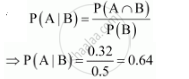
APPEARS IN
RELATED QUESTIONS
Assume that each born child is equally likely to be a boy or a girl. If a family has two children, what is the conditional probability that both are girls? Given that
- the youngest is a girl.
- at least one is a girl.
Suppose that 80% of all families own a television set. If 5 families are interviewed at random, find the probability that
a. three families own a television set.
b. at least two families own a television set.
If P(A) = 0.8, P(B) = 0.5 and P(B|A) = 0.4, find P(A ∪ B)
Determine P(E|F).
A coin is tossed three times, where
E: at least two heads, F: at most two heads
Determine P(E|F).
Two coins are tossed once, where
E: tail appears on one coin, F: one coin shows head
Determine P(E|F).
Two coins are tossed once, where
E: no tail appears, F: no head appears
A black and a red dice are rolled.
Find the conditional probability of obtaining a sum greater than 9, given that the black die resulted in a 5.
An instructor has a question bank consisting of 300 easy True/False questions, 200 difficult True/False questions, 500 easy multiple choice questions and 400 difficult multiple choice questions. If a question is selected at random from the question bank, what is the probability that it will be an easy question given that it is a multiple-choice question?
If a leap year is selected at random, what is the chance that it will contain 53 Tuesdays?
If A and B are events such as that P(A) = `1/2`, P(B) = `1/3` and P(A ∩ B) = `1/4`, then find
1) P(A / B)
2) P(B / A)
A card is drawn from a well-shuffled pack of playing cards. What is the probability that it is either a spade or an ace or both?
In an examination, 30% of students have failed in subject I, 20% of the students have failed in subject II and 10% have failed in both subject I and subject II. A student is selected at random, what is the probability that the student has failed in subject I, if it is known that he is failed in subject II?
From a pack of well-shuffled cards, two cards are drawn at random. Find the probability that both the cards are diamonds when the first card drawn is replaced in the pack
Three fair coins are tossed. What is the probability of getting three heads given that at least two coins show heads?
If for two events A and B, P(A) = `3/4`, P(B) = `2/5` and A ∪ B = S (sample space), find the conditional probability P(A/B)
The probability that a car being filled with petrol will also need an oil change is 0.30; the probability that it needs a new oil filter is 0.40; and the probability that both the oil and filter need changing is 0.15. If a new oil filter is needed, what is the probability that the oil has to be changed?
One bag contains 5 white and 3 black balls. Another bag contains 4 white and 6 black balls. If one ball is drawn from each bag, find the probability that both are white
One bag contains 5 white and 3 black balls. Another bag contains 4 white and 6 black balls. If one ball is drawn from each bag, find the probability that both are black
Given P(A) = 0.4 and P(A ∪ B) = 0.7 Find P(B) if P(A/B) = 0.4
Suppose the chances of hitting a target by a person X is 3 times in 4 shots, by Y is 4 times in 5 shots, and by Z is 2 times in 3 shots. They fire simultaneously exactly one time. What is the probability that the target is damaged by exactly 2 hits?
Choose the correct alternative:
A, B, and C try to hit a target simultaneously but independently. Their respective probabilities of hitting the target are `3/4, 1/2, 5/8`. The probability that the target is hit by A or B but not by C is
In a multiple-choice question, there are three options out of which only one is correct. A person is guessing the answer at random. If there are 7 such questions, then the probability that he will get exactly 4 correct answers is ______
If X denotes the number of ones in five consecutive throws of a dice, then P(X = 4) is ______
Let A and B be two events. If P(A) = 0.2, P(B) = 0.4, P(A ∪ B) = 0.6, then P(A|B) is equal to ______.
If P(A) = `4/5`, and P(A ∩ B) = `7/10`, then P(B|A) is equal to ______.
A bag contains 6 red and 5 blue balls and another bag contains 5 red and 8 blue balls. A ball is drawn from the first bag and without noticing its colour is placed in the second bag. If a ball is drawn from the second bag, then find the probability that the drawn ball is red in colour.
If P(A) = `1/2`, P(B) = 0, then `P(A/B)` is
If A and B are two events such that P(A) = `1/3`, P(B) = `1/5` and P(A ∪ B) = `1/2`, then P(A|B') + P(B|A') is equal to ______.
For a biased dice, the probability for the different faces to turn up are
| Face | 1 | 2 | 3 | 4 | 5 | 6 |
| P | 0.10 | 0.32 | 0.21 | 0.15 | 0.05 | 0.17 |
The dice is tossed and it is told that either the face 1 or face 2 has shown up, then the probability that it is face 1, is ______.
If for two events A and B, P(A – B) = `1/5` and P(A) = `3/5`, then `P(B/A)` is equal to ______.
A Problem in Mathematics is given to the three students A, B and C. Their chances of solving the problem are `1/2, 1/3` and `1/4` respectively. Find the probability that exactly two students will solve the problem.
Three friends go to a restaurant to have pizza. They decide who will pay for the pizza by tossing a coin. It is decided that each one of them will toss a coin and if one person gets a different result (heads or tails) than the other two, that person would pay. If all three get the same result (all heads or all tails), they will toss again until they get a different result.
- What is the probability that all three friends will get the same result (all heads or all tails) in one round of tossing?
- What is the probability that they will get a different result in one round of tossing?
- What is the probability that they will need exactly four rounds of tossing to determine who would pay?
If P(B) = `3/5`, P(A | B) = `1/2` and P(A ∪ B) = `4/5`, then P(A ∪ B) + P(A' ∪ B) =
If A and B are events and \[P(B) \neq 0\], which expression gives \[P(A \mid B)\]?
If A and B are events and \[P(A) \neq 0\], which expression gives \[P(B \mid A)\]?
For \[E=\{(b,b)\}\] and \[F=\{(b,b),(g,b),(b,g)\}\], what are \[E\cap F\], \[P(E\cap F)\], and \[P(F)\]?
Which sequence correctly applies a given condition when finding a conditional probability?
