Advertisements
Advertisements
प्रश्न
If P(A) = 0.8, P(B) = 0.5 and P(B|A) = 0.4, find P(A|B)
Advertisements
उत्तर
It is given that P(A) = 0.8, P(B) = 0.5, and P(B|A) = 0.4
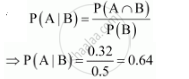
APPEARS IN
संबंधित प्रश्न
In a game, a man wins Rs 5 for getting a number greater than 4 and loses Rs 1 otherwise, when a fair die is thrown. The man decided to thrown a die thrice but to quit as and when he gets a number greater than 4. Find the expected value of the amount he wins/loses
40% students of a college reside in hostel and the remaining reside outside. At the end of the year, 50% of the hostelers got A grade while from outside students, only 30% got A grade in the examination. At the end of the year, a student of the college was chosen at random and was found to have gotten A grade. What is the probability that the selected student was a hosteler ?
A bag X contains 4 white balls and 2 black balls, while another bag Y contains 3 white balls and 3 black balls. Two balls are drawn (without replacement) at random from one of the bags and were found to be one white and one black. Find the probability that the balls were drawn from bag Y.
If P(A) = 0.8, P(B) = 0.5 and P(B|A) = 0.4, find P(A ∪ B)
Evaluate P(A ∪ B), if 2P(A) = P(B) = `5/13` and P(A | B) = `2/5`
Determine P(E|F).
A coin is tossed three times, where
E: at least two heads, F: at most two heads
Determine P(E|F).
Two coins are tossed once, where
E: tail appears on one coin, F: one coin shows head
Determine P(E|F).
Two coins are tossed once, where
E: no tail appears, F: no head appears
Determine P(E|F).
A die is thrown three times,
E: 4 appears on the third toss, F: 6 and 5 appears respectively on first two tosses
A black and a red dice are rolled.
Find the conditional probability of obtaining a sum greater than 9, given that the black die resulted in a 5.
An instructor has a question bank consisting of 300 easy True/False questions, 200 difficult True/False questions, 500 easy multiple choice questions and 400 difficult multiple choice questions. If a question is selected at random from the question bank, what is the probability that it will be an easy question given that it is a multiple-choice question?
A and B are two events such that P (A) ≠ 0. Find P (B|A), if A ∩ B = Φ.
An urn contains 2 white and 2 black balls. A ball is drawn at random. If it is white, it is not replaced into the urn. Otherwise, it is replaced with another ball of the same colour. The process is repeated. Find the probability that the third ball is drawn is black.
A box has 20 pens of which 2 are defective. Calculate the probability that out of 5 pens drawn one by one with replacement, at most 2 are defective.
Two balls are drawn from an urn containing 3 white, 5 red and 2 black balls, one by one without replacement. What is the probability that at least one ball is red?
From a pack of well-shuffled cards, two cards are drawn at random. Find the probability that both the cards are diamonds when first card drawn is kept aside
Three fair coins are tossed. What is the probability of getting three heads given that at least two coins show heads?
Select the correct option from the given alternatives :
Bag I contains 3 red and 4 black balls while another Bag II contains 5 red and 6 black balls. One ball is drawn at random from one of the bags and it is found to be red. The probability that it was drawn from Bag II
If P(A) = 0.5, P(B) = 0.8 and P(B/A) = 0.8, find P(A/B) and P(A ∪ B)
A problem in Mathematics is given to three students whose chances of solving it are `1/3, 1/4` and `1/5`. What is the probability that exactly one of them will solve it?
The probability that a car being filled with petrol will also need an oil change is 0.30; the probability that it needs a new oil filter is 0.40; and the probability that both the oil and filter need changing is 0.15. If a new oil filter is needed, what is the probability that the oil has to be changed?
One bag contains 5 white and 3 black balls. Another bag contains 4 white and 6 black balls. If one ball is drawn from each bag, find the probability that both are white
One bag contains 5 white and 3 black balls. Another bag contains 4 white and 6 black balls. If one ball is drawn from each bag, find the probability that one white and one black
Choose the correct alternative:
A, B, and C try to hit a target simultaneously but independently. Their respective probabilities of hitting the target are `3/4, 1/2, 5/8`. The probability that the target is hit by A or B but not by C is
Two dice are thrown. Find the probability that the sum of numbers appearing is more than 11, is ______.
The total number of ways in which 5 balls of different colours can be distributed among 3 persons so that each person gets at least one ball is ______
Three machines E1, E2, E3 in a certain factory produced 50%, 25% and 25%, respectively, of the total daily output of electric tubes. It is known that 4% of the tubes produced one each of machines E1 and E2 are defective, and that 5% of those produced on E3 are defective. If one tube is picked up at random from a day’s production, calculate the probability that it is defective.
If P(A) = `2/5`, P(B) = `3/10` and P(A ∩ B) = `1/5`, then P(A|B).P(B'|A') is equal to ______.
If P(A) = 0.4, P(B) = 0.8 and P(B|A) = 0.6, then P(A ∪ B) is equal to ______.
If two balls are drawn from a bag containing 3 white, 4 black and 5 red balls. Then, the probability that the drawn balls are of different colours is:
A bag contains 6 red and 5 blue balls and another bag contains 5 red and 8 blue balls. A ball is drawn from the first bag and without noticing its colour is placed in the second bag. If a ball is drawn from the second bag, then find the probability that the drawn ball is red in colour.
A bag contains 3 red and 4 white balls and another bag contains 2 red and 3 white balls. If one ball is drawn from the first bag and 2 balls are drawn from the second bag, then find the probability that all three balls are of the same colour.
If P(A) = `1/2`, P(B) = 0, then `P(A/B)` is
A pack of cards has one card missing. Two cards are drawn randomly and are found to be spades. The probability that the missing card is not a spade, is ______.
For a biased dice, the probability for the different faces to turn up are
| Face | 1 | 2 | 3 | 4 | 5 | 6 |
| P | 0.10 | 0.32 | 0.21 | 0.15 | 0.05 | 0.17 |
The dice is tossed and it is told that either the face 1 or face 2 has shown up, then the probability that it is face 1, is ______.
Compute P(A|B), if P(B) = 0.5 and P (A ∩ B) = 0.32.
If P(B) = `3/5`, P(A | B) = `1/2` and P(A ∪ B) = `4/5`, then P(A ∪ B) + P(A' ∪ B) =
Which conditional probabilities are equal to 1 when \[P(F)\neq 0\]?
For independent events, which equality holds provided \[P(B)\neq 0\]?
