Advertisements
Advertisements
प्रश्न
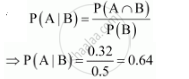
If P(A) = 0.8, P(B) = 0.5 and P(B|A) = 0.4, find P(A|B)
Advertisements
उत्तर
It is given that P(A) = 0.8, P(B) = 0.5, and P(B|A) = 0.4
APPEARS IN
संबंधित प्रश्न
In a game, a man wins Rs 5 for getting a number greater than 4 and loses Rs 1 otherwise, when a fair die is thrown. The man decided to thrown a die thrice but to quit as and when he gets a number greater than 4. Find the expected value of the amount he wins/loses
Evaluate P(A ∪ B), if 2P(A) = P(B) = `5/13` and P(A | B) = `2/5`
Determine P(E|F).
A coin is tossed three times, where
E: at most two tails, F: at least one tail
Determine P(E|F).
Two coins are tossed once, where
E: tail appears on one coin, F: one coin shows head
Determine P(E|F).
Two coins are tossed once, where
E: no tail appears, F: no head appears
A fair die is rolled. Consider events E = {1, 3, 5}, F = {2, 3} and G = {2, 3, 4, 5} Find P (E|F) and P (F|E)
A fair die is rolled. Consider events E = {1, 3, 5}, F = {2, 3} and G = {2, 3, 4, 5} Find P (E|G) and P (G|E)
A fair die is rolled. Consider events E = {1, 3, 5}, F = {2, 3} and G = {2, 3, 4, 5} Find P ((E ∪ F)|G) and P ((E ∩ G)|G)
If P(A) = `1/2`, P(B) = 0, then P(A|B) is ______.
A die is tossed thrice. Find the probability of getting an odd number at least once.
A and B are two events such that P (A) ≠ 0. Find P (B|A), if A is a subset of B.
If a leap year is selected at random, what is the chance that it will contain 53 Tuesdays?
A card is drawn from a well-shuffled pack of playing cards. What is the probability that it is either a spade or an ace or both?
If events A and B are independent, such that `P(A)= 3/5`, `P(B)=2/3` 'find P(A ∪ B).
In an examination, 30% of students have failed in subject I, 20% of the students have failed in subject II and 10% have failed in both subject I and subject II. A student is selected at random, what is the probability that the student has failed in at least one subject?
A bag contains 10 white balls and 15 black balls. Two balls are drawn in succession without replacement. What is the probability that, one is white and other is black?
Three fair coins are tossed. What is the probability of getting three heads given that at least two coins show heads?
A problem in Mathematics is given to three students whose chances of solving it are `1/3, 1/4` and `1/5`. What is the probability that exactly one of them will solve it?
One bag contains 5 white and 3 black balls. Another bag contains 4 white and 6 black balls. If one ball is drawn from each bag, find the probability that both are black
One bag contains 5 white and 3 black balls. Another bag contains 4 white and 6 black balls. If one ball is drawn from each bag, find the probability that one white and one black
Choose the correct alternative:
A, B, and C try to hit a target simultaneously but independently. Their respective probabilities of hitting the target are `3/4, 1/2, 5/8`. The probability that the target is hit by A or B but not by C is
Three machines E1, E2, E3 in a certain factory produced 50%, 25% and 25%, respectively, of the total daily output of electric tubes. It is known that 4% of the tubes produced one each of machines E1 and E2 are defective, and that 5% of those produced on E3 are defective. If one tube is picked up at random from a day’s production, calculate the probability that it is defective.
Find the probability that in 10 throws of a fair die a score which is a multiple of 3 will be obtained in at least 8 of the throws.
Let A and B be two events. If P(A) = 0.2, P(B) = 0.4, P(A ∪ B) = 0.6, then P(A|B) is equal to ______.
If P(A) = `1/2`, P(B) = 0, then `P(A/B)` is
If the sum of numbers obtained on throwing a pair of dice is 9, then the probability that number obtained on one of the dice is 4, is ______.
If A and B are two events such that `P(A/B) = 2 xx P(B/A)` and P(A) + P(B) = `2/3`, then P(B) is equal to ______.
If A and B are two independent events such that P(A) = `1/3` and P(B) = `1/4`, then `P(B^'/A)` is ______.
A Problem in Mathematics is given to the three students A, B and C. Their chances of solving the problem are `1/2, 1/3` and `1/4` respectively. Find the probability that exactly two students will solve the problem.
Students of under graduation submitted a case study on “Understanding the Probability of Left-Handedness in Children Based on Parental Handedness”. Following Recent studies suggest that roughly 12% of the world population is left-handed. Depending on the parents’ handedness, the chances of having a left-handed child are as follows:
Scenario A: Both parents are left-handed, with a 24% chance of the child being left-handed.
Scenario B: The fathers is right-handed and the mothers left-handed, with a 22% chance of child being left-handed.
Scenario C: The fathers left-handed and the mother is right-handed, with a 17% chance of child being left-handed.
Scenario D: Both parents are right-handed, with a 9% chance of having a left-handed child.
Assuming that scenarios A, B, C and D are equally likely and L denotes the event that the child is left-handed, answer the following questions.
- What is the overall probability that a randomly selected child is left-handed?
- Given that exactly one parent is left-handed, what is the probability that a randomly selected child is left-handed?
- If a child is left-handed, what is the probability that both parents are left-handed?
If A and B are events and \[P(B) \neq 0\], which expression gives \[P(A \mid B)\]?
If A and B are events and \[P(A) \neq 0\], which expression gives \[P(B \mid A)\]?
Which conditional probabilities are equal to 1 when \[P(F)\neq 0\]?
For independent events, which equality holds provided \[P(B)\neq 0\]?
Which sequence correctly applies a given condition when finding a conditional probability?
