Advertisements
Advertisements
Questions
If `cos θ = 12/13`, show that `sin θ (1 - tan θ) = 35/156`.
If `cos θ = 12/13`, verify that `sin θ (1 - tan θ) = 35/156`.
Advertisements
Solution
Given: cos θ = `12/13`
To prove: sin θ (1 – tan θ) = `35/156`
Proof: We know, cos θ = `B/H`
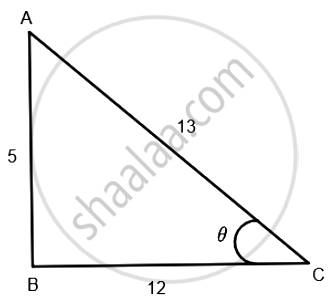
where the right-angled triangle’s base is B and its hypotenuse is H. ∠ACB = 8 is achieved by building a right triangle ABC at a right angle to B.
AB is perpendicular, BC = 12 is base, and AC = 13 is hypotenuse.
According to Pythagoras theorem, we have
AC2 = AB2 + BC2
132 = AB2 + 122
169 = AB2 + 144
169 – 144 = AB2
25 = AB2
AB = `sqrt25`
AB = 5
sin θ = `P/H = 5/13`
So, tan θ = `P/H = 5/12`
Put the values in sin θ (1 – tan θ) to find its value,
sin θ (1 – tan θ) = `15/3 (1 - 5/12)`
= `5/13 xx 7/12`
= `35/156`
Hence Proved.
RELATED QUESTIONS
Given sec θ = `13/12`, calculate all other trigonometric ratios.
In ΔABC, right angled at B. If tan A = `1/sqrt3` , find the value of
- sin A cos C + cos A sin C
- cos A cos C − sin A sin C
State whether the following are true or false. Justify your answer.
sec A = `12/5` for some value of angle A.
In the following, trigonometric ratios are given. Find the values of the other trigonometric ratios.
`cos A = 4/5`
In the following, trigonometric ratios are given. Find the values of the other trigonometric ratios.
`sin theta = sqrt3/2`
If 3 tan θ = 4, find the value of `(4cos theta - sin theta)/(2cos theta + sin theta)`
If 3 cot θ = 2, find the value of `(4sin theta - 3 cos theta)/(2 sin theta + 6cos theta)`.
If `cot theta = 1/sqrt3` show that `(1 - cos^2 theta)/(2 - sin^2 theta) = 3/5`
If sin θ = `12/13`, Find `(sin^2 θ - cos^2 θ)/(2sin θ cos θ) × 1/(tan^2 θ)`.
If Cosec A = 2 find `1/(tan A) + (sin A)/(1 + cos A)`
Evaluate the following
sin 45° sin 30° + cos 45° cos 30°
Evaluate the following
cos 60° cos 45° - sin 60° ∙ sin 45°
Evaluate the following
cos2 30° + cos2 45° + cos2 60° + cos2 90°
Evaluate the following
tan2 30° + tan2 60° + tan2 45°
Evaluate the Following:
`(tan^2 60^@ + 4 cos^2 45^@ + 3 sec^2 30^@ + 5 cos^2 90)/(cosec 30^@ + sec 60^@ - cot^2 30^@)`
sin (45° + θ) – cos (45° – θ) is equal to ______.
If cosec θ - cot θ = `1/3`, the value of (cosec θ + cot θ) is ______.
3 sin² 20° – 2 tan² 45° + 3 sin² 70° is equal to ______.
If sin 2A = `1/2` tan² 45° where A is an acute angle, then the value of A is ______.
If A and (2A – 45°) are acute angles such that sin A = cos (2A – 45°), then tan A is equal to ______.
If sin θ + sin² θ = 1, then cos² θ + cos4 θ = ______.
The value of the expression `[(sin^2 22^circ + sin^2 68^circ)/(cos^2 22^circ + cos^2 68^circ) + sin^2 63^circ + cos 63^circ sin 27^circ]` is ______.
Prove the following:
If tan A = `3/4`, then sinA cosA = `12/25`
The value of the expression (sin 80° – cos 80°) is negative.
A ladder rests against a vertical wall at an inclination α to the horizontal. Its foot is pulled away from the wall through a distance p so that its upper end slides a distance q down the wall and then the ladder makes an angle β to the horizontal. Show that `p/q = (cos β - cos α)/(sin α - sin β)`
Prove that sec θ + tan θ = `cos θ/(1 - sin θ)`.
Proof: L.H.S. = sec θ + tan θ
= `1/square + square/square`
= `square/square` ......`(∵ sec θ = 1/square, tan θ = square/square)`
= `((1 + sin θ) square)/(cos θ square)` ......[Multiplying `square` with the numerator and denominator]
= `(1^2 - square)/(cos θ square)`
= `square/(cos θ square)`
= `cos θ/(1 - sin θ)` = R.H.S.
∴ L.H.S. = R.H.S.
∴ sec θ + tan θ = `cos θ/(1 - sin θ)`
What will be the value of sin 45° + `1/sqrt(2)`?
If θ is an acute angle of a right angled triangle, then which of the following equation is not true?
Evaluate 2 sec2 θ + 3 cosec2 θ – 2 sin θ cos θ if θ = 45°.
