Advertisements
Advertisements
Question
If ∠A and ∠B are acute angles such that cos A = cos B, then show that ∠A = ∠B.
Advertisements
Solution 1
Let us consider a triangle ABC in which CD ⊥ AB.
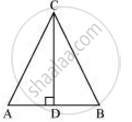
It is given that
cos A = cos B
⇒ `("AD")/("AC") = ("BD")/("BC")` ...(1)
We have to prove ∠A = ∠B.
To prove this, let us extend AC to P such that BC = CP.
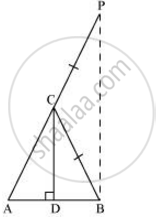
From equation (1), we obtain
`("AB")/("BD") = ("AC")/("BC")`
⇒ `("AD")/("BD") = ("AC")/("CP")` ...(By construction, we have BC = CP) ...(2)
By using the converse of B.P.T,
CD || BP
⇒ ∠ACD = ∠CPB ...(Corresponding angles) ...(3)
And, ∠BCD = ∠CBP ...(Alternate interior angles) …(4)
By construction, we have BC = CP
∴ ∠CBP = ∠CPB ...(Angle opposite to equal sides of a triangle) …(5)
From equations (3), (4) and (5), we obtain
∠ACD = ∠BCD …(6)
In ΔCAD and ΔCBD,
∠ACD = ∠BCD ...[Using equation (6)]
∠CDA = ∠CDB ...[Both 90°]
Therefore, the remaining angles should be equal.
∴∠CAD = ∠CBD
⇒ ∠A = ∠B
Alternatively,
Let us consider a triangle ABC in which CD ⊥ AB.
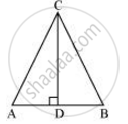
It is given that,
cos A = cos B
⇒ `("AD")/("AC") = ("BC")/("BC")`
⇒ `("AD")/("BD") = ("AC")/("BC")`
Let `("AD")/("BD") = ("AC")/("BC") = k`
⇒ AD = k × BD …(1)
And, AC = k × BC …(2)
Using Pythagoras theorem for triangles CAD and CBD, we obtain
CD2 = AC2 − AD2 …(3)
And, CD2 = BC2 − BD2 …(4)
From equations (3) and (4), we obtain
AC2 − AD2 = BC2 − BD2
⇒ (k BC)2 − (k BD)2 = BC2 − BD2
⇒ k2 (BC2 − BD2) = BC2 − BD2
⇒ k2 = 1
⇒ k = 1
Putting this value in equation (2), we obtain
AC = BC
⇒ ∠A = ∠B ...(Angles opposite to equal sides of a triangle)
Solution 2
∠A and ∠B are acute angles
Cos A = cos B S.T ∠A = ∠B
Let us consider right angled triangle ACB.
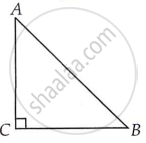
We have cos A = `"adjacent side"/"Hypotenuse"`
= `("AC")/("AB")`
cos B = `("BC")/("AB")`
cos A = cos B
`("AC")/("AB") = ("BC")/("AB")`
AC = BC
∠A = ∠B
