Advertisements
Advertisements
Question
In the following, one of the six trigonometric ratios is given. Find the values of the other trigonometric ratios.
`tan theta = 8/15`
Advertisements
Solution
We know that `tan theta = "๐๐๐๐๐ ๐๐ก๐ ๐ ๐๐๐"/"๐๐๐๐๐๐๐๐ก ๐ ๐๐๐" = 8/15`
Now consider a right-angled Δle ABC.
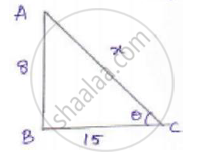
By applying Pythagoras theorem
๐ด๐ถ2 = ๐ด๐ต2 + ๐ต๐ถ2
๐ฅ2 = 82 + 152
๐ฅ2 = 225 + 64 = 289
`x = sqrt289 = 17`
`sin theta = "๐๐๐๐๐ ๐๐ก๐ ๐ ๐๐๐"/"โ๐ฆ๐๐๐ก๐๐๐ข๐ ๐" = 8/17`
`cos theta = "๐๐๐๐๐๐๐๐ก ๐ ๐๐๐"/"โ๐ฆ๐๐๐ก๐๐๐ข๐ ๐" = 15/17`
`tan theta = "๐๐๐๐๐ ๐๐ก๐ ๐ ๐๐๐"/"๐๐๐๐๐๐๐๐ก ๐ ๐๐๐" = 8/15`
`cot theta = 1/tan theta = 1/(8/15) = 15/8`
`cosec theta = 1/sin theta = (1/8)/17 = 17/8`
`sec theta = 1/cos theta= (1/15)/17 = 17/15`
APPEARS IN
RELATED QUESTIONS
If sin A = `3/4`, calculate cos A and tan A.
If ∠A and ∠B are acute angles such that cos A = cos B, then show that ∠A = ∠B.
In ΔPQR, right angled at Q, PR + QR = 25 cm and PQ = 5 cm. Determine the values of sin P, cos P and tan P.
State whether the following are true or false. Justify your answer.
sec A = `12/5` for some value of angle A.
In the following, trigonometric ratios are given. Find the values of the other trigonometric ratios.
`cos A = 4/5`
If tan θ = `a/b` prove that `(a sin theta - b cos theta)/(a sin theta + b cos theta) = (a^2 - b^2)/(a^2 + b^2)`
If `cos θ = 12/13`, show that `sin θ (1 - tan θ) = 35/156`.
If `cot theta = 1/sqrt3` show that `(1 - cos^2 theta)/(2 - sin^2 theta) = 3/5`
If Cosec A = 2 find `1/(tan A) + (sin A)/(1 + cos A)`
Evaluate the Following
`cot^2 30^@ - 2 cos^2 60^circ- 3/4 sec^2 45^@ - 4 sec^2 30^@`
Evaluate the Following
4(sin4 30° + cos2 60°) − 3(cos2 45° − sin2 90°) − sin2 60°
If sin (A − B) = sin A cos B − cos A sin B and cos (A − B) = cos A cos B + sin A sin B, find the values of sin 15° and cos 15°.
If cos (40° + A) = sin 30°, then value of A is ______.
5 tan² A – 5 sec² A + 1 is equal to ______.
Prove that sec θ + tan θ = `cos θ/(1 - sin θ)`.
Proof: L.H.S. = sec θ + tan θ
= `1/square + square/square`
= `square/square` ......`(โต sec θ = 1/square, tan θ = square/square)`
= `((1 + sin θ) square)/(cos θ square)` ......[Multiplying `square` with the numerator and denominator]
= `(1^2 - square)/(cos θ square)`
= `square/(cos θ square)`
= `cos θ/(1 - sin θ)` = R.H.S.
∴ L.H.S. = R.H.S.
∴ sec θ + tan θ = `cos θ/(1 - sin θ)`
Prove that: cot θ + tan θ = cosec θ·sec θ
Proof: L.H.S. = cot θ + tan θ
= `square/square + square/square` ......`[โต cot θ = square/square, tan θ = square/square]`
= `(square + square)/(square xx square)` .....`[โต square + square = 1]`
= `1/(square xx square)`
= `1/square xx 1/square`
= cosec θ·sec θ ......`[โต "cosec" θ = 1/square, sec θ = 1/square]`
= R.H.S.
∴ L.H.S. = R.H.S.
∴ cot θ + tan θ = cosec·sec θ
`sqrt(3)` cos2A + `sqrt(3)` sin2A is equal to ______.
If b = `(3 + cot π/8 + cot (11π)/24 - cot (5π)/24)`, then the value of `|bsqrt(2)|` is ______.
If sinθ = `1/sqrt(2)` and `π/2 < θ < π`. Then the value of `(sinθ + cosθ)/tanθ` is ______.
If θ is an acute angle and sin θ = cos θ, find the value of tan2 θ + cot2 θ – 2.
