मराठी

If ∠A and ∠B are acute angles such that cos A = cos B, then show that ∠A = ∠B. - Mathematics

Advertisements
Advertisements

प्रश्न

If ∠A and ∠B are acute angles such that cos A = cos B, then show that ∠A = ∠B.

बेरीज
Advertisements

उत्तर १

Let us consider a triangle ABC in which CD ⊥ AB.
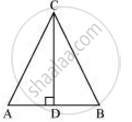
It is given that

cos A = cos B

⇒ `("AD")/("AC") = ("BD")/("BC")`            ...(1)

We have to prove ∠A = ∠B.

To prove this, let us extend AC to P such that BC = CP.
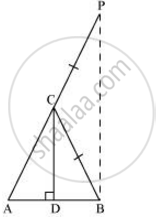
From equation (1), we obtain

`("AB")/("BD") = ("AC")/("BC")`

⇒ `("AD")/("BD") = ("AC")/("CP")`           ...(By construction, we have BC = CP)          ...(2)

By using the converse of B.P.T,

CD || BP

⇒ ∠ACD = ∠CPB         ...(Corresponding angles)             ...(3)

And, ∠BCD = ∠CBP          ...(Alternate interior angles)               …(4)

By construction, we have BC = CP

∴ ∠CBP = ∠CPB              ...(Angle opposite to equal sides of a triangle)       …(5)

From equations (3), (4) and (5), we obtain

∠ACD = ∠BCD               …(6)

In ΔCAD and ΔCBD,

∠ACD = ∠BCD               ...[Using equation (6)]

∠CDA = ∠CDB               ...[Both 90°]

Therefore, the remaining angles should be equal.

∴∠CAD = ∠CBD

⇒ ∠A = ∠B

Alternatively,

Let us consider a triangle ABC in which CD ⊥ AB.
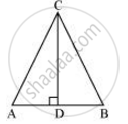
It is given that,

cos A = cos B

⇒ `("AD")/("AC") = ("BC")/("BC")`

⇒ `("AD")/("BD") = ("AC")/("BC")`

Let `("AD")/("BD") = ("AC")/("BC") = k`

⇒ AD = k × BD                    …(1)

And, AC = k × BC               …(2)

Using Pythagoras theorem for triangles CAD and CBD, we obtain

CD2 = AC2 − AD2           …(3)

And, CD2 = BC2 − BD2               …(4)

From equations (3) and (4), we obtain

AC2 − AD2 = BC2 − BD2

⇒ (k BC)2 − (k BD)2 = BC2 − BD2

⇒ k2 (BC2 − BD2) = BC2 − BD2

⇒ k2 = 1

⇒ k = 1

Putting this value in equation (2), we obtain

AC = BC

⇒ ∠A = ∠B               ...(Angles opposite to equal sides of a triangle)

shaalaa.com

उत्तर २

∠A and ∠B are acute angles

Cos A = cos B S.T ∠A = ∠B

Let us consider right angled triangle ACB.
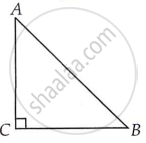
We have cos A = `"adjacent side"/"Hypotenuse"`

= `("AC")/("AB")`

cos B = `("BC")/("AB")`

cos A = cos B

`("AC")/("AB") = ("BC")/("AB")`

AC = BC

∠A = ∠B

shaalaa.com
  या प्रश्नात किंवा उत्तरात काही त्रुटी आहे का?
पाठ 8: Introduction to Trigonometry - Exercise 8.1 [पृष्ठ १८१]

APPEARS IN

एनसीईआरटी Mathematics [English] Class 10
पाठ 8 Introduction to Trigonometry
Exercise 8.1 | Q 6 | पृष्ठ १८१
आरडी शर्मा Mathematics [English] Class 10
पाठ 10 Trigonometric Ratios
Exercise 10.1 | Q 33 | पृष्ठ २५

व्हिडिओ ट्यूटोरियलVIEW ALL [2]

संबंधित प्रश्‍न

State whether the following are true or false. Justify your answer.

The value of tan A is always less than 1.


State whether the following are true or false. Justify your answer.

sec A = `12/5` for some value of angle A.


State whether the following are true or false. Justify your answer.

cos A is the abbreviation used for the cosecant of angle A.


In the following, trigonometric ratios are given. Find the values of the other trigonometric ratios.

`cos A = 4/5`


In the following, one of the six trigonometric ratios is given. Find the values of the other trigonometric ratios.

tan θ = 11


In the following, trigonometric ratios are given. Find the values of the other trigonometric ratios.

`sec theta = 13/5`


If tan θ = `a/b` prove that `(a sin theta - b cos theta)/(a sin theta + b cos theta) = (a^2 - b^2)/(a^2 + b^2)`


Evaluate the Following

`4/(cot^2 30^@) + 1/(sin^2 60^@) - cos^2 45^@`


Find the value of x in the following :

`2sin 3x = sqrt3`


Find the value of x in the following :

`sqrt3 sin x = cos x`


sin (45° + θ) – cos (45° – θ) is equal to ______.


`(sin theta)/(1 + cos theta)` is ______.


The value of the expression `[(sin^2 22^circ + sin^2 68^circ)/(cos^2 22^circ + cos^2 68^circ) + sin^2 63^circ + cos 63^circ sin 27^circ]` is ______.


Find the value of sin 45° + cos 45° + tan 45°.


Find will be the value of cos 90° + sin 90°.


If cos(α + β) = `(3/5)`, sin(α – β) = `5/13` and 0 < α, β < `π/4`, then tan (2α) is equal to ______.


The maximum value of the expression 5cosα + 12sinα – 8 is equal to ______.


(3 sin2 30° – 4 cos2 60°) is equal to ______.


Evaluate: 5 cosec2 45° – 3 sin2 90° + 5 cos 0°.


Share
Notifications

Englishहिंदीमराठी


      Forgot password?
Use app×