Advertisements
Advertisements
Question
State whether the following are true or false. Justify your answer.
The value of tan A is always less than 1.
Options
True
False
Advertisements
Solution
This statement is False.
Explanation:
Consider a ΔABC, right-angled at B.
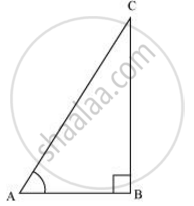
tan A = `("Side opposite to ∠A")/("Side adjacent to ∠A")`
= `12/5`
But `12/5 > 1`
∴ tan A > 1
So, tan A < 1 is not always true.
Hence, the given statement is false.
A tangent of an angle is the ratio of sides other than hypotenuse, which may be equal or unequal to each other.
APPEARS IN
RELATED QUESTIONS
Given sec θ = `13/12`, calculate all other trigonometric ratios.
In the following, trigonometric ratios are given. Find the values of the other trigonometric ratios.
`cos A = 4/5`
In the following, one of the six trigonometric ratios is given. Find the values of the other trigonometric ratios.
tan θ = 11
If 3 cot θ = 2, find the value of `(4sin theta - 3 cos theta)/(2 sin theta + 6cos theta)`.
if `tan theta = 12/13` Find `(2 sin theta cos theta)/(cos^2 theta - sin^2 theta)`
if `cos theta = 3/5`, find the value of `(sin theta - 1/(tan theta))/(2 tan theta)`
if `sec A = 17/8` verify that `(3 - 4sin^2A)/(4 cos^2 A - 3) = (3 - tan^2 A)/(1 - 3 tan^2 A)`
If `tan θ = 20/21` show that `(1 - sin theta + cos theta)/(1 + sin theta + cos theta) = 3/7`
If Cosec A = 2 find `1/(tan A) + (sin A)/(1 + cos A)`
Evaluate the Following:
`tan 45^@/(cosec 30^@) + sec 60^@/cot 45^@ - (5 sin 90^@)/(2 cos 0^@)`
Find the value of x in the following :
`sqrt3 tan 2x = cos 60^@ + sin45^@ cos 45^@`
If sin θ + sin² θ = 1, then cos² θ + cos4 θ = ______.
Prove the following:
If tan A = `3/4`, then sinA cosA = `12/25`
If 4 tanθ = 3, then `((4 sintheta - costheta)/(4sintheta + costheta))` is equal to ______.
Find the value of sin 0° + cos 0° + tan 0° + sec 0°.
If sec θ = `1/2`, what will be the value of cos θ?
Find will be the value of cos 90° + sin 90°.
`sqrt(3)` cos2A + `sqrt(3)` sin2A is equal to ______.
Let f(x) = sinx.cos3x and g(x) = cosx.sin3x, then the value of `7((f(π/7) + g(π/7))/(g((5π)/14) + f((5π)/14)))` is ______.
