Advertisements
Advertisements
प्रश्न
If `cos θ = 12/13`, show that `sin θ (1 - tan θ) = 35/156`.
If `cos θ = 12/13`, verify that `sin θ (1 - tan θ) = 35/156`.
Advertisements
उत्तर
Given: cos θ = `12/13`
To prove: sin θ (1 – tan θ) = `35/156`
Proof: We know, cos θ = `B/H`
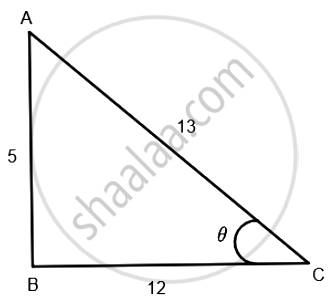
where the right-angled triangle’s base is B and its hypotenuse is H. ∠ACB = 8 is achieved by building a right triangle ABC at a right angle to B.
AB is perpendicular, BC = 12 is base, and AC = 13 is hypotenuse.
According to Pythagoras theorem, we have
AC2 = AB2 + BC2
132 = AB2 + 122
169 = AB2 + 144
169 – 144 = AB2
25 = AB2
AB = `sqrt25`
AB = 5
sin θ = `P/H = 5/13`
So, tan θ = `P/H = 5/12`
Put the values in sin θ (1 – tan θ) to find its value,
sin θ (1 – tan θ) = `15/3 (1 - 5/12)`
= `5/13 xx 7/12`
= `35/156`
Hence Proved.
APPEARS IN
संबंधित प्रश्न
In Given Figure, find tan P – cot R.

If sin A = `3/4`, calculate cos A and tan A.
If cot θ = `7/8`, evaluate cot2 θ.
In the following, trigonometric ratios are given. Find the values of the other trigonometric ratios.
`sin A = 2/3`
If `cot theta = 1/sqrt3` show that `(1 - cos^2 theta)/(2 - sin^2 theta) = 3/5`
If `tan theta = 1/sqrt7` `(cosec^2 theta - sec^2 theta)/(cosec^2 theta + sec^2 theta) = 3/4`
if `tan theta = 12/13` Find `(2 sin theta cos theta)/(cos^2 theta - sin^2 theta)`
if `sec A = 17/8` verify that `(3 - 4sin^2A)/(4 cos^2 A - 3) = (3 - tan^2 A)/(1 - 3 tan^2 A)`
if `cot theta = 3/4` prove that `sqrt((sec theta - cosec theta)/(sec theta +cosec theta)) = 1/sqrt7`
If `tan θ = 20/21` show that `(1 - sin theta + cos theta)/(1 + sin theta + cos theta) = 3/7`
Evaluate the following
sin 45° sin 30° + cos 45° cos 30°
Evaluate the following
sin2 30° + sin2 45° + sin2 60° + sin2 90°
Find the value of x in the following :
`sqrt3 sin x = cos x`
Find the value of x in each of the following :
cos x = cos 60º cos 30º + sin 60º sin 30º
If cosec θ - cot θ = `1/3`, the value of (cosec θ + cot θ) is ______.
If A and (2A – 45°) are acute angles such that sin A = cos (2A – 45°), then tan A is equal to ______.
If sin θ + sin² θ = 1, then cos² θ + cos4 θ = ______.
If cos A = `4/5`, then the value of tan A is ______.
If sin A = `1/2`, then the value of cot A is ______.
Given that sinα = `1/2` and cosβ = `1/2`, then the value of (α + β) is ______.
The value of the expression `[(sin^2 22^circ + sin^2 68^circ)/(cos^2 22^circ + cos^2 68^circ) + sin^2 63^circ + cos 63^circ sin 27^circ]` is ______.
Find the value of sin 0° + cos 0° + tan 0° + sec 0°.
What will be the value of sin 45° + `1/sqrt(2)`?
Find an acute angle θ when `(cos θ - sin θ)/(cos θ + sin θ) = (1 - sqrt(3))/(1 + sqrt(3))`
Let f(x) = sinx.cos3x and g(x) = cosx.sin3x, then the value of `7((f(π/7) + g(π/7))/(g((5π)/14) + f((5π)/14)))` is ______.
If f(x) = `3cos(x + (5π)/6) - 5sinx + 2`, then maximum value of f(x) is ______.
Let tan9° = `(1 - sqrt((sqrt(5)k)/m))k` where k = `sqrt(5) + 1` then m is equal to ______.
If `θ∈[(5π)/2, 3π]` and 2cosθ + sinθ = 1, then the value of 7cosθ + 6sinθ is ______.
If cosec θ = `("p" + "q")/("p" - "q")` (p ≠ q ≠ 0), then `|cot(π/4 + θ/2)|` is equal to ______.
If θ is an acute angle of a right angled triangle, then which of the following equation is not true?
